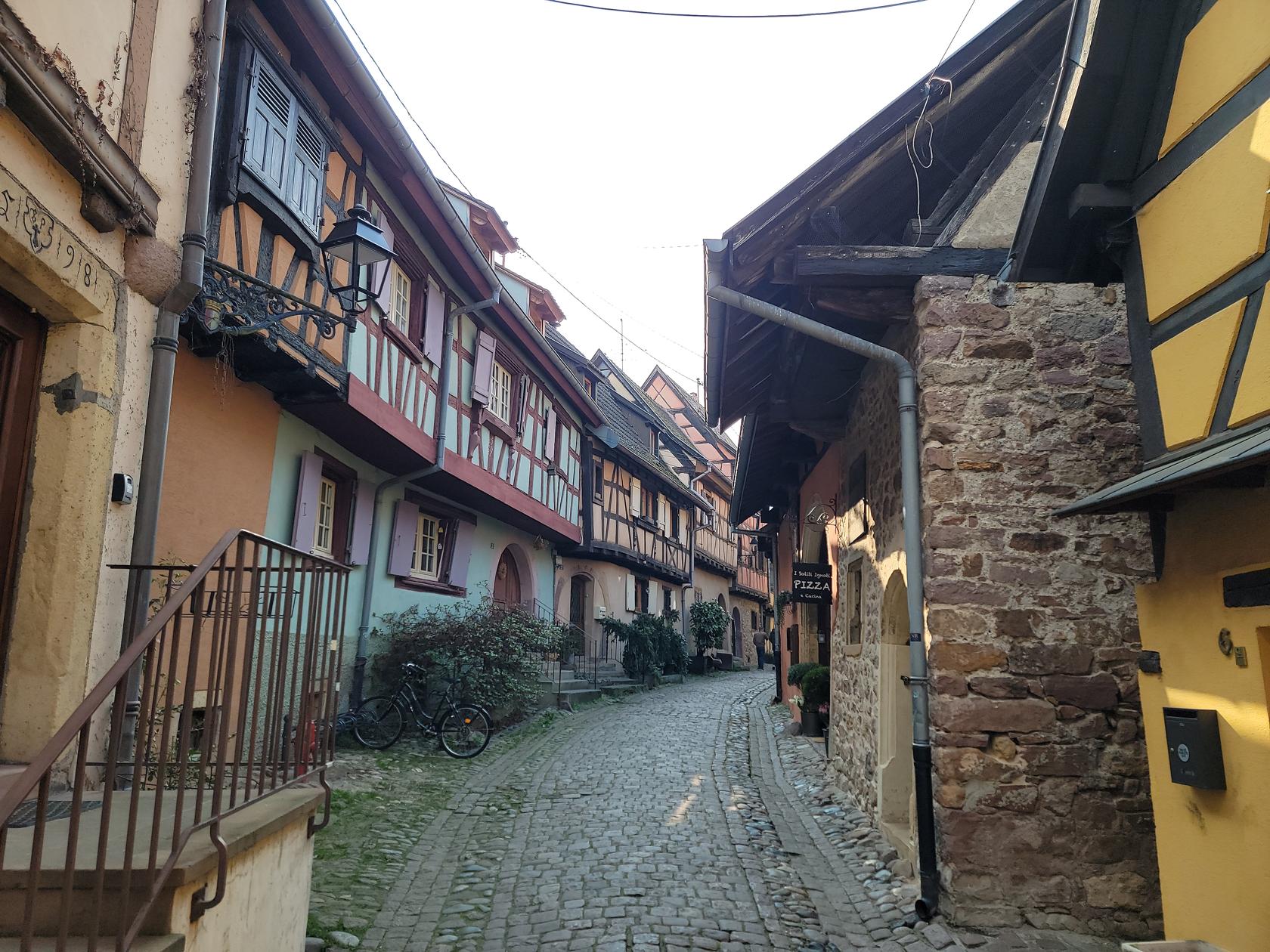
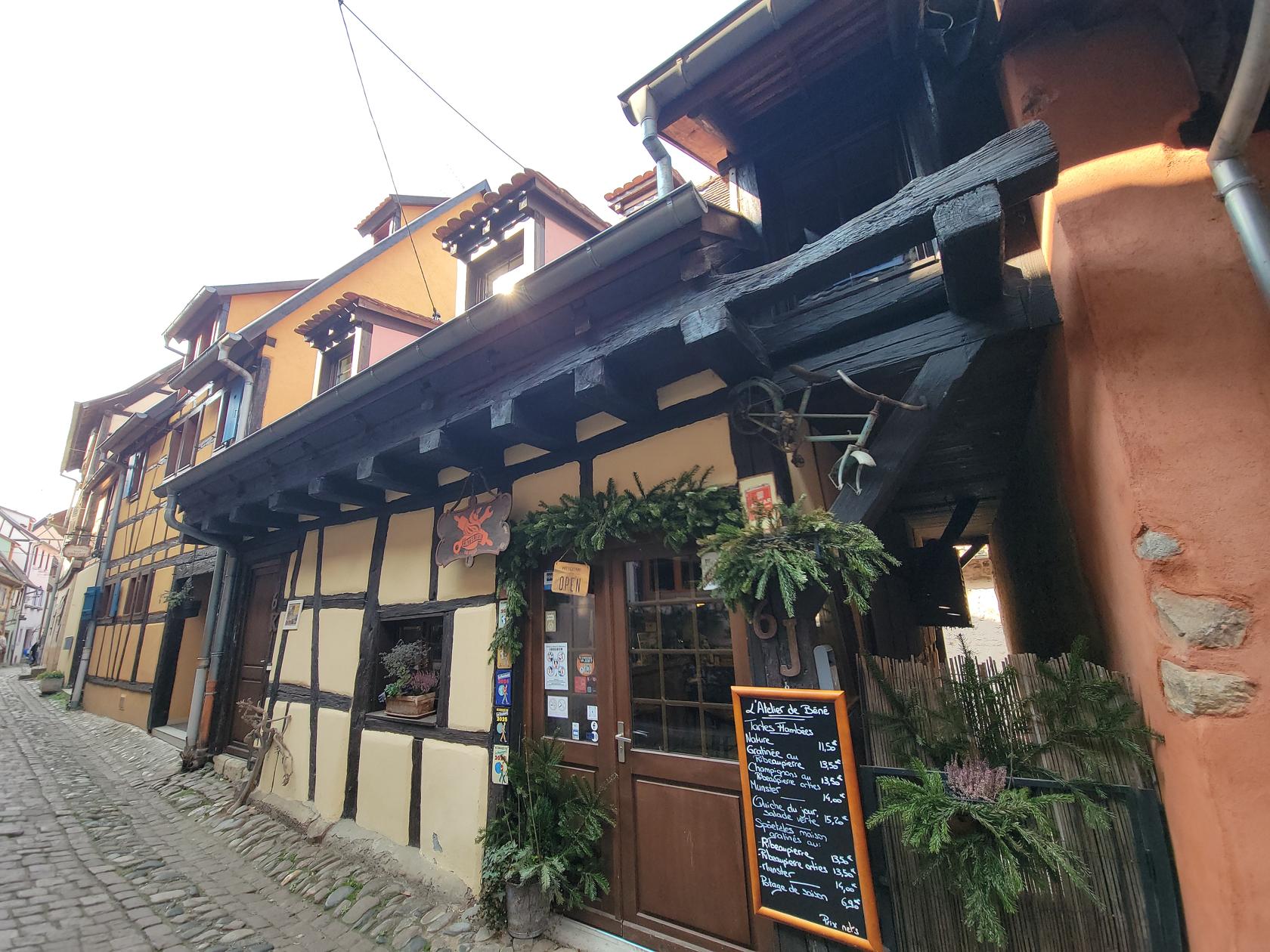
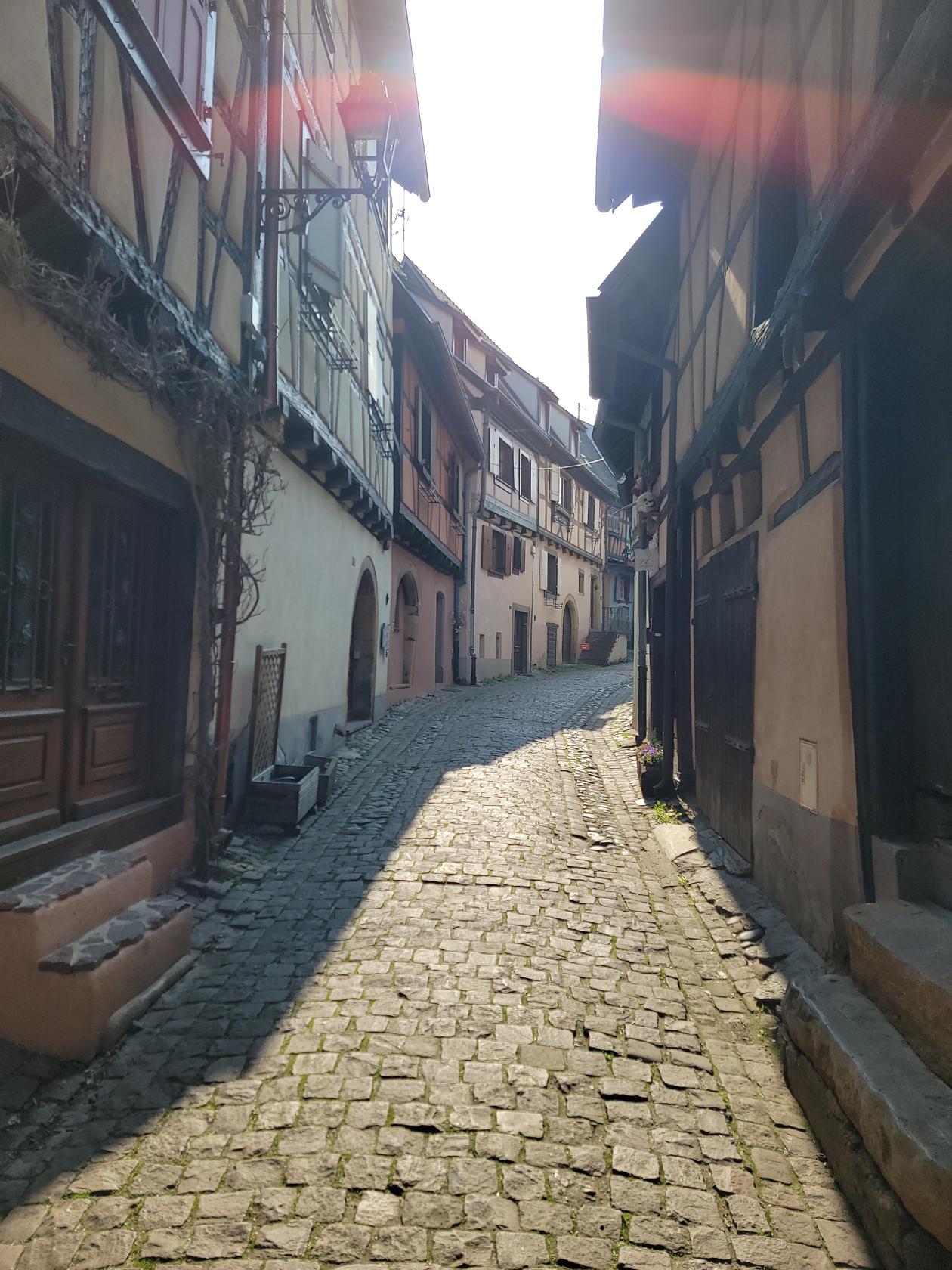
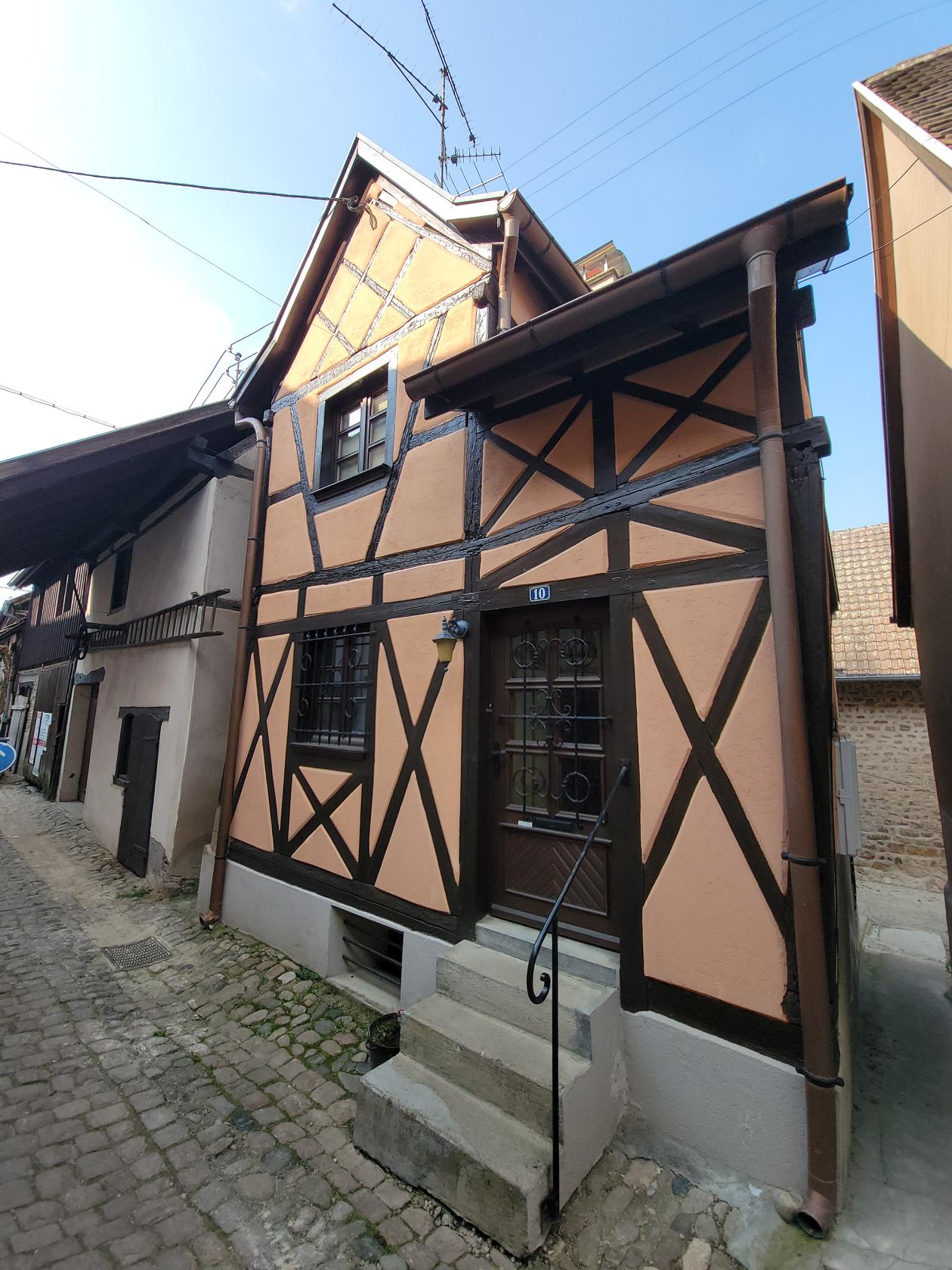
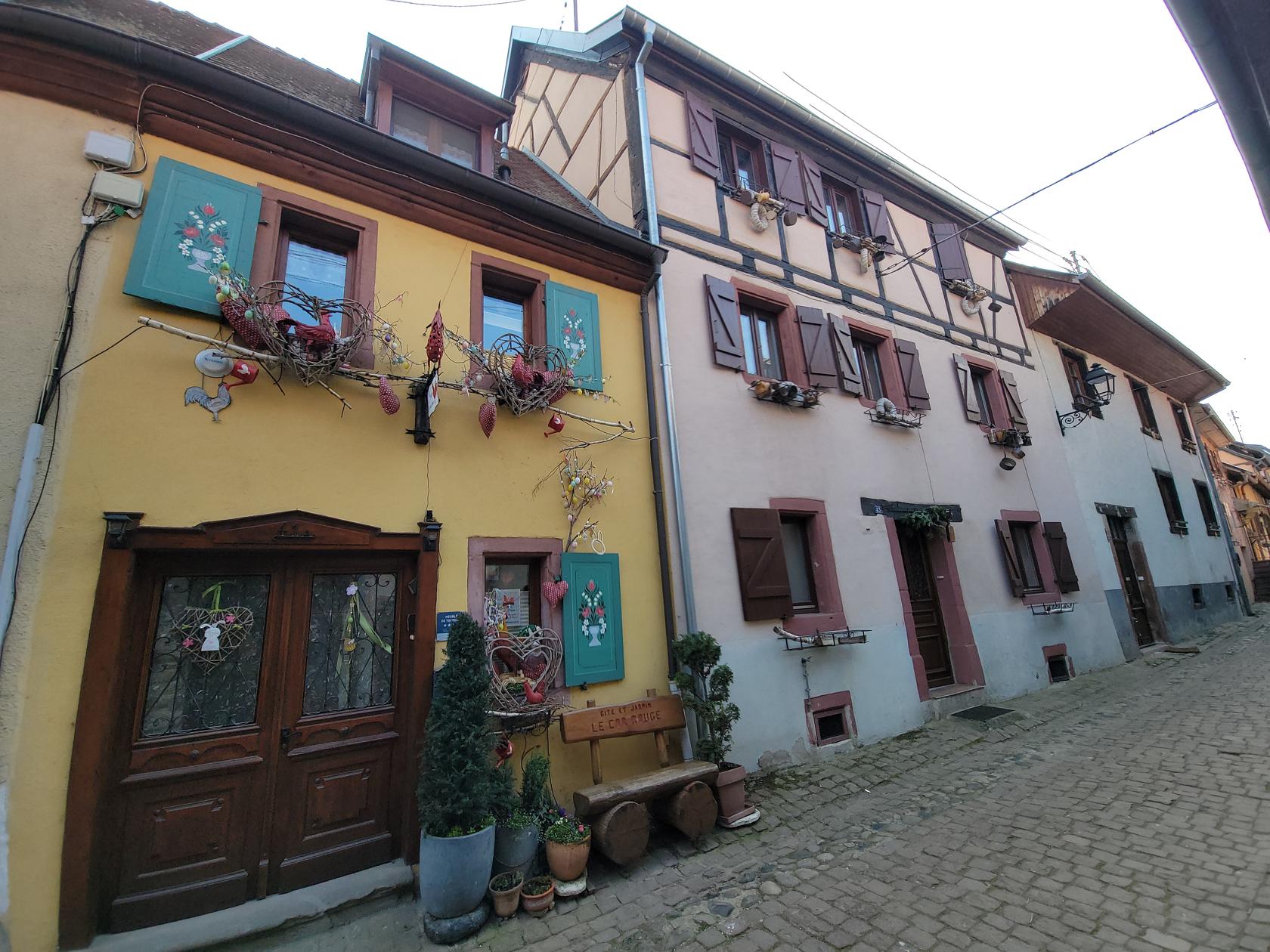
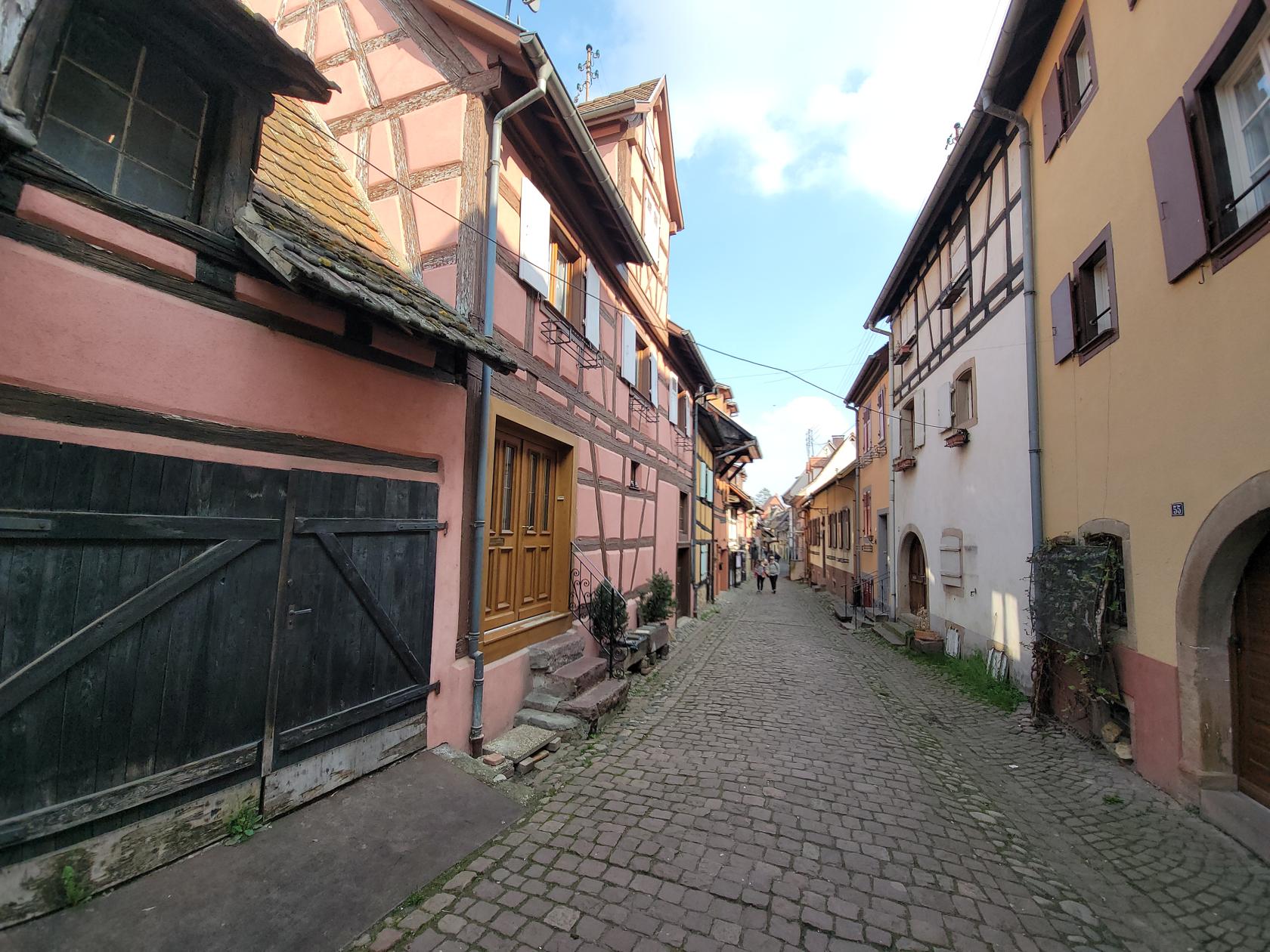
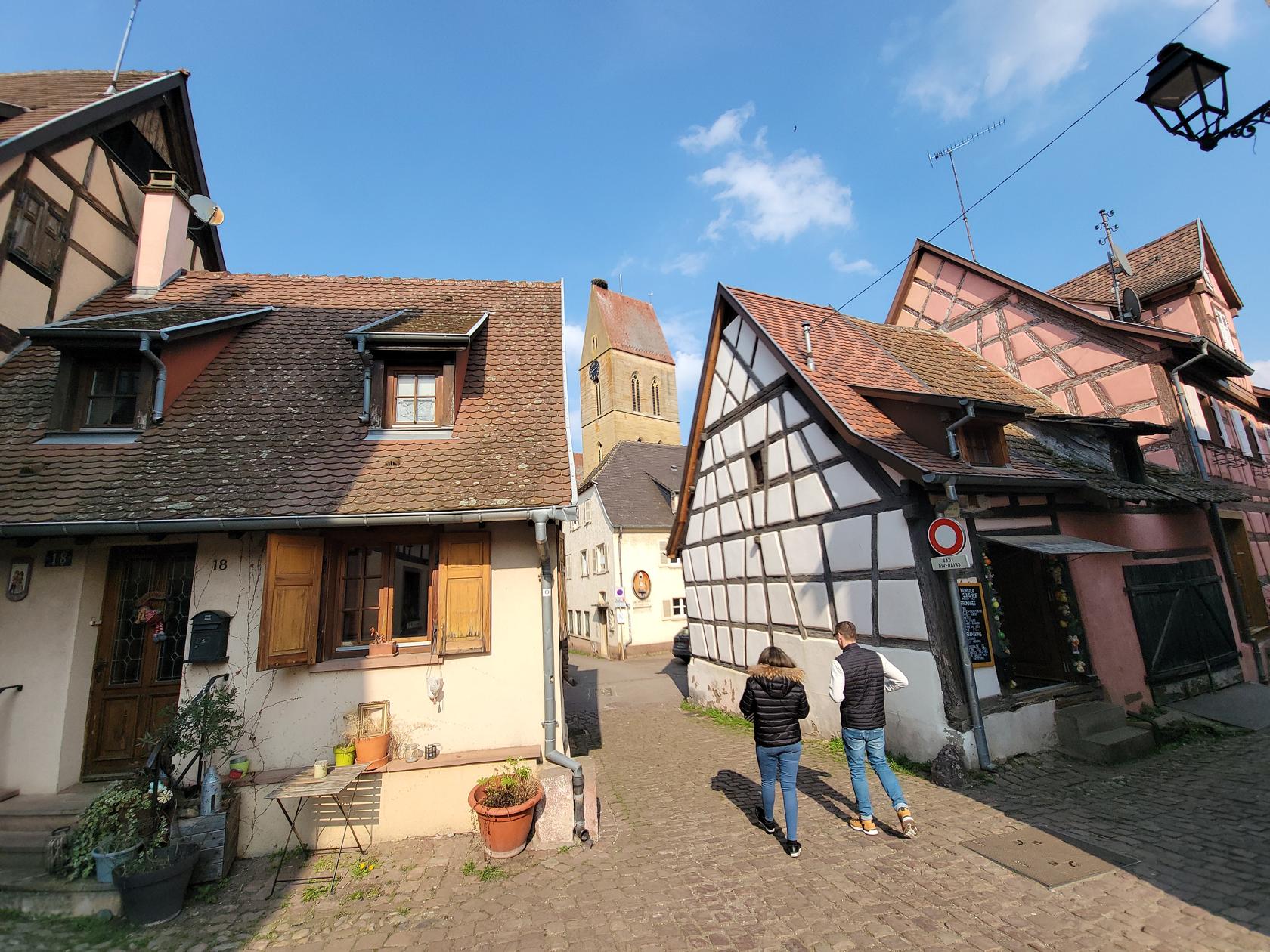
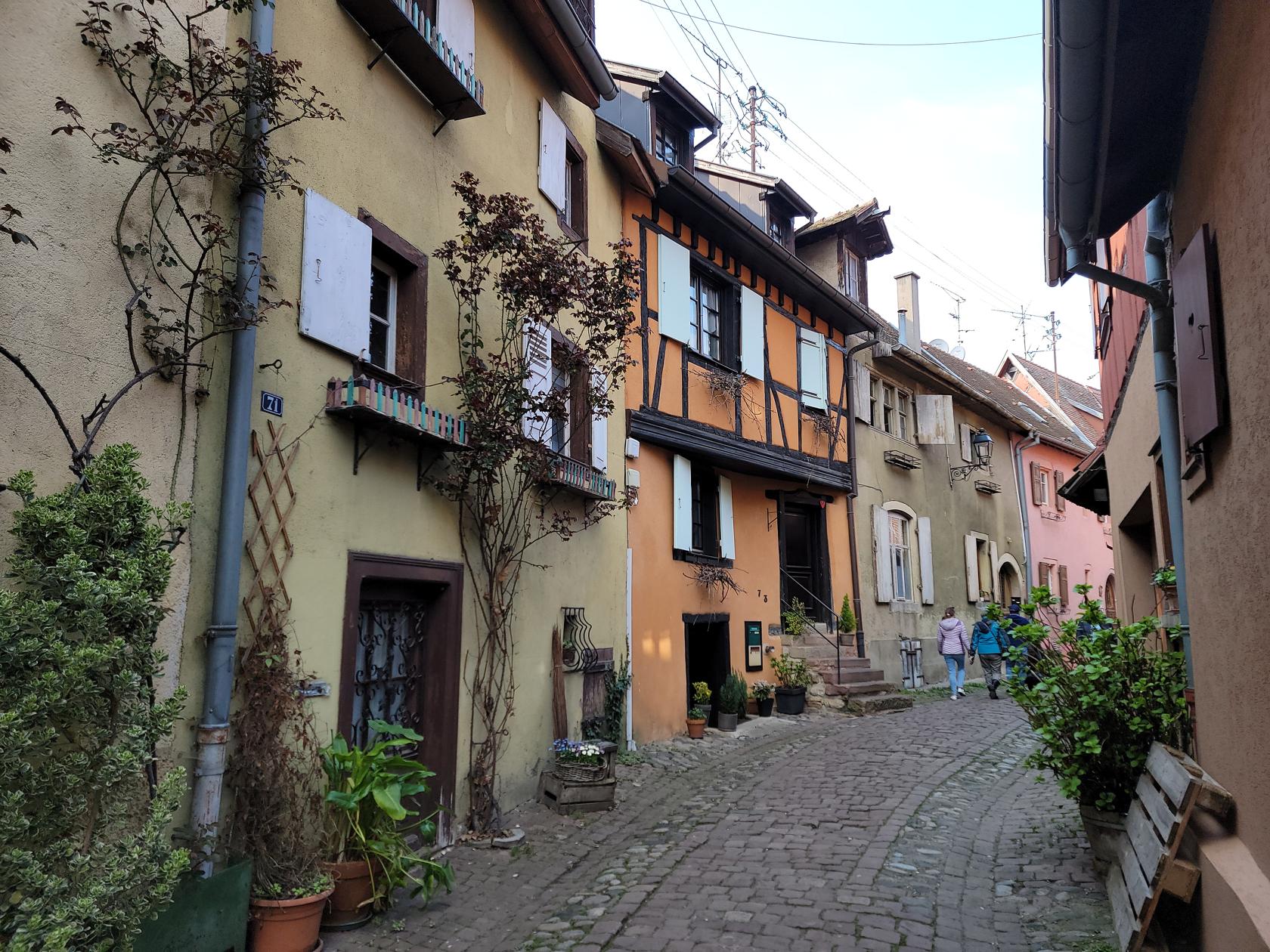
A stone’s throw from Colmar is the small Zwiebelstadt of Eguisheim[1]In German it is spelled Egisheim, France. Here you will enjoy what a small medievalAlsatian town feels like.
Equisheim
The germans use the term Zwiebelstadtto denote any small medieval town that is formed like an onion. Though typically they have eight sides with concentric alleys bisected by a Grand Rue, or main street, they may be circular or oval as well. In the center of it all you will usually find a church or main plaza.
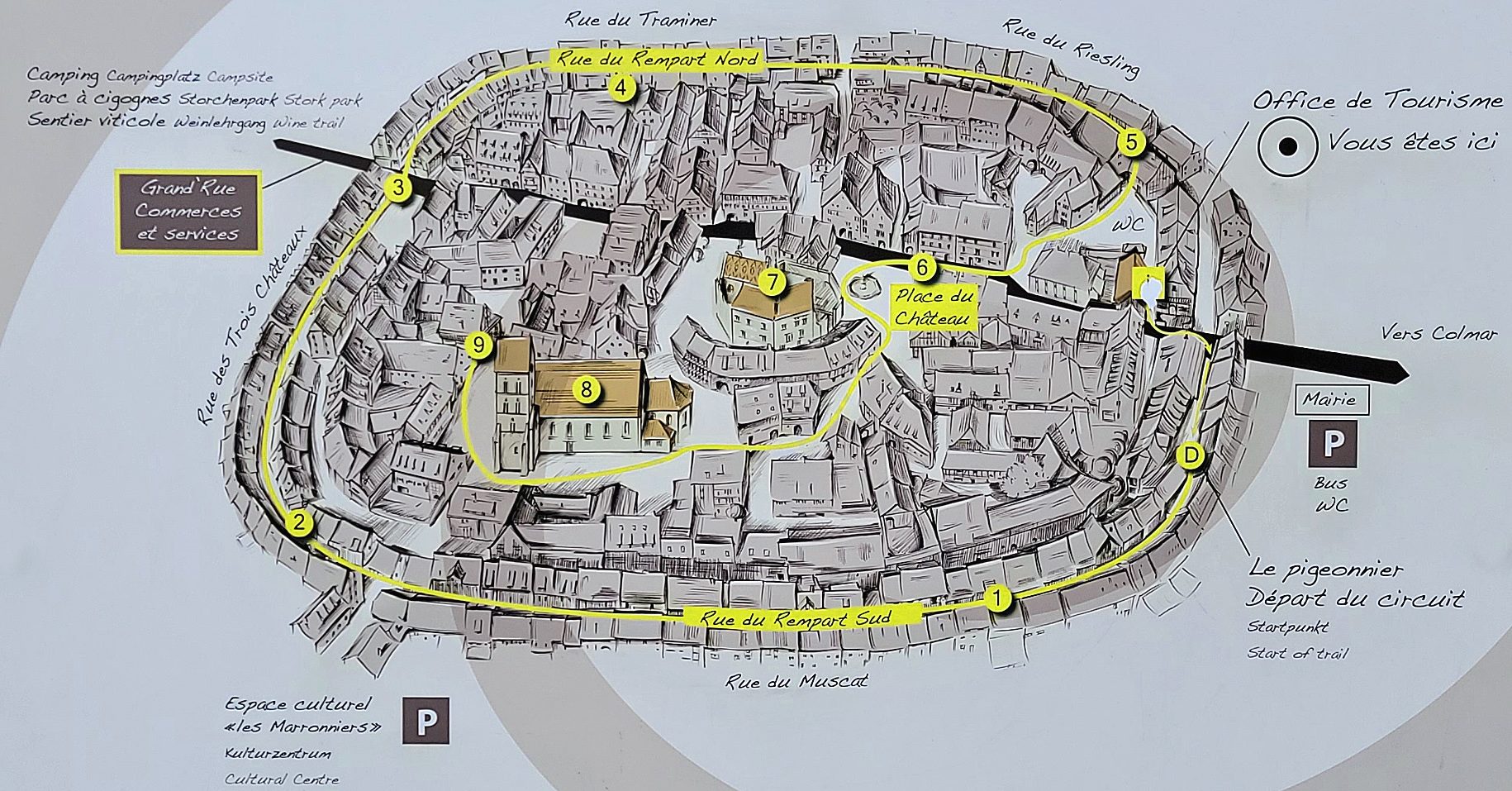
City Map – Stadtplan – Eguisheim, France
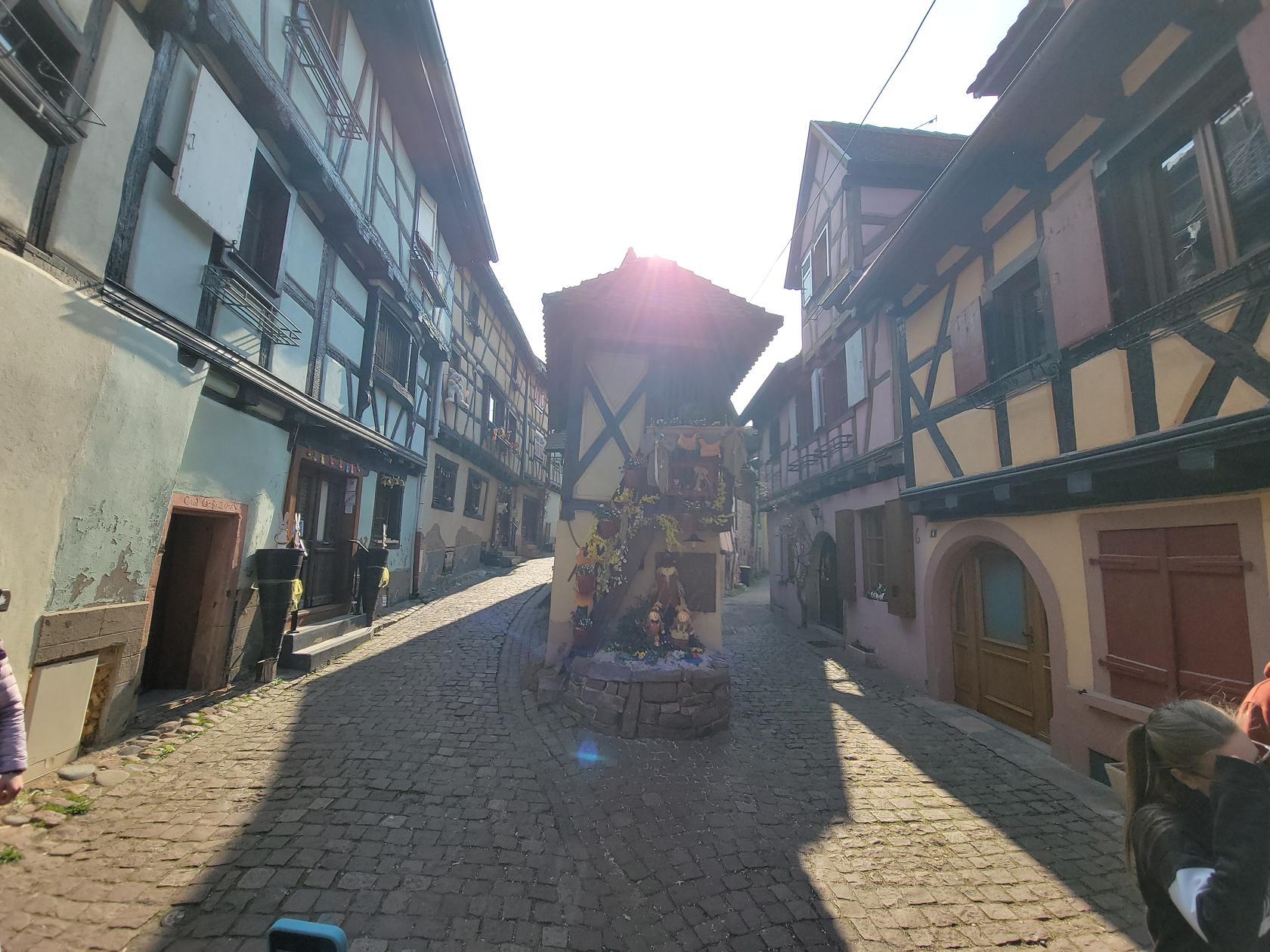
In the above the following are noteworthy, according to town officials, starting at (D) with the Pigeon Loft.
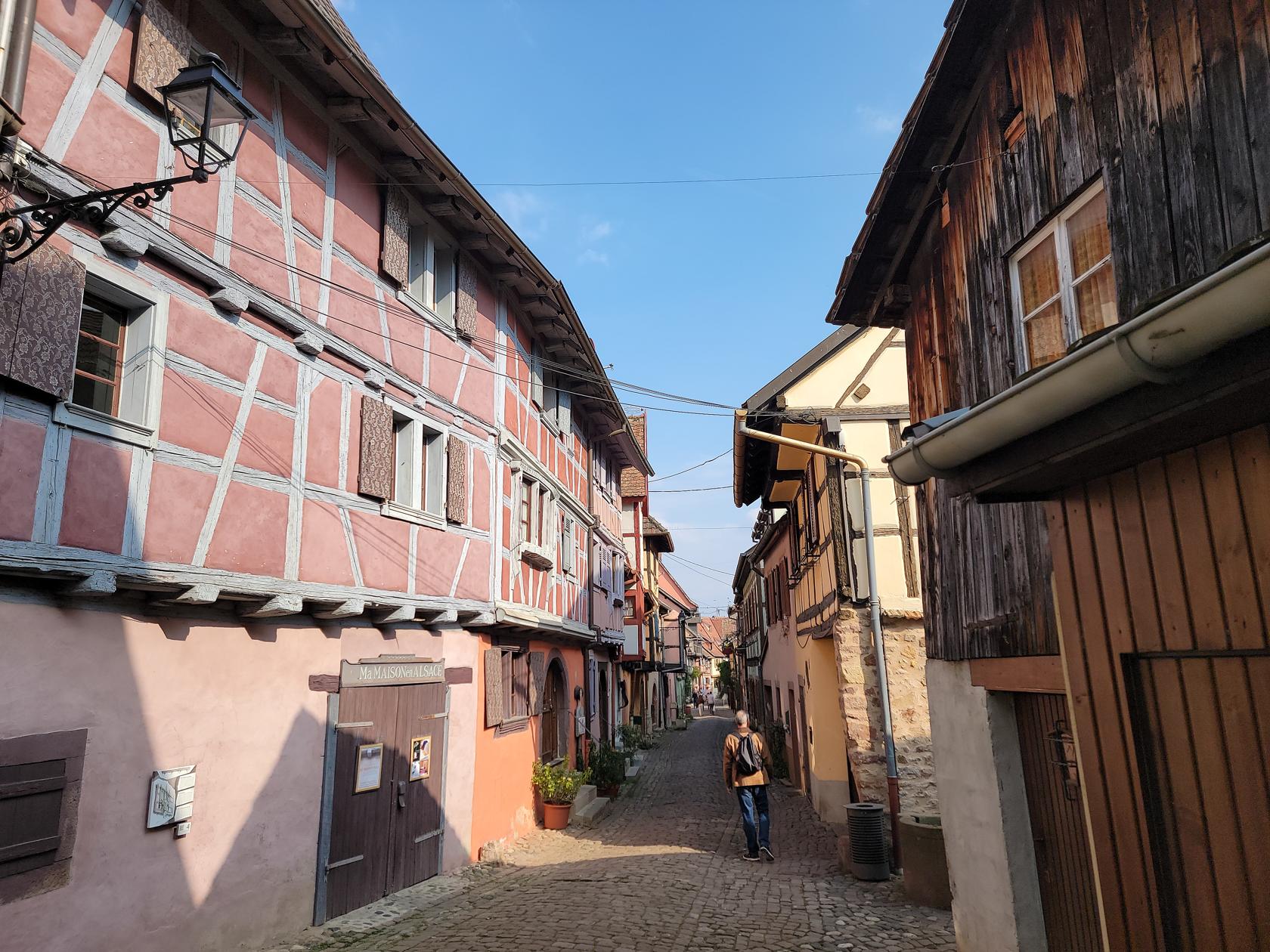
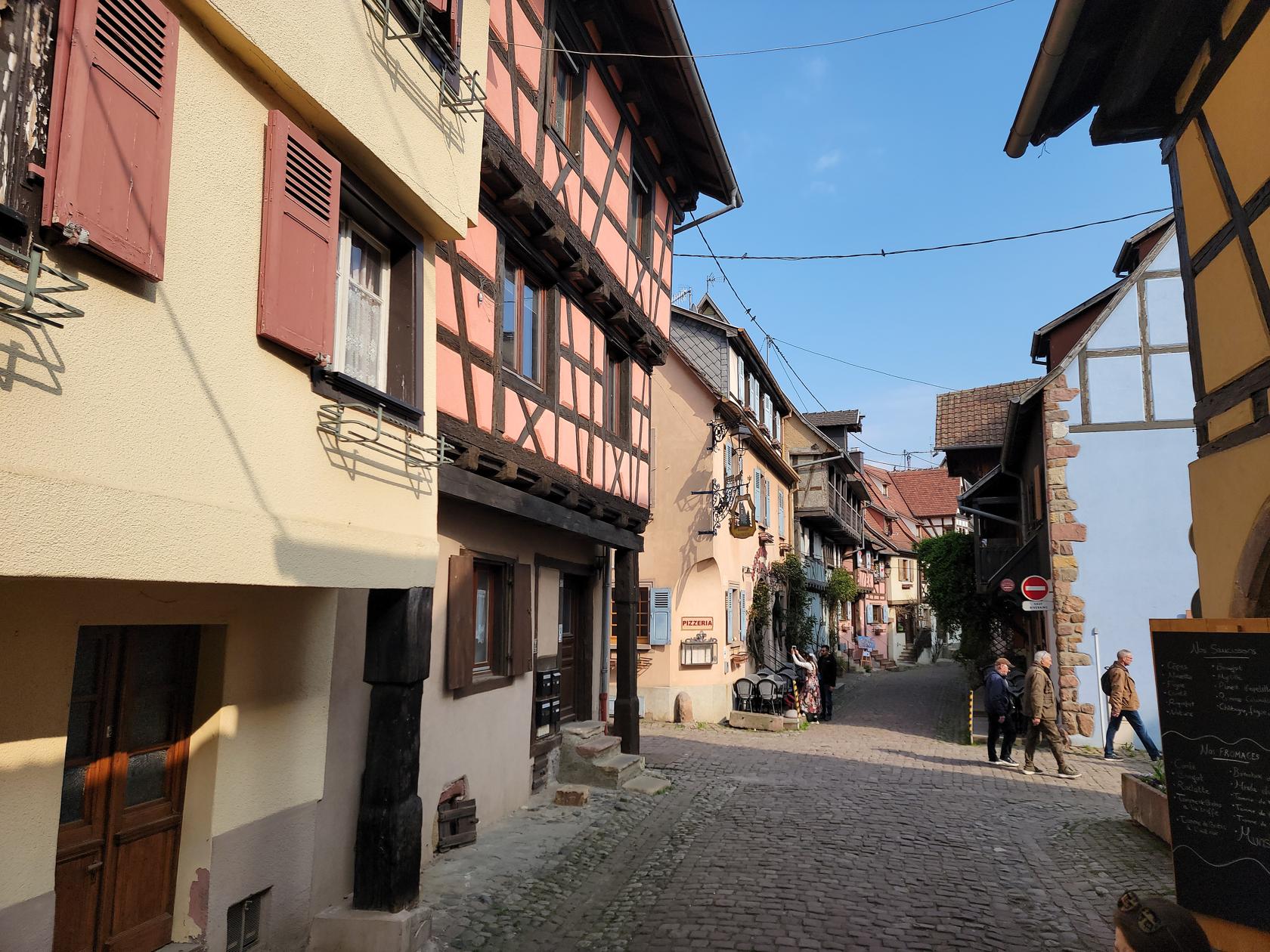
Rue de Ramport – The colors of Eguisheim
Rue de Ramport – Round and round the town
The gates of the town
The town’s inscriptions
Stone engravings
The chateau
The host of the chapel
The virgins of Eguisheim (the church)
The tithe courtyards
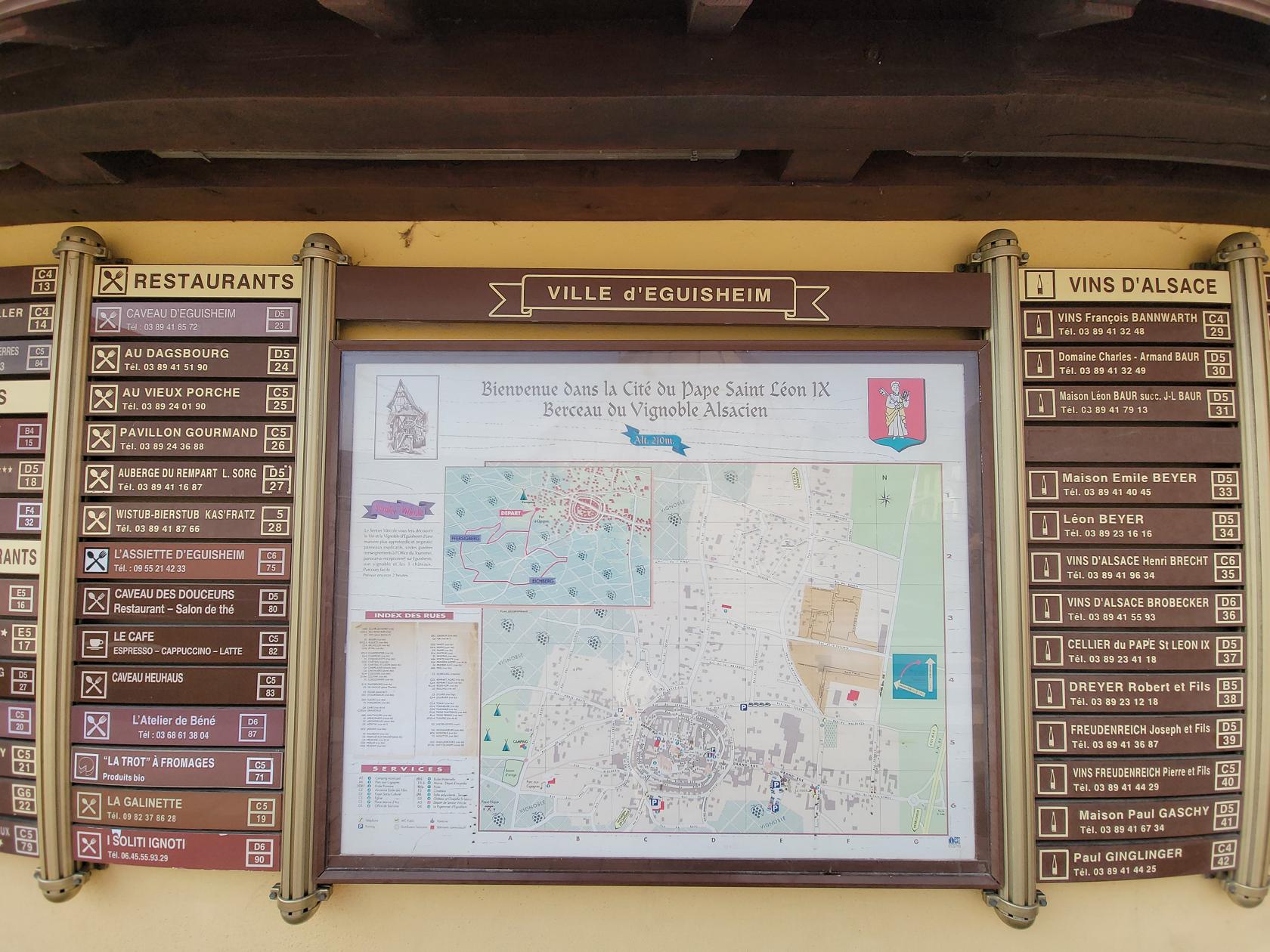
The area around the town is noted for its excellent alsatian wines. Upon entering the town visitors can see a record of the vineyards proudly displayed along with restaurants and a map of the town.
Alsatian WIneries – Eguisheim, France
Getting There
From Colmar a quick drive down the Rue de Tiefenbach or the Route de Rouffach puts you on the D83 for a short time before you reach one of the many small roads that will take you into town, though typically it would be the Rue de la 1er Armée.
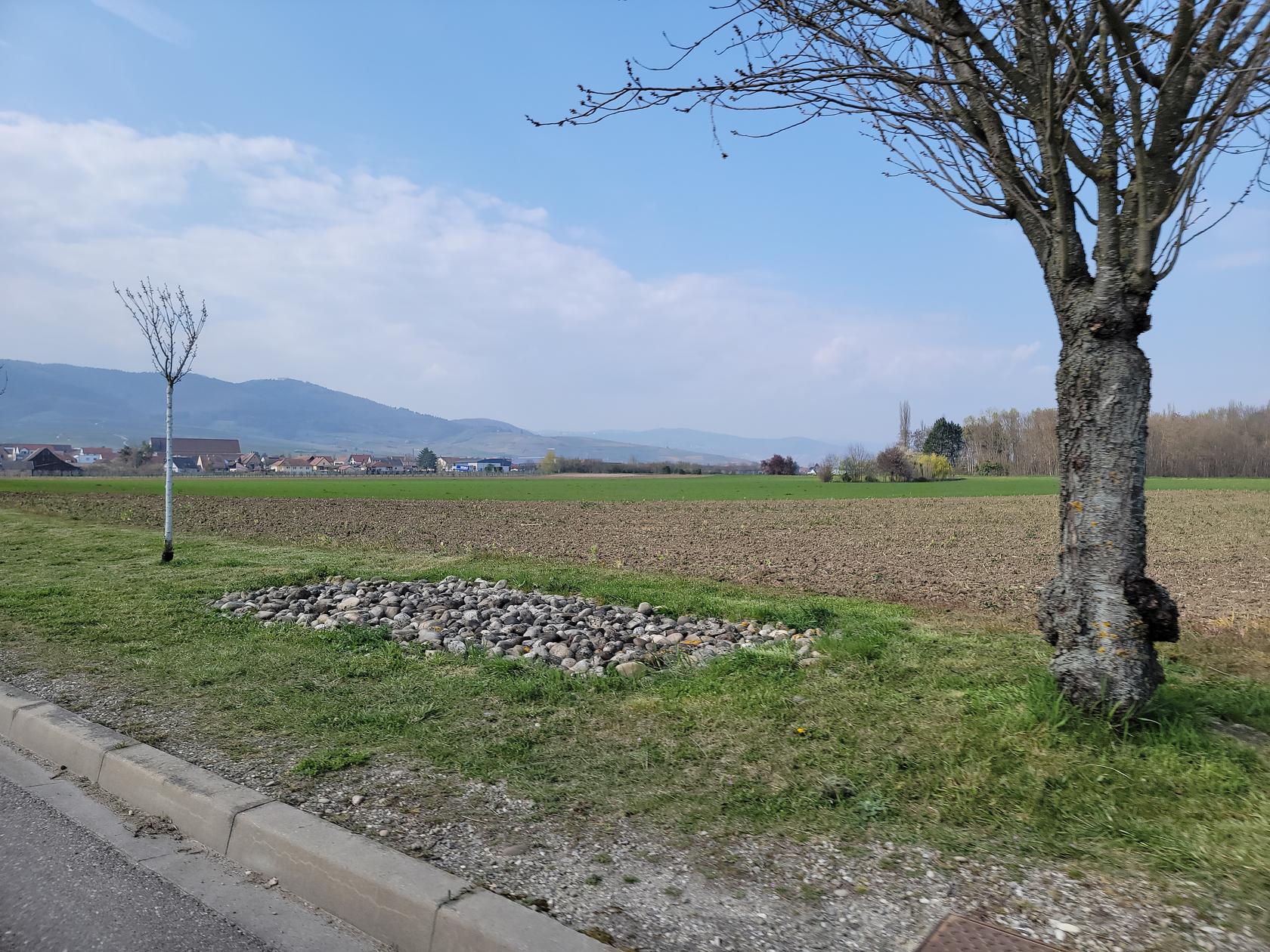
The fields outside – Entering the town – Eguisheim, France
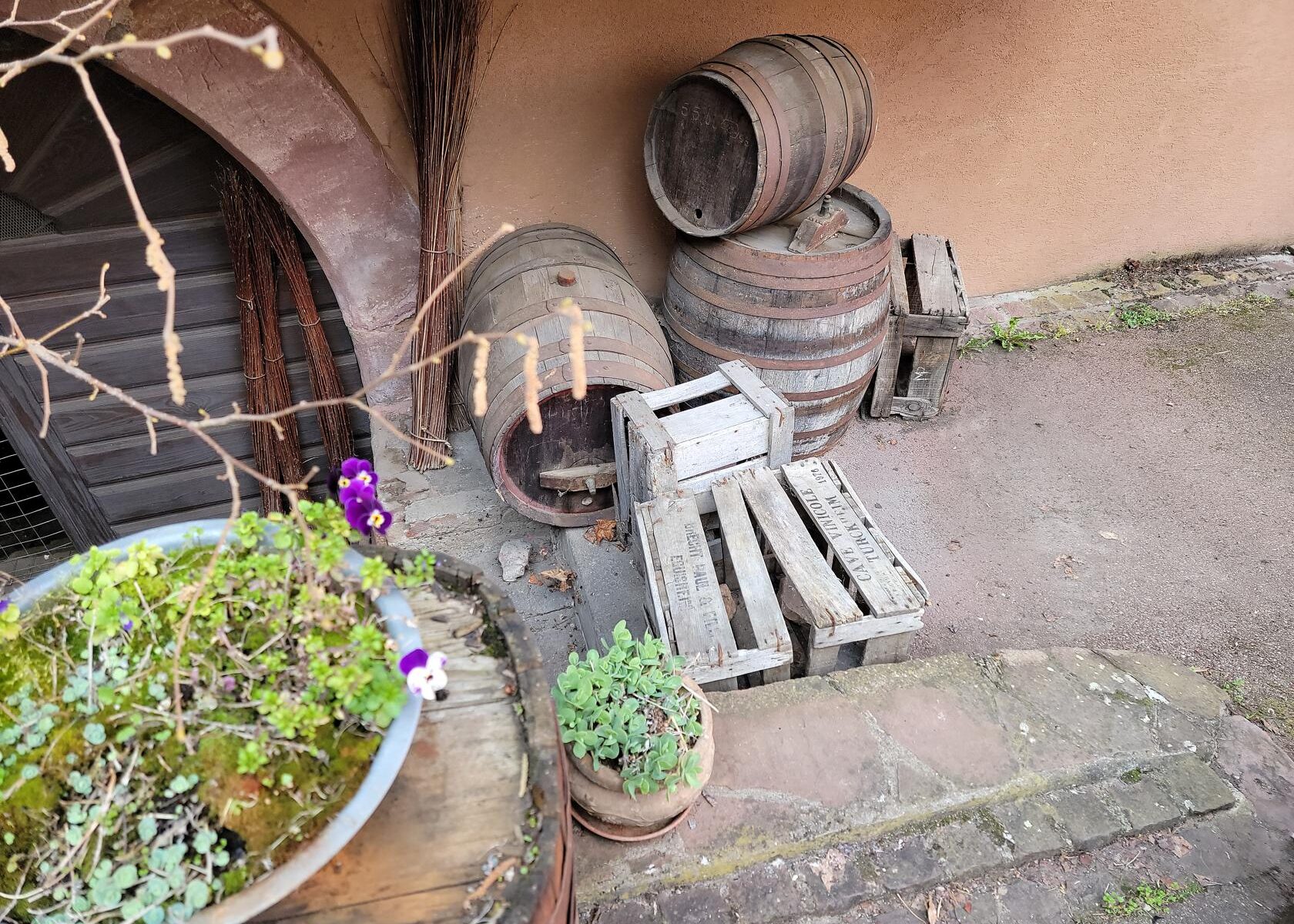
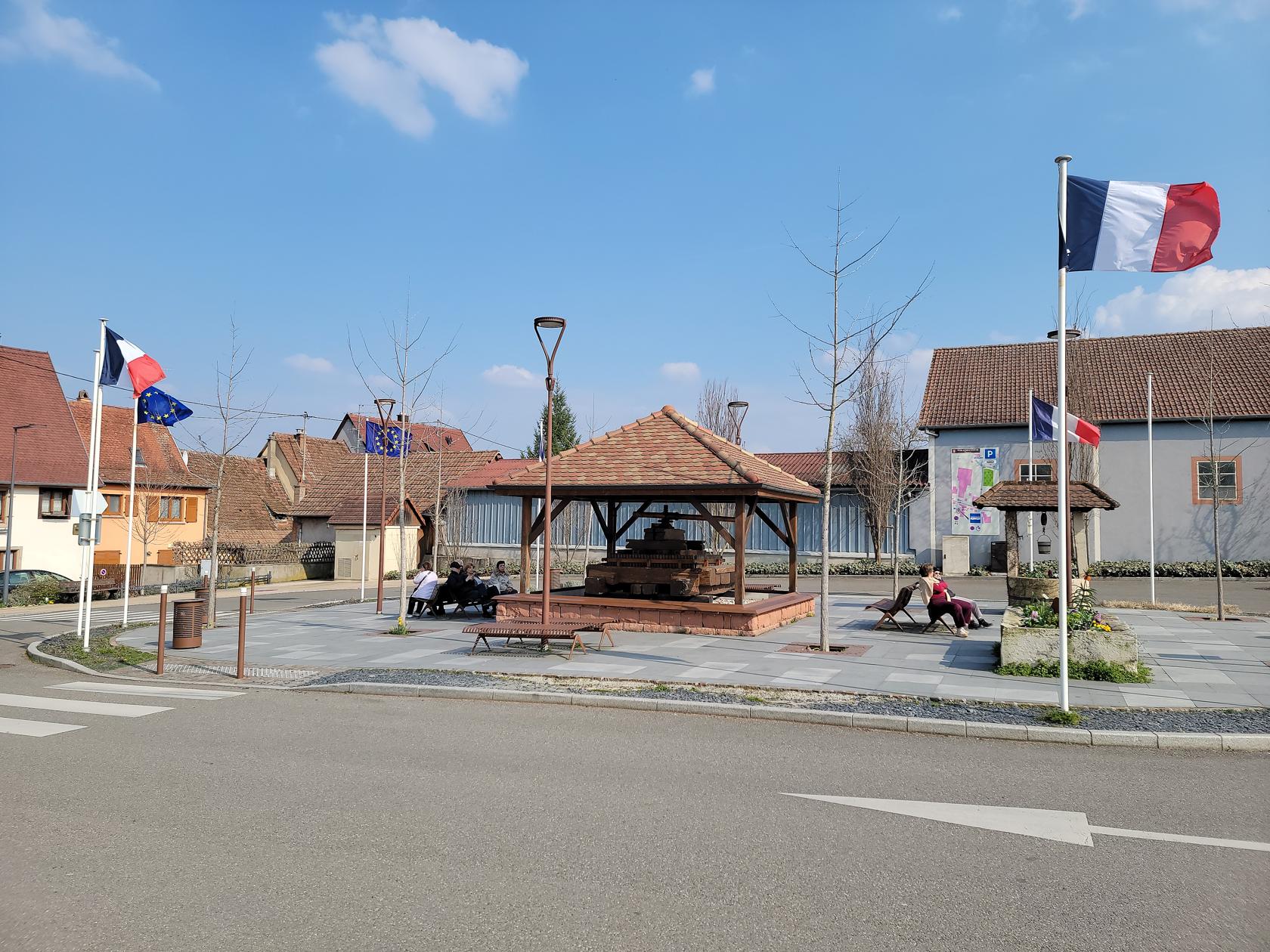
Wine press near parking lot – Eguisheim, France
Grand Rue
Cutting through the center of town is the Grand Rue, or main street. Here is where you will find most all of the shops and many of the wineries.
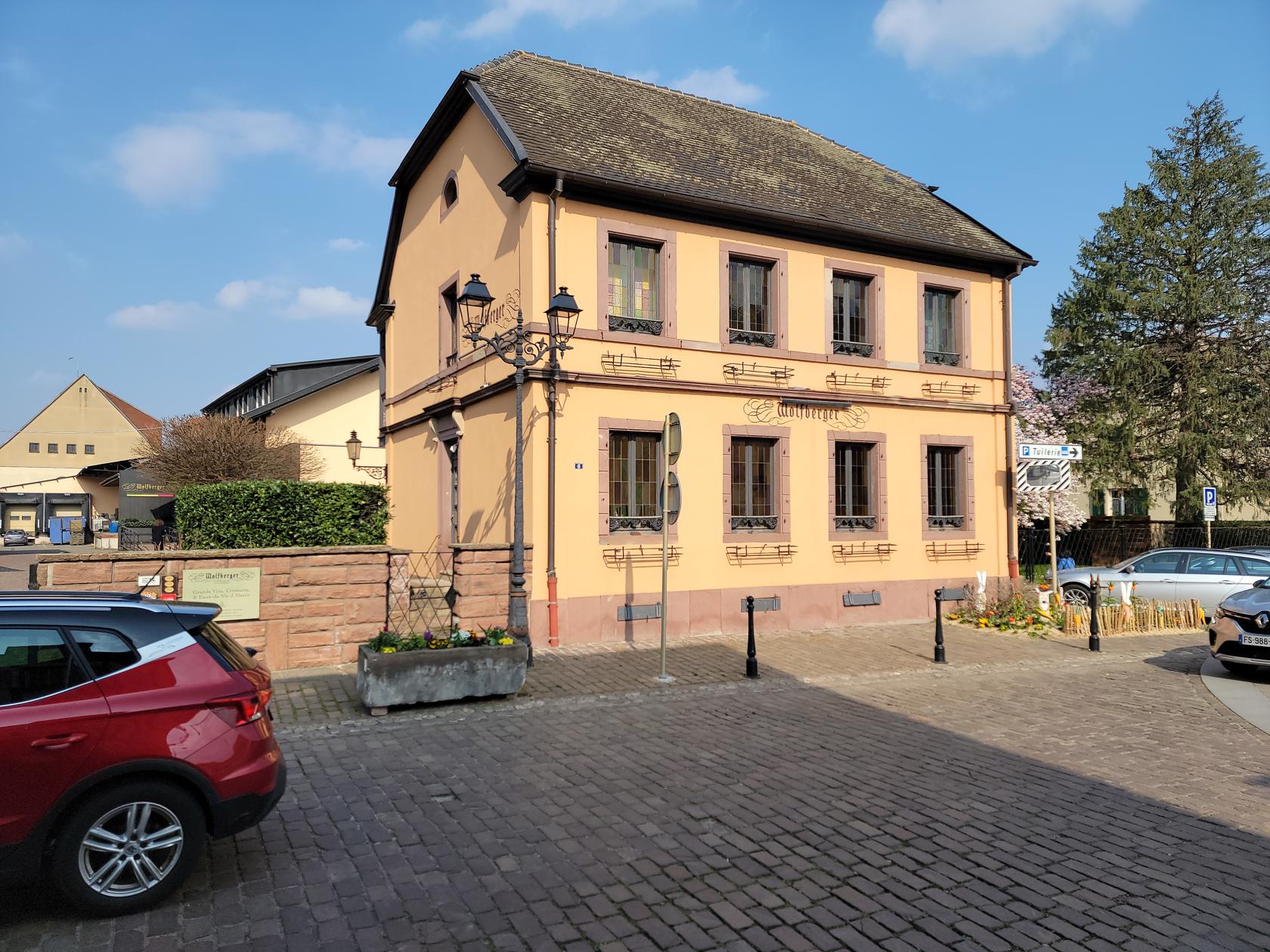
Typical winery on the edge of town – Eguisheim, France
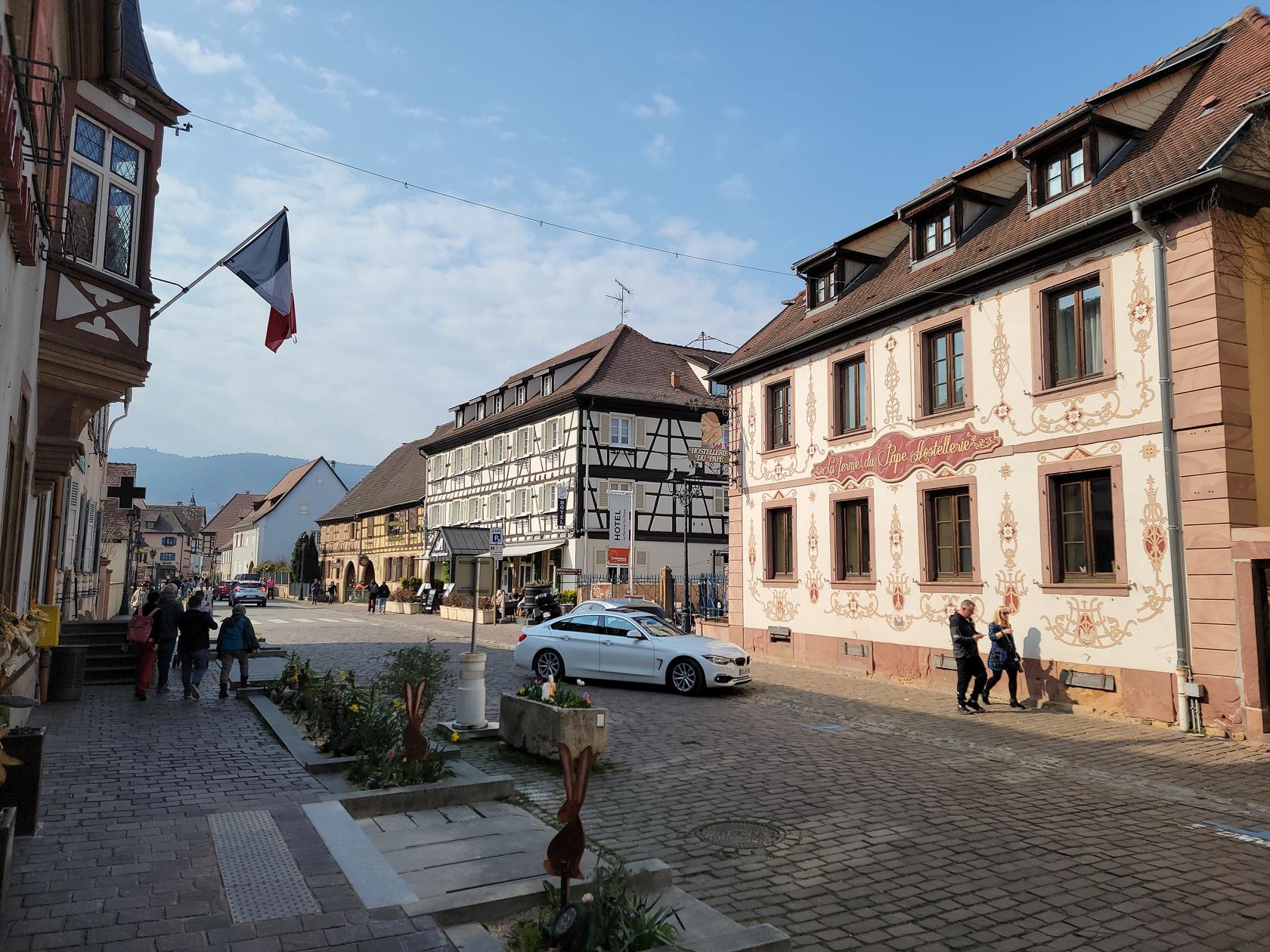
Entering town – Grand Rue – Eguisheim, France
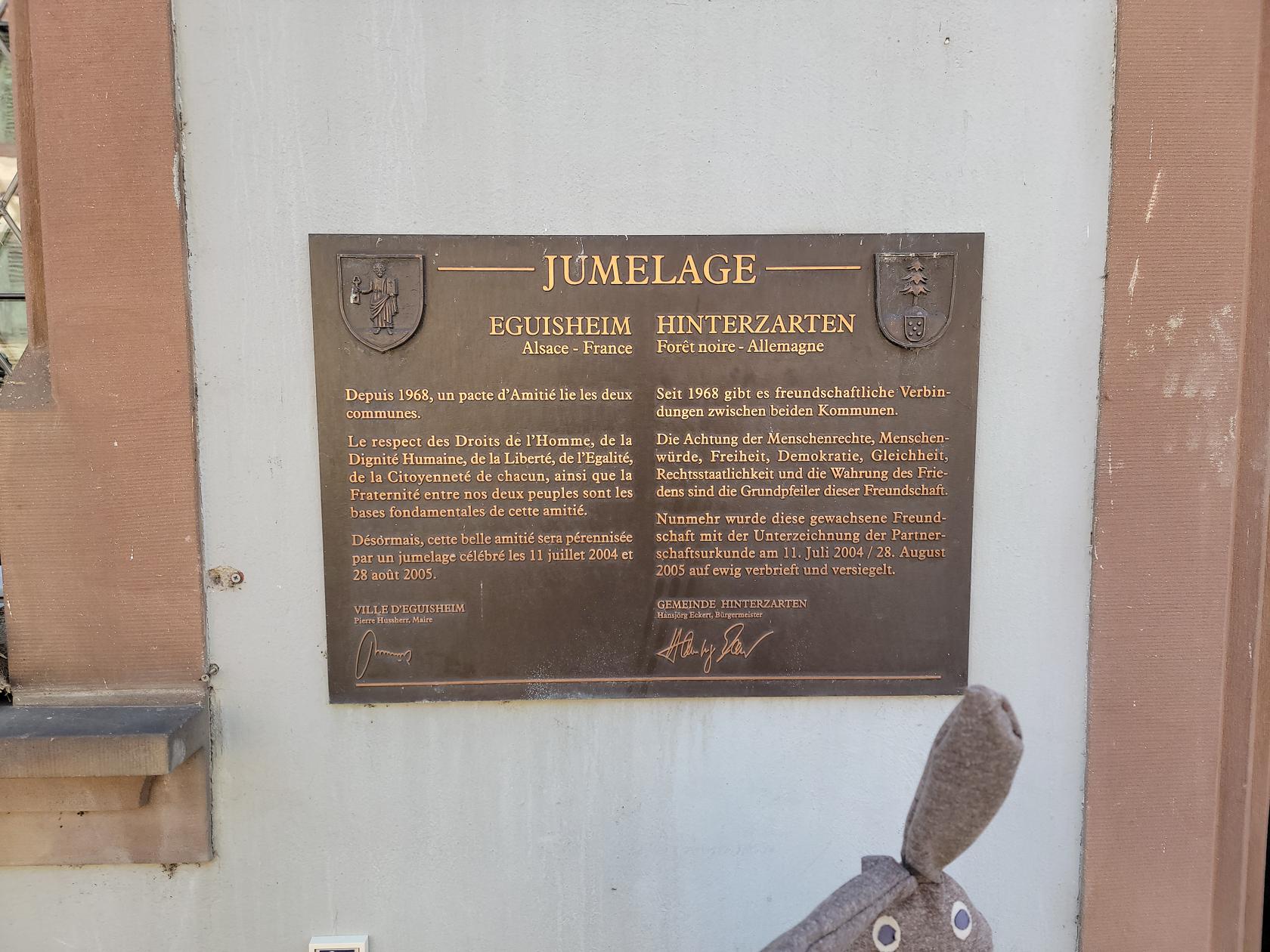
Paired towns Eguisheim and Hinterzarten – Grand Rue – Eguisheim, France
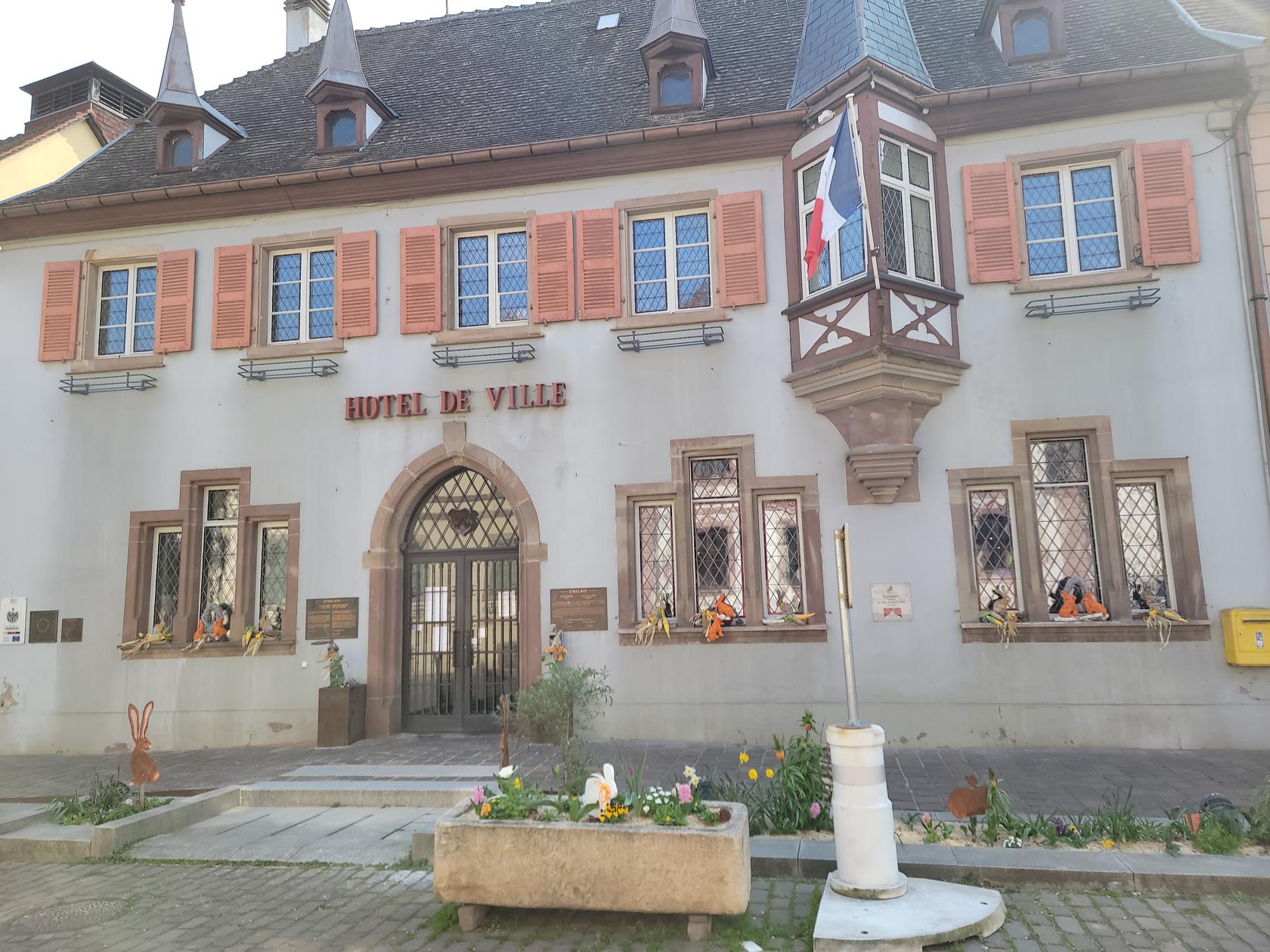
Hotel de Ville – Grand Rue – Eguisheim, France
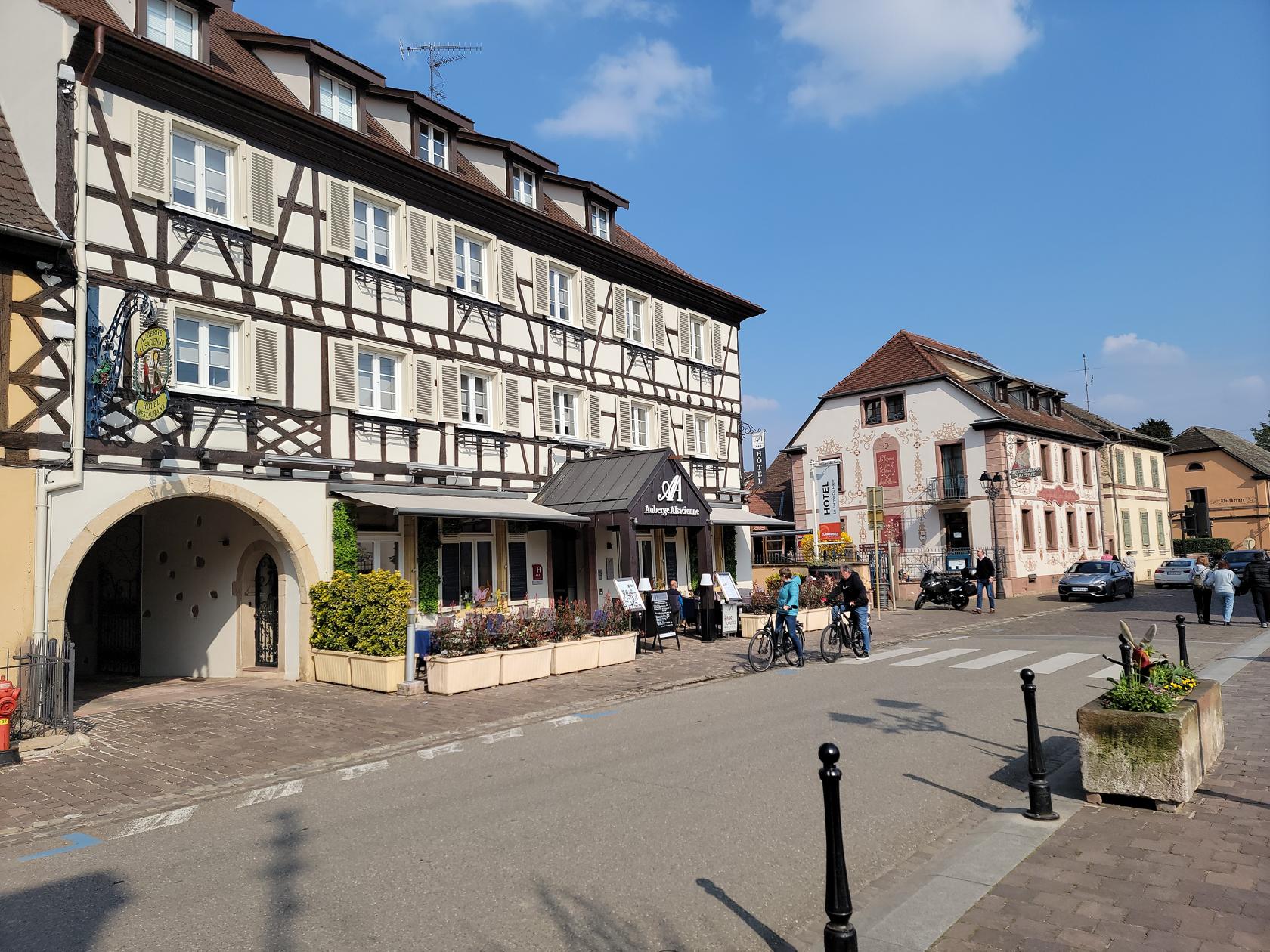
More hotels – Grand Rue – Eguisheim, France
Winery – Grand Rue – Eguisheim, France
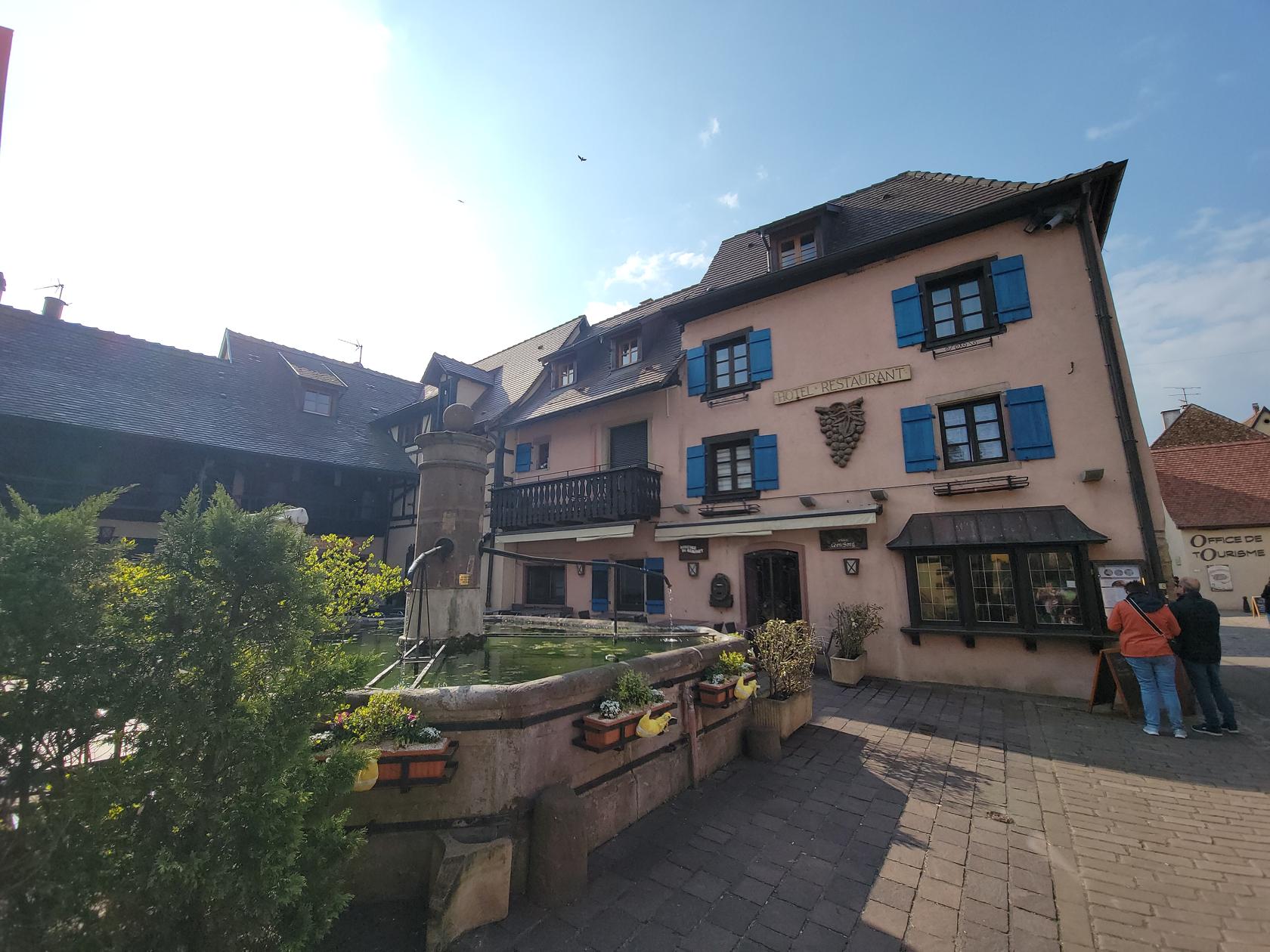
The tourism office is close by the Eguisheim Fountain, so once you locate that, it’s just a stone’s throw away.
Fountain of Eguisheim – Grand Rue – Eguisheim, France
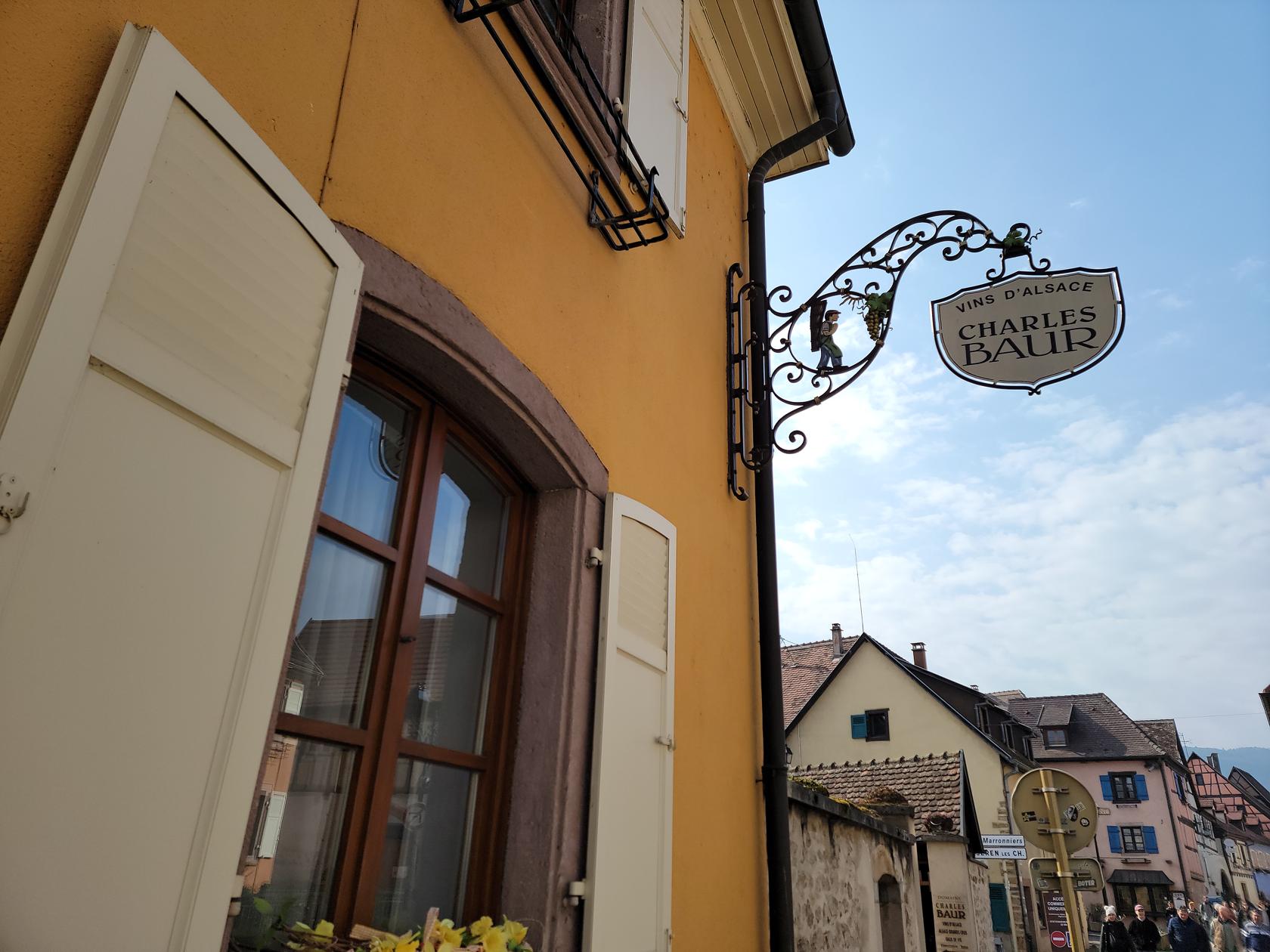
Charles Bauer winery – Grand Rue – Eguisheim, France
Rue de Rempart
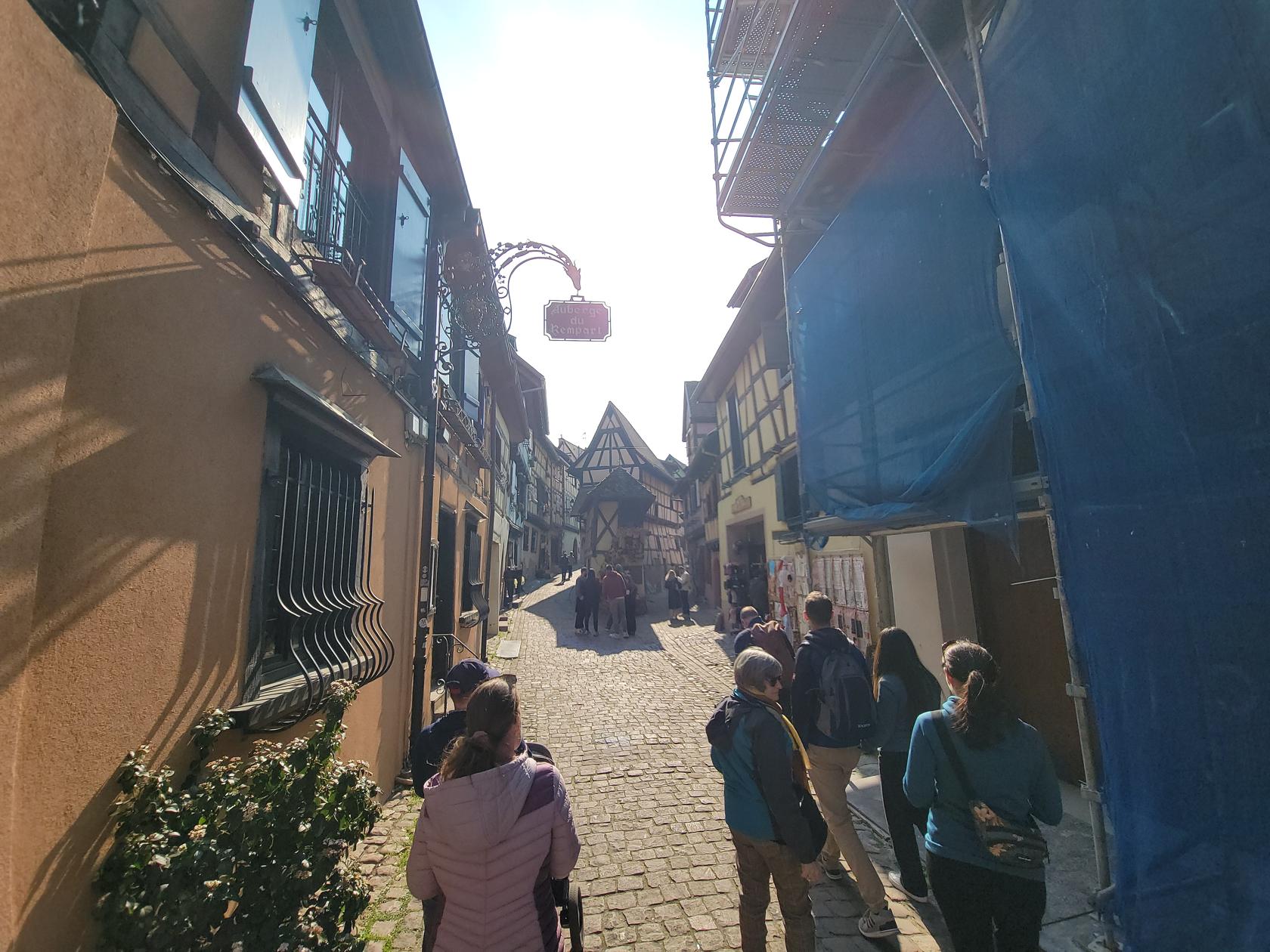
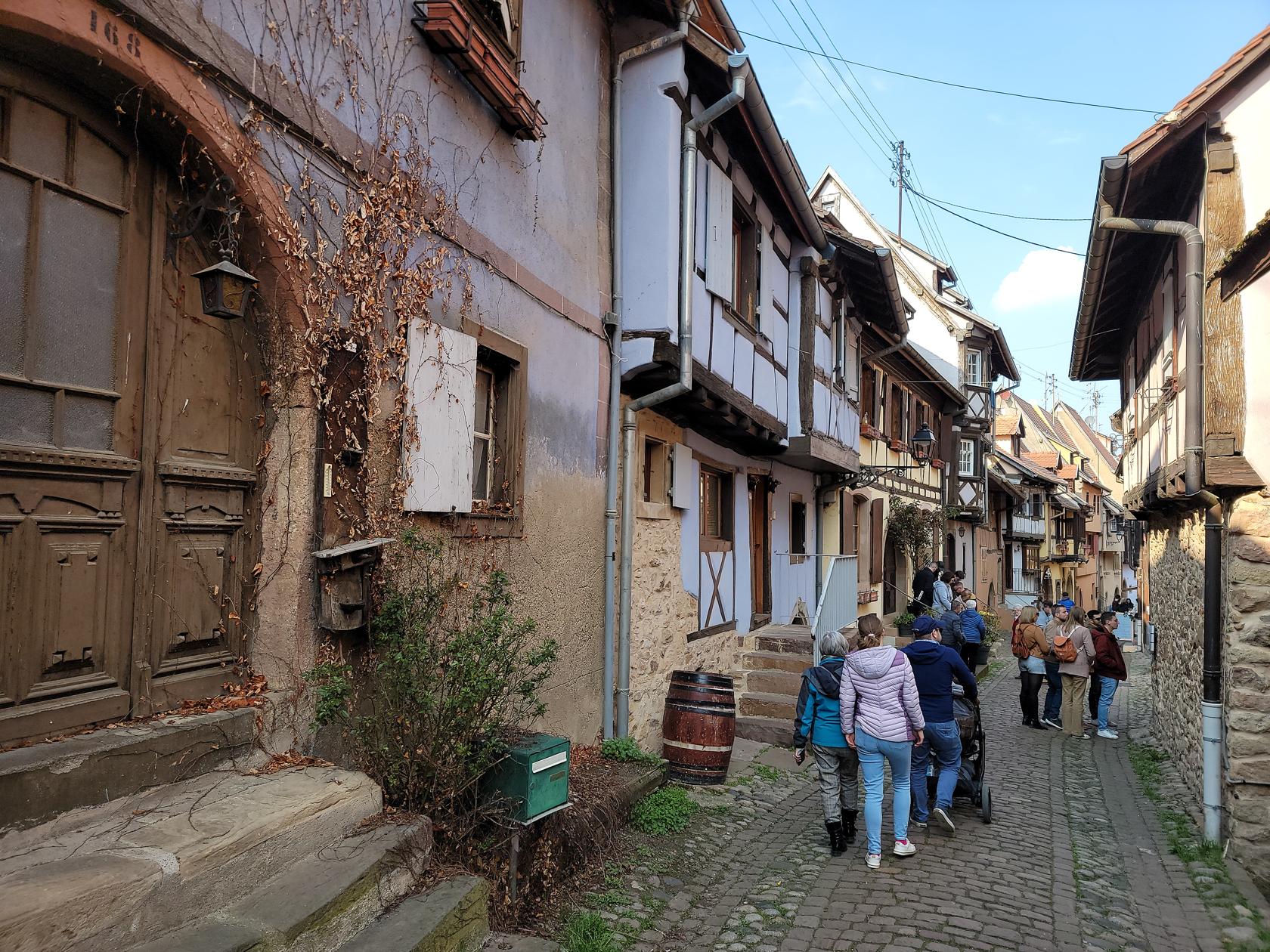
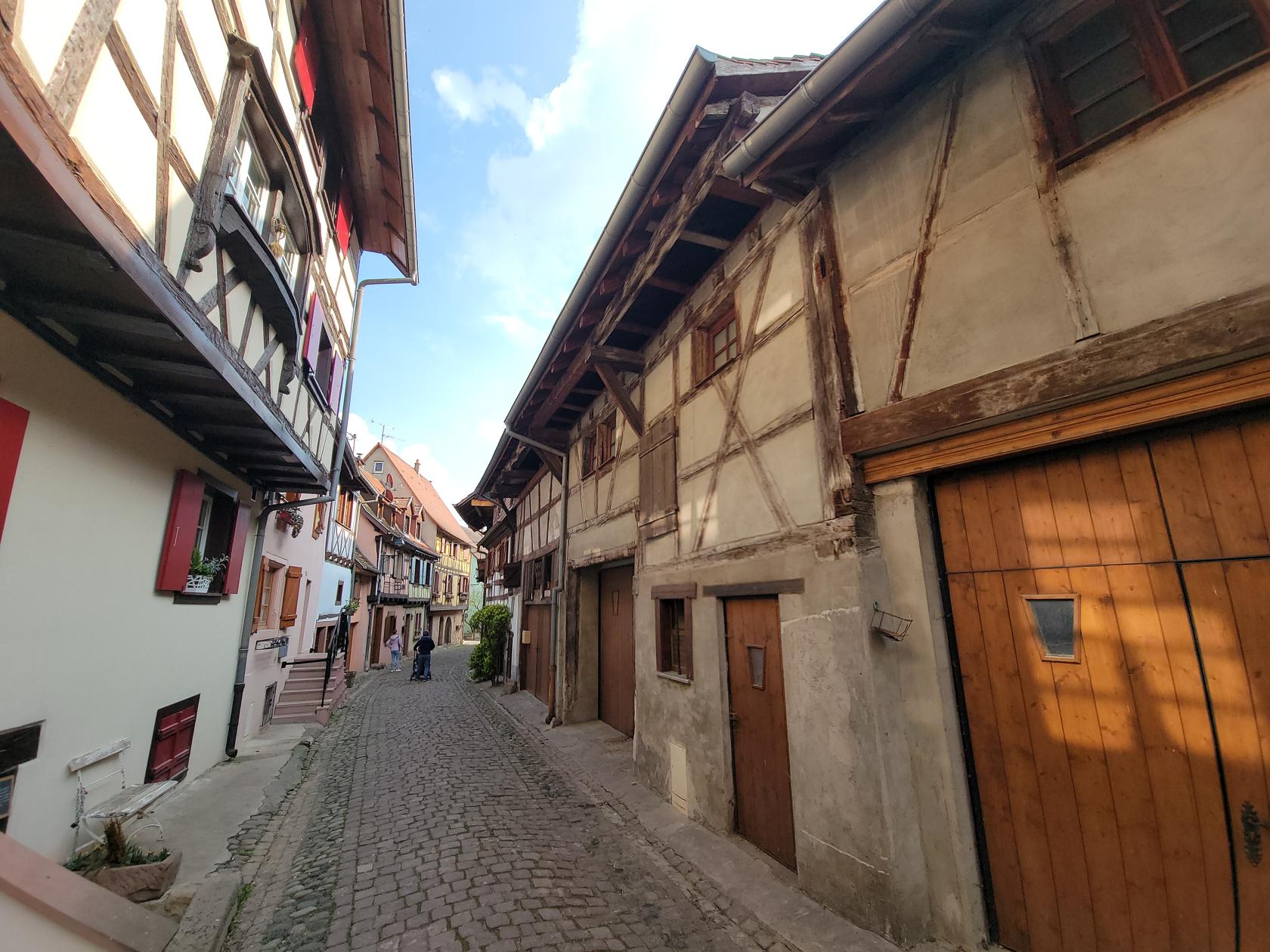
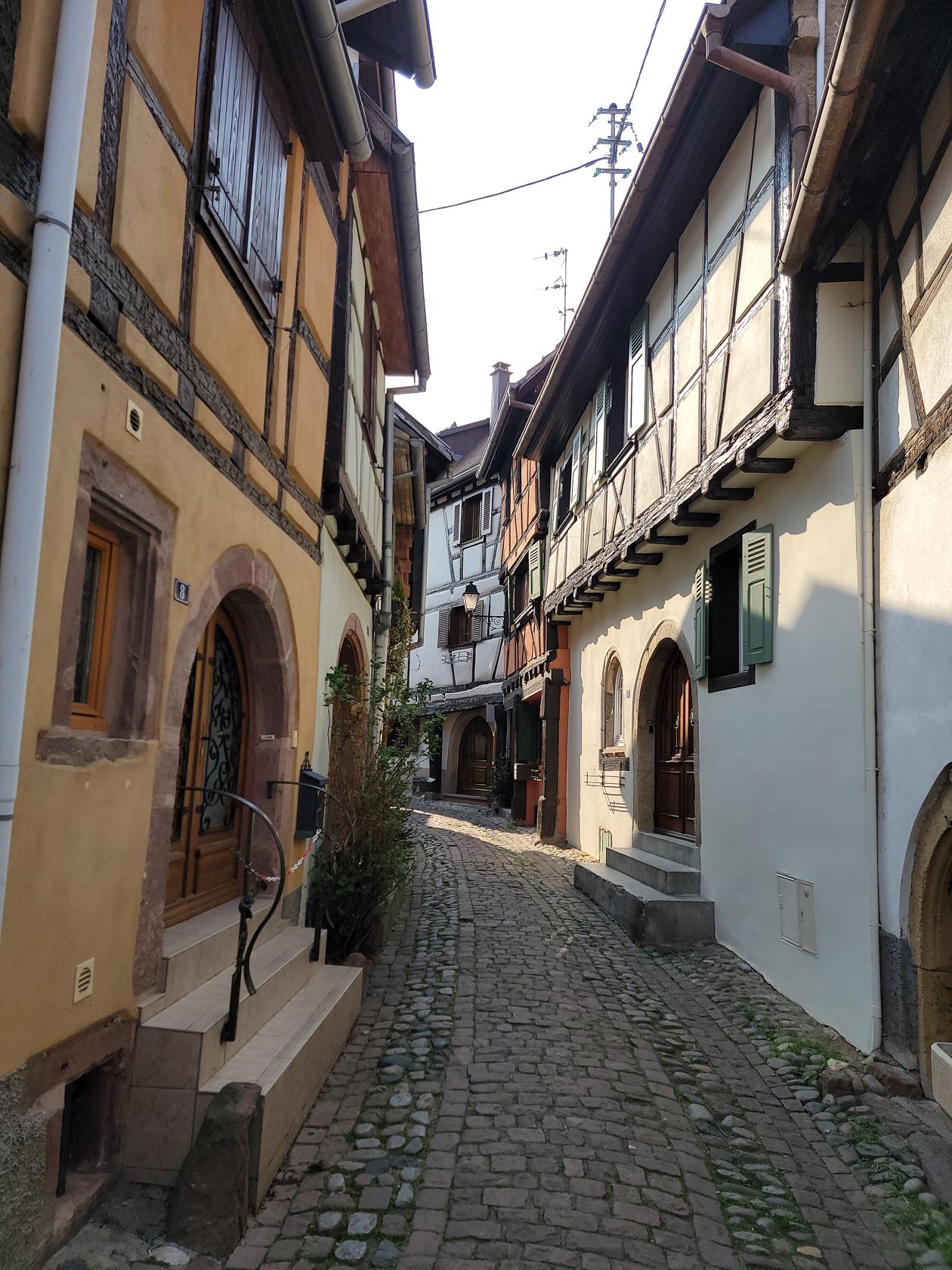
We spent most of our time walking this alley, which circumnavigates the town. Since the town is laid out like an onion, you will eventually come back to where you started.
La Grange de Eguisheim – Rue de Rempart – Eguisheim, France
La Grange de Eguisheim – Rue de Rempart – Eguisheim, France
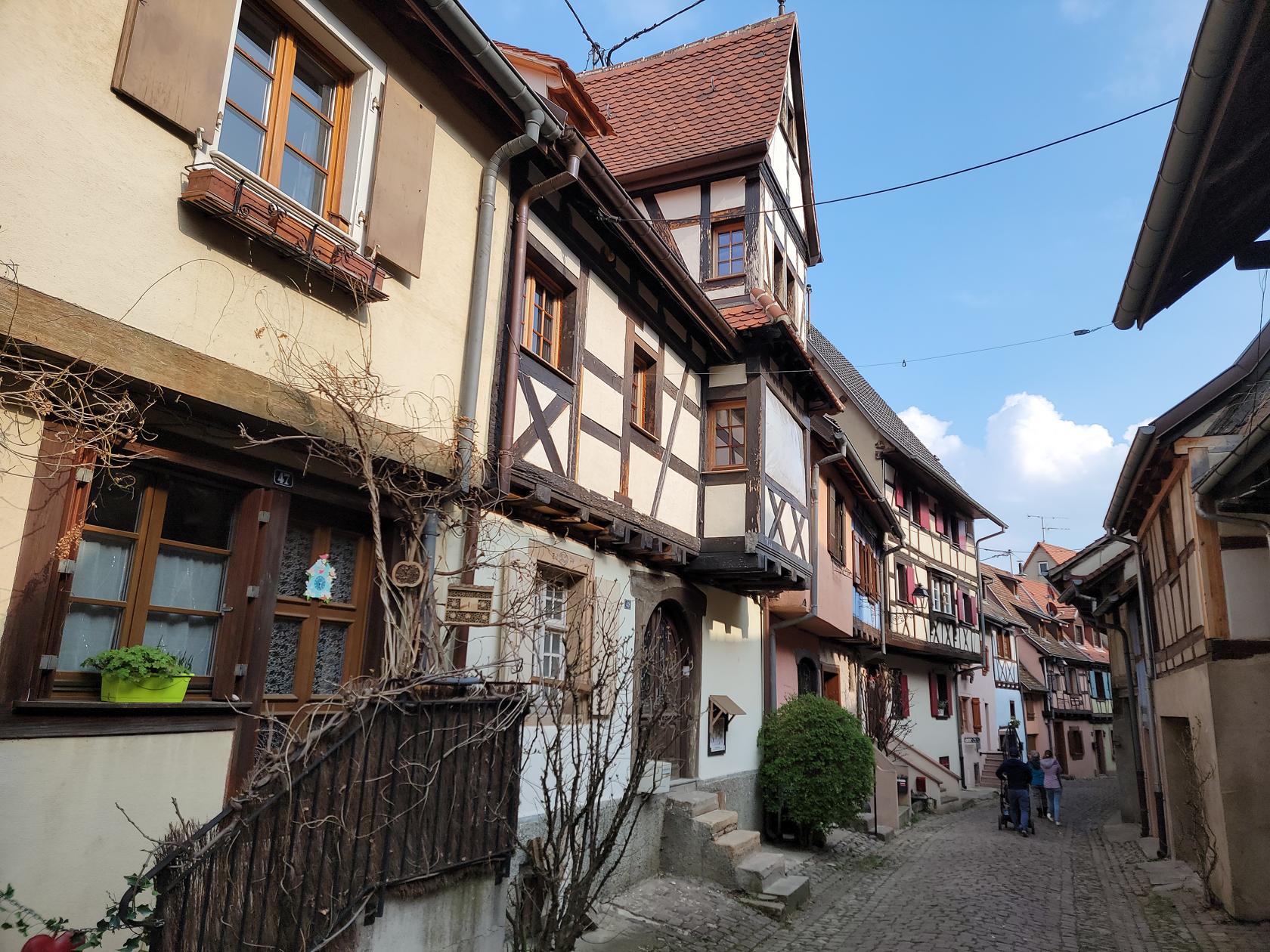
Timber Houses – Rue de Rempart – Eguisheim, France
Quaint cafe – Rue de Rempart – Eguisheim, France
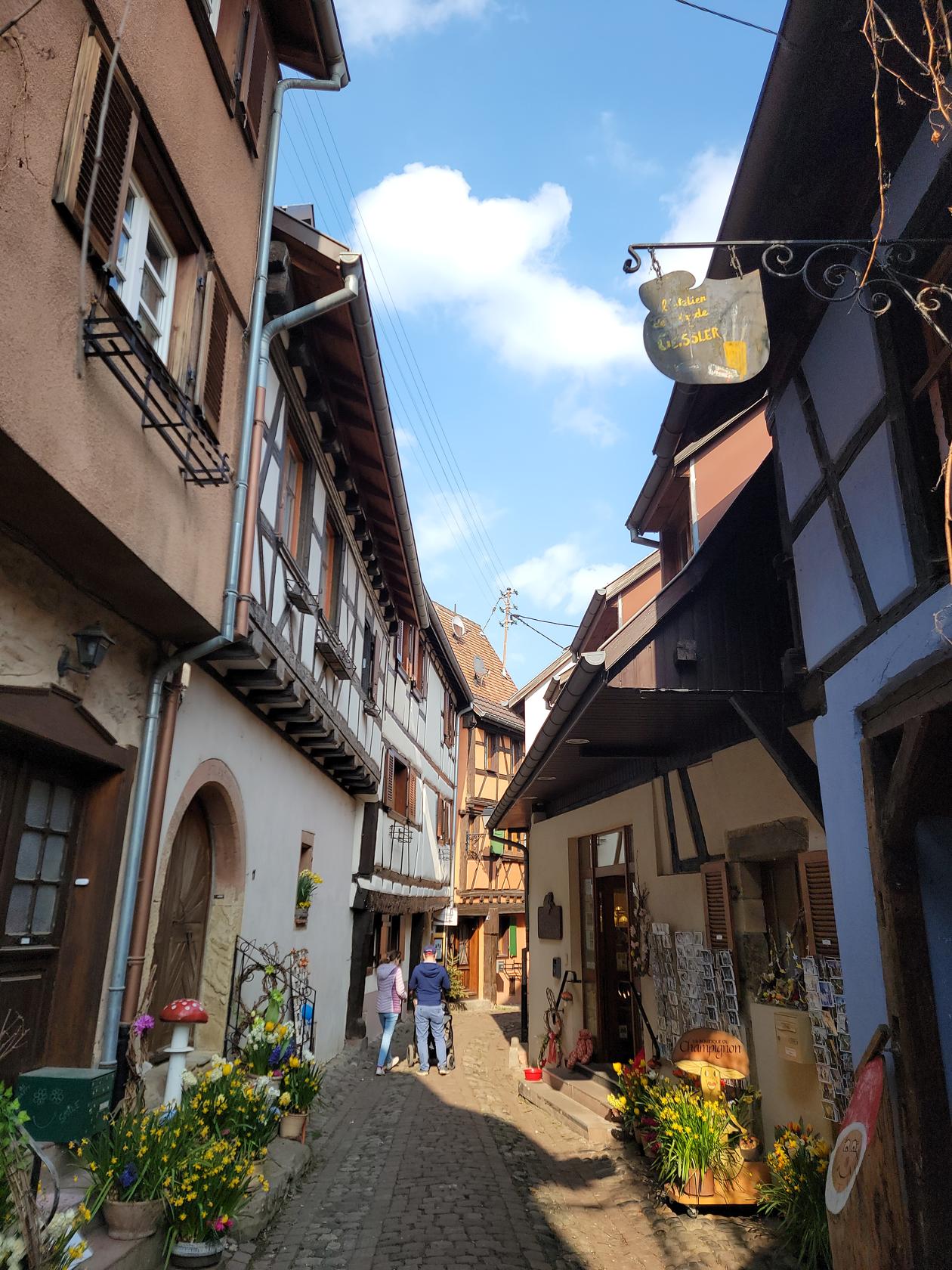
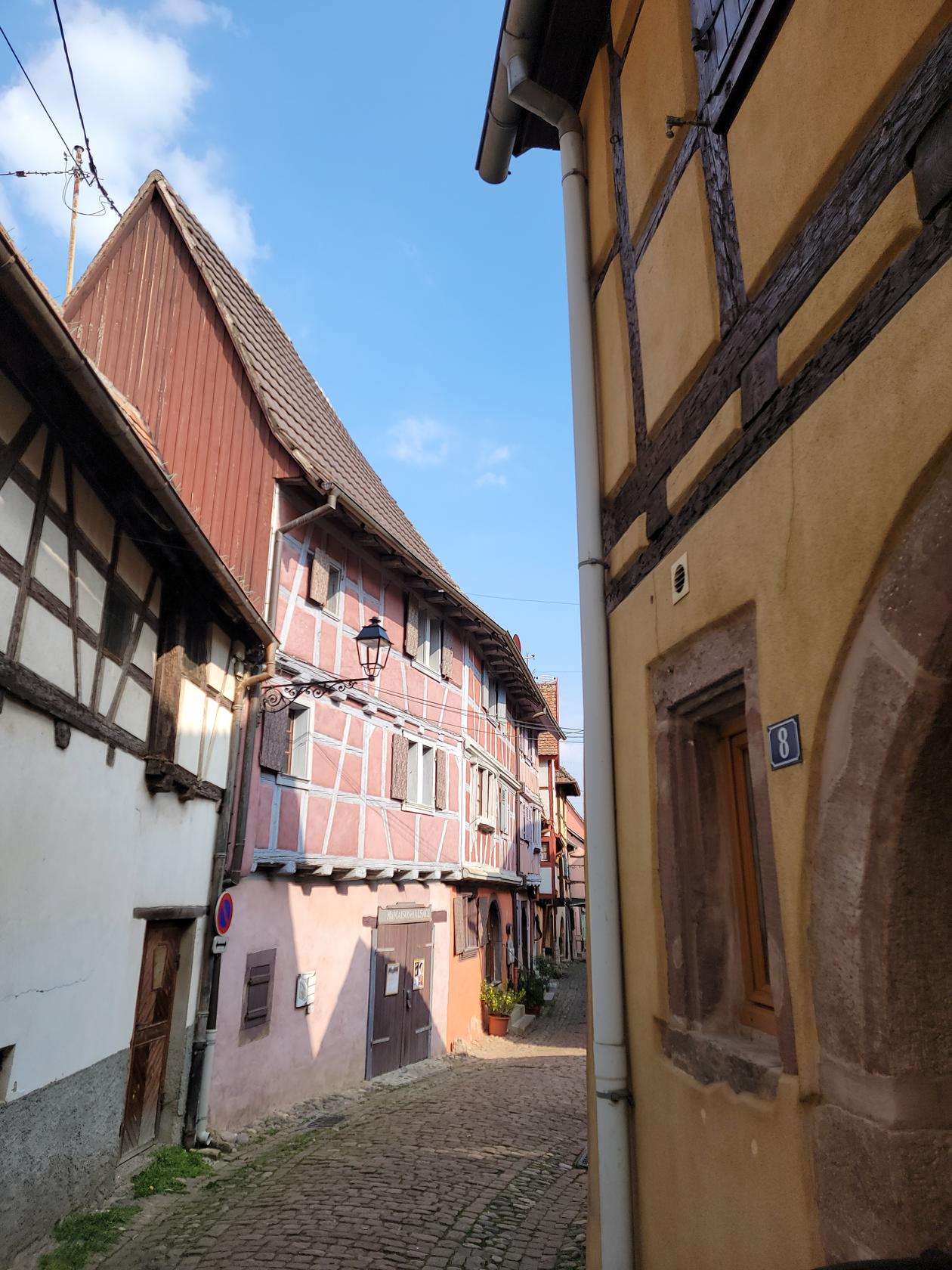
Cobbled alley – Rue de Rempart – Eguisheim, France
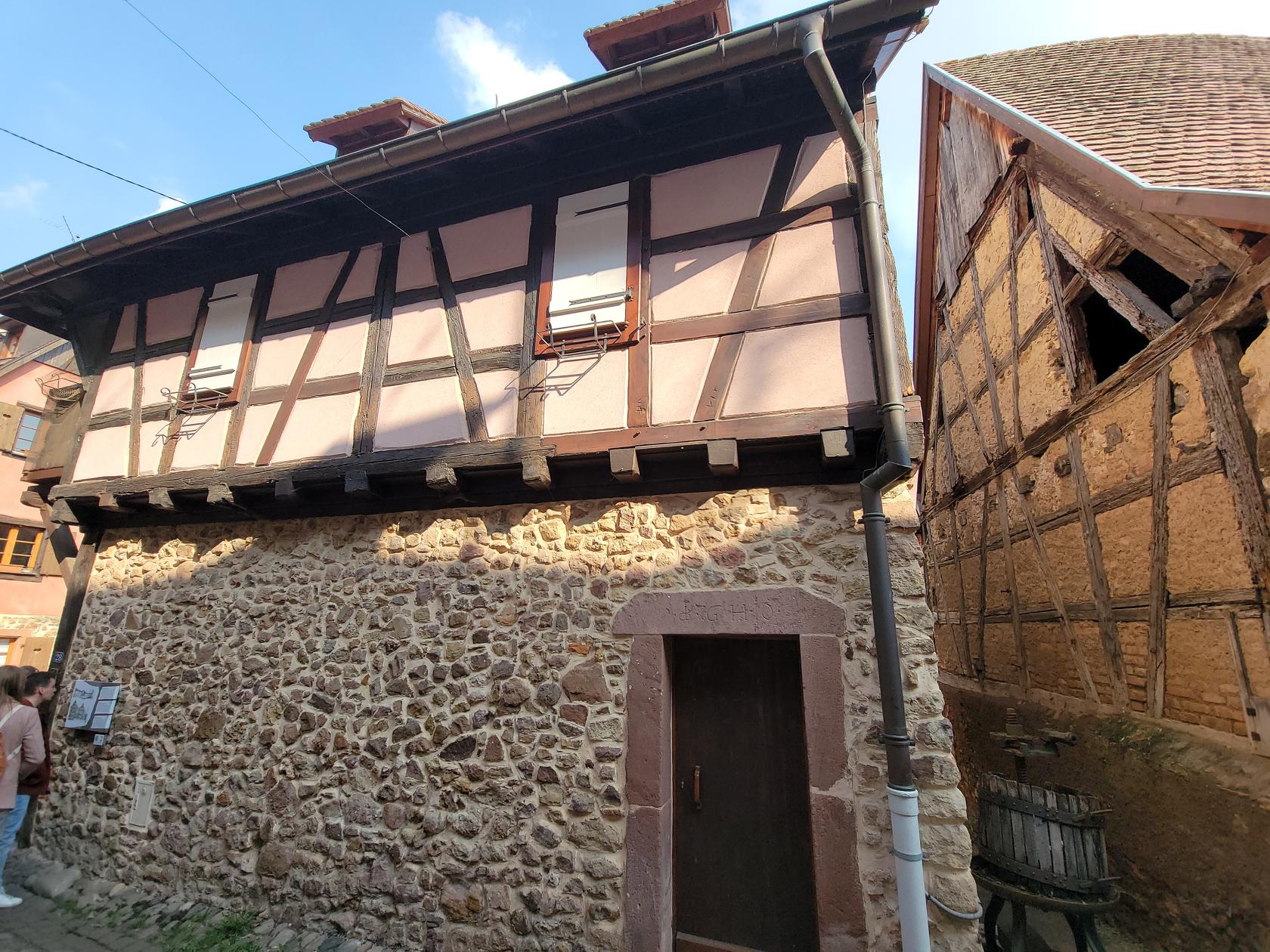
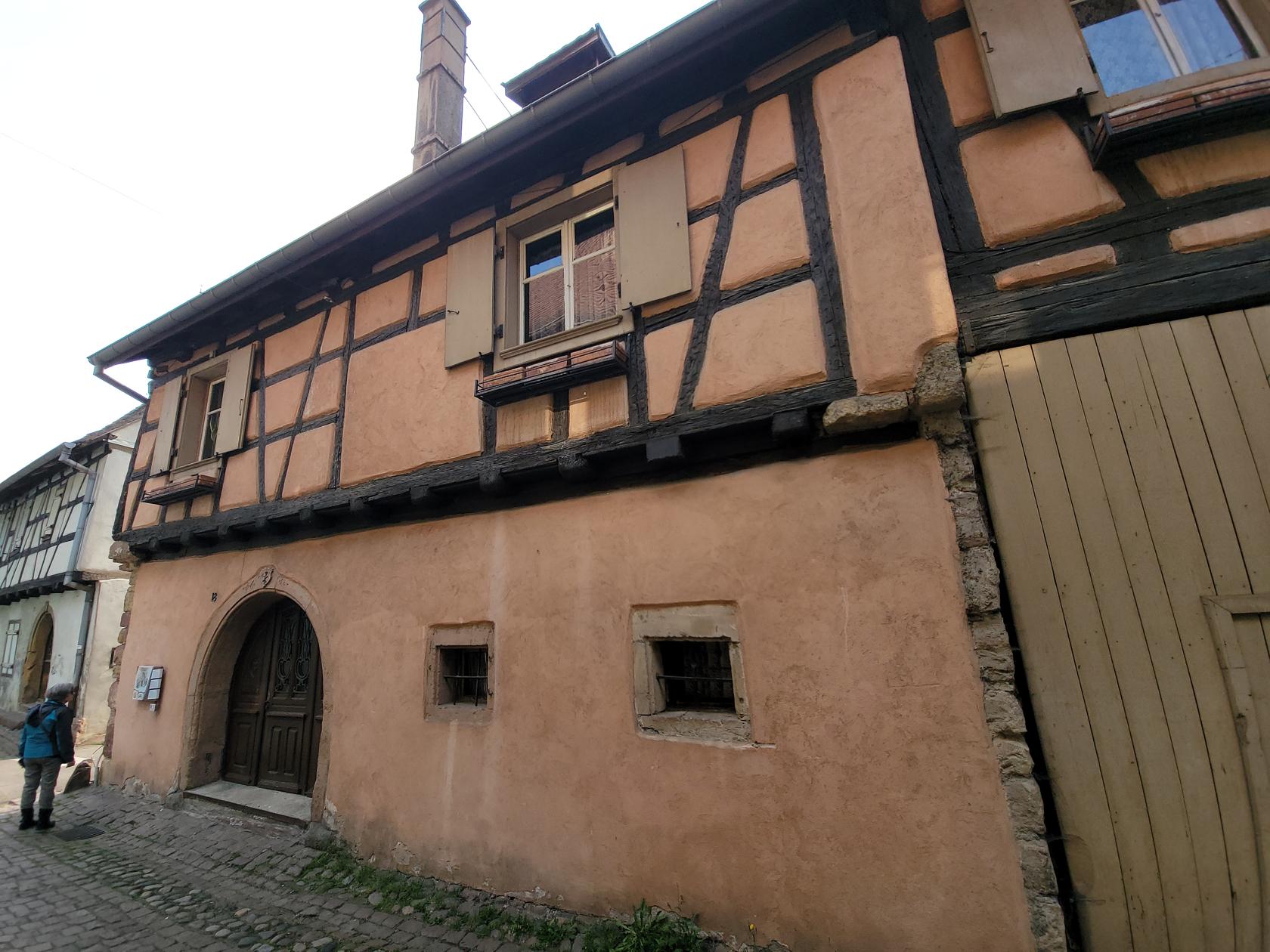
Small timbered house – Rue de Rempart – Eguisheim, France
More timbered houses – Rue de Rempart – Eguisheim, France
Walking along – Rue de Rempart – Eguisheim, France
Tower of Église Saints-Pierre-et-Paul – Rue de Rempart – Eguisheim, France
Ericka, Gabi, Vlad and Patti walking ahead – Rue de Rempart – Eguisheim, France
The Rue de Rempart creates two rows of buildings that acted like fortifications for the town. Since the town was not initially meant to be a fortress, but was more economical in nature, the outside wall turned into another row of houses some time in the sixteenth century.
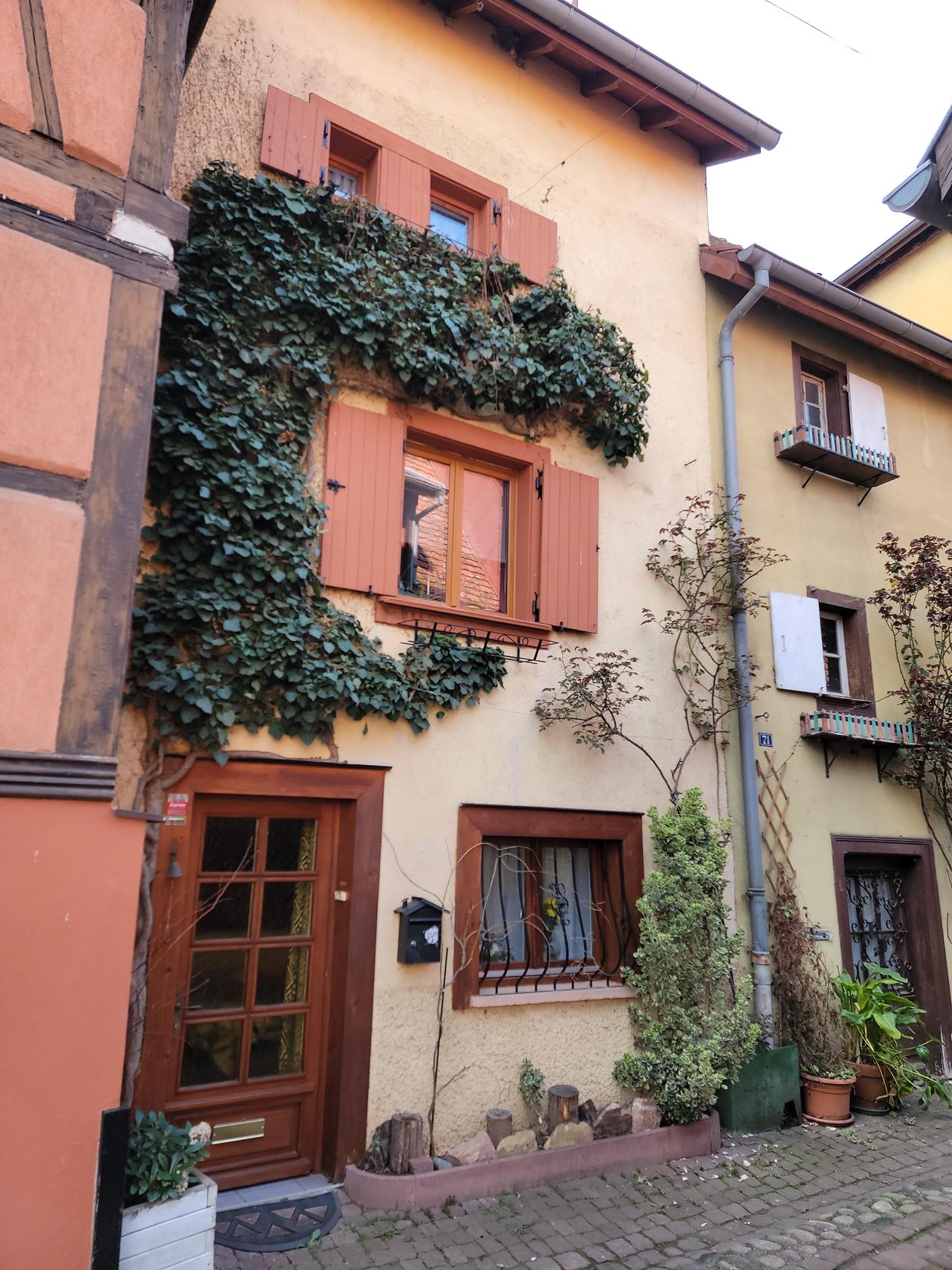
Ivy on house – Rue de Rempart – Eguisheim, France
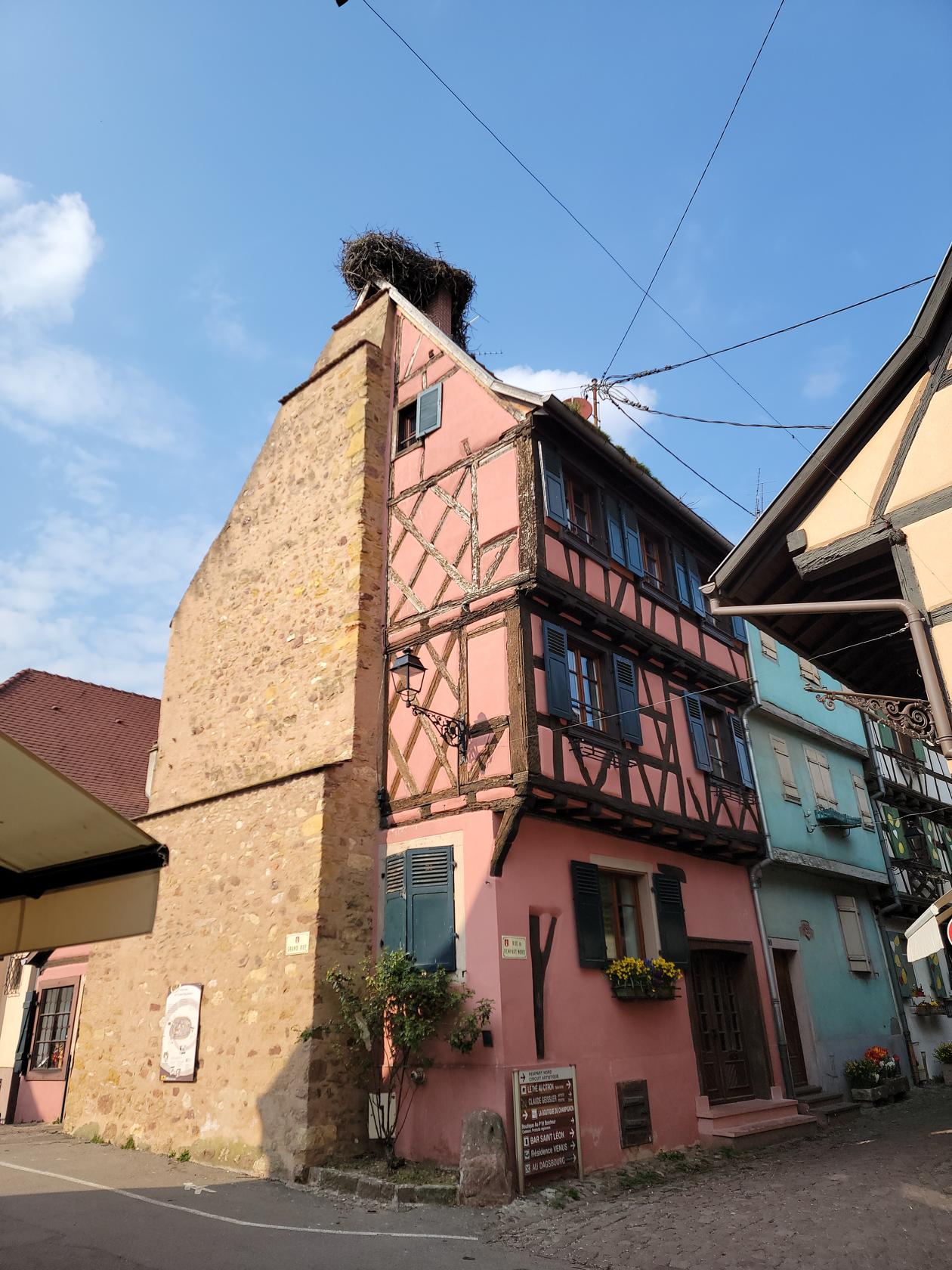
Storks are everywhere – Rue de Rempart – Eguisheim, France
Shops – Rue de Rempart – Eguisheim, France
Houses that formed the outter wall of the original town – Rue de Rempart – Eguisheim, France
Houses that formed the outter wall of the original town – Rue de Rempart – Eguisheim, France
Round and round Eguisheim – Rue de Rempart – Eguisheim, France
Intersection of Grand Rue – Rue de Rempart – Eguisheim, France
And on it goes in a great circle – Rue de Rempart – Eguisheim, France
Ericka, Gabi, Vlad and Patti walking ahead – Rue de Rempart – Eguisheim, France
Less renovated houses – Rue de Rempart – Eguisheim, France
Many buildings in the town are also adorned with coats-of-arms. Many of the pediments and lintels are decorated with them and other engravings, usually left by the stone masons themselves. In most cases the coat-of-arms indicated who lived in the house according to their profession, a butcher’s block for a butcher for example. However, a sword crossing a shield would indicate a master craftsman in that profession.
Coats of arms on buildings and other markings – Rue de Rempart – Eguisheim, France
Chapelle Saint-Léon IX
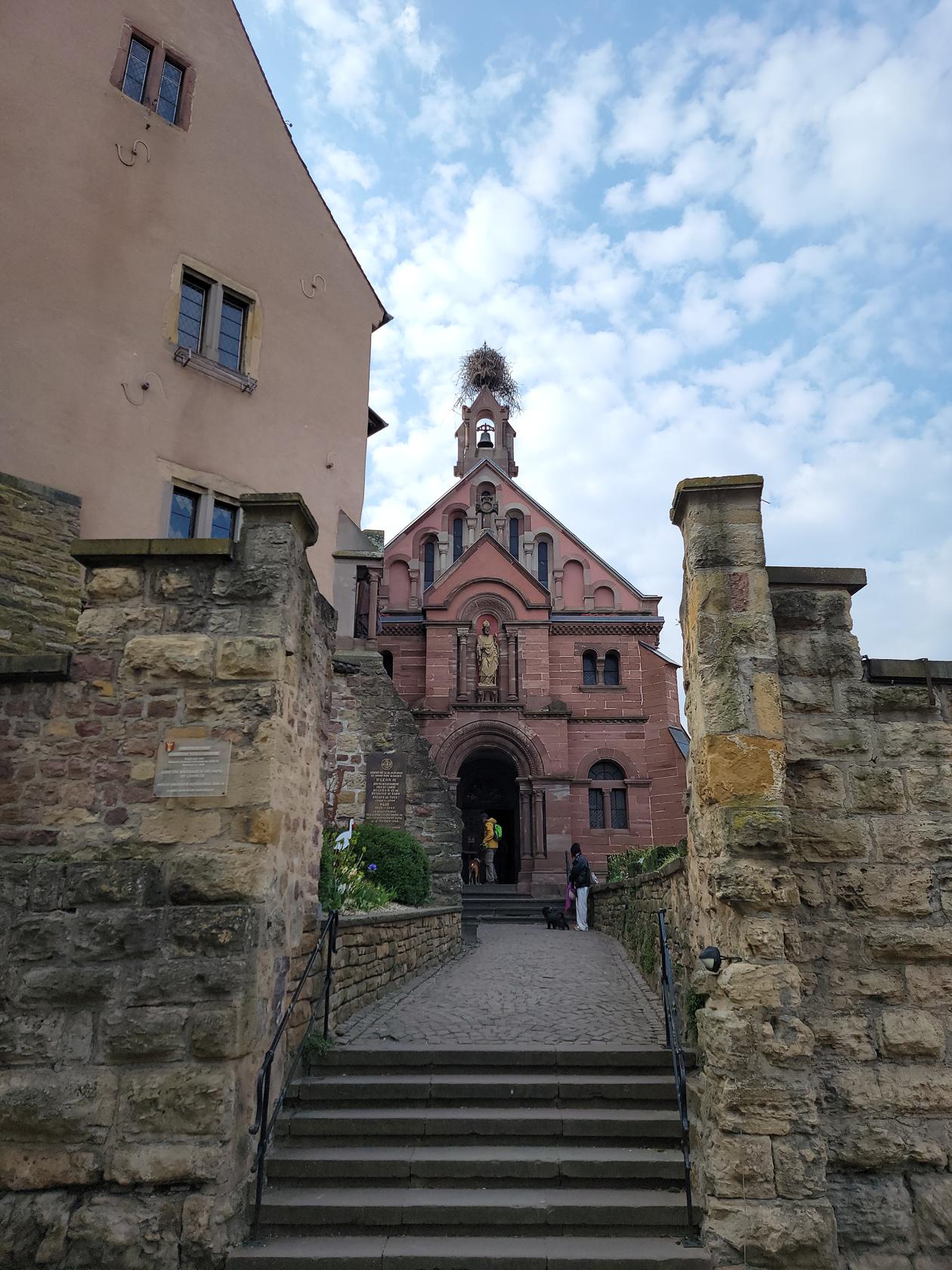
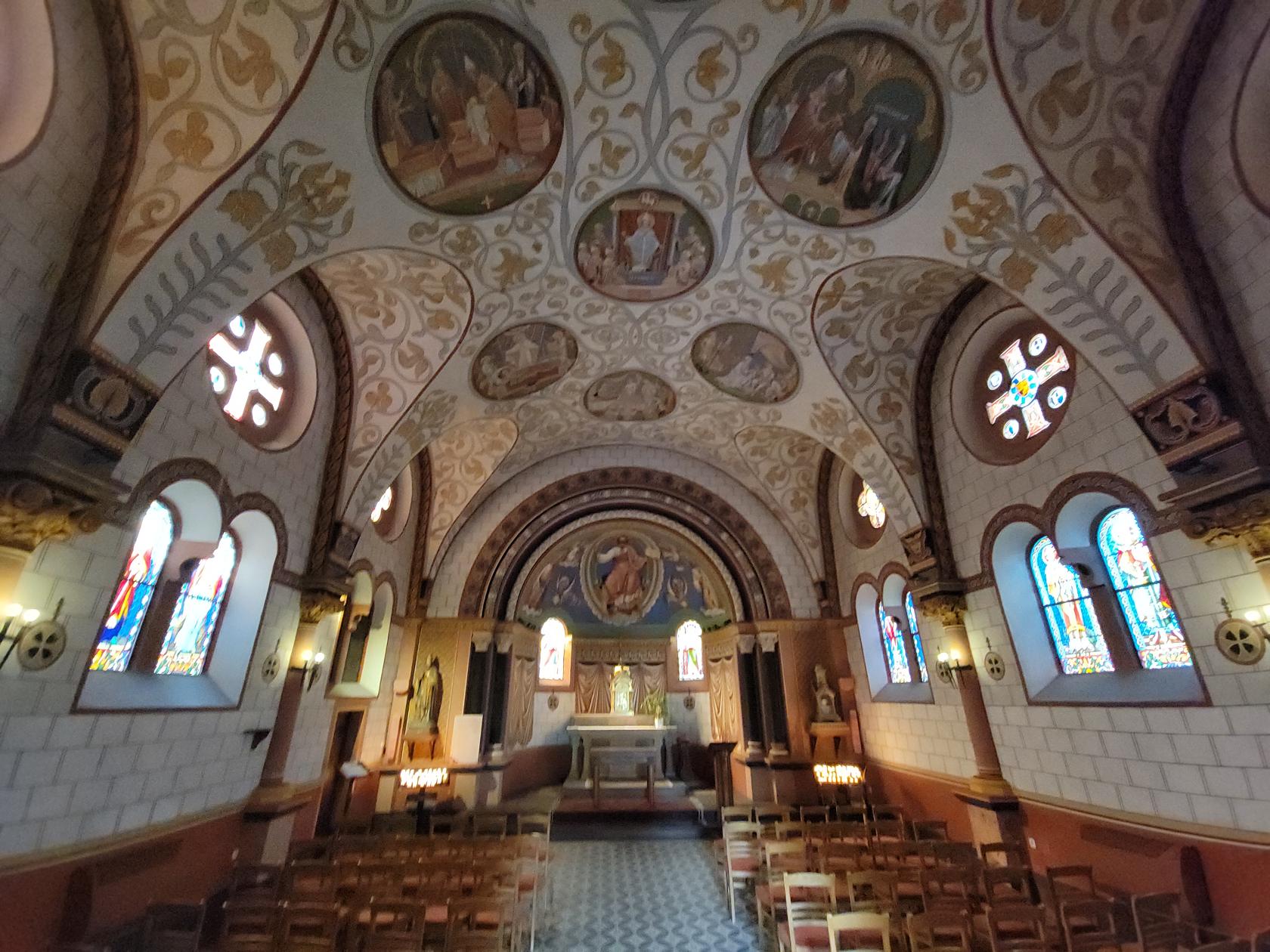
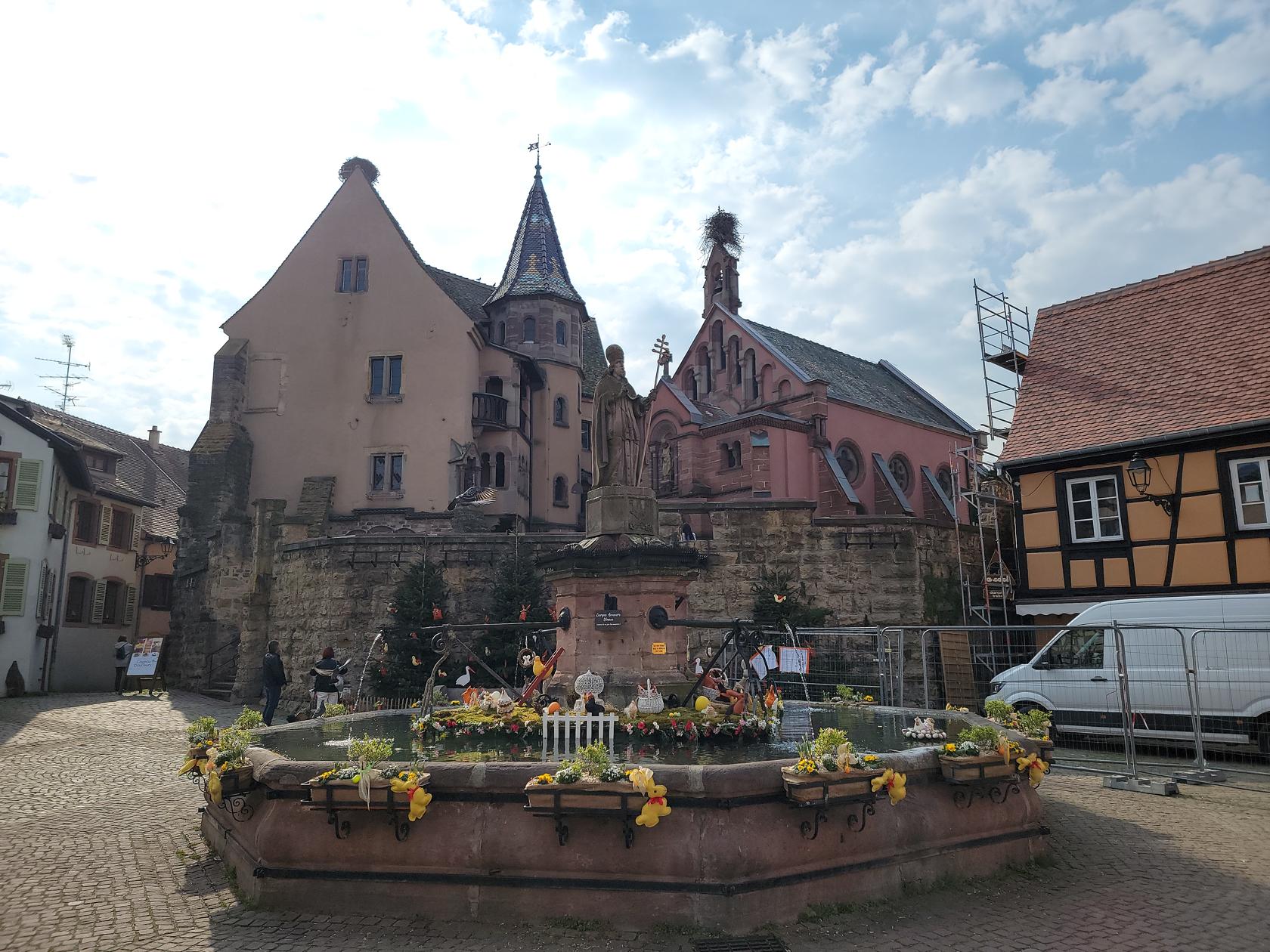
Along with the chateau that is close by, the Chapel of Saint Leon IX is a central sight. The fountain of Saint Leon is directly below the stairs to the chapel.
Chapelle Saint-Léon IX – Place du Château Saint Léon – Eguisheim, France
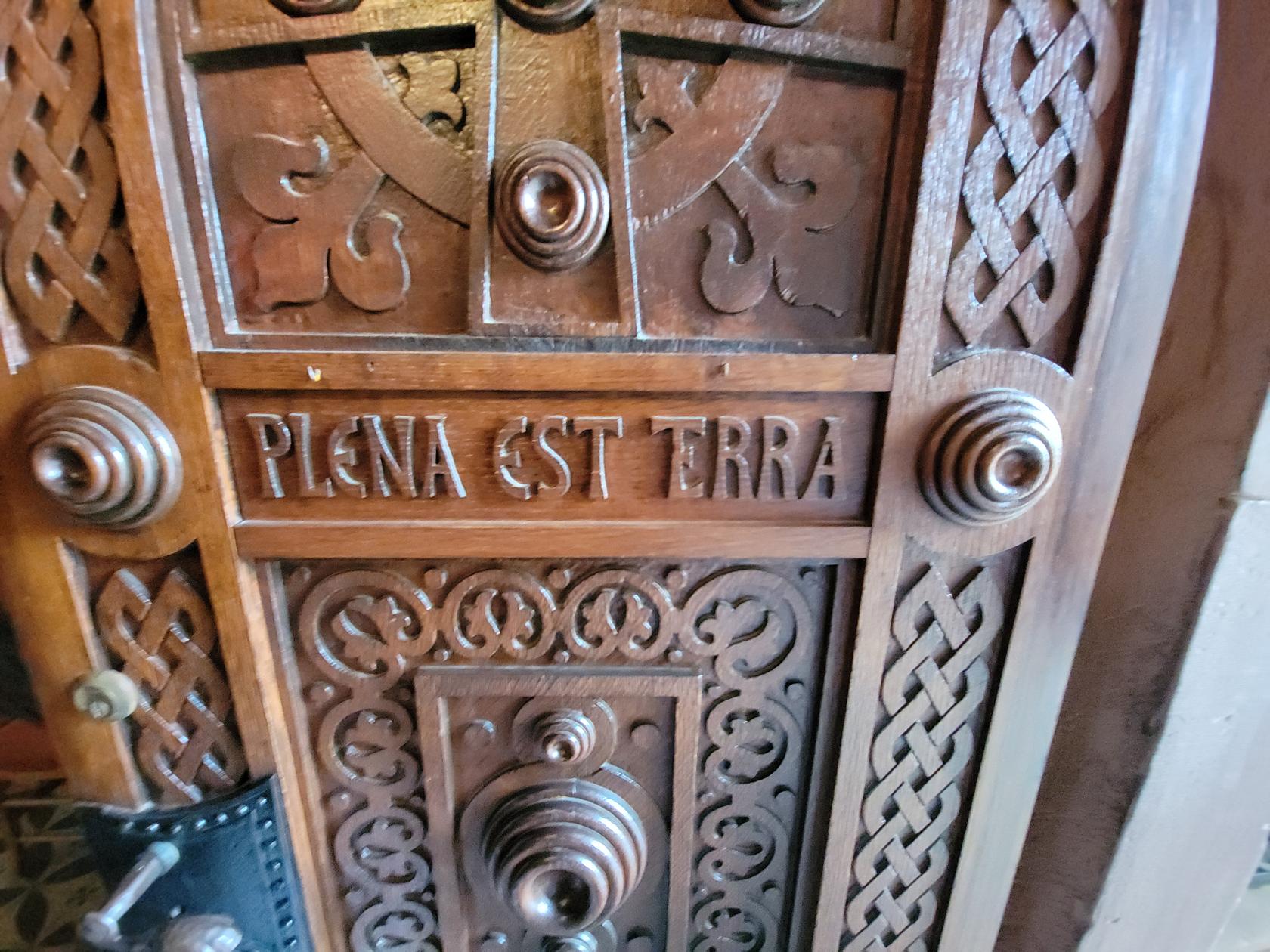
Chapelle Saint-Léon IX – Inside – Place du Château Saint Léon – Eguisheim, France
Chapelle Saint-Léon IX – Main Entrance – Place du Château Saint Léon – Eguisheim, France
Place du Château Saint Léon – Eguisheim, France
Église Saints-Pierre-et-Paul
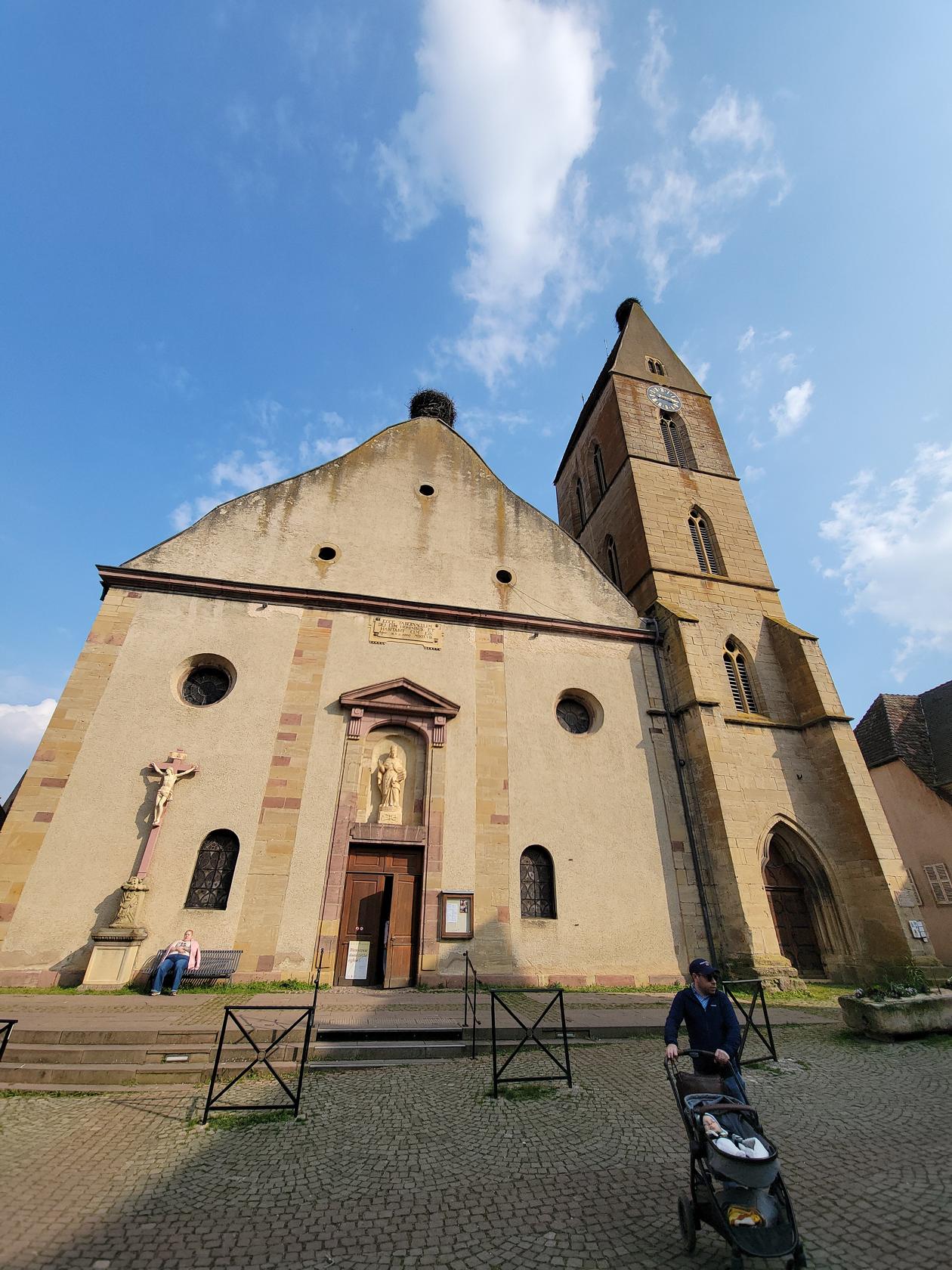
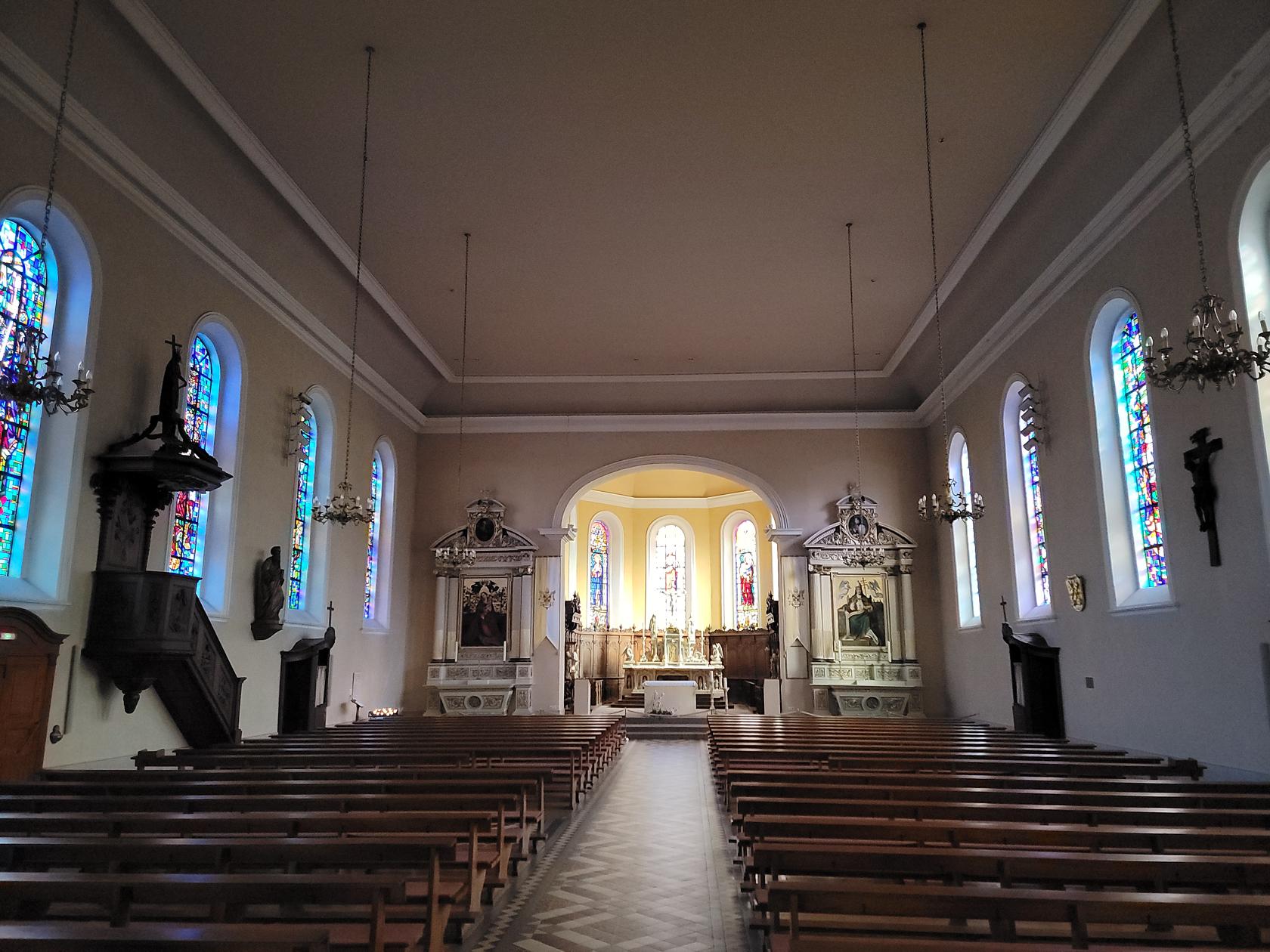
Off on another street is the Church of Saints Peter and Paul. Though larger than the chapel, the outside and inside are more austere.
Église Saints-Pierre-et-Paul – Eguisheim, France
Église Saints-Pierre-et-Paul – Inside – Eguisheim, France
Other Sights
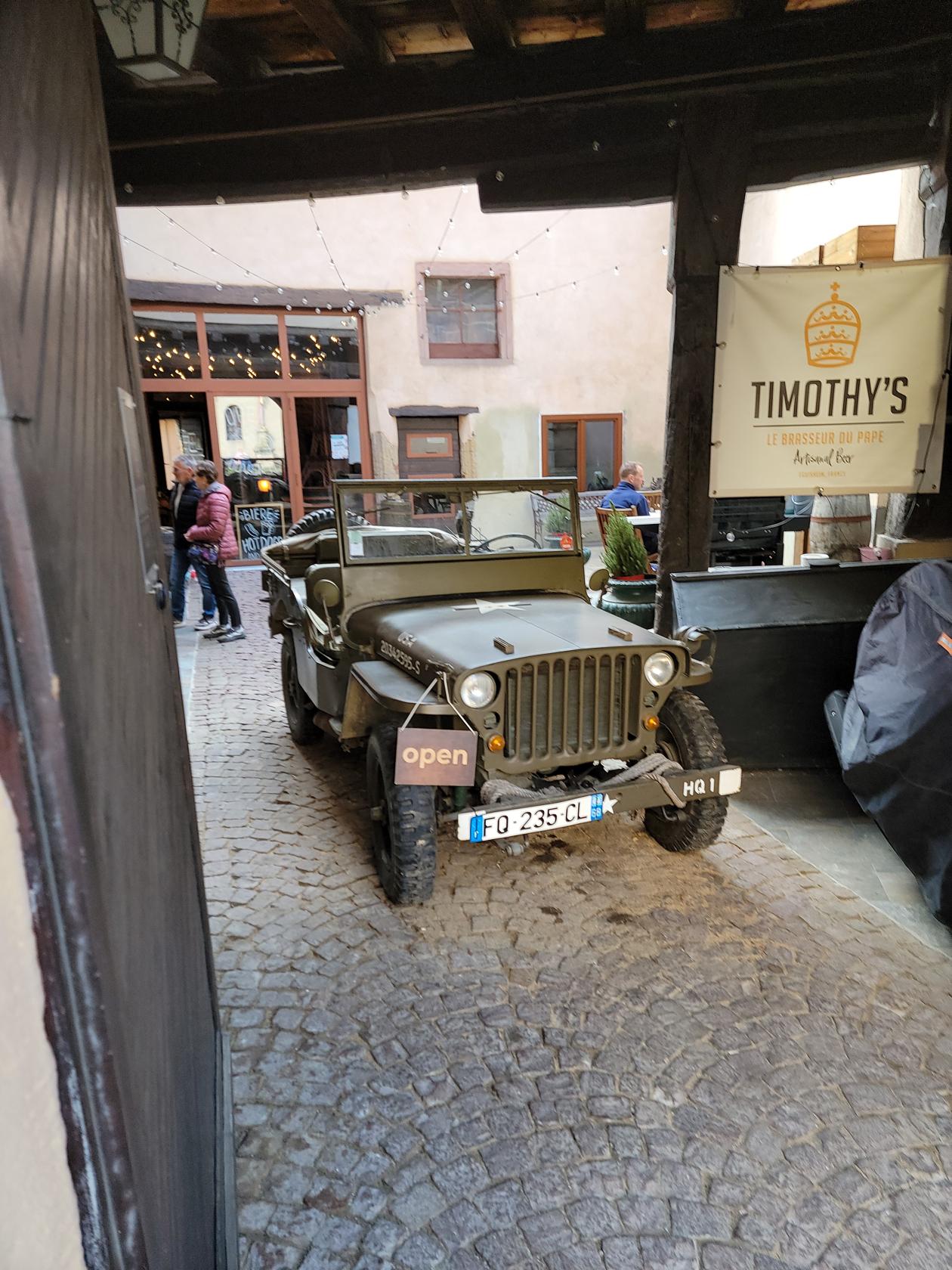
If you walk enough you will find an old American Willeys Jeep left over from the war. There are also several other wineries of the main streets as well.
One last view – Eguisheim, France
Old American Willeys Jeep – Eguisheim, France
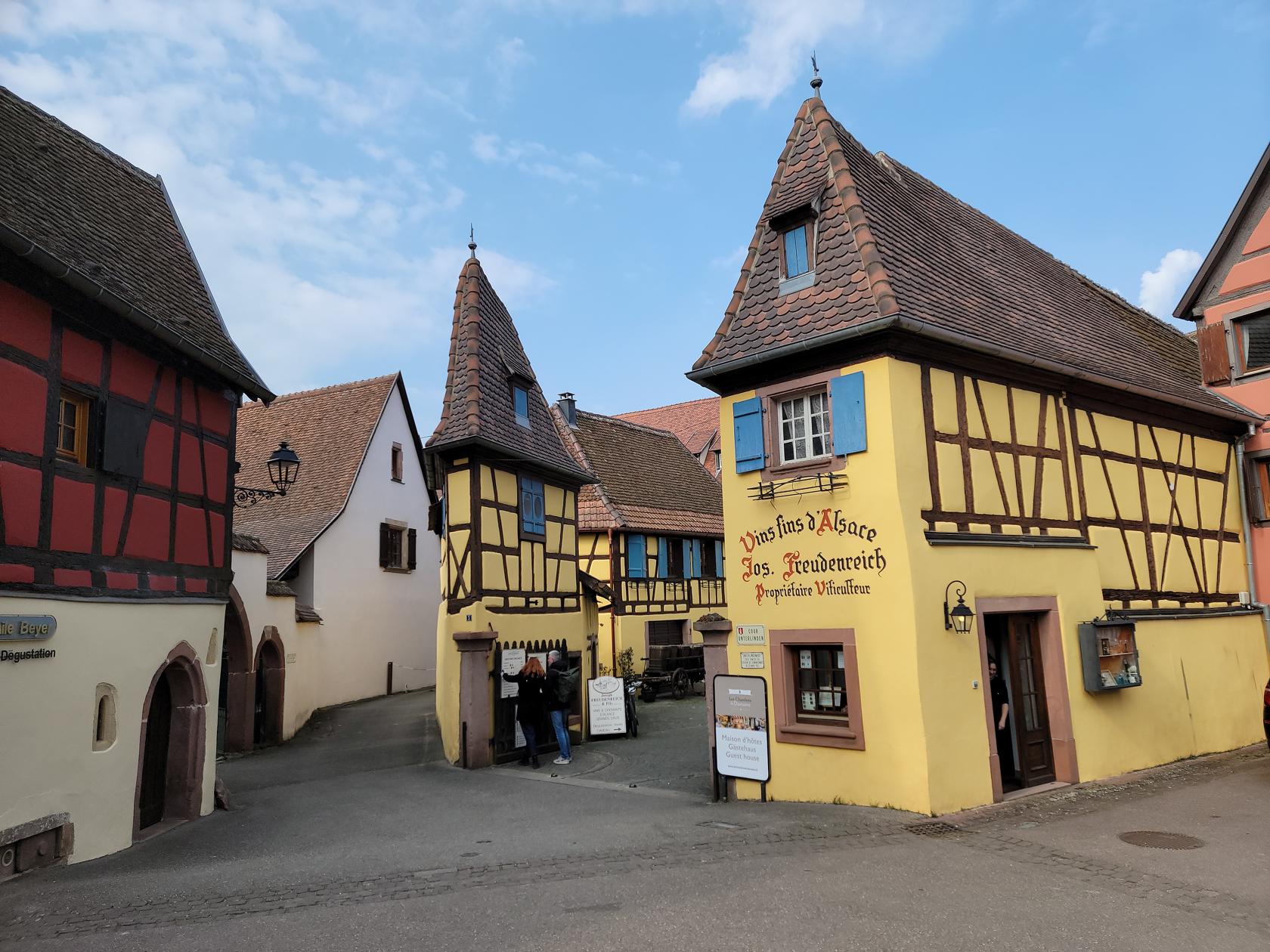
Jos. Freudenreich Winery – Cour Unterlinden – Eguisheim, France
Though we only spent a few hours here, we thoroughly enjoyed it, especially since the weather was very nice. It might make more sense though, to stay a bit longer and enjoy a wine tour throught he vineyards and one or two wine tastings. In any event, it is a great place to stop and is highly recommended.
Restaurants
Unfortunately, we cannot commend a place to eat or drink, since we did neither in Eguisheim. A wine tasting might be commended though, since it is at the center of Alsatian wine country!
South of the river Tanaro is the wine region of Langhe and the two of the most well known Italian wine towns, Barolo and Barbaresco. For any wine enthusiast, it is an important stop on par with the fabled wineries of Napa Valley in California, the Saône river valley of Burgundy and the Gironde river valley of Bordeaux in France.
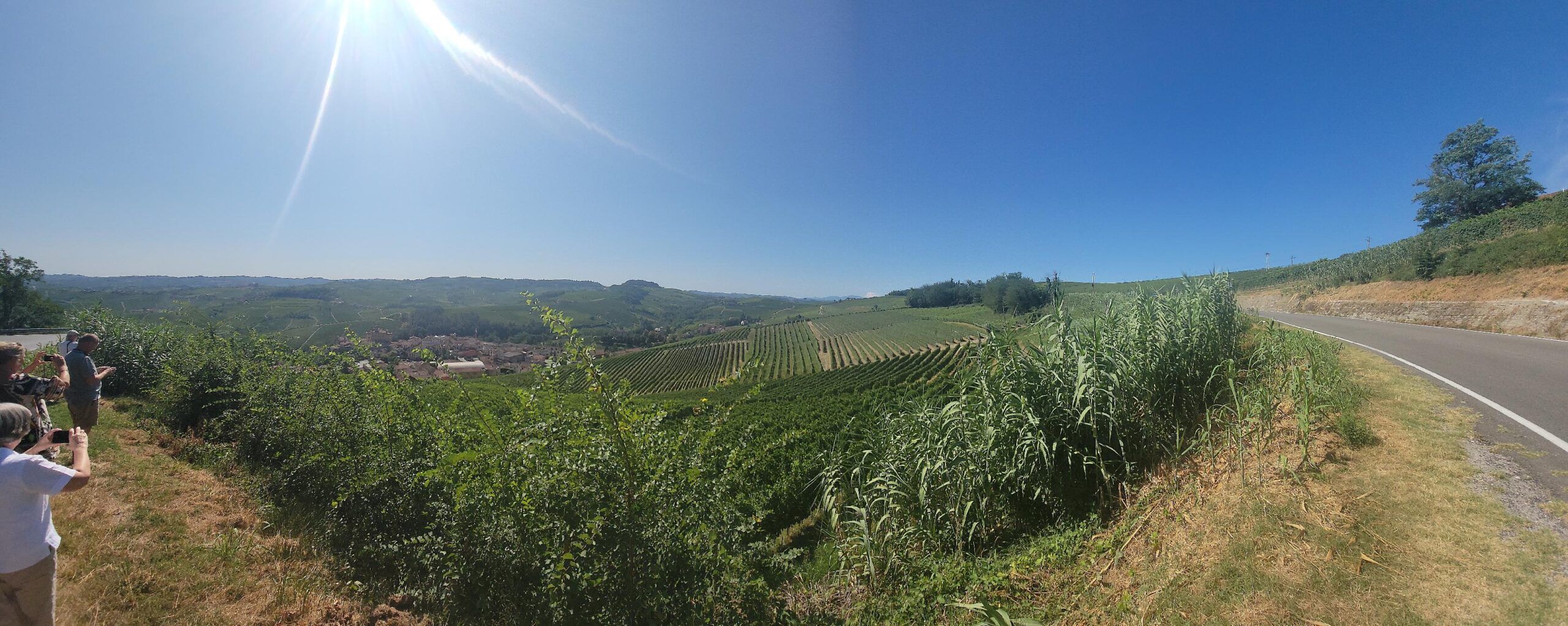
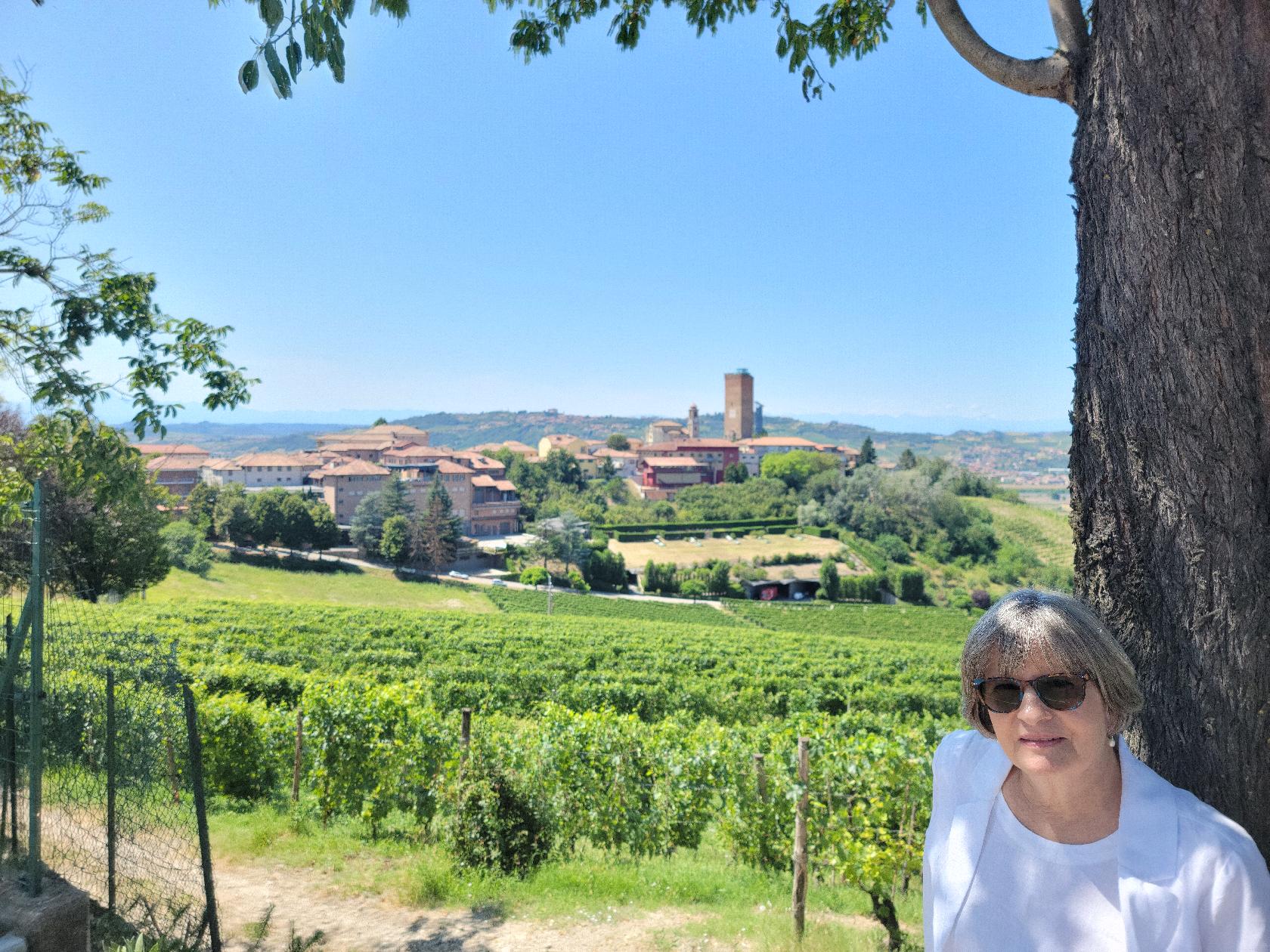
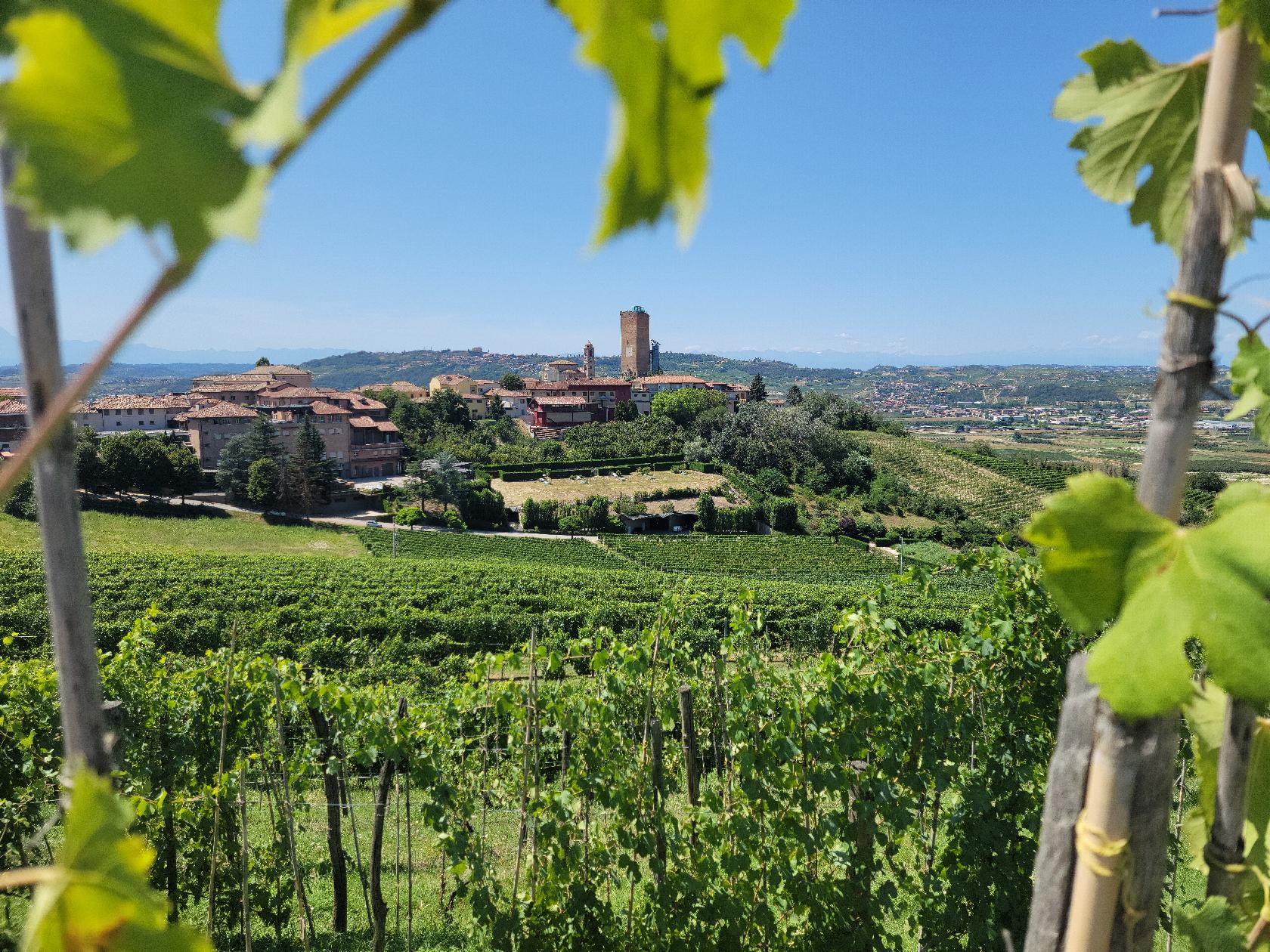
Barolo and its vineyards – Barolo, Italy
Langhe
For the Piedmont this region is by far the most important place for wine and truffles. Every year during the fall, people flock to this small region in Italy to enjoy the Italian harvest of truffles, both black and white, and naturally the wines that are produced in this region. Our recent summer trip concentrated on the wines and to enjoy a wine tour with other wine enthusiasts from Germany and Denmark. Though we did sample the black truffles while here, I can only say we are not fans. So wine it is..!
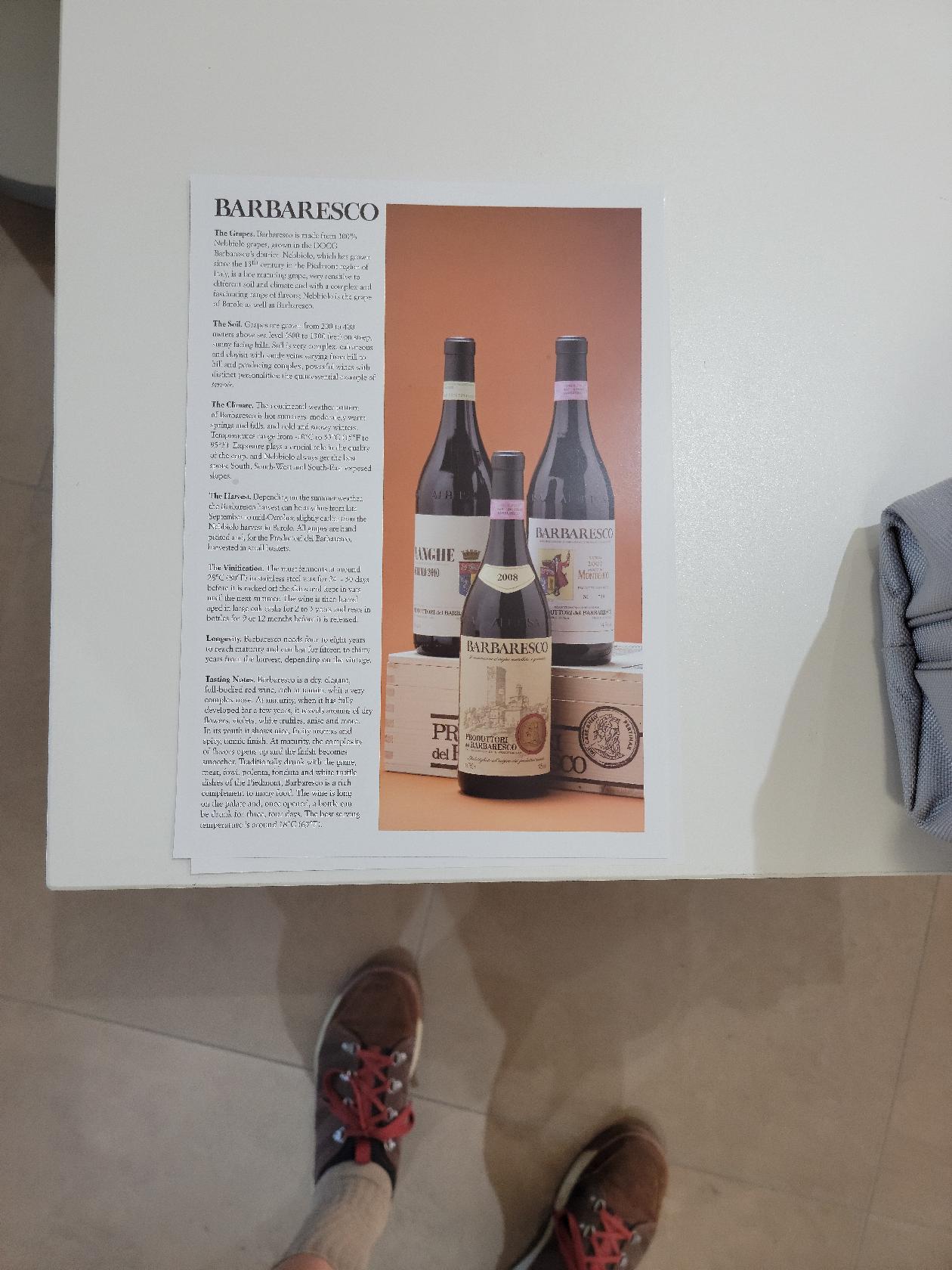
First, some background. The wine production and labeling in the area is controlled by a Control Denomination of Origin, or Denominazione di origine controllata, as it is in the rest of Italy. Structured after the French model and adopted by the European Union (EU), there are essentially four designations for Italian wines:
Denominazione di origine, or DO, this is rarely used
Indicazione geografica tipica, or IGT, this is used to designate wines typical of the region
Denominazione di origine controllata, or DOC, to indicate wines controlled and designated for the area
Denominazione di origine controllata e garantita, or DOCG, to indicate wines controlled and guaranteed to be from the area
The last two appellations are the most important, since they both assure a rigid and specific level of government oversight, as well as control over the labeling and the origins of the grapes in the wines of these designations.
It should also be noted that no IGT wines are produced in Piedmont or Valle D’Aosta.
DOC
Originally there were only the first three designations, DOC being the highest of them. However, the Italian food industry quickly decided that its designation was far too liberal and included other foodstuffs within the standard, so they requested a more rigorous standard, thus DOCG came into being for wine only and superseded DOC.
Much like DOCG, the DOC requirements demand that such wines use only certain grape varietals, are aged properly, have a certain alcohol content and be produced within certain areas or regions. Though the number of bottles that may be produced for a given wine is somewhat restrictive, the wines do not have the direct governmental wine panel oversight or trails of paper found in the higher classification.
Wines of this category are Barbera, Dolcetto and Nebbiolo, all of which are designated grape varieties and may be identified as such on a bottle marked as DOC.
DOCG
DOCG is by far the more rigorous designation and is controlled to such a degree, that the vintner is forced to follow rigid rules regarding the care and quality of the wines throughout its production, all the way down to the number of labels they will receive for their bottles for each wine.
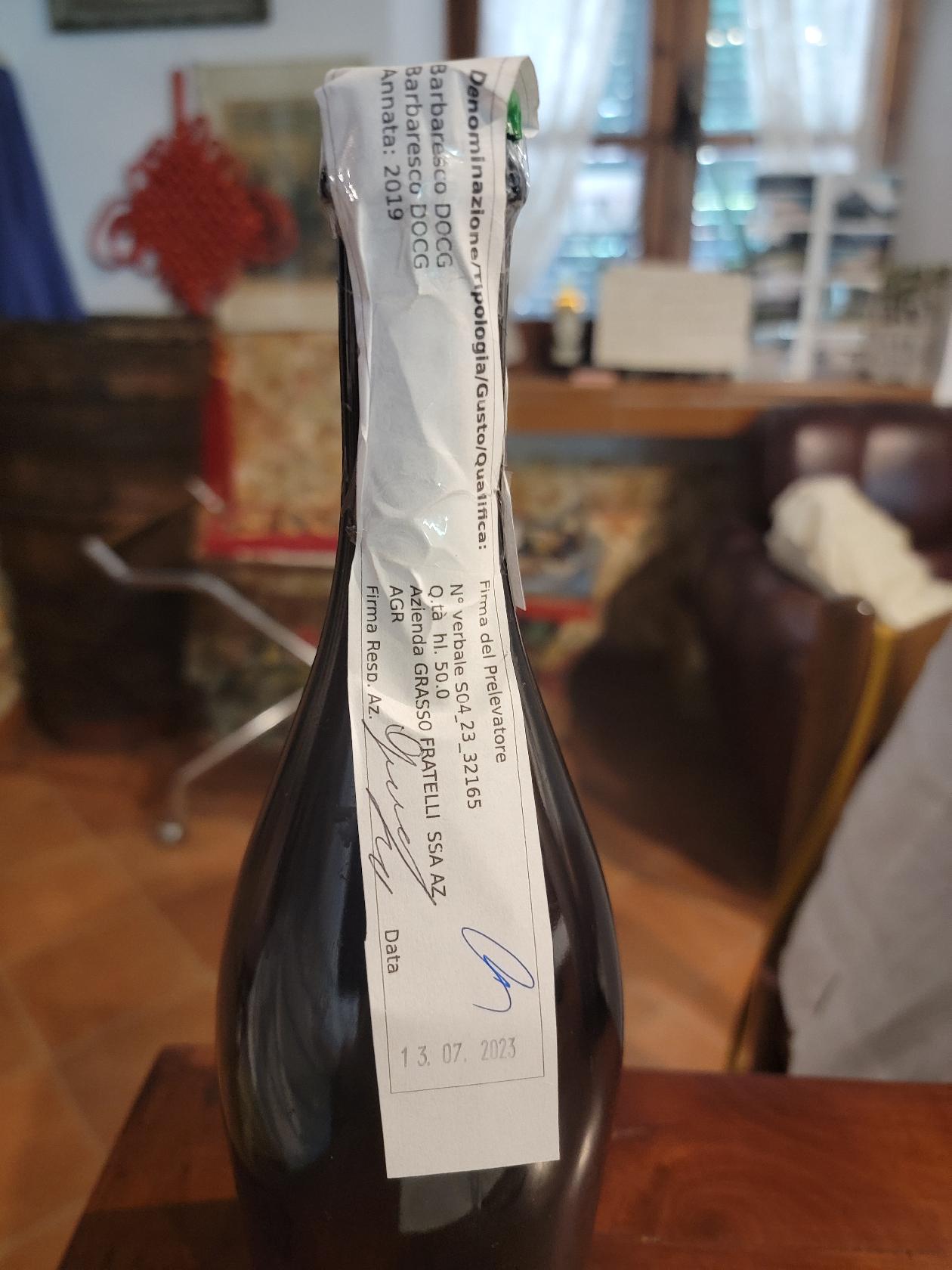
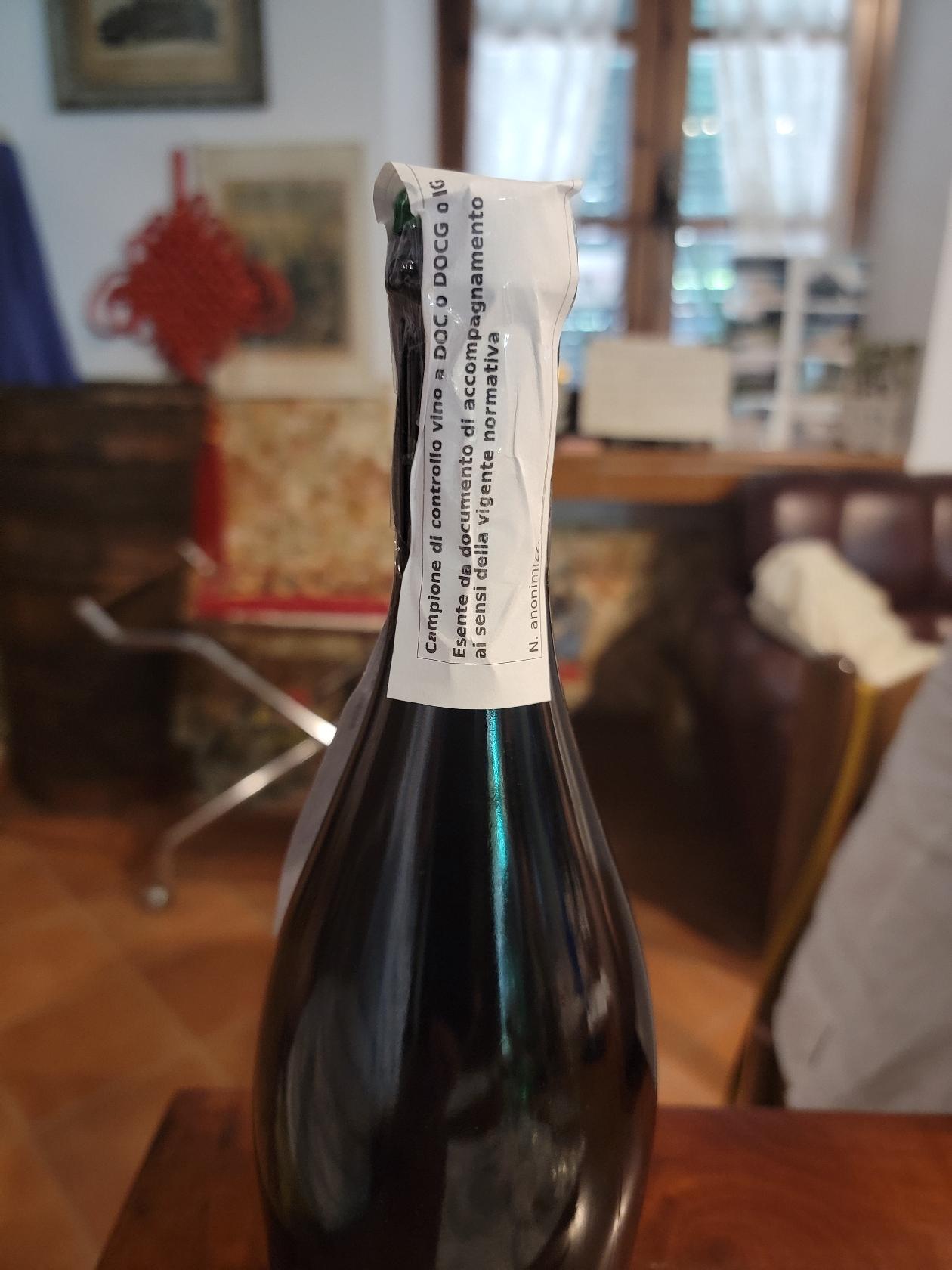
Once the wine is produced, a batch of five (5) bottles are processed, corked, sealed and labeled for the authorities. All of which have the CDO label across the corks, signed, sealed and documented. Four of the bottles are taken for lab analysis and a wine panel judges them to ensure quality, clarity and that the wine produced meets the standard set for DOCG for that wine and region. One bottle is left with the produced. An example from the Grasso Brother vineyard in Barbaresco is shown below.
The Grasso Brothers – One of five bottles the DOCG leaves with proprietor – Barbaresco, Italy
The Grasso Brothers – One of five bottles the DOCG leaves with proprietor – Barbaresco, Italy
Our Wine Tour
For our wine tour we chose Alba Wine Tours. We tried to arrange a private tour, but they only offer group tours of up to six people. The cost for us for a one-day tour of Barolo and Barbaresco was 220€/person. Yes, a bit expensive, but unlike our experience in the United States at such venues, we tasted more than 25 wines. Moreover, our hosts were more than happy to provide us with second tastings or additional wine, if we enjoyed it and felt a certain wine was exceptional.
For each wine taste, they dispensed between 5-10dl, which is not bad considering a normal glass of wine is typically around 20dl. Typically in the States you barely get enough wine to get a nose on it, let alone taste it. Which probably shows that most wineries in the States are more interested in mitigating costs, then in pleasing theirs guests and trying to sell their product. This usually indicates to me that their products are typically not good enough to sell to begin with, let alone taste.
Unfortunately, as is true of most wine tastings, most of the wine was dumped. However, by the end of the day, it was very evident that we all had more than our fair share.
Barolo
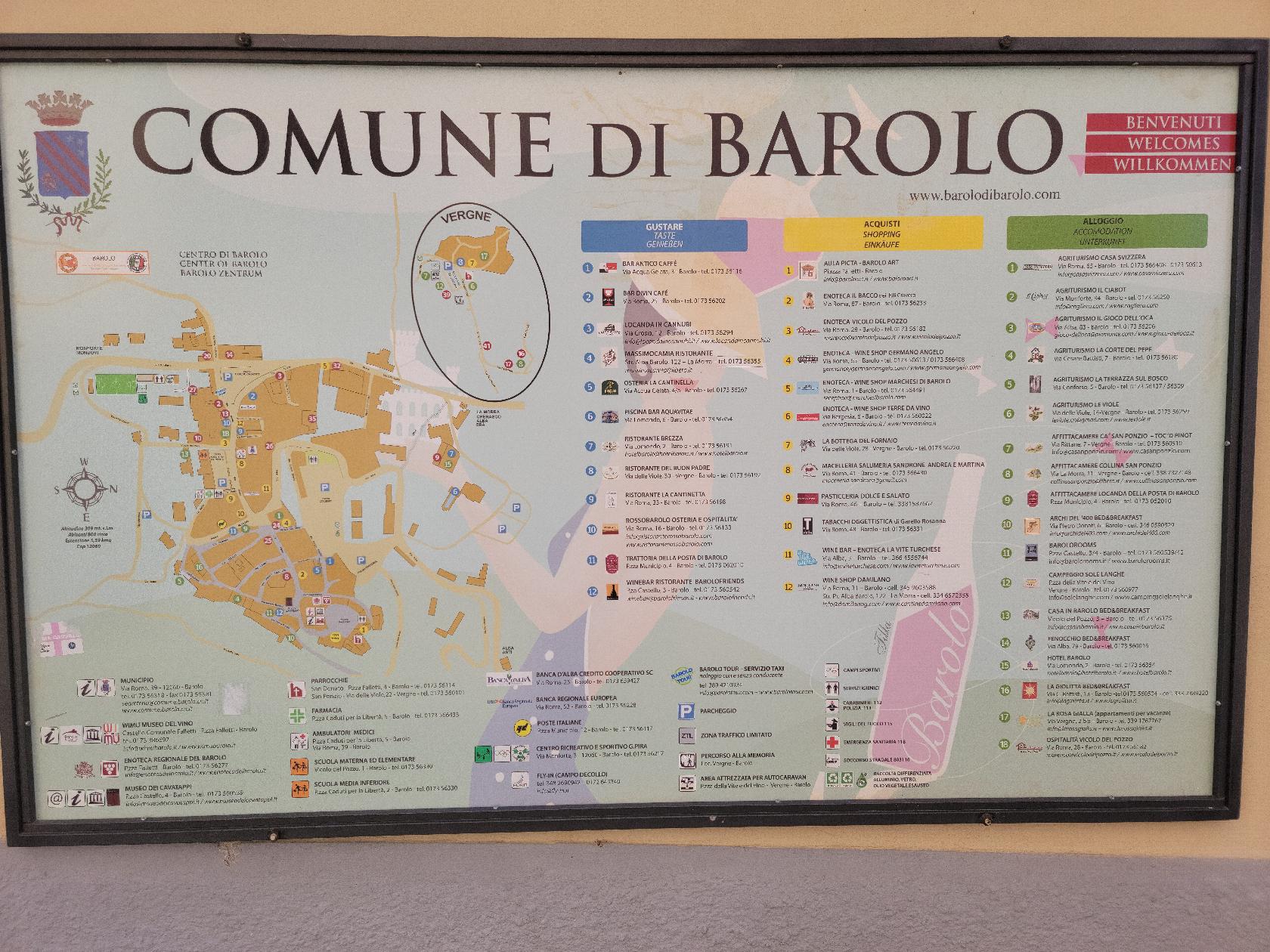
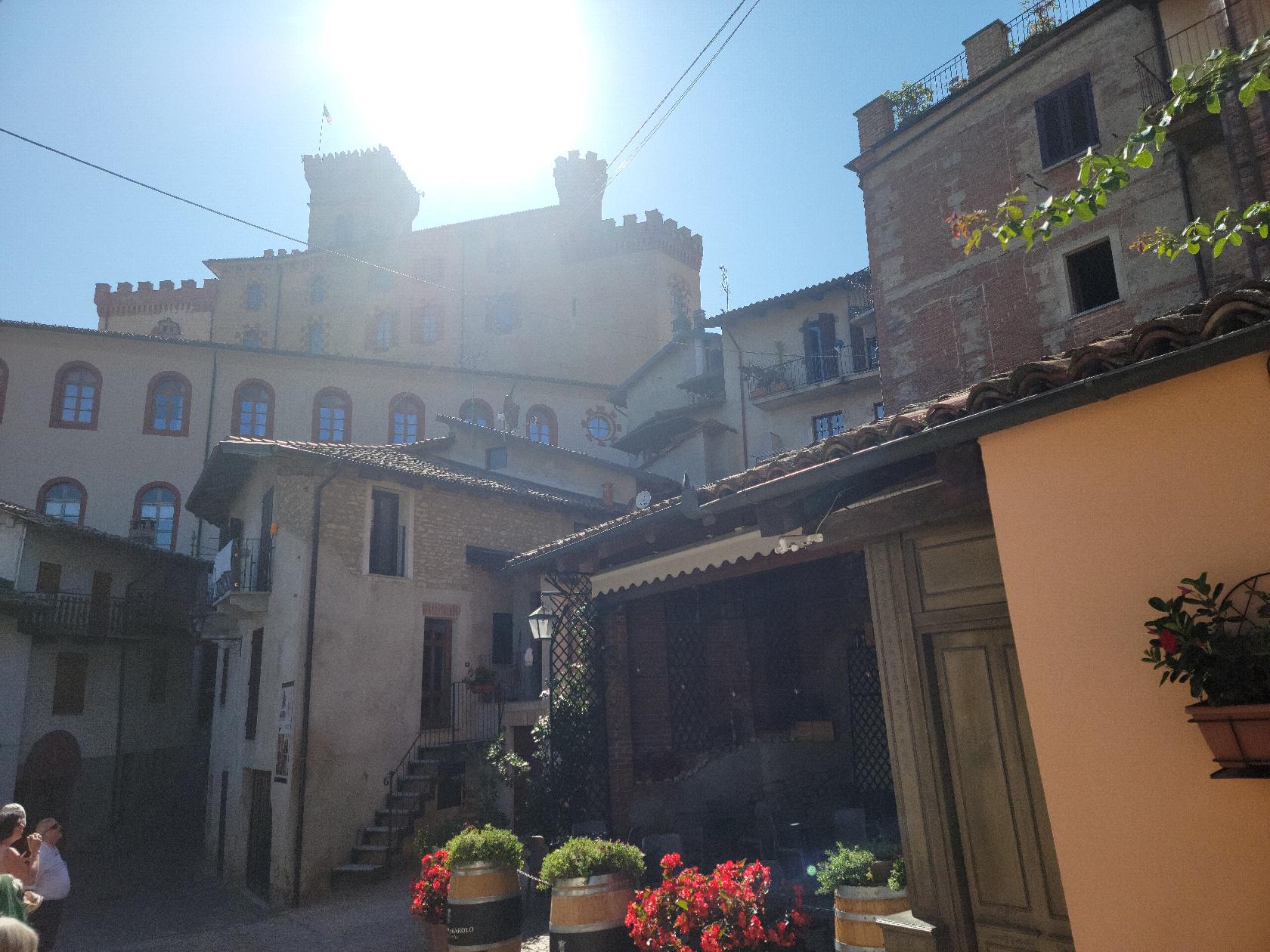
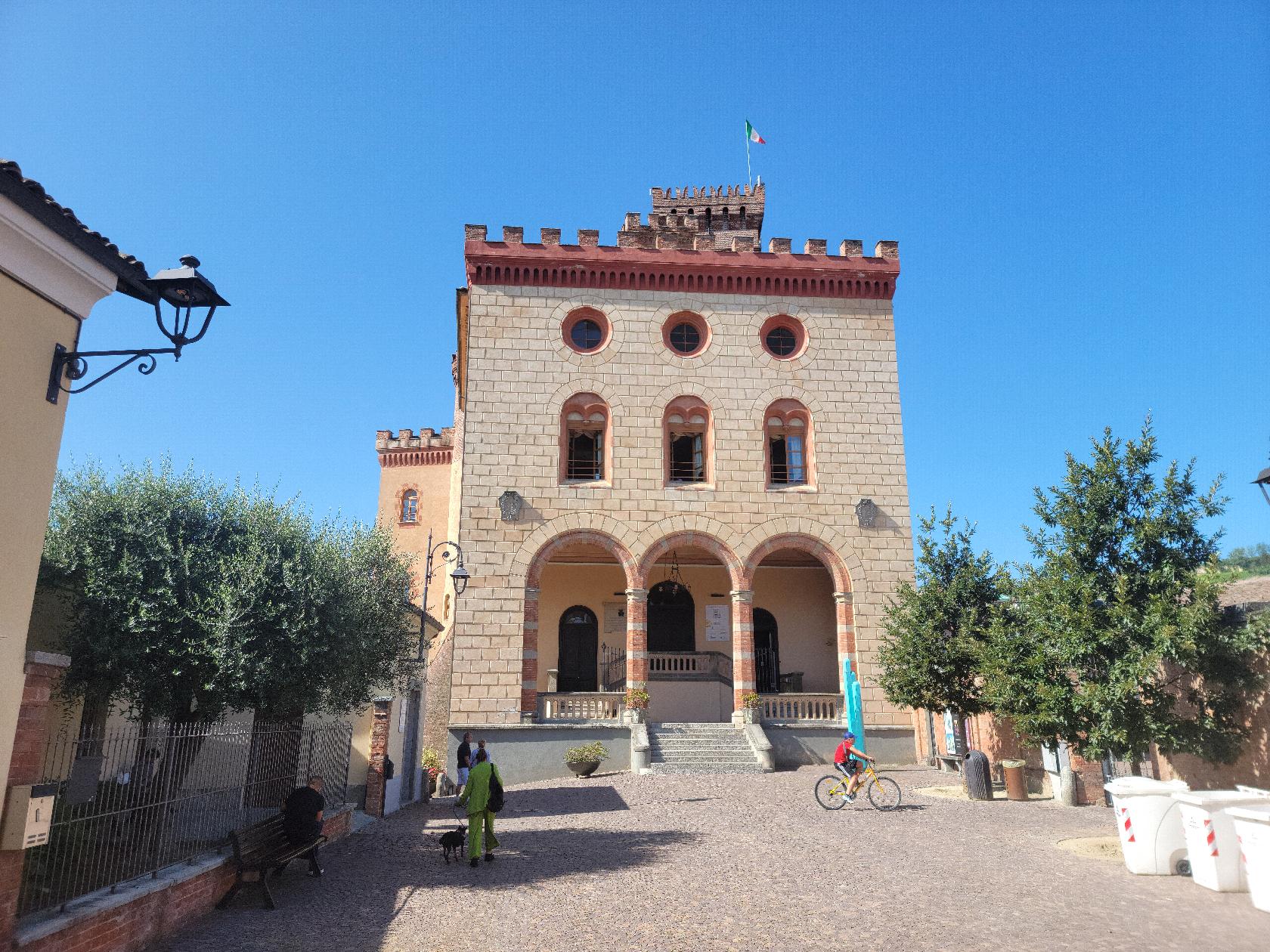
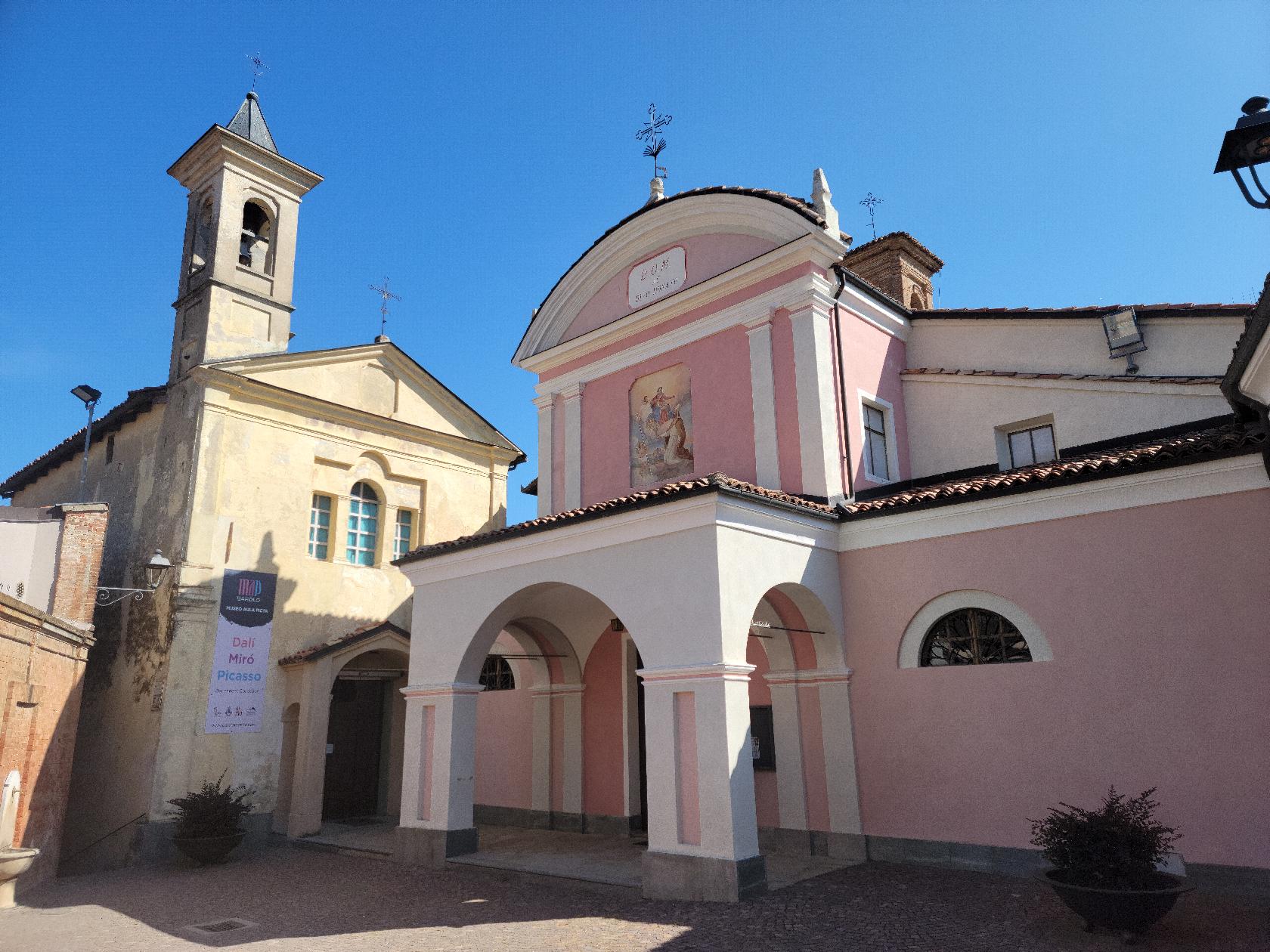
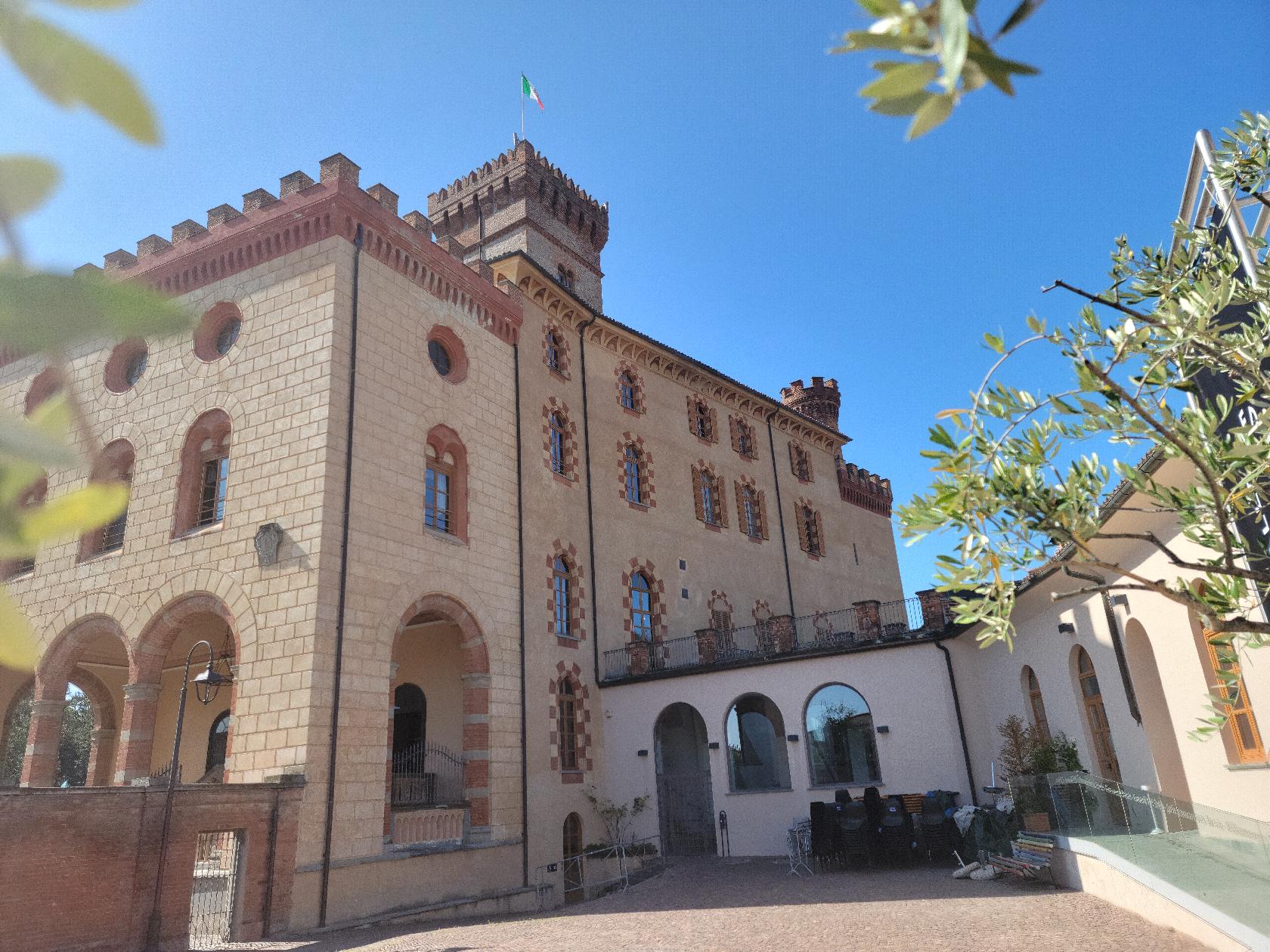
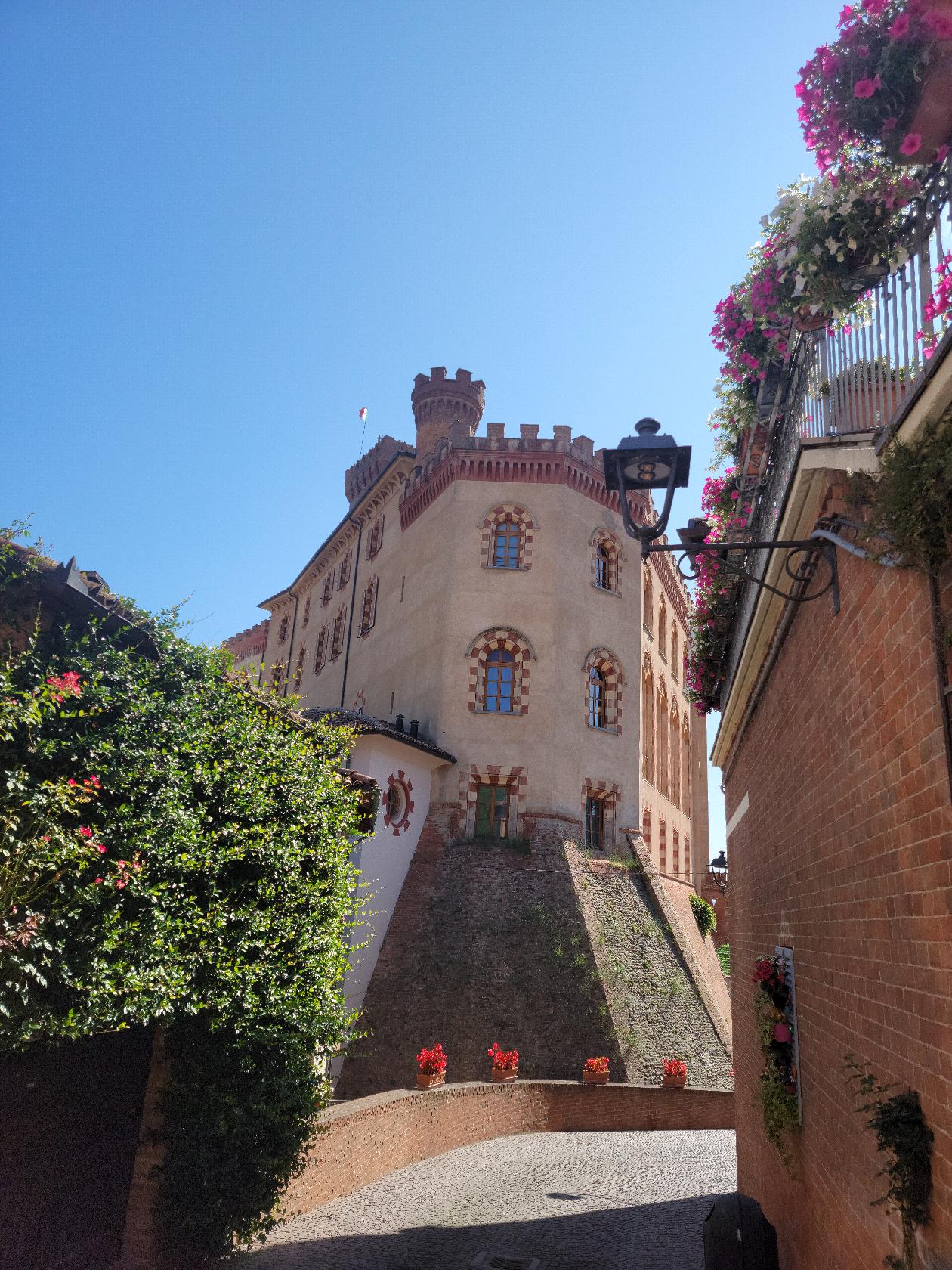
Our first stop was in the small town of Barolo, a castle turned museum being its most prominent feature. There are of course numerous wine stores, most belonging to vineyards in the region, which have tastings and sell wine. We only stopped to see the town and to continue to our first stop, the Azienda Agricola Stra, also known as Stra Winemakers with Foresteria.
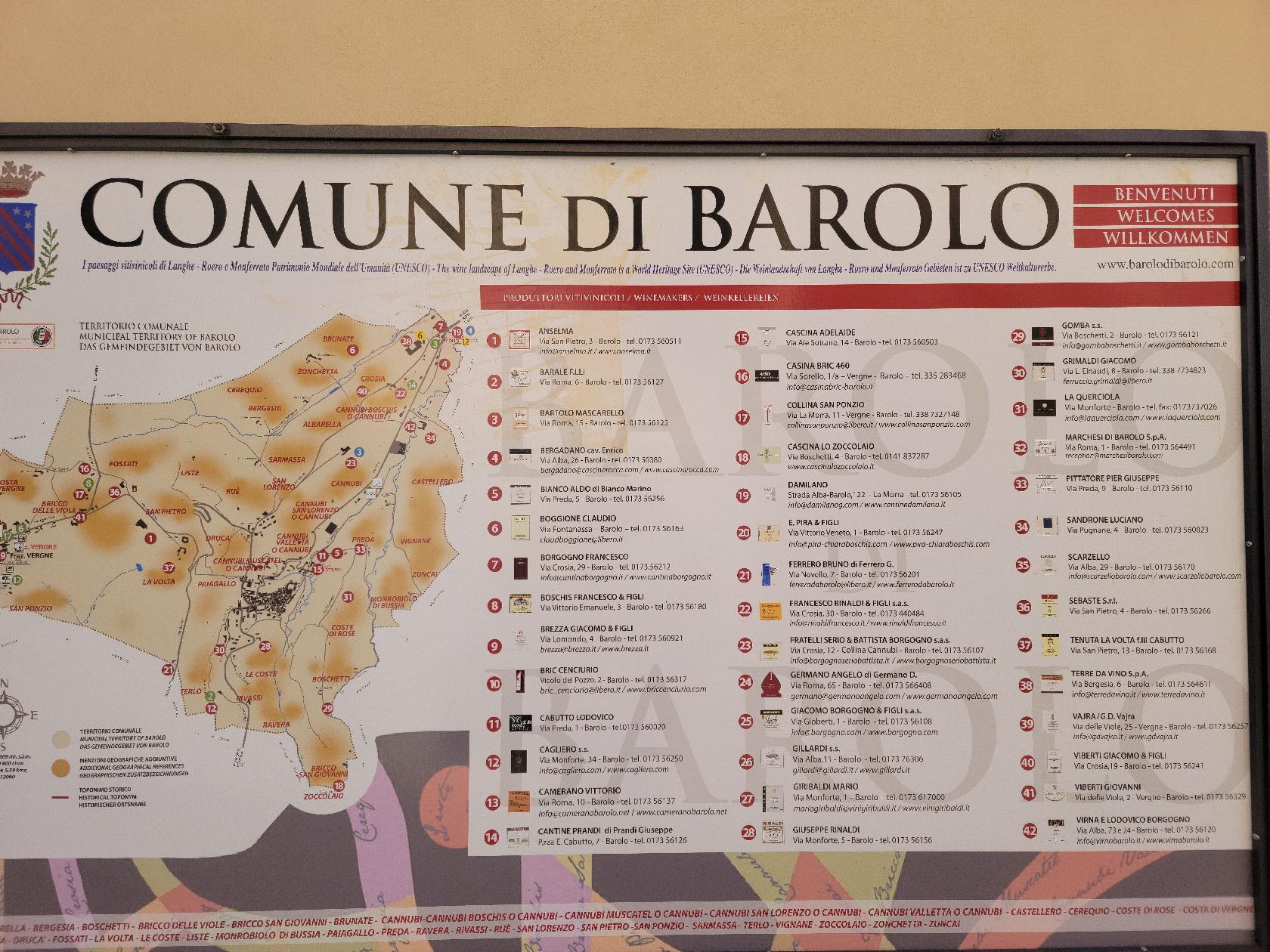
Commune of Barolo – Town Map – Barolo, Italy
Commune of Barolo – Sights – Barolo, Italy
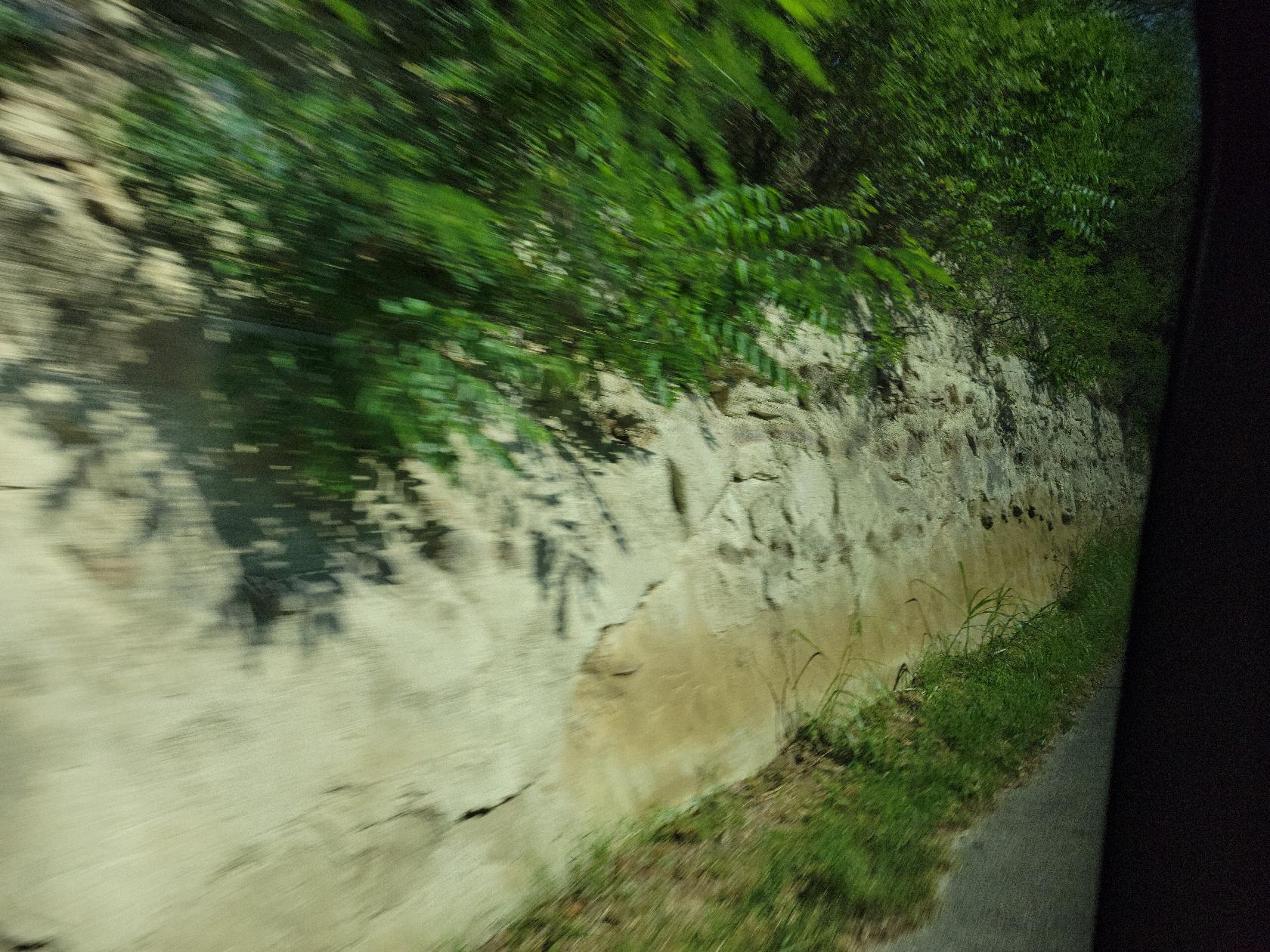
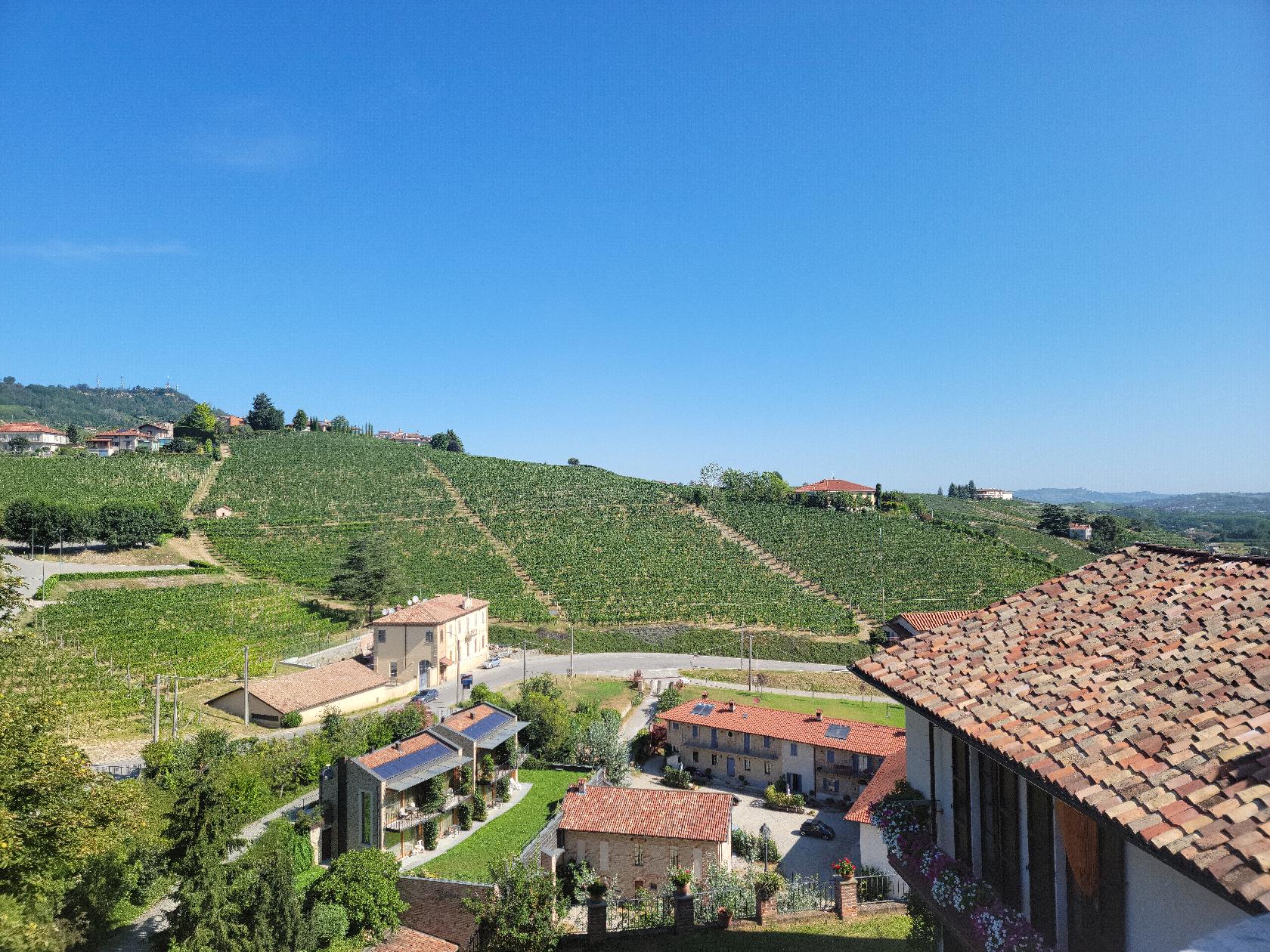
One of the most notable features of Barolo is its soil and topology. Not only is the soil a kind of hard-pack mixture of sand, clay and other components, its valleys are steep and almost treacherous.
The chaulky, silty and sanding earth of Barolo – Barolo, Italy
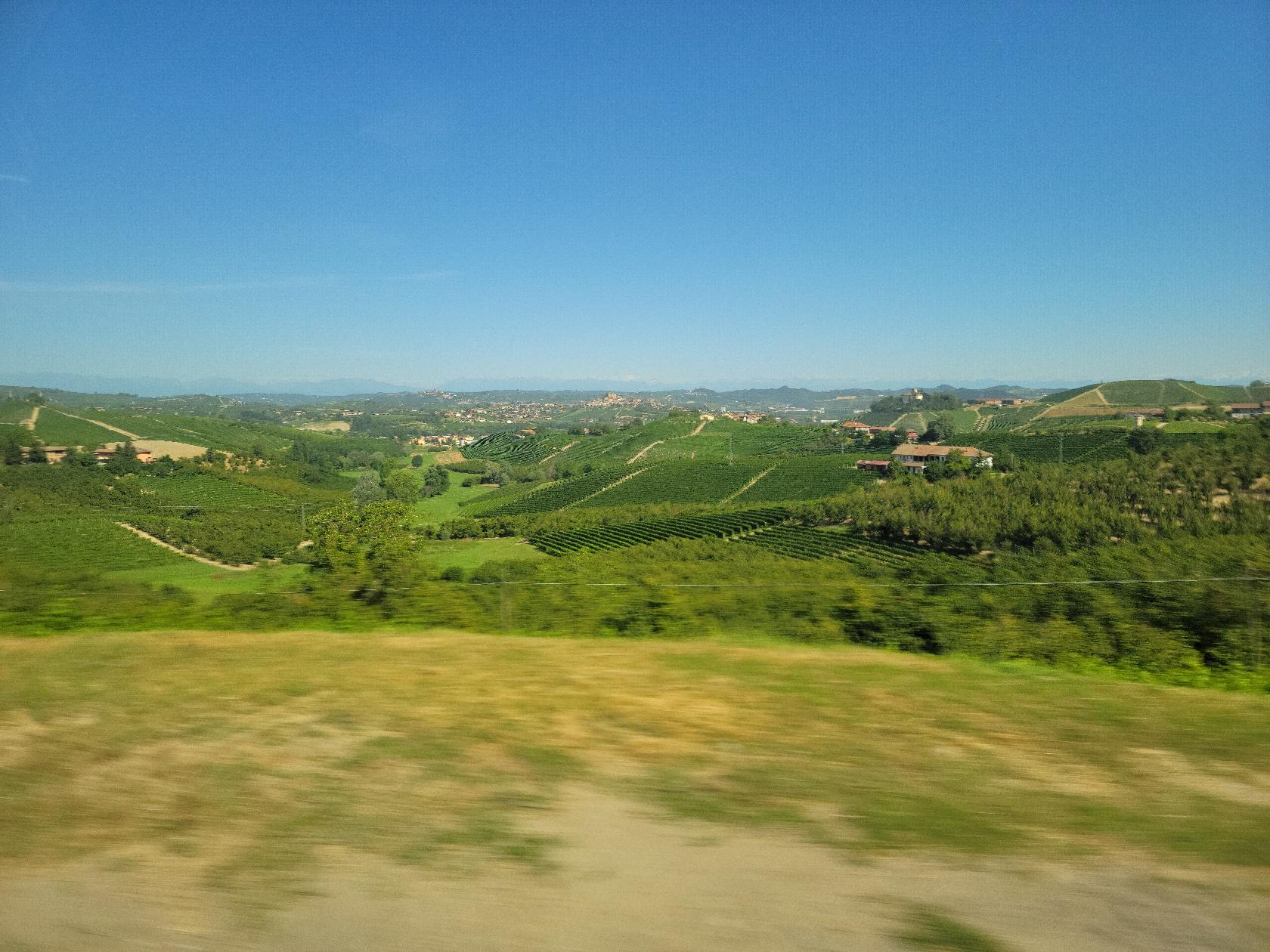
Alba in the distance – Barolo, Italy
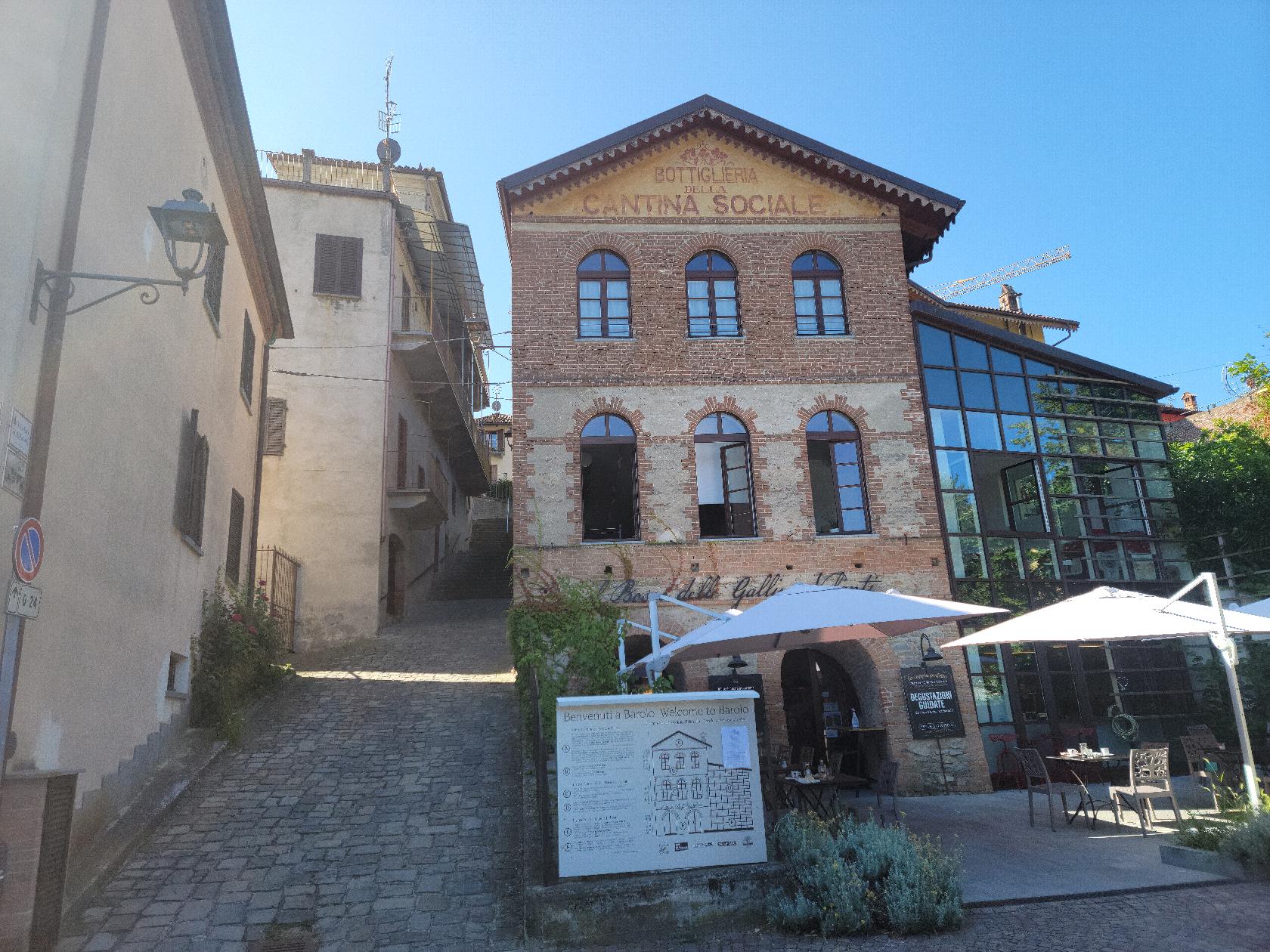
The town – Barolo, Italy
Castello Comunale Falletti di Barolo – Barolo, Italy
Castle and wine museum – Barolo, Italy
Church of San Donato – Barolo, Italy
Vineyards – Barolo, Italy
Castello Comunale Falletti di Barolo – Barolo, Italy
Castello Comunale Falletti di Barolo – Barolo, Italy
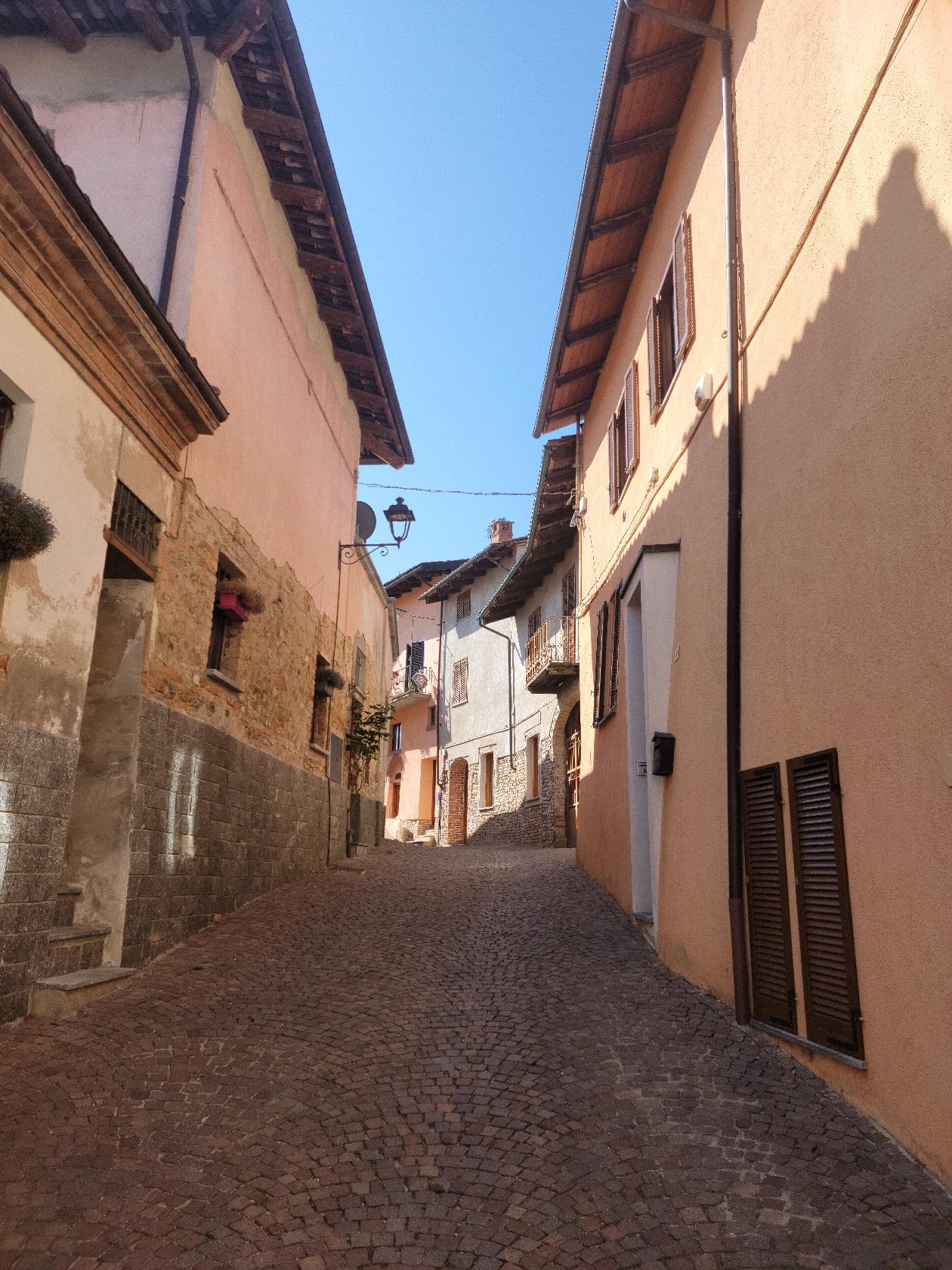
Town streets – Barolo, Italy
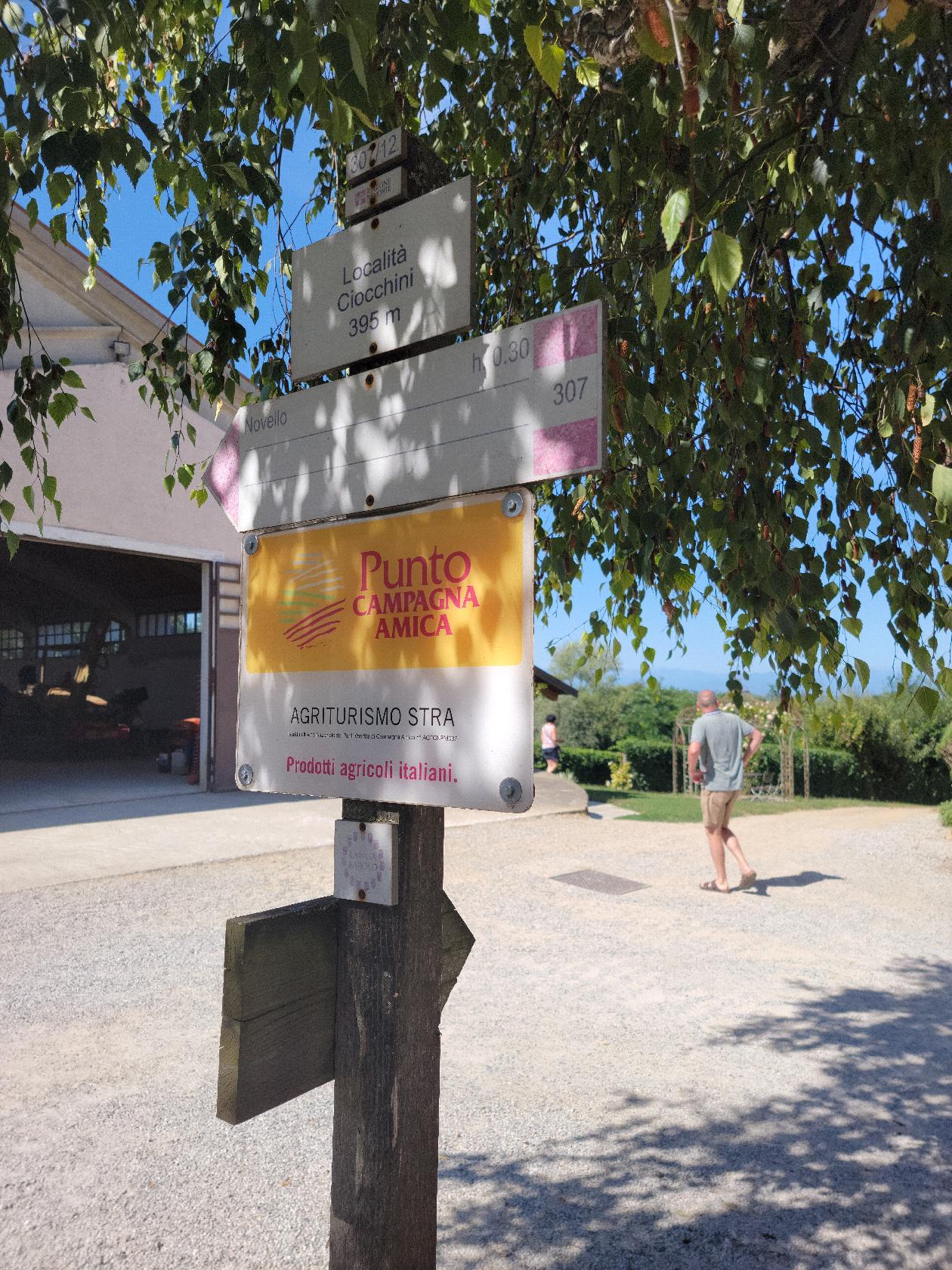
Azienda Agricola Stra
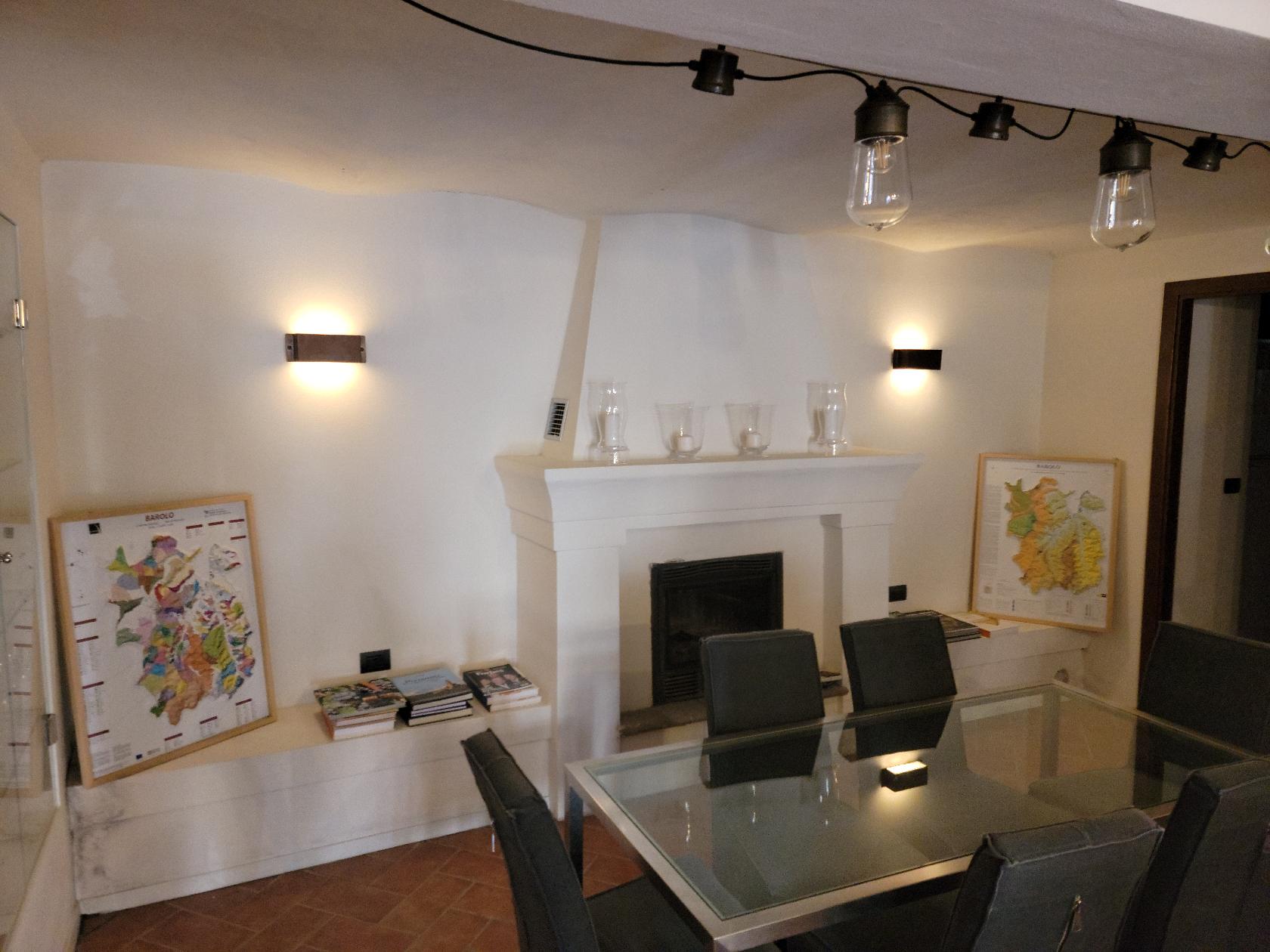
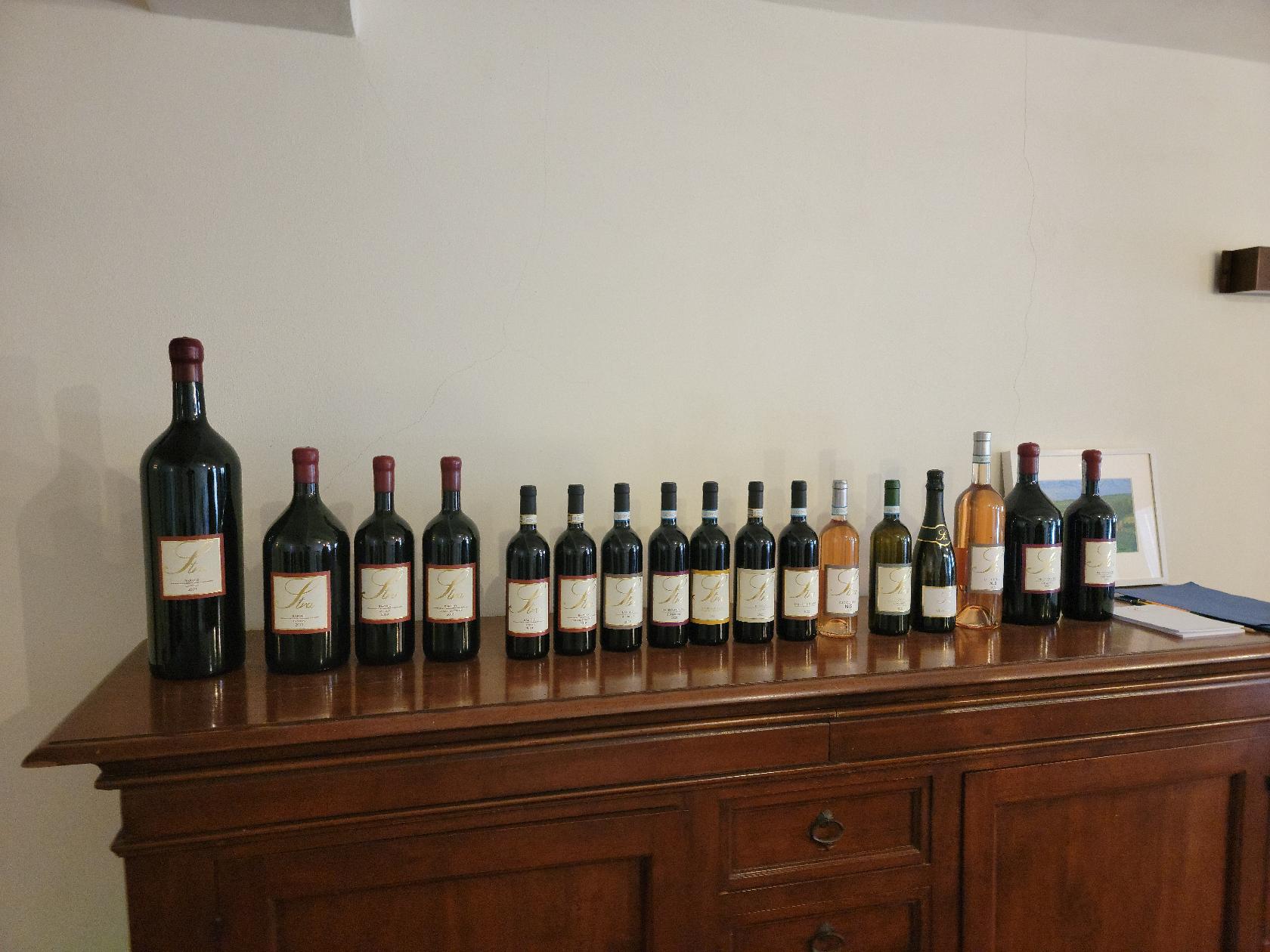
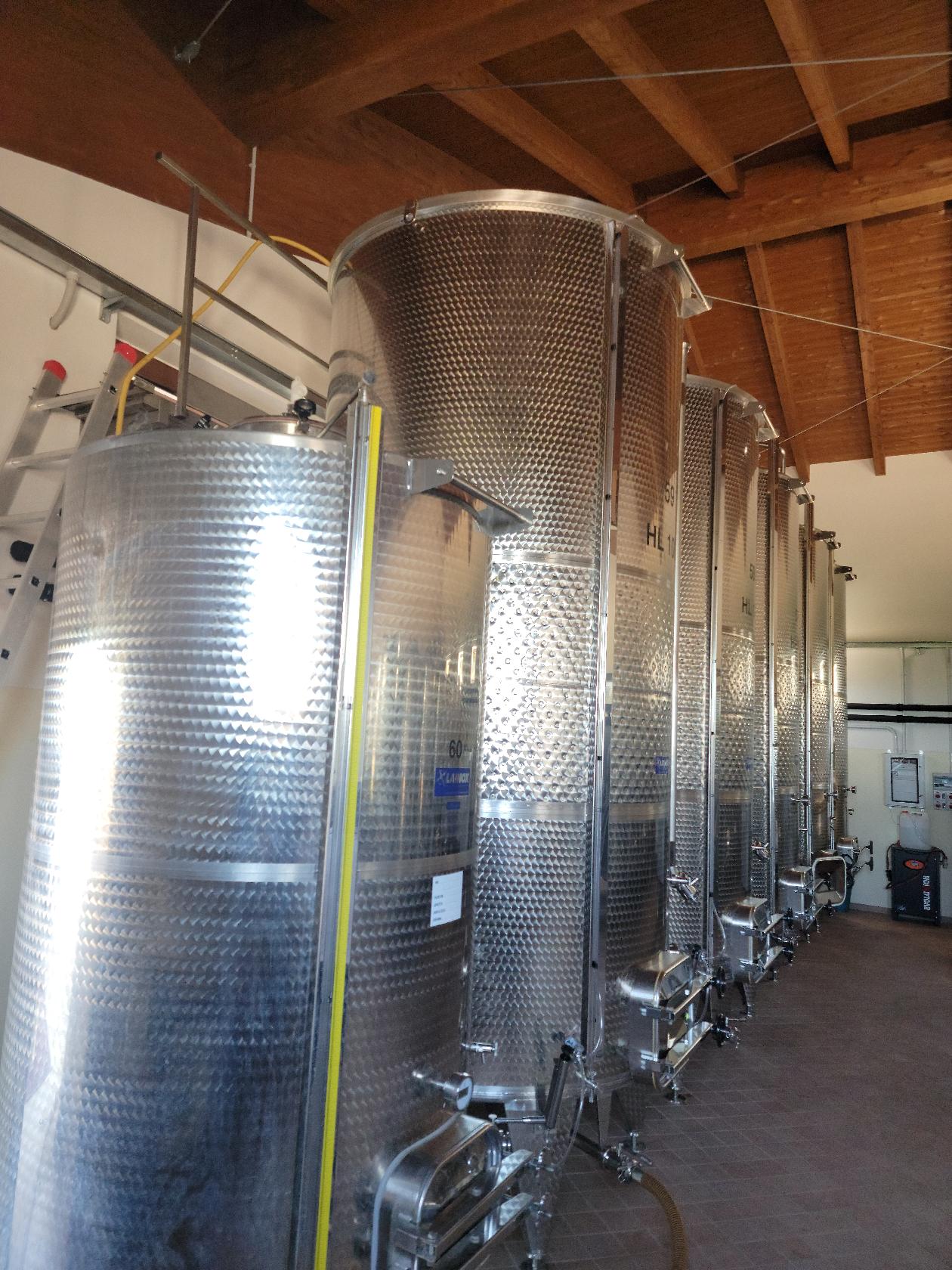
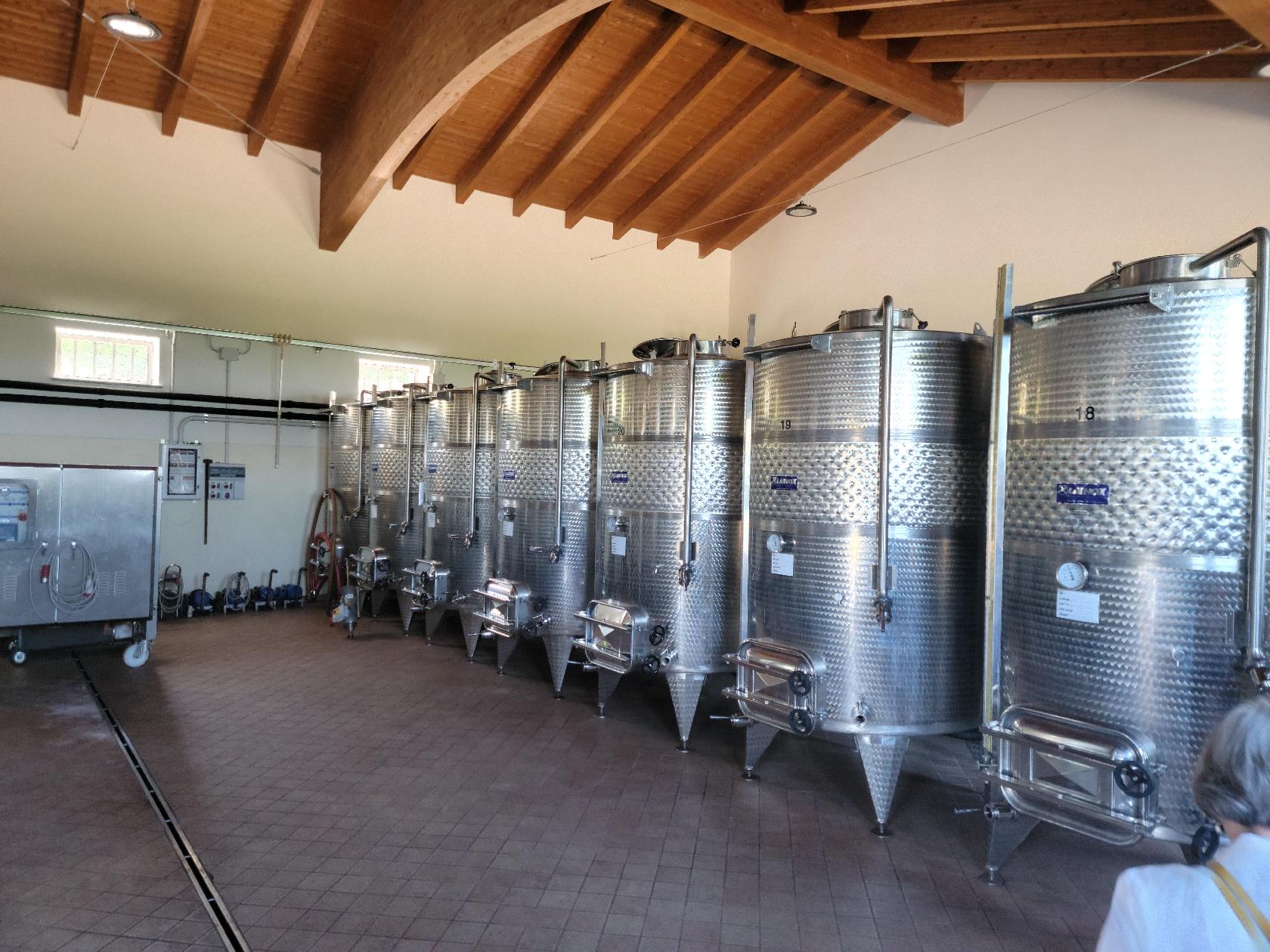
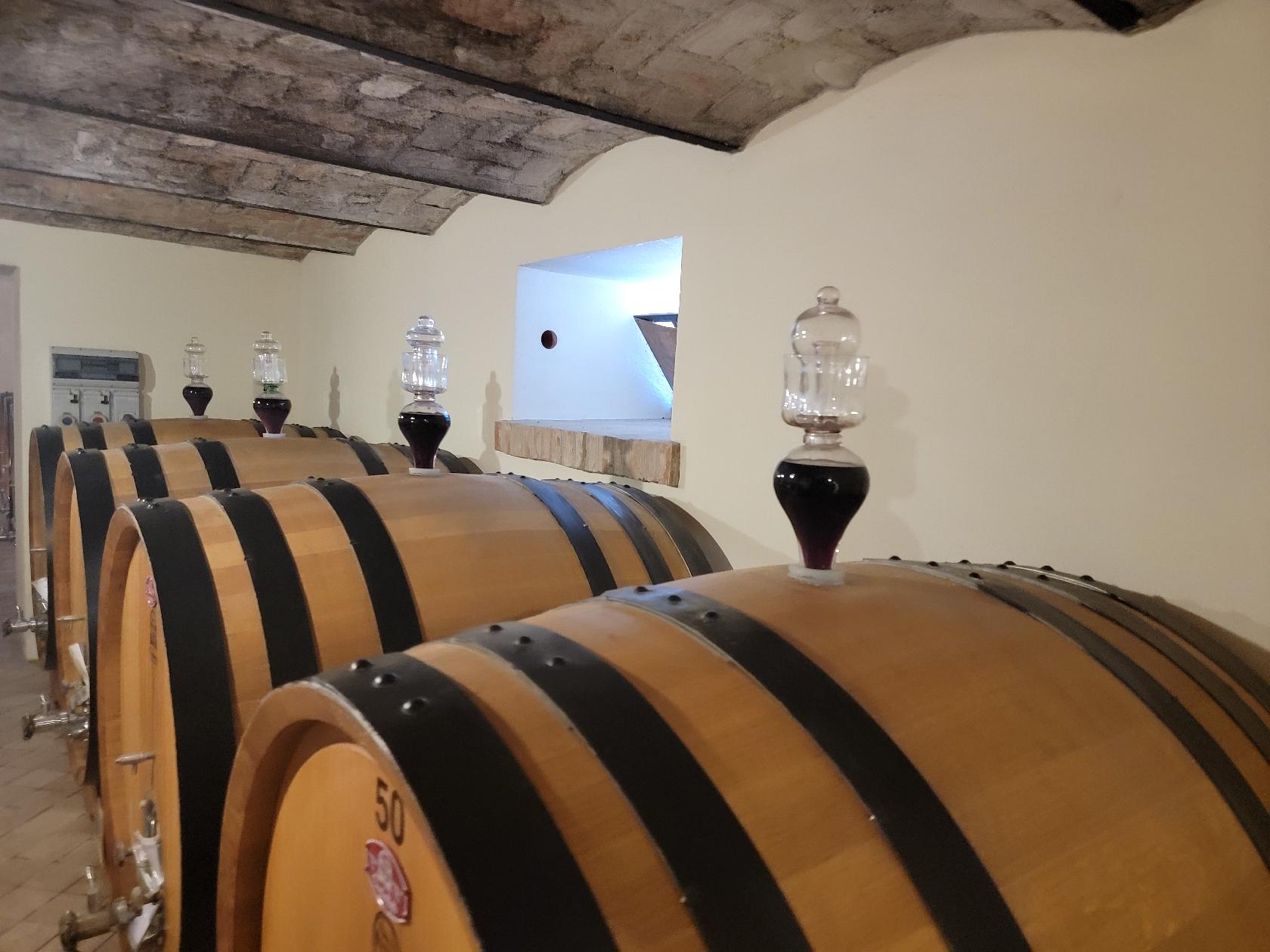
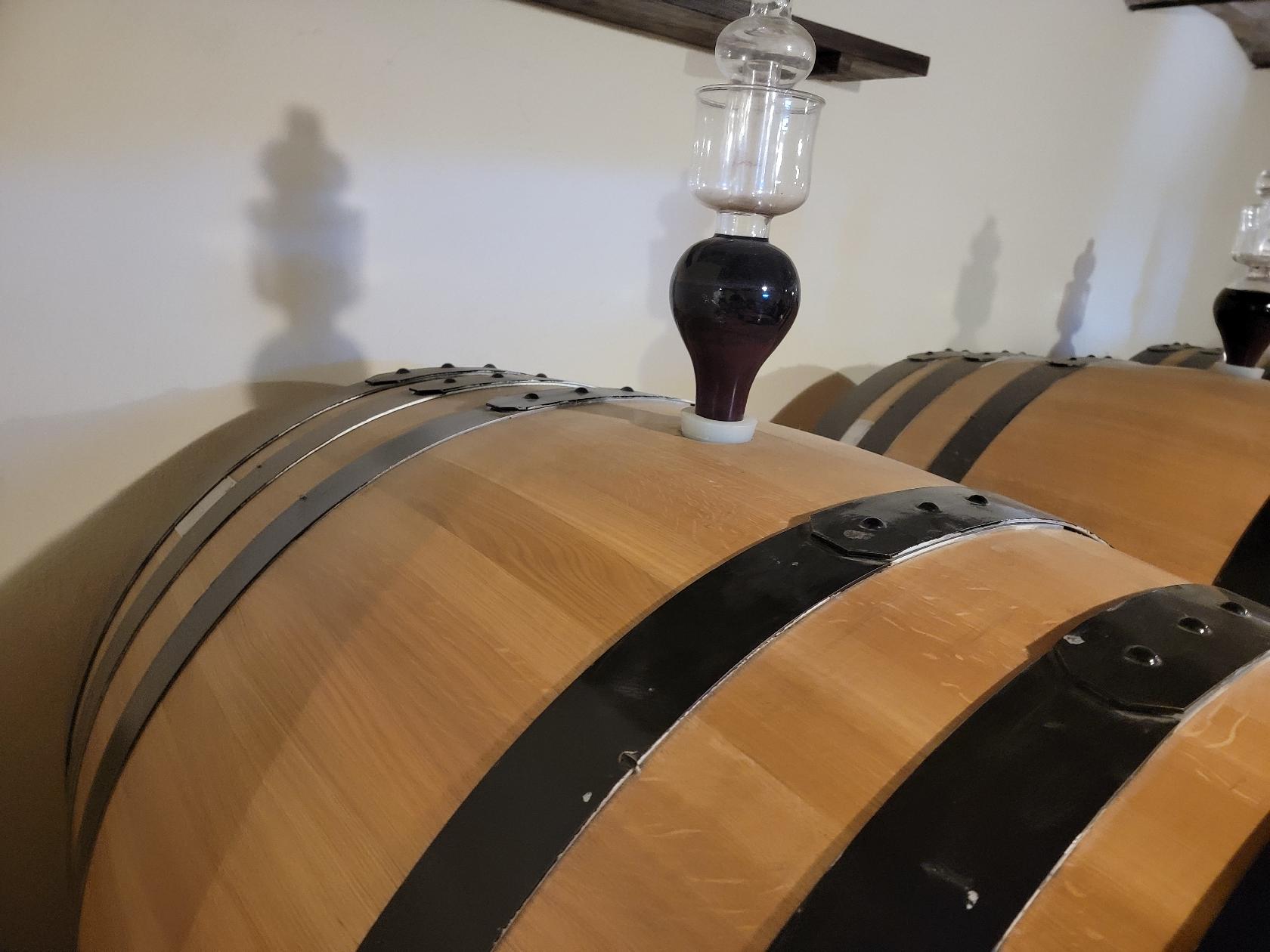
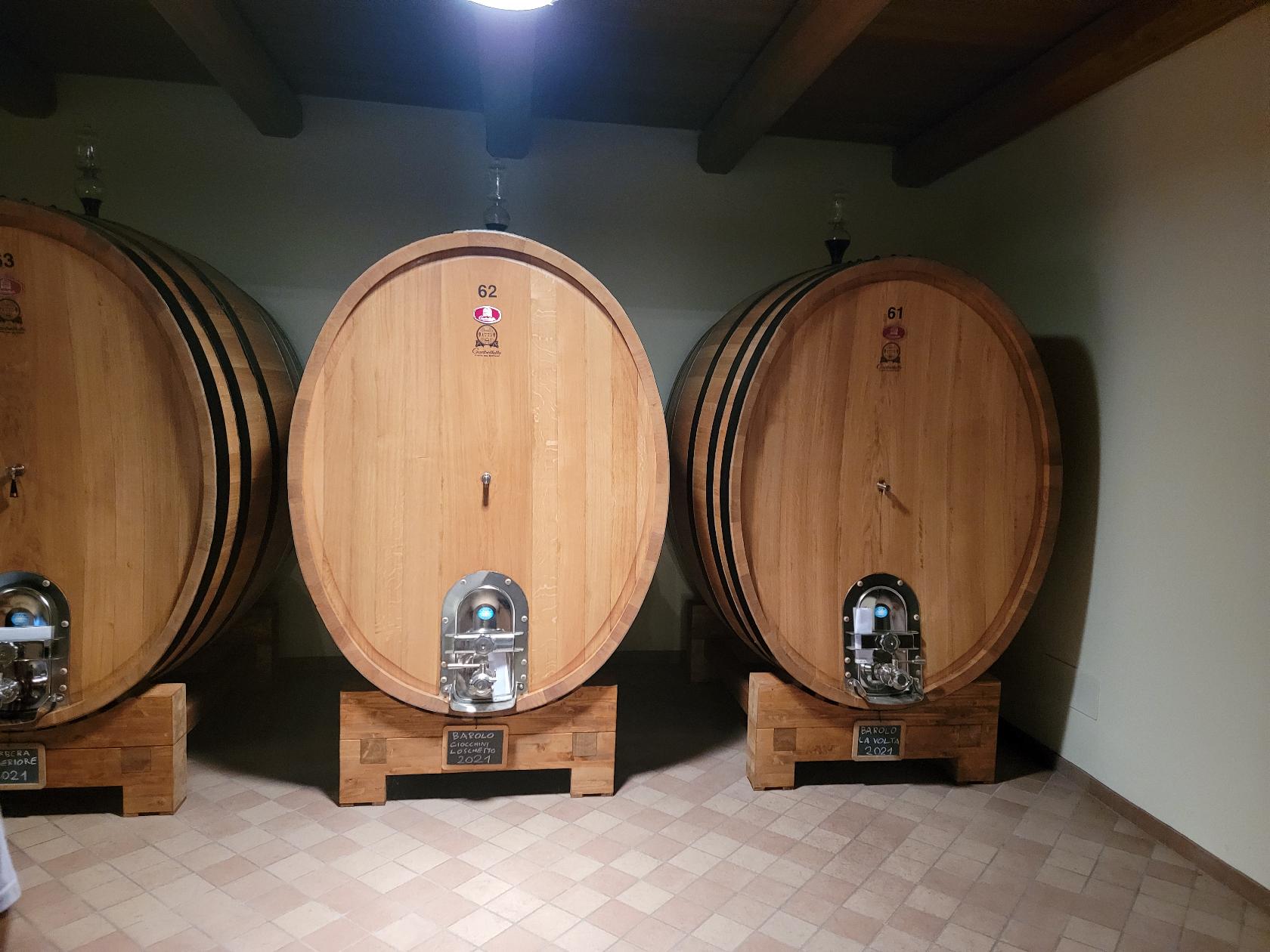
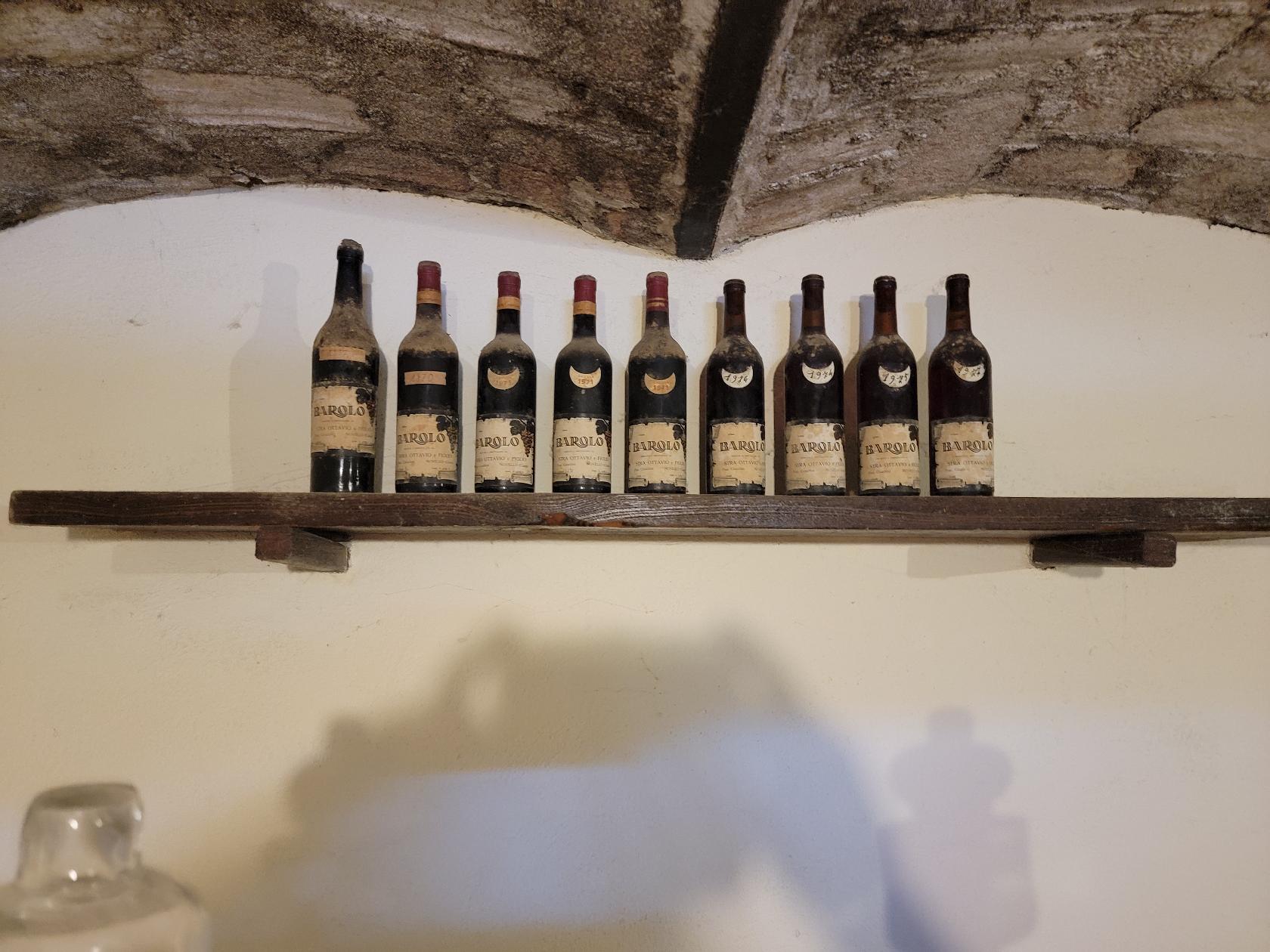
Our stop at Agritourism Stra was very informative and our hosts, including our tour driver, Saverio Molinai, were very instructive about the wines and the process to make them. This included a tour of the wine producing facilities and their cellars, where the wines are stored and kept during the aging process.
Agritursimo Stra – Old wines from the vineyard – Barolo, Italy
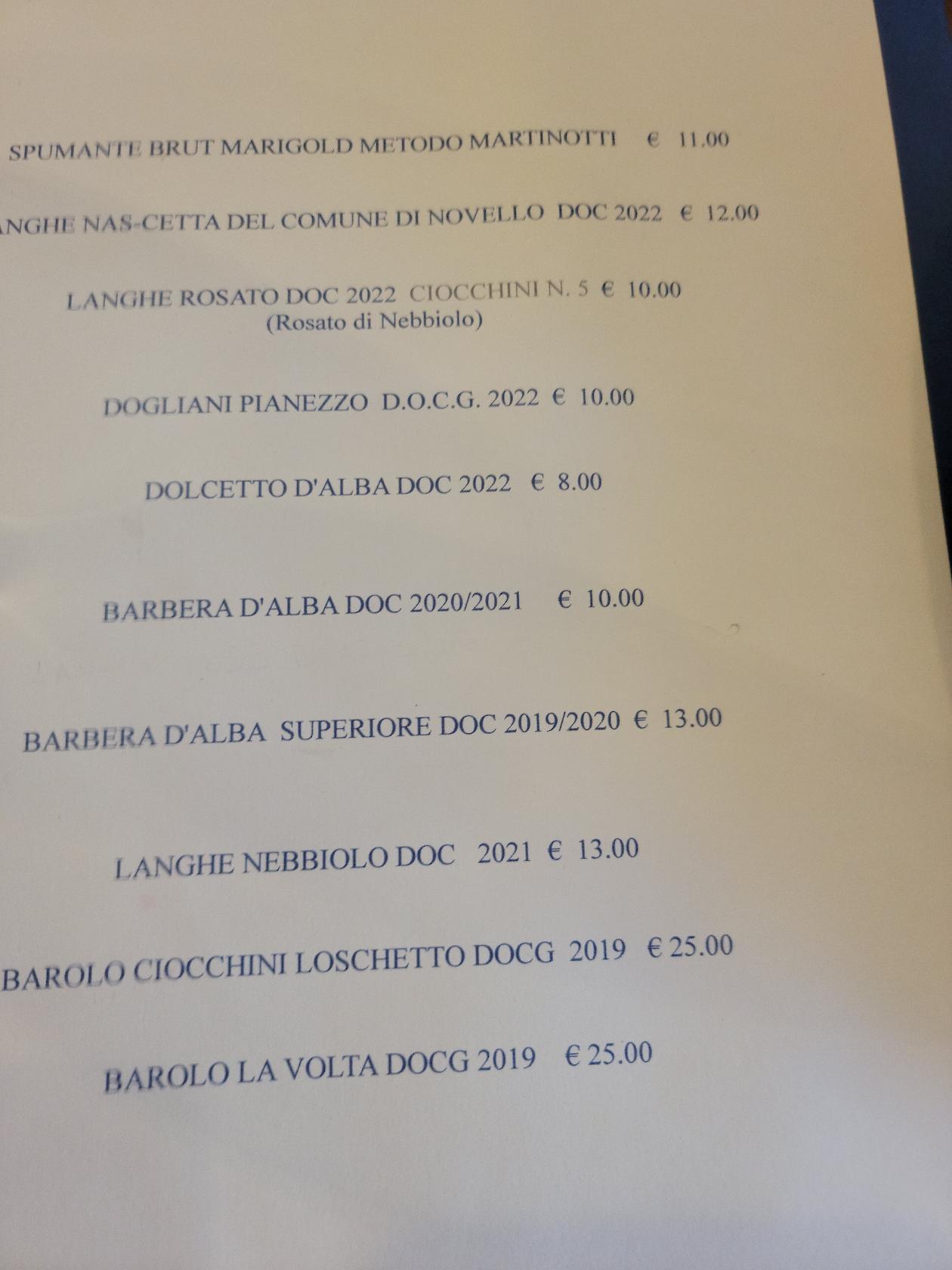
The tasting included a flight of all the wines they produce, with one exception, the Dolcetto 2022 for 8€. The list below shows some of the wines offered and we essentially when from the top of the list to the bottom.
Azienda Agricola Stra – Initial Tasting List – Barolo, Italy
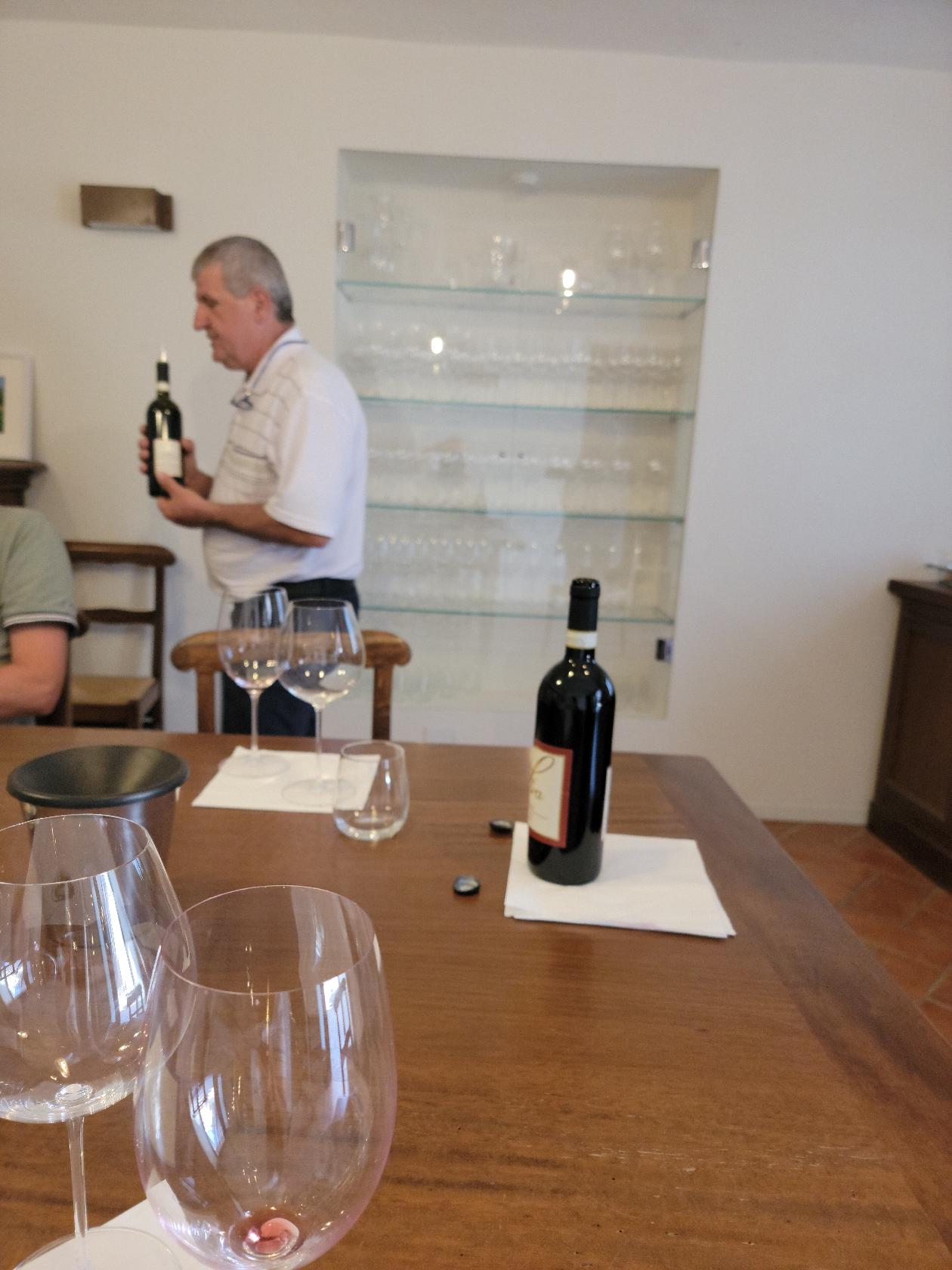
All during our tasting, our tour guide explained the various aspects of Barolo, its soil, the wines and the wine making process they used. He was actually very knowledgeable and when he was not sure about something that was particular to this producer, he would ask our host and she provided the necessary explanation.
Agritursimo Stra – Tasting room – Barolo, Italy
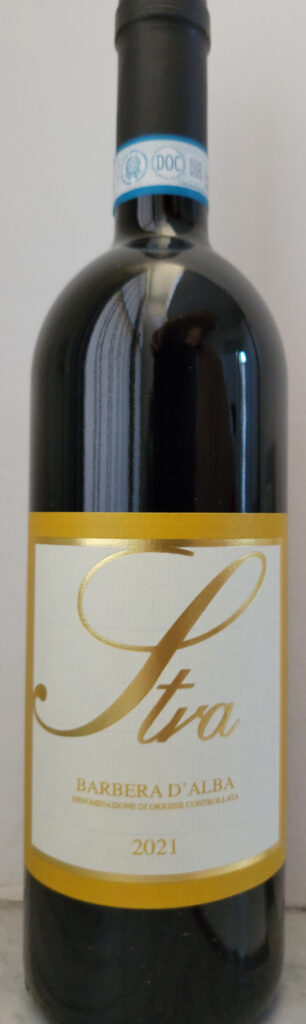
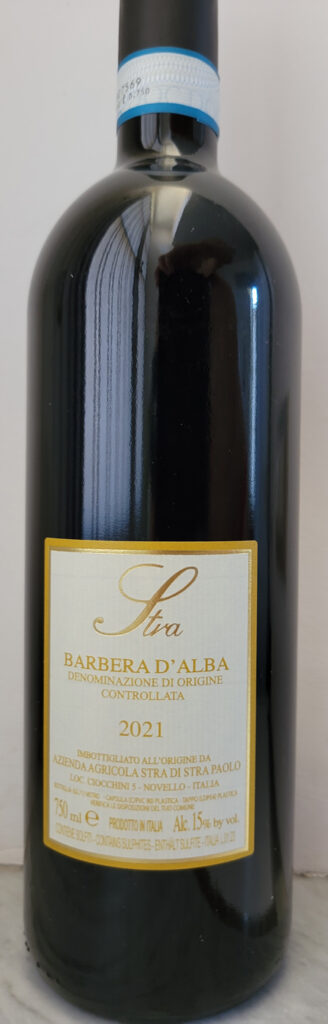
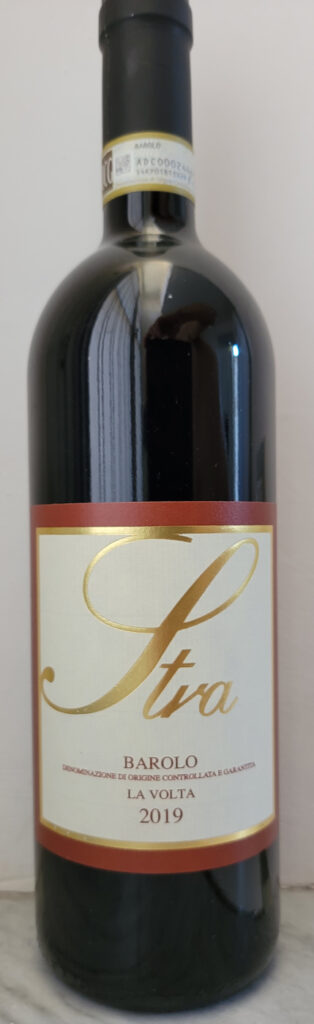
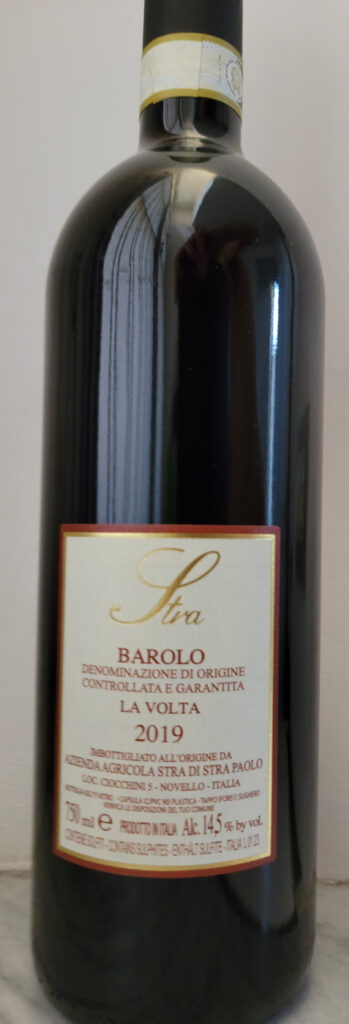
Impressed with the quality of the wines, we purchased almost half a case of five bottles, two bottles of DOCG Stra La Volta 2019 Barolo and three bottles of DOC Stra Barbera D’Alba 2021. Of course, the Barolo is kind of young to drink right now and needs a handful of years to mellow. But the Barbera is young and fruity, with plenty of tannin, cherry and tobacco overtones and ready to drink now. It would be great with a nice steak or any other dish that could compete with its strength.
Azienda Agricola Stra – DOCG Barolo La Volta 2019, Front – Barolo, Italy
Azienda Agricola Stra – DOCG Barolo La Volta 2019, Front – Barolo, Italy
The last thing that we tried here that was not on the list was their Grappa. I actually forgot what they labeled it as and what the year was, but for a grappa is was very good. Most grappa can be a bit strong, even harsh, this one was actually a pleasure to drink, even Patti liked it, and she doesn’t even like grappa.
Barbaresco
Our stop in Barbaresco included two stops, one in town for a tasting at Produttori del Barbaresco S.A.C., or the commune wine store; the other at the Grasso Brothers to the south of Barbaresco in Giacoso. The town, Barbaresco, is unmistakable from a distance, due to its distinct tower which is so prominent on the horizon.
Patti with the town in the distance – Barbaresco, Italy
The town – Barbaresco, Italy
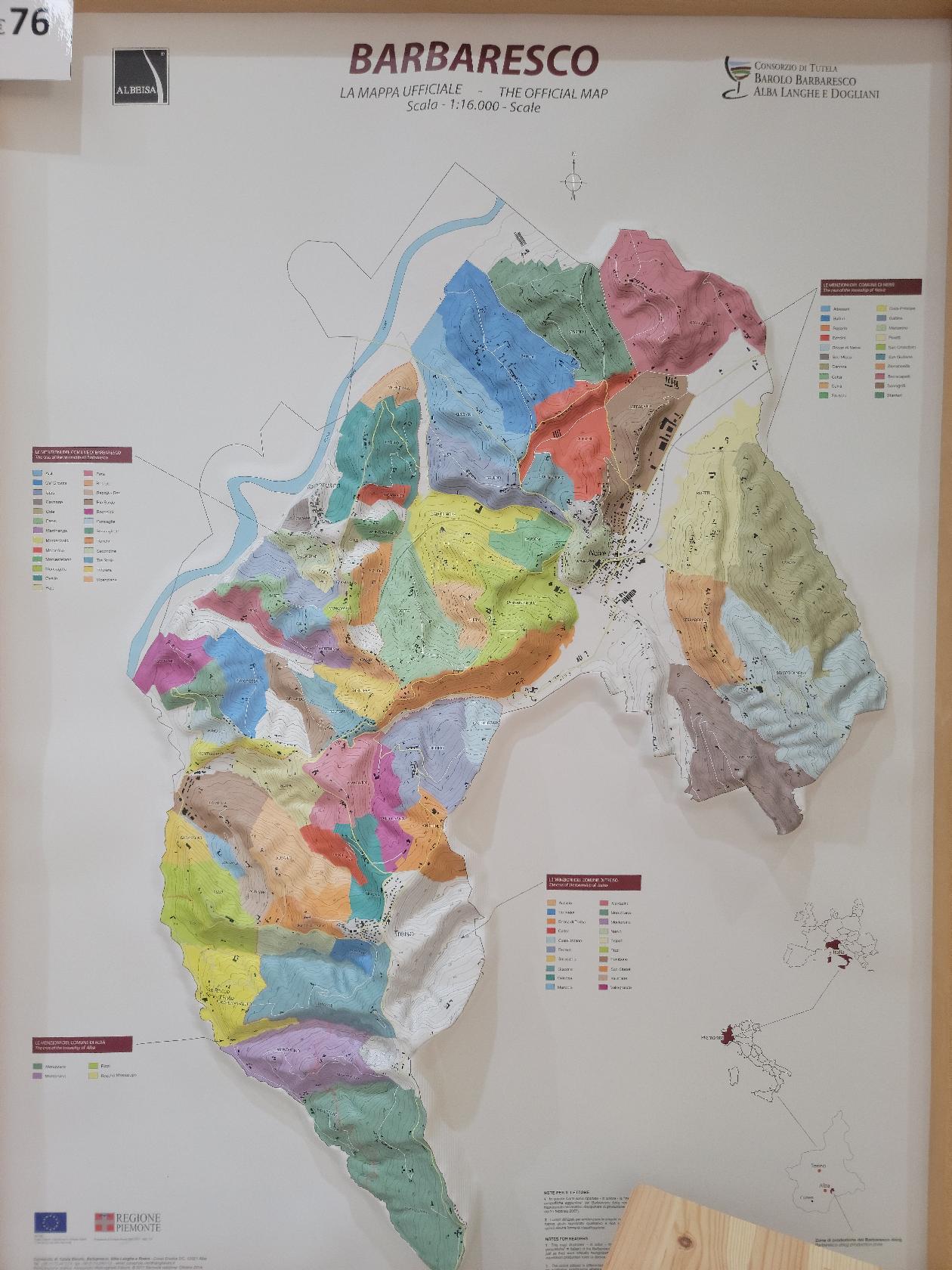
Commune wine shop map – Barbaresco, Italy
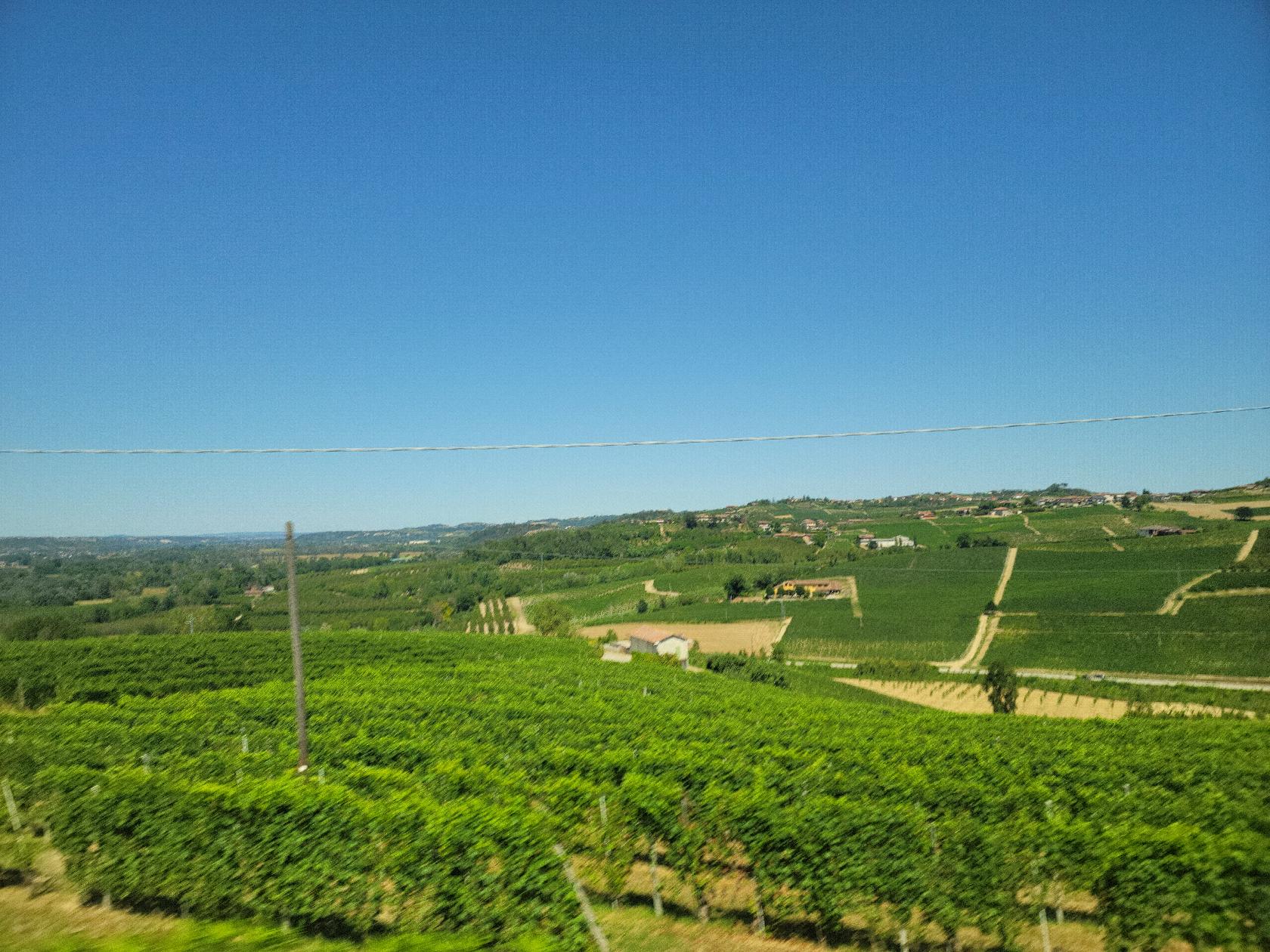
The land here is flatter and clearly more rolling than in Barolo. The valleys are not as steep and the vineyards appear to be able to employ more of their land to grapes. However, our guide told us that the primary reason some of the land still has trees was for truffle production in the area, its not necessarily unproductive, just used for another purpose.
Traveling to Barbaresco – Barbaresco, Italy
Vineyards of Barbaresco – Barbaresco, Italy
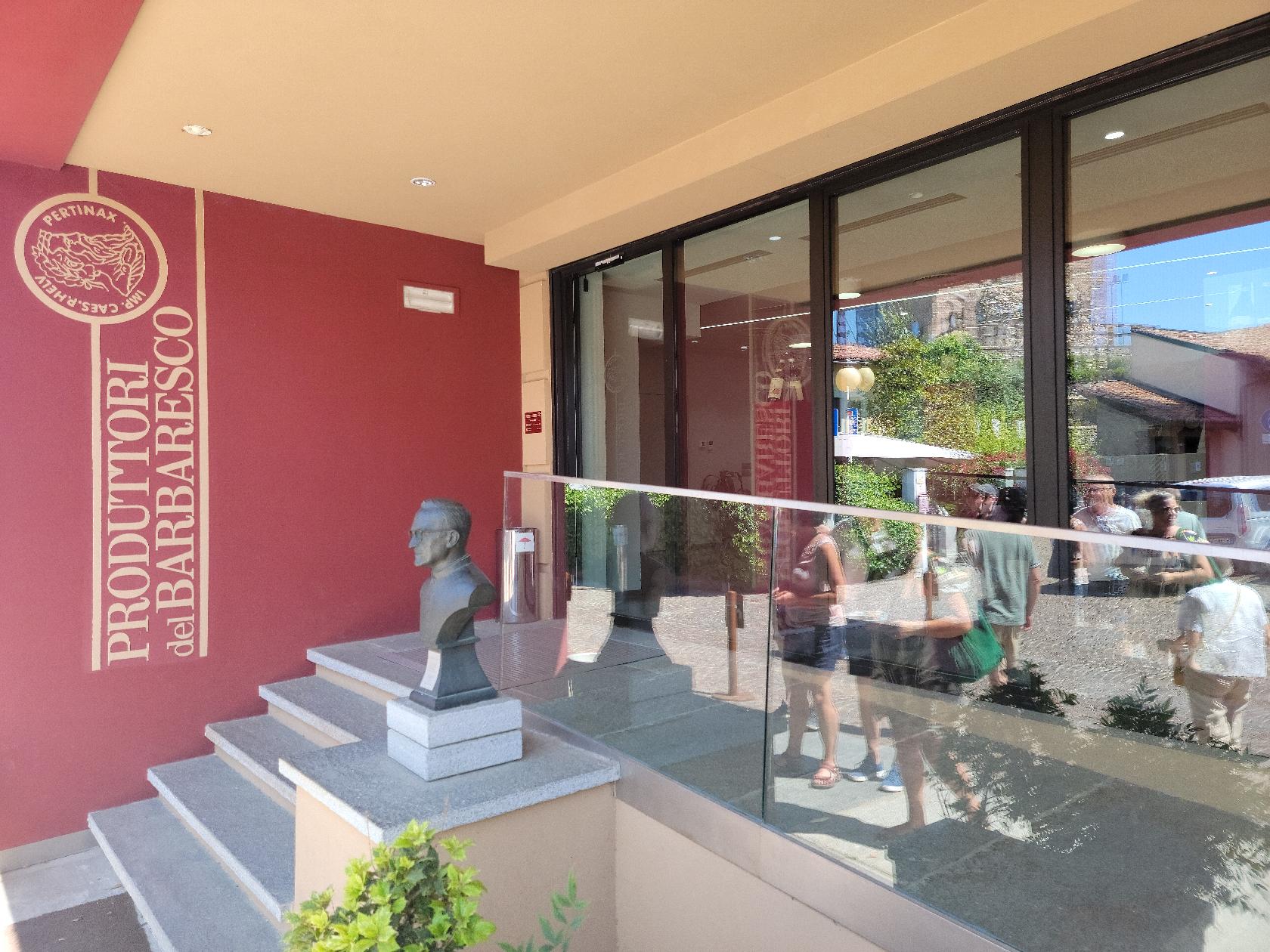
Produttori del Barbaresco S.A.C.
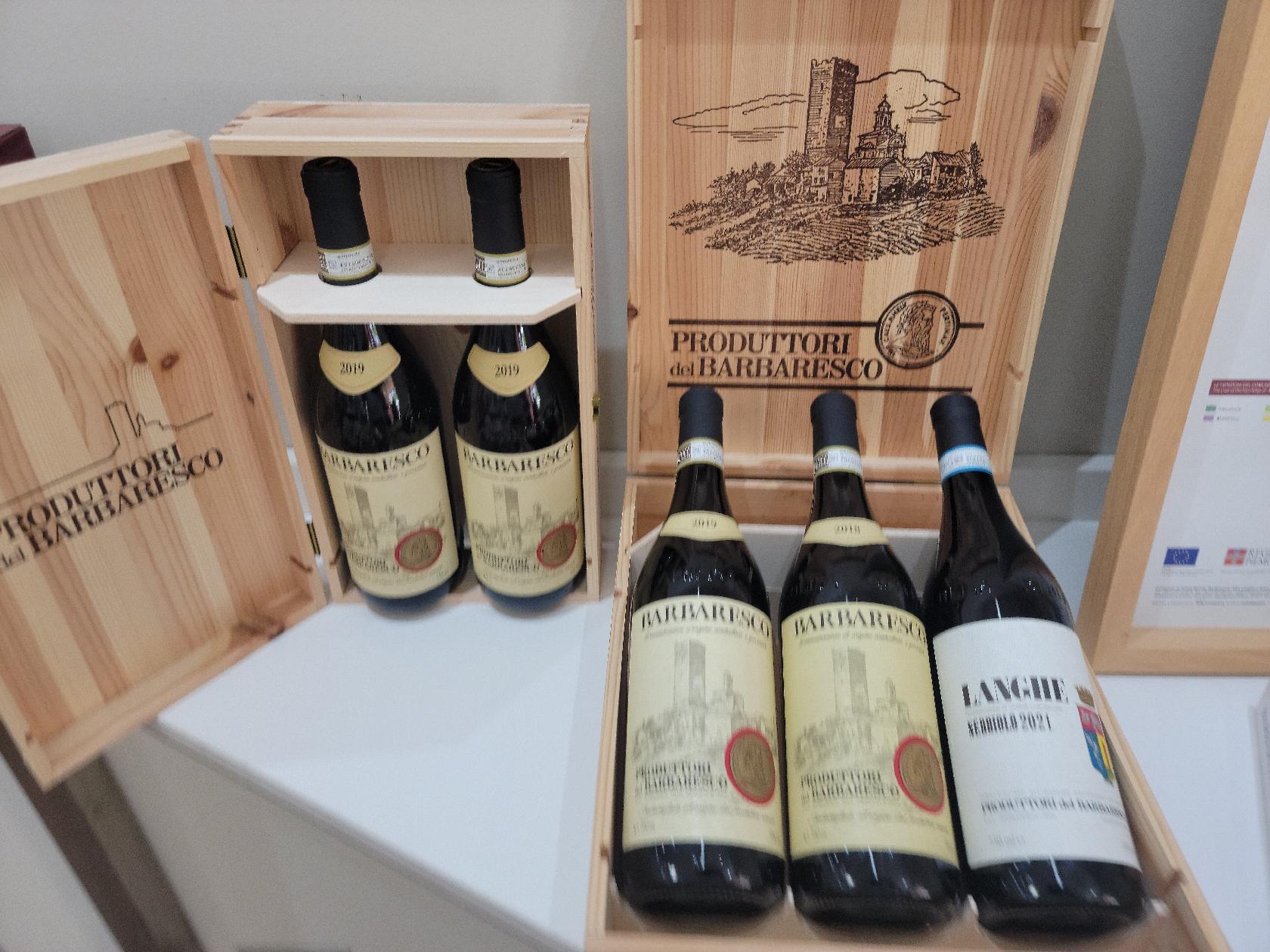
The inside of this store is rather modern, almost sterile in a contemporary way. Here we tasted the DOC Langhe Nebbiolo 2021 and two DOCG Barbarescos, a 2018 and a 2019. The nebbiolo was rather dry with little fruit and unimpressive, but clear with a crisp ruby color and a distinct nose. The 2018 and 2019 Barbarescos were a bit disappointing. Although they were typical of a nebbiolo varietal for Barbaresco, there price was rather high. I felt I could find a similar one that was less expensive in Turin.
Commune wine shop – Barbaresco, Italy
Commune wine shop wines – Barbaresco, Italy
Commune wine shop map – Barbaresco, Italy
Commune wine shop – Barbaresco, Italy
The last thing we tried was their Grappa. It was typical for grappa, lots of alcohol and perhaps a bit harsh. So this stop was a bit disappointing, but we got to see that town.
Vineyards of Barbaresco – Barbaresco, Italy
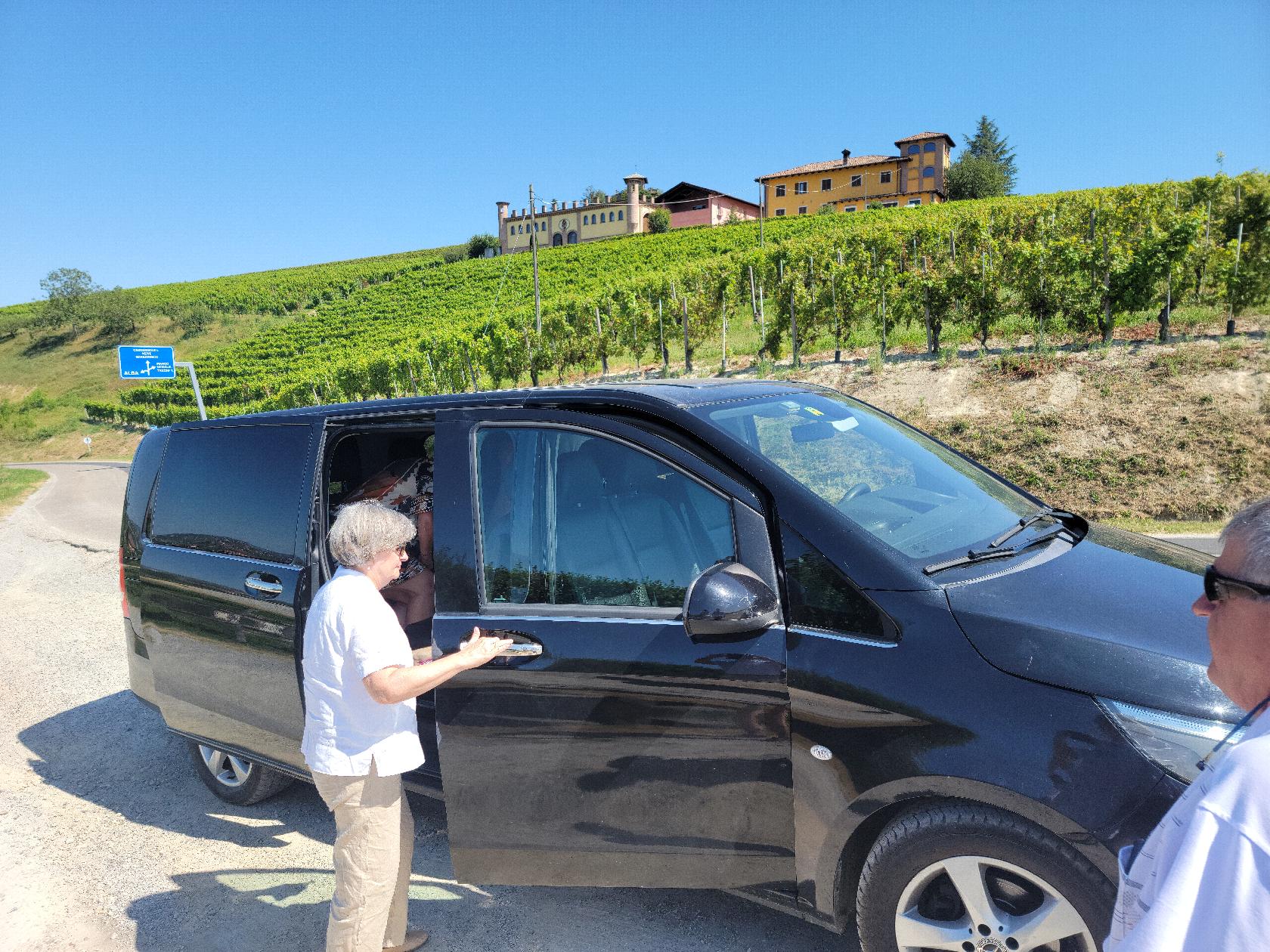
Patti getting into our vehicle – Barbaresco, Italy
We left here without purchasing anything.
Azienda Agricola Grasso Fratelli
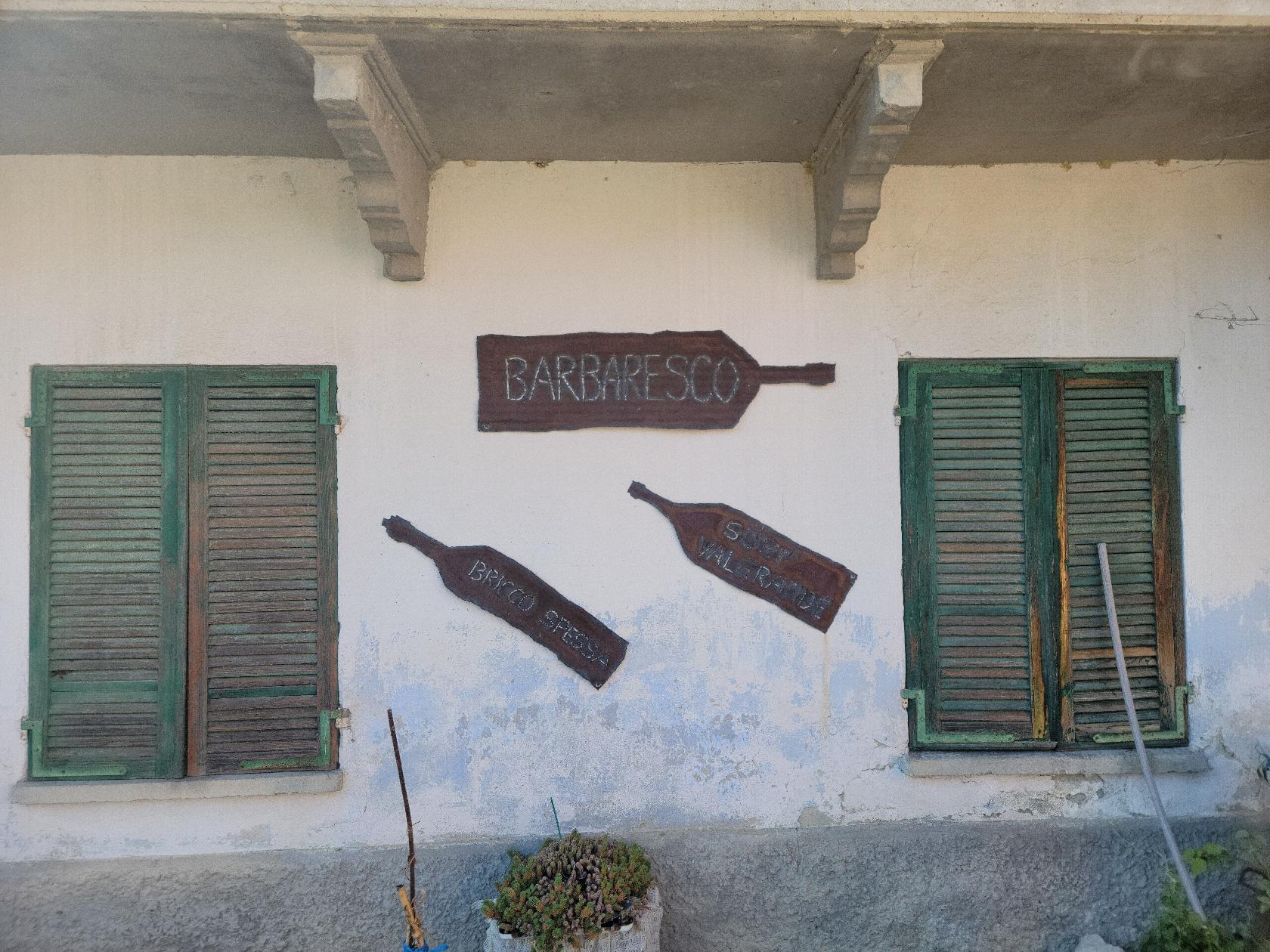
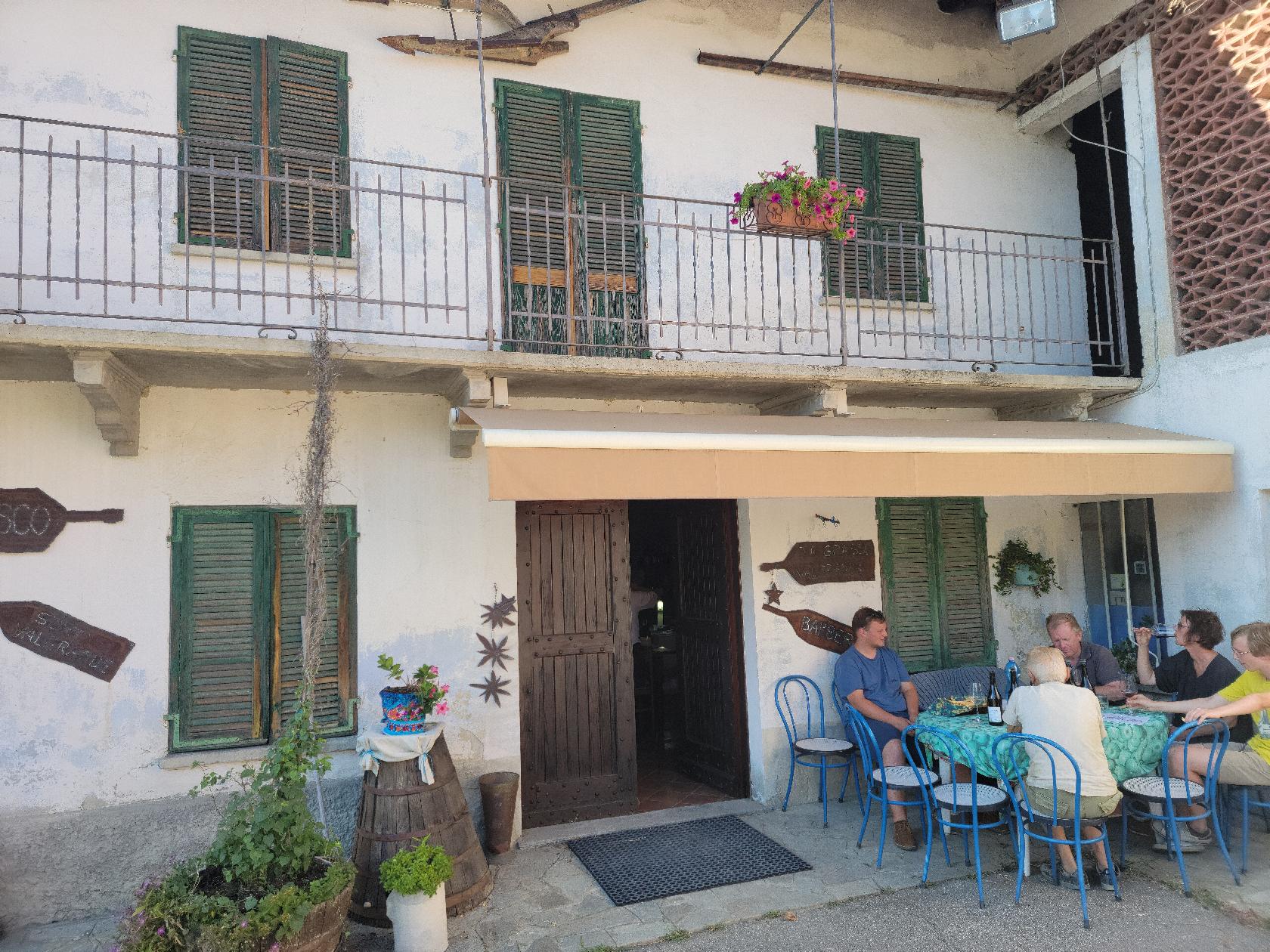
The Grasso Fratelli, or Grasso Brothers, have a rather unassuming winery. From the outside the construction is typical for Piedmont and it is adorned with signs of the wines they make, like Barbaresco, Bricco Spessa, Barbera, etc. One could call it a typical farm.
Grasso Brothers – Barbaresco, Italy
Grasso Brothers – Barbaresco, Italy
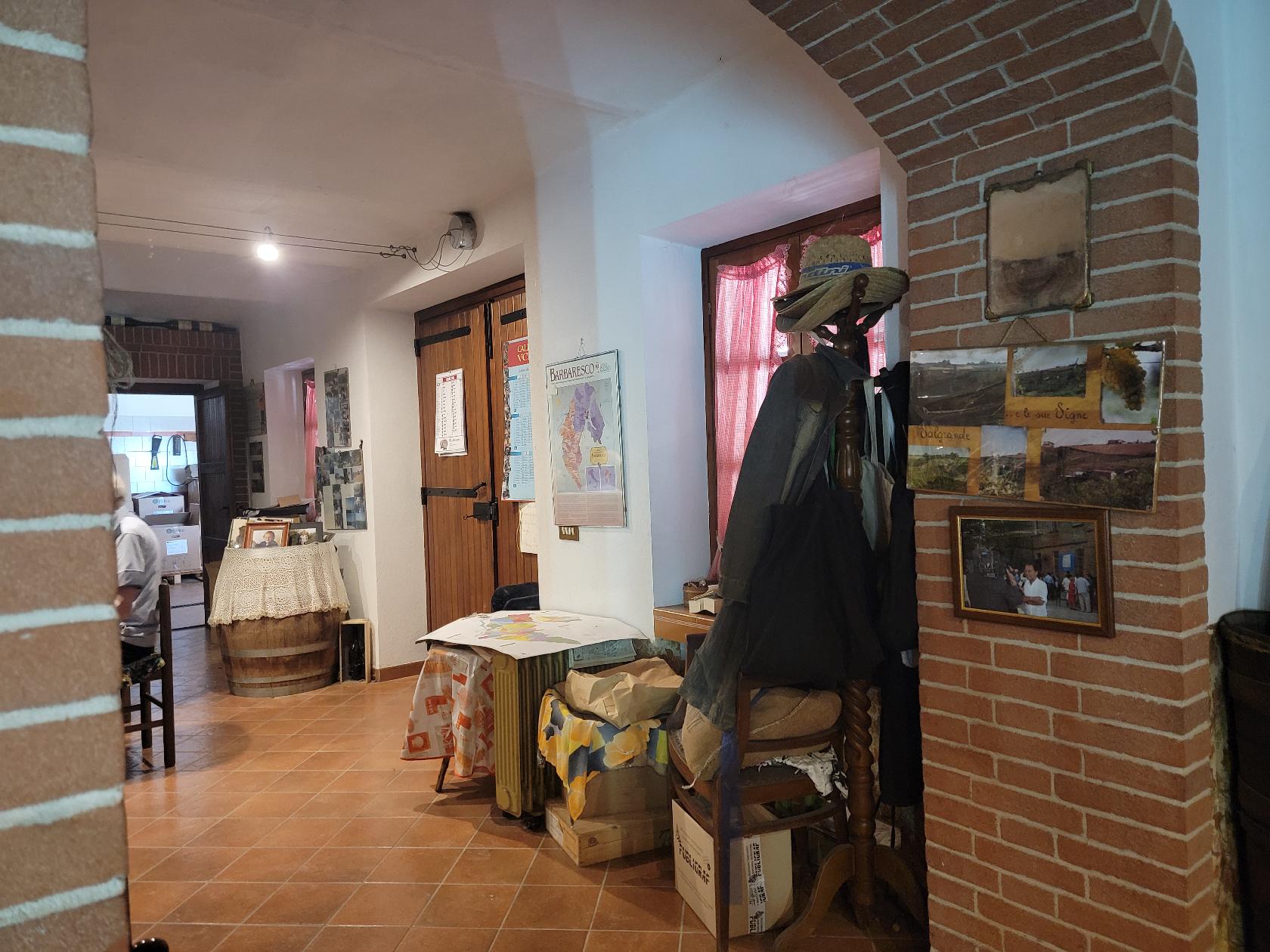
The Grasso Brothers – Inside the bodega – Barbaresco, Italy
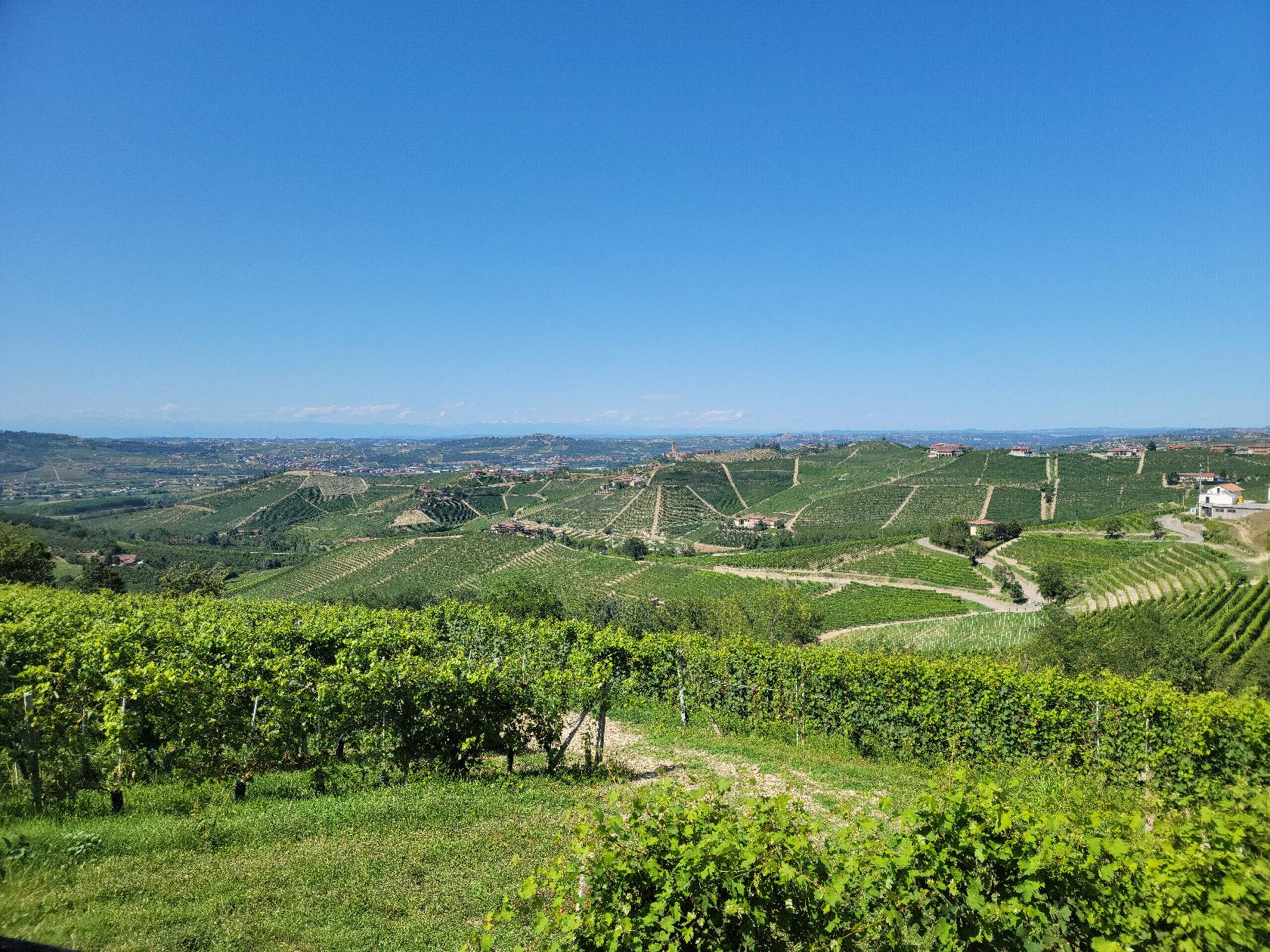
The vineyards – Barbaresco, Italy
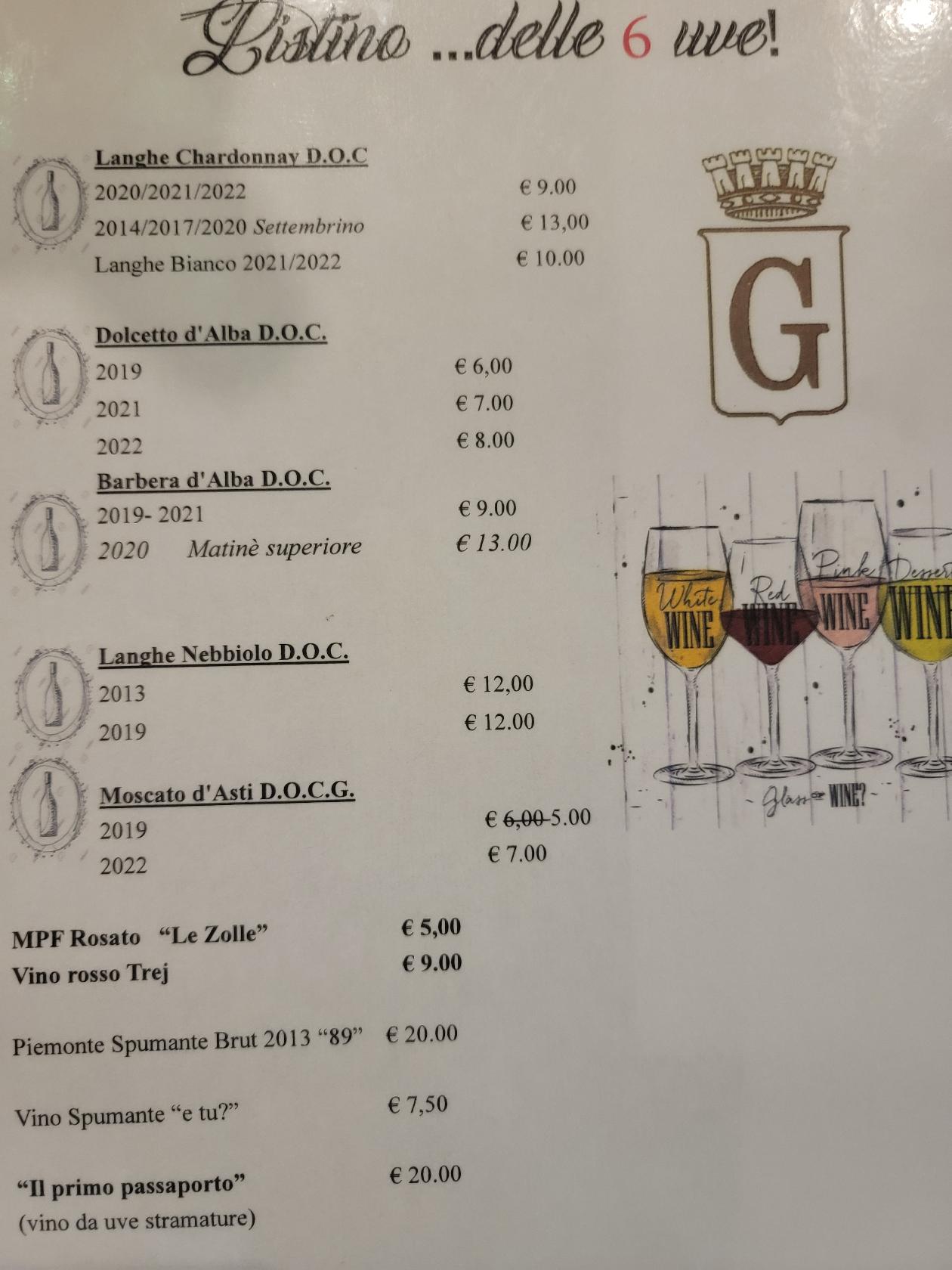
The building houses two large rooms for tasting and the atmosphere is rather laid back. The wines for the tasting contained Chardonnays, Dolcettos, Barberas, Nebbiolos, a Moscato, a Rosato and a wine called Vino rosso Trej. All of these wines were very good, including the Chardonnays which I thought were very clean and not overly oaked, like most complain about in the United States.
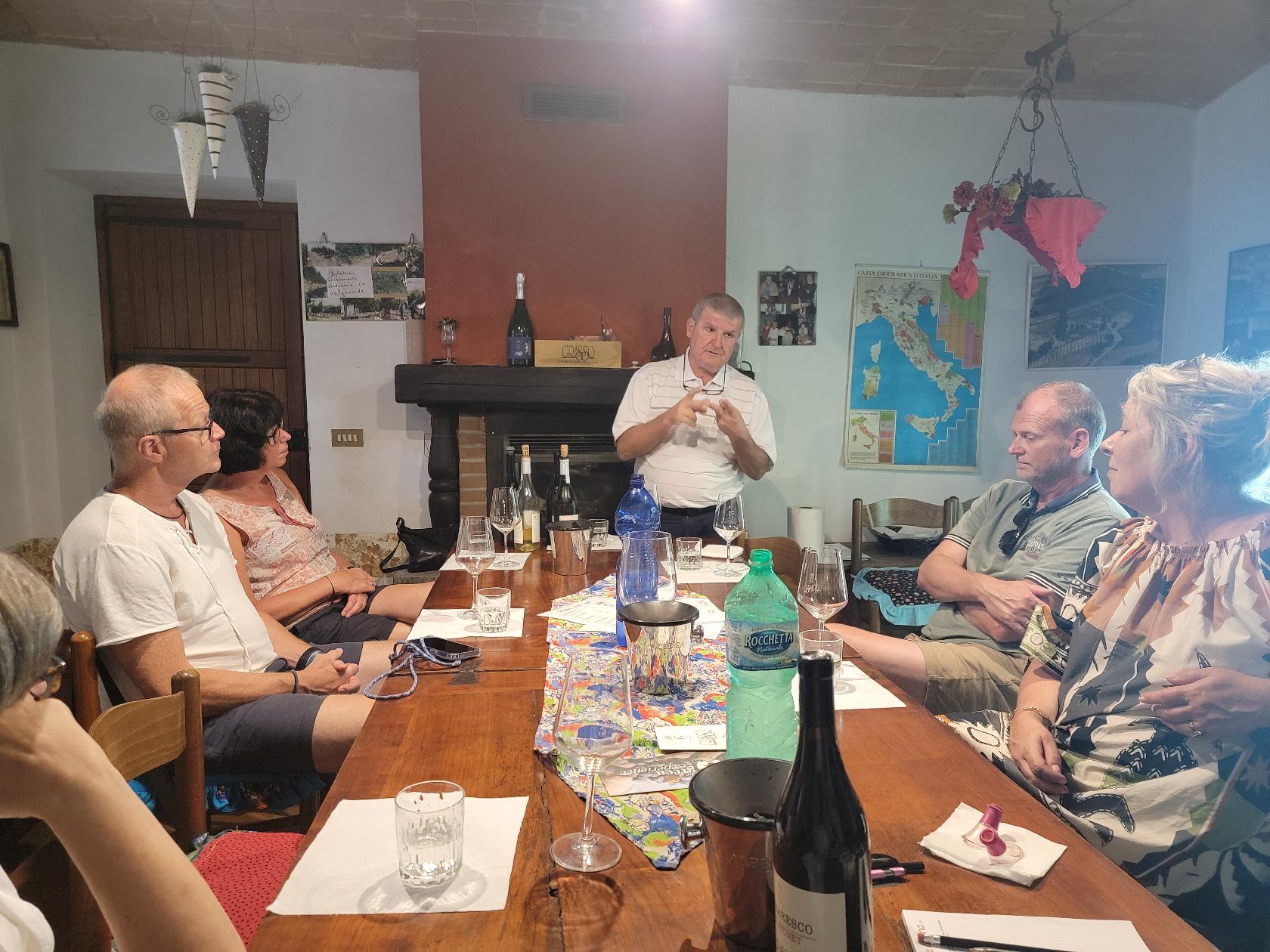
The Grasso Brothers – Our group and Saverio Molinari, our tour guide, explaining Barbaresco wines – Barbaresco, Italy
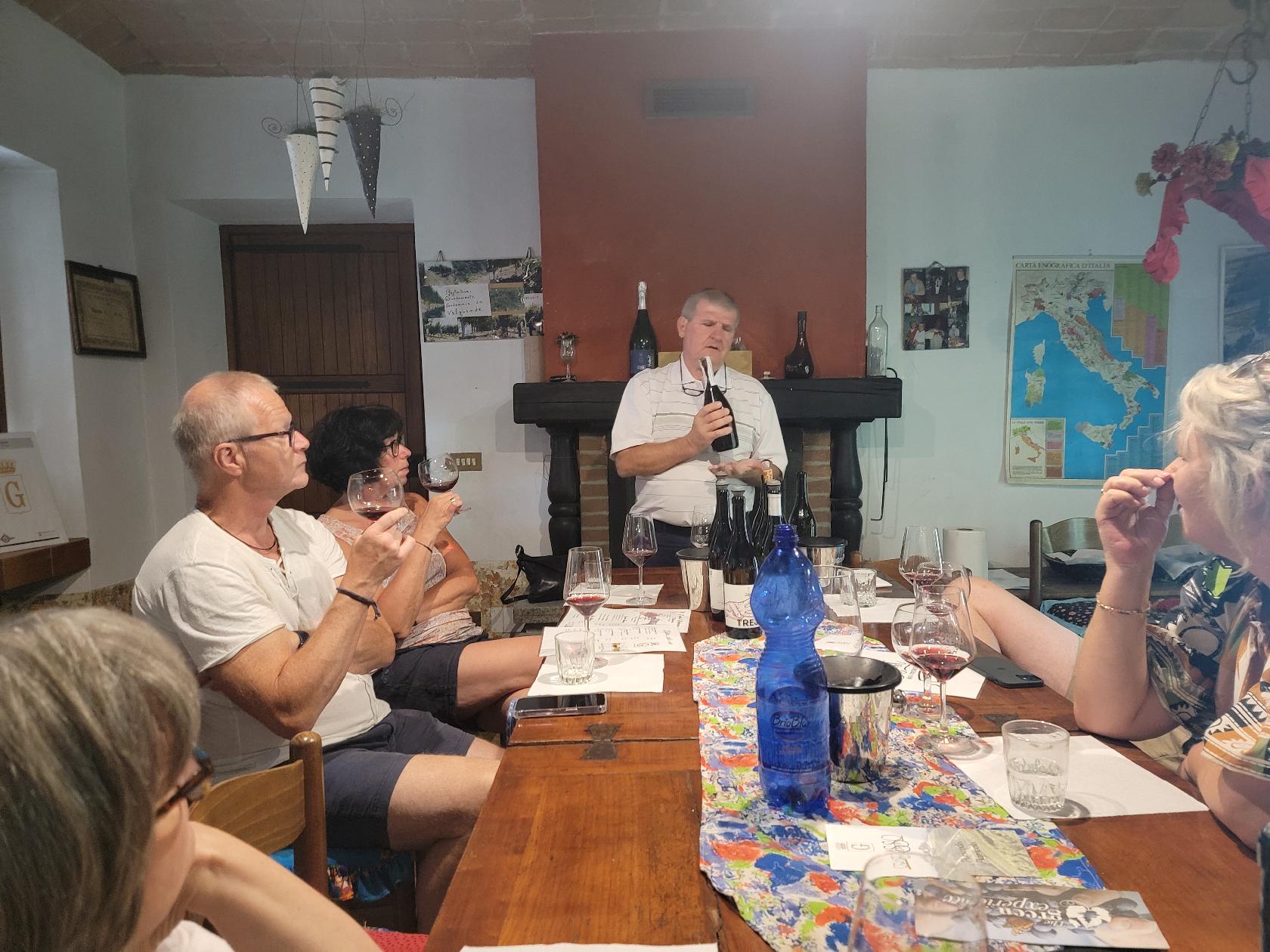
The Grasso Brothers – Saverio Molinari, explaining DOCG rules and requirements – Barbaresco, Italy
There were however no Barbarescos on the list to taste, so we were all a bit taken aback. Once we mentioned this, our host and driver Saverio went to retrieve a few bottles for us to try
The Grasso Brothers – Initial Tasting List – Barbaresco, Italy
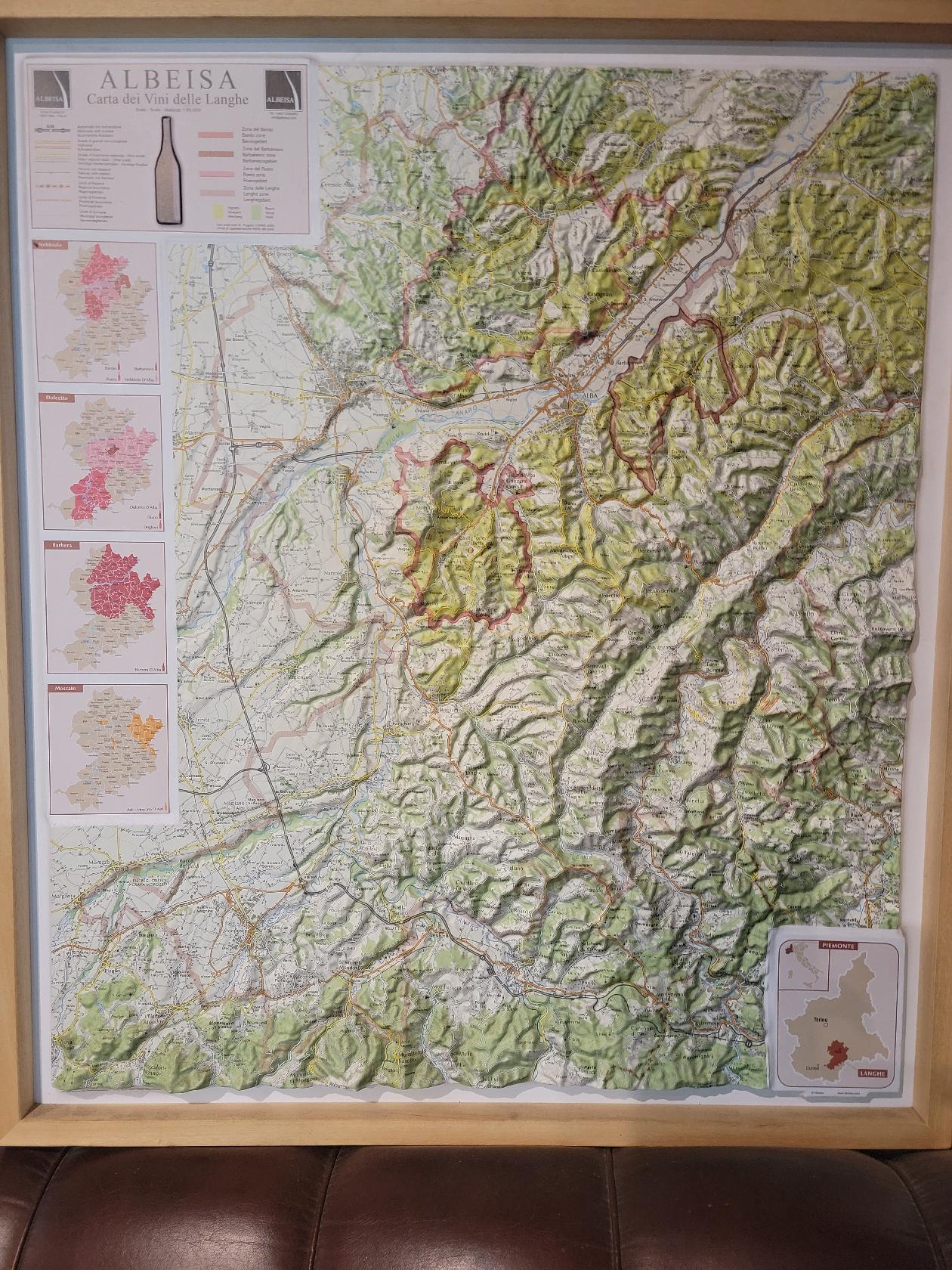
A map of Barbaresco – Barbaresco, Italy
There was an immediate reaction and the brothers appeared, looking a bit hesitant. However, Saverio convinced them that if they don’t let people try the wines, they won’t sell them.
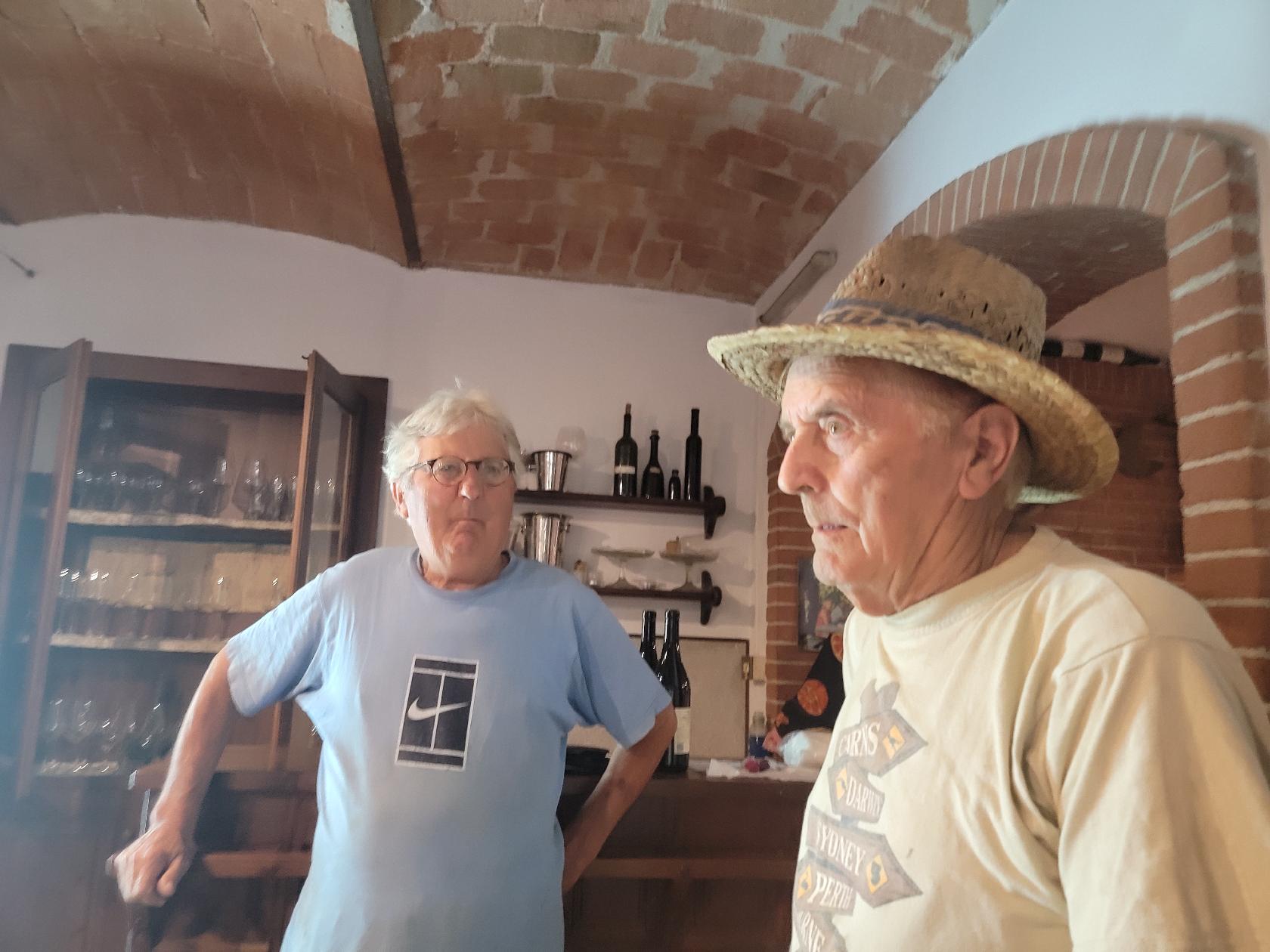
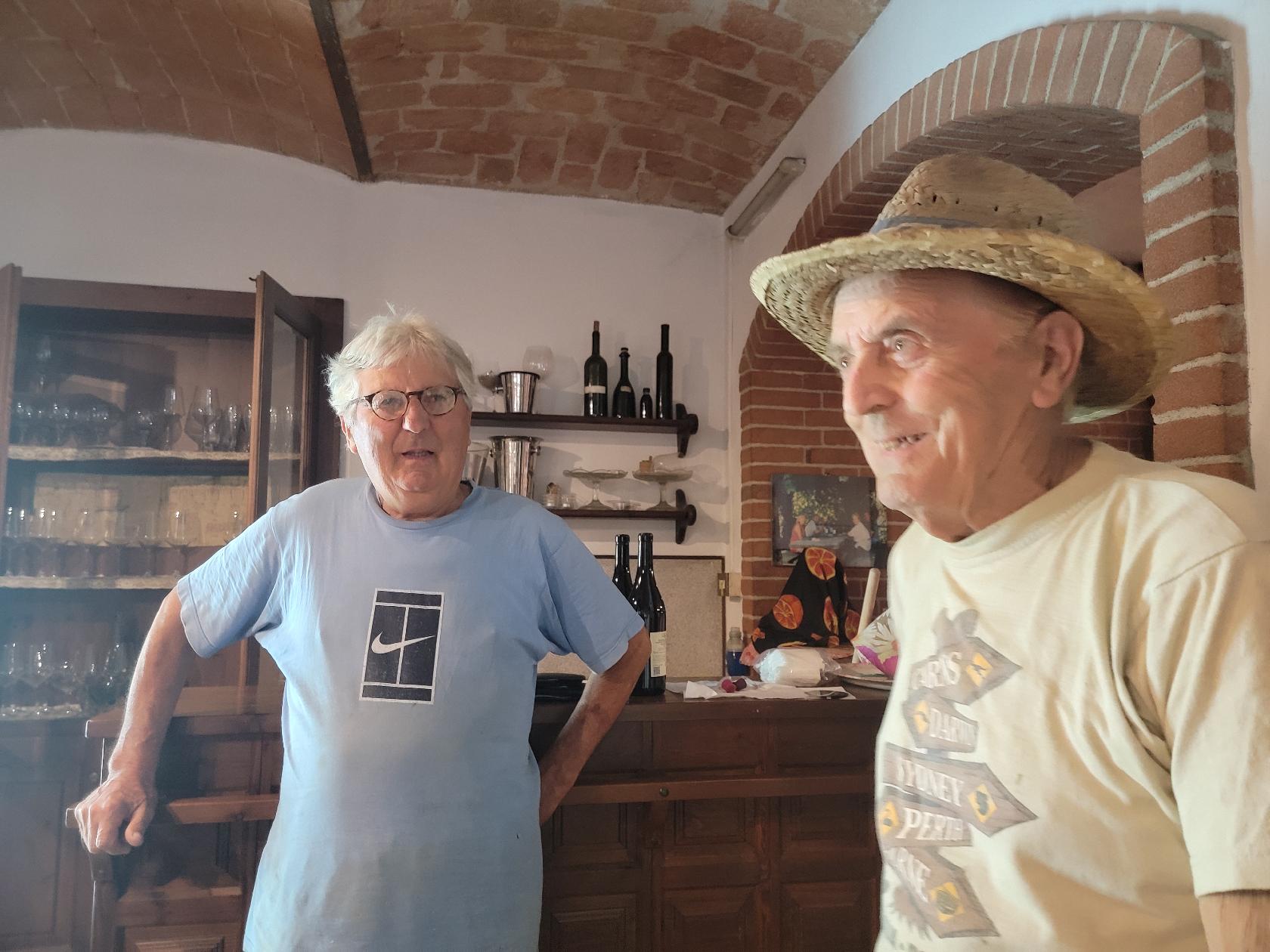
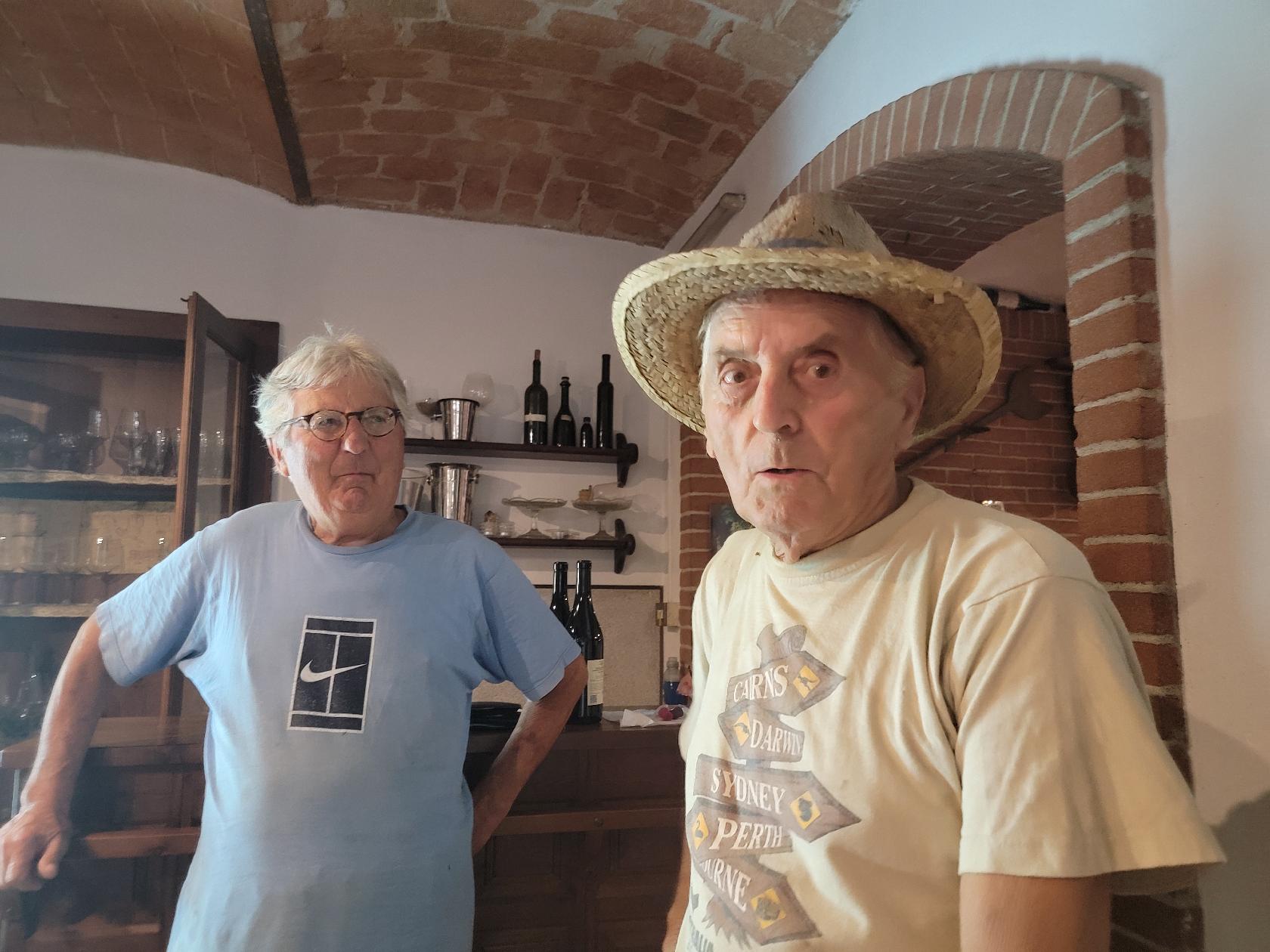
The brothers have never marries and still work on the farm, though some of the work is done by the cooperative. They have been working their plot of land for over sixty years. The eldest, Alfredo, is eighty-two (82) years old this year and the other brother, Luigi, about ten years his junior. The two brothers came to the table and talked with our guide, while we tried the wine.
The Grasso Brothers – Luigi and Alfredo Grasso – Barbaresco, Italy
The Grasso Brothers – Luigi and Alfredo Grasso – Barbaresco, Italy
The Grasso Brothers – Luigi and Alfredo Grasso – Barbaresco, Italy
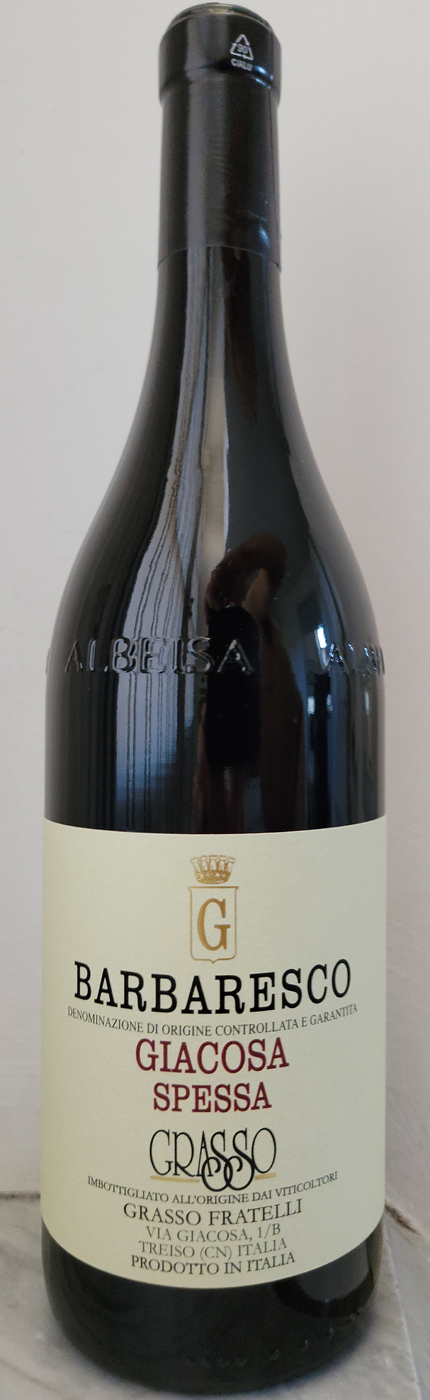
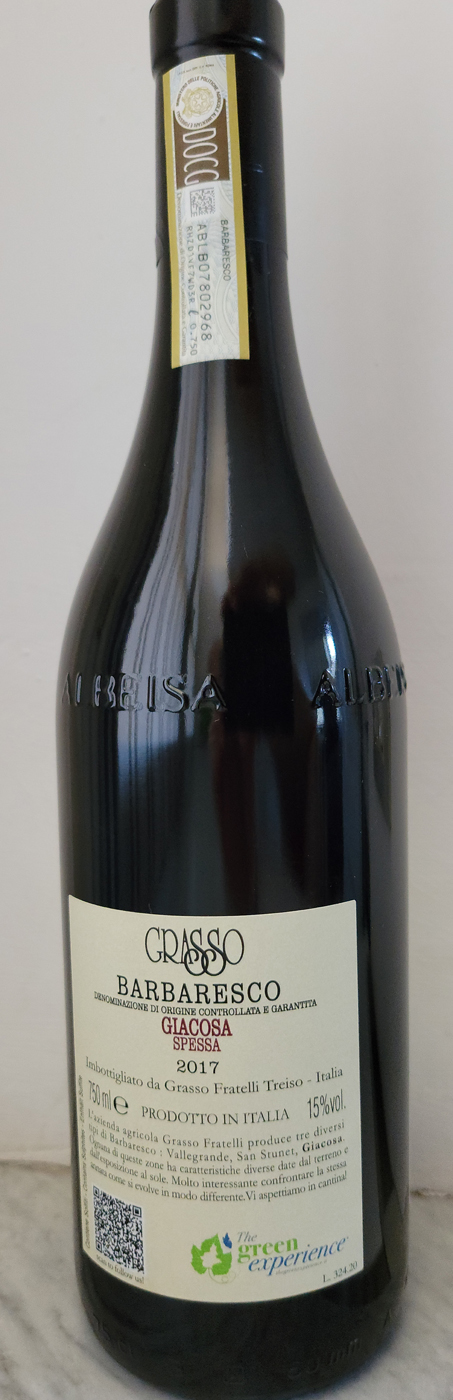
The best bottle was their DOCG Giacosa Spessa Barbaresco 2017. This is an amazingly good wine, full of cherry and other fruity undertones along with plenty of alcohol for longevity, coupled with an amazing nose and a rich red color typical for a nebbiolo, and best of all, ready to drink now. The vines that it is produced from are of the oldest in the vineyard, being planted by Alfredo when he was only twenty years old. This means that the roots of these vines have driven over a meter deep into the ground, allowing them to access different soils and salts. It is so good, I had to purchase two bottles. Unfortunately, I was not able to carry more, so I had to keep to that limit. A planning mistake I will not make again in the future.
The Grasso Brothers – DOCG Giacosa Spessa 2017, Front – Barbaresco, Italy
The Grasso Brothers – DOCG Giacosa Spessa 2017, Back – Barbaresco, Italy
Restaurants
We visited one restaurant for lunch, which we had to inform the tour operator in advance of how much we wanted to spend. At the time, the limits were 30€/person, 50€/person and 70€/person, for which the unnamed restaurant would provide a basic lunch with appetizer and primi, or a heavier lunch with appetizer, primi and secondi, or a culinary delight of the same, but made personally by the chef. We both thought it was overpriced. So we went off-menu and ordered from the daily specials and only what we wanted.
Locanda La Gemella
For lunch we stopped at Locanda la Gamella on the edge of town. A very nice, I would say upscale restaurant with a very dynamic menu. They also have daily and chef’s specials, so there seems to be something for everyone.
We went a la carte with the special Tajarin al ragu, some still water and a glass of wine. Our total bill came to 51€ total for the both of us, which wasn’t too bad, but still a bit pricey. Unfortunately, neither myself nor my wife took any photographs of our dishes or the place, though they were kind of normal and not very special for the Piedmont.
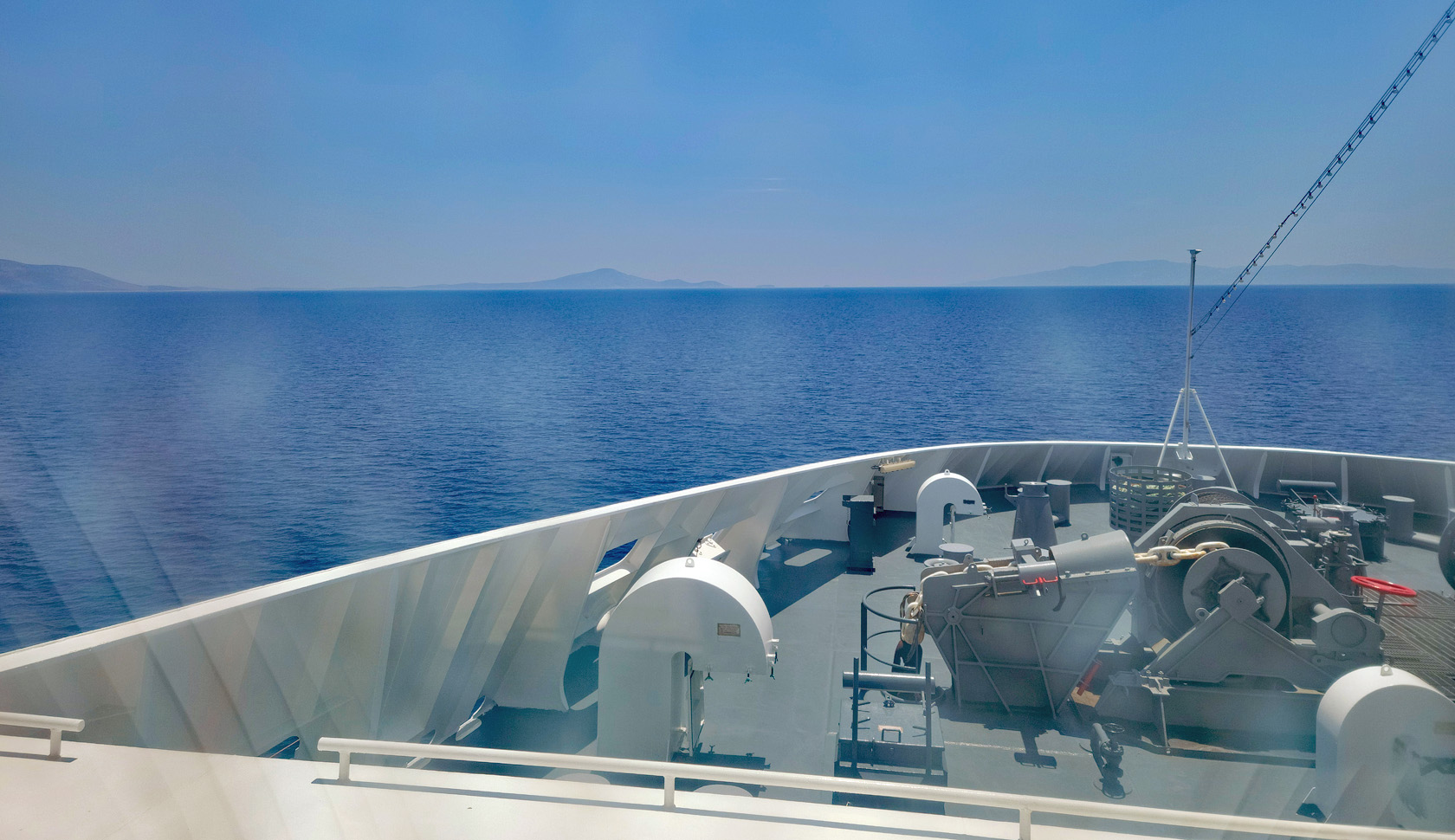
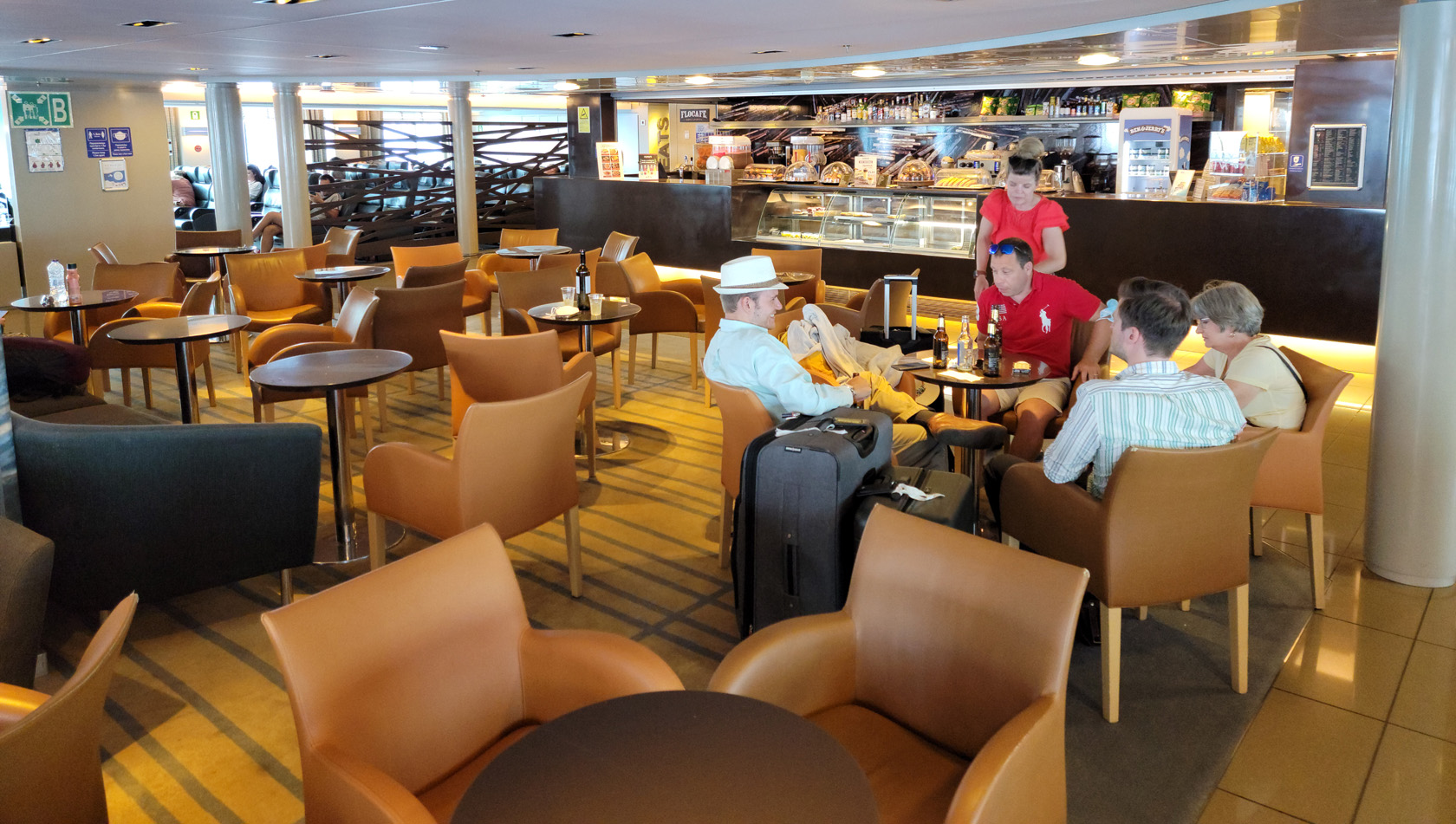
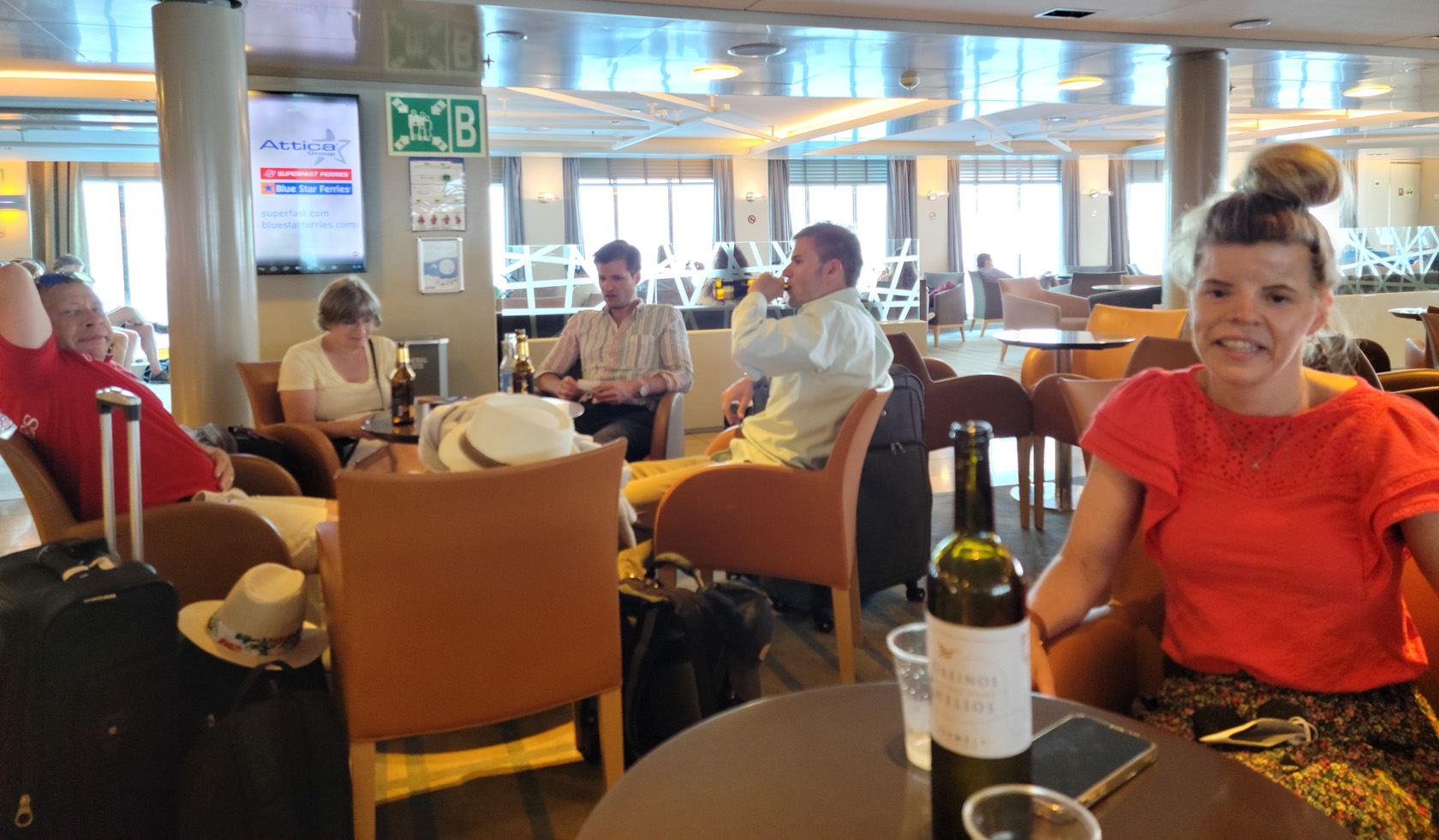
Well we took the ferry from Naxos to Santorini and as luck would have it, it was very smooth. We were kind of worried about it, because the prior days leading up to our excursion, it was very windy and the water was extremely rough. My wife had already related to me, that in rough seas, they sometimes cancel the ferries between islands; we didn’t need any of that. It was bad enough that she had contracted bronchitis and was just getting her voice back. In fact, my son-in-law also had a cold, making their holiday just a bit more annoying than usual.
We were off the ferry in no time and looking for our driver, which with all of the vehicles and people, was actually easier than I had thought it was going to be. After sitting in the car for about fifteen minutes, waiting for the long procession of cars, buses, trucks and other vehicles to make it up the cliff, the road before us had more switchbacks than teeth on a saw. But it was slow going, so motion sickness never became an issue.
Naxos to Santorini – Ferry on the Aegean Sea
Naxos to Santorini – Ferry
Naxos to Santorini – Gabi, Patti, Dana, Tristan and Ericka
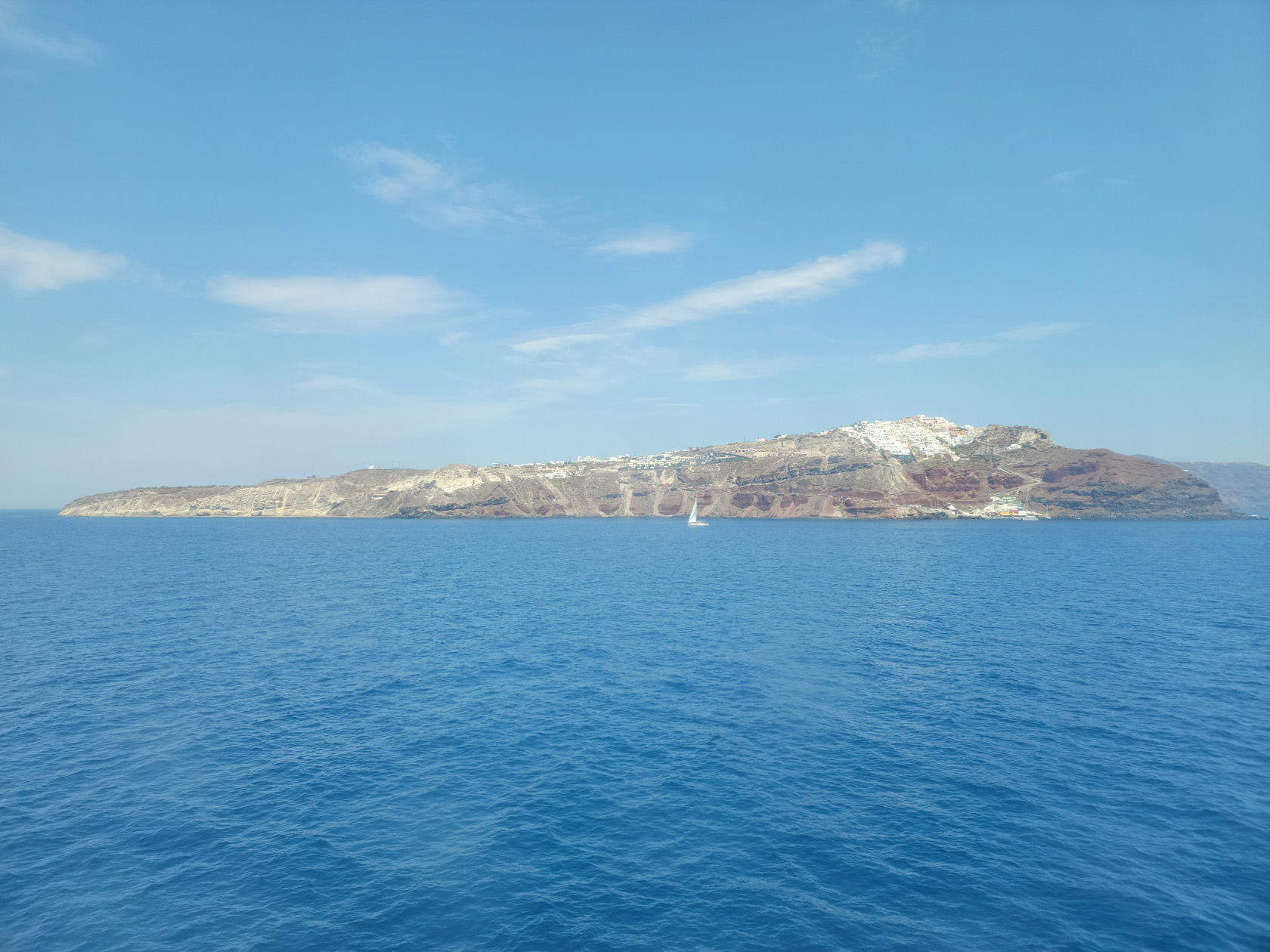
Naxos to Santorini – Oia from Ferry
Once we reached the top and made it through the stop sign, we were in our Heliotopos Hotel in Imerovigli in no time. On Santorini we actually split our vacation between two different hotels, one in Imerovigli and one in Oia. And aside from the driver from the shuttle service driving past our hotel in Oia, for which we had a fairly long walk in the heat, no other problems befell us while on Santorini.
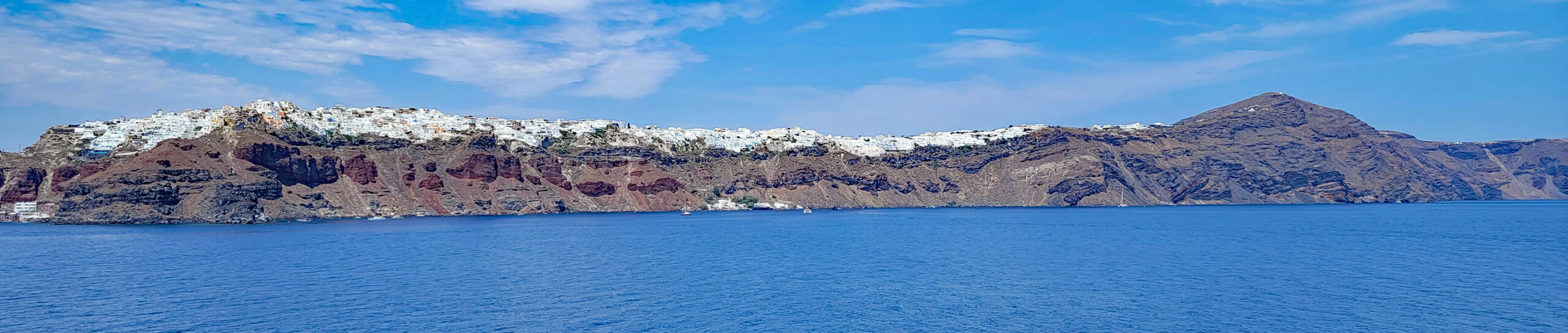
Naxos to Santorini – Imerovigli and Thira from Ferry
Another island in the Cyclades island chain, Santorini is a large caldera formed from an ancient volcano that blew its top some time around 1450 BCE. When it did, it had a major impact on the Minoan population that had settled on the chain of islands.
The Greek Evil Eye
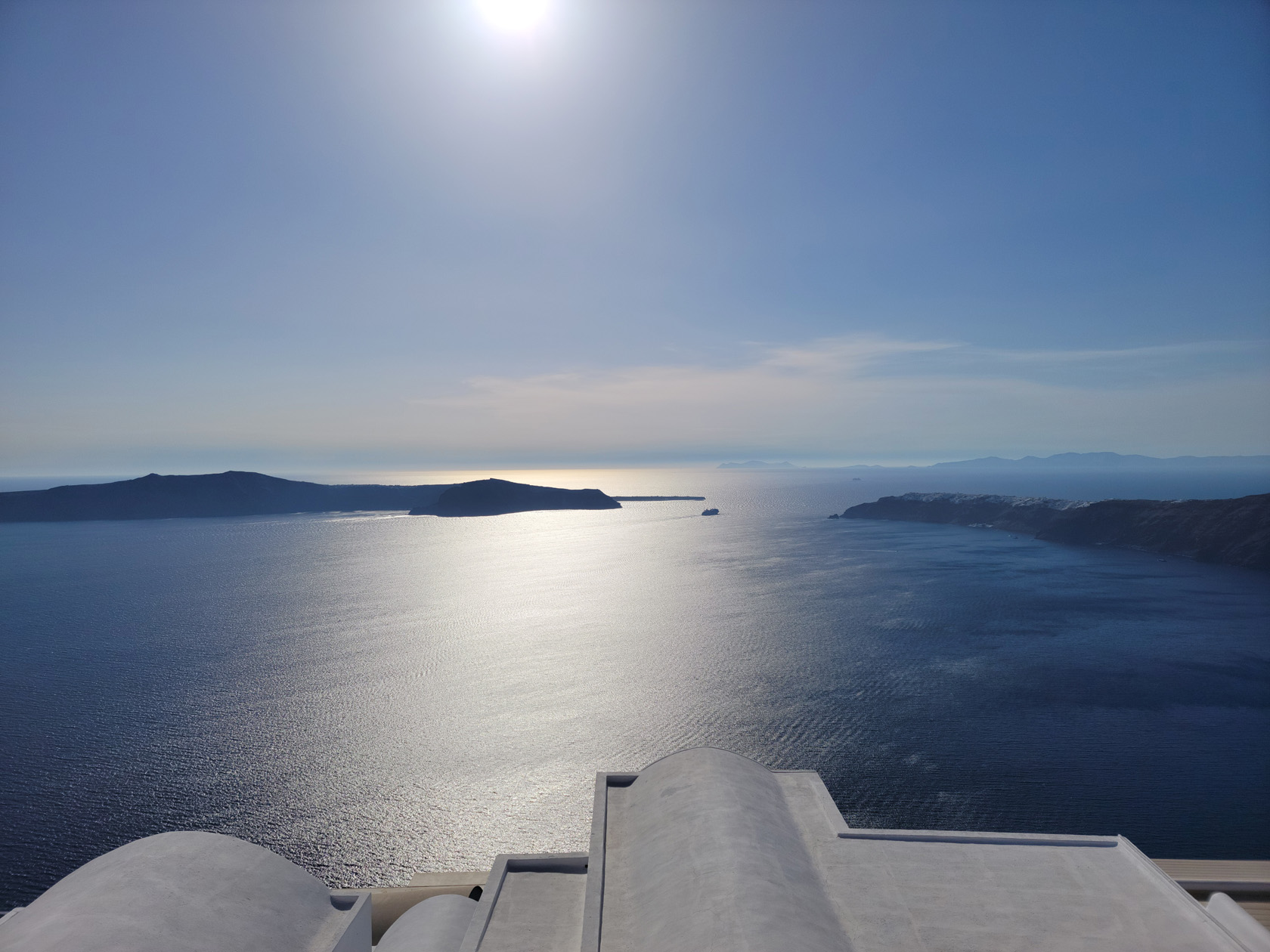
One might say the island of Santorini now looks like a great Greek Evil Eye from the sky. A small ring of islands with a caldera of water and a center made from the remaining two active volcanoes. If of course one is superstitious like that.
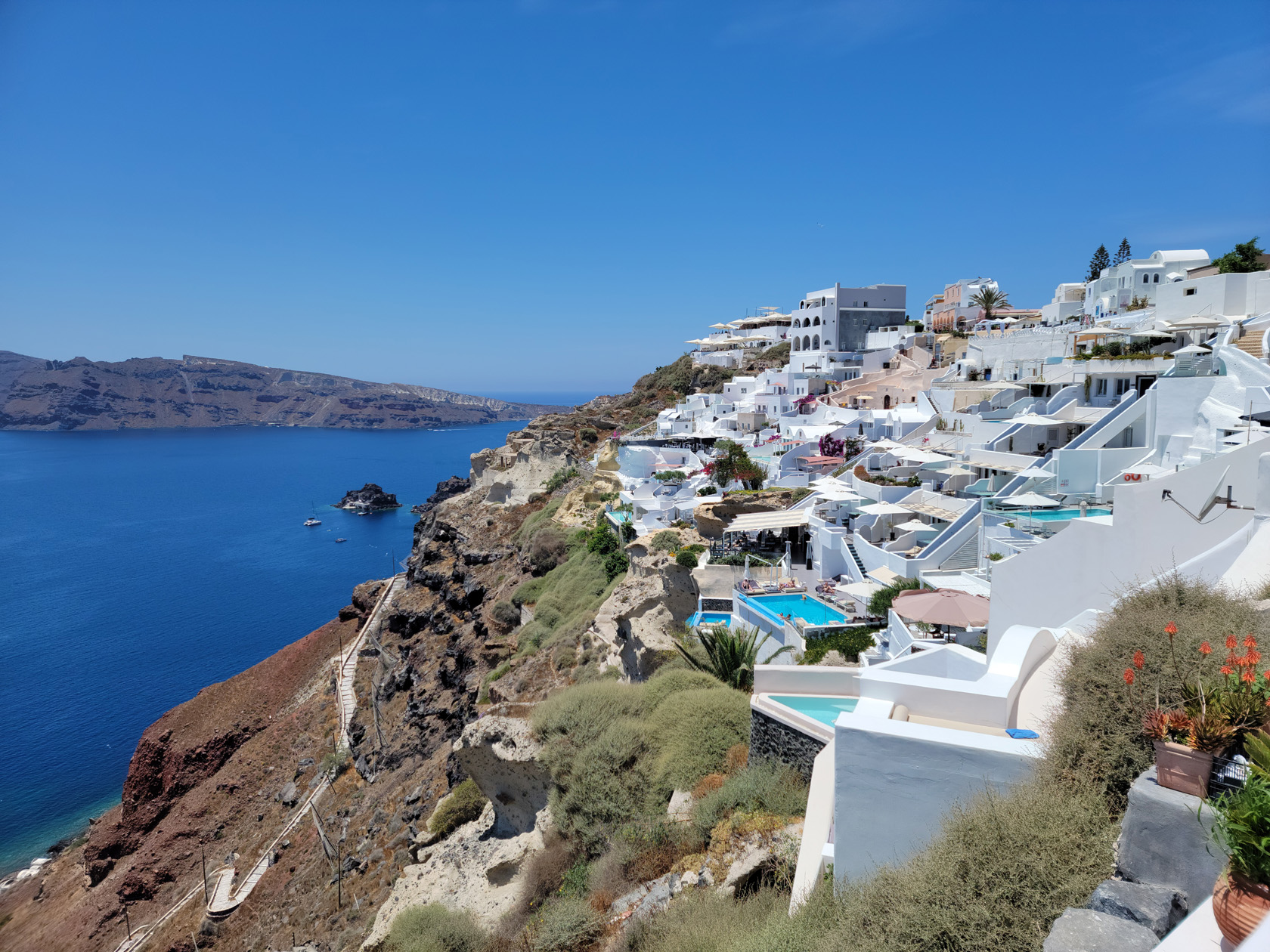
Imerovigli – A Volcanic Aerie
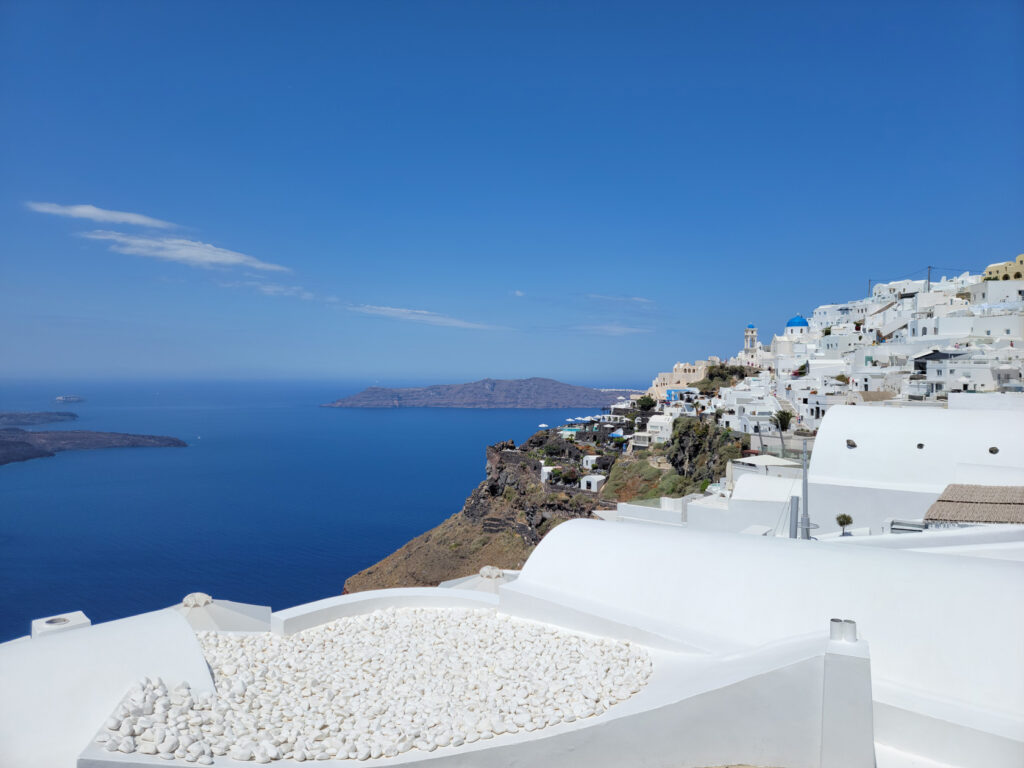
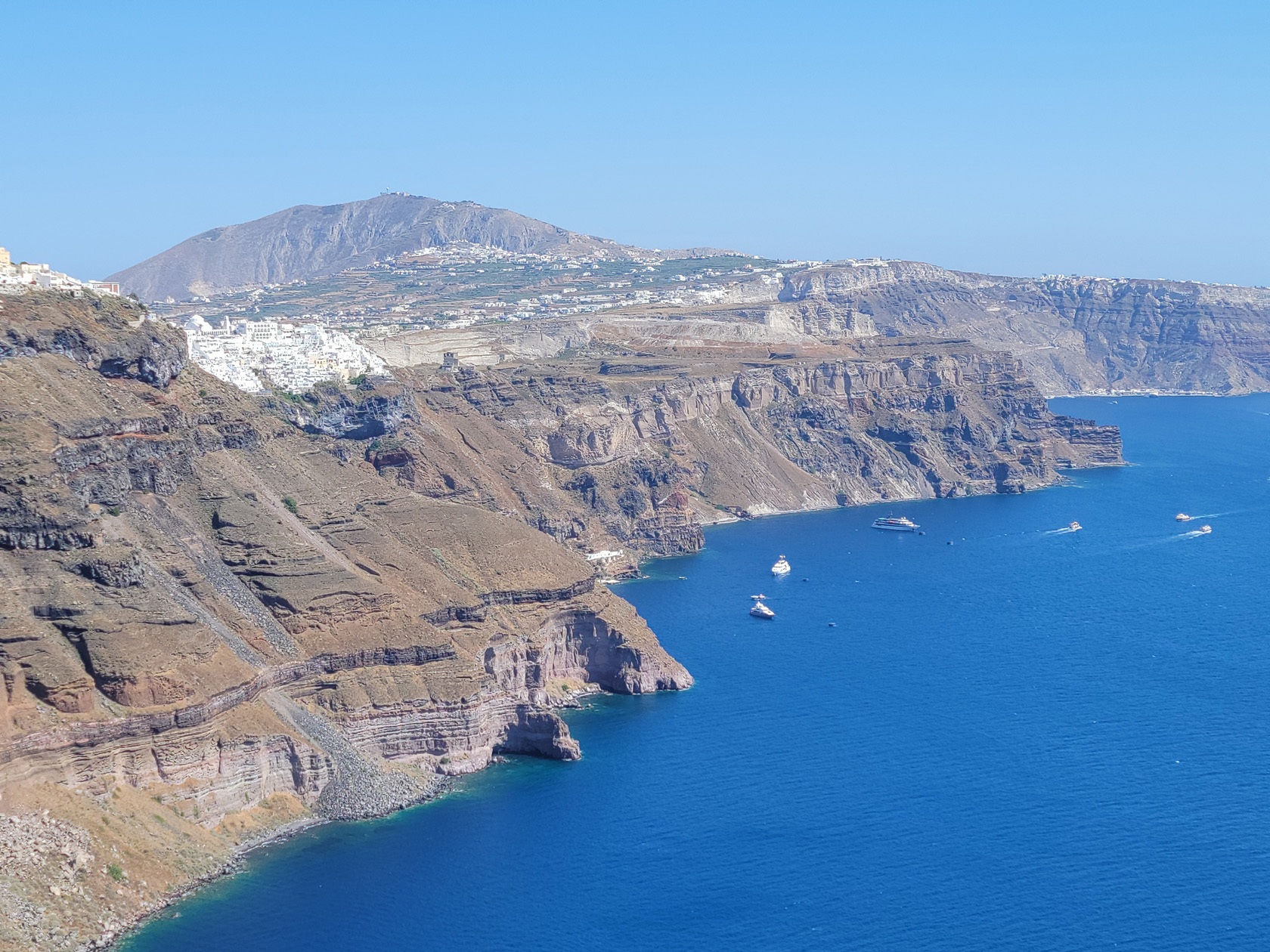
At the highest point on the largest piece of the caldera that still remains, sits Imerovigli. It is perched on and along the cliff, as though some flock of birds had built it. Yet historically most of the initial building were for wine making and production, later repurposed for the tourist industry.
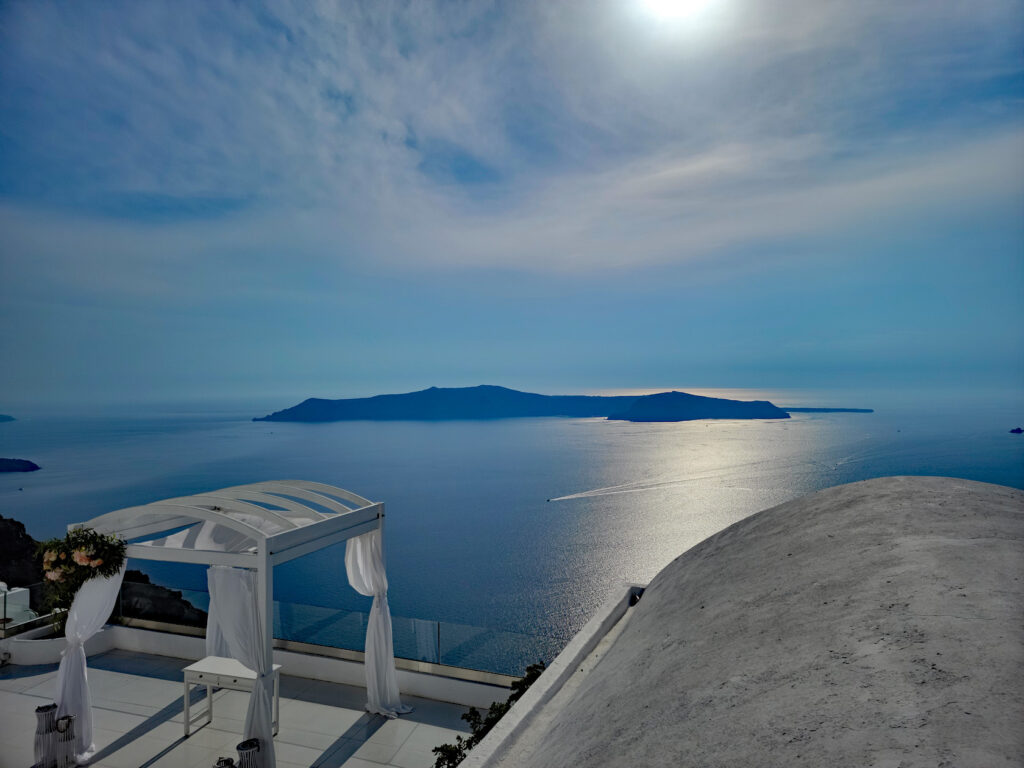
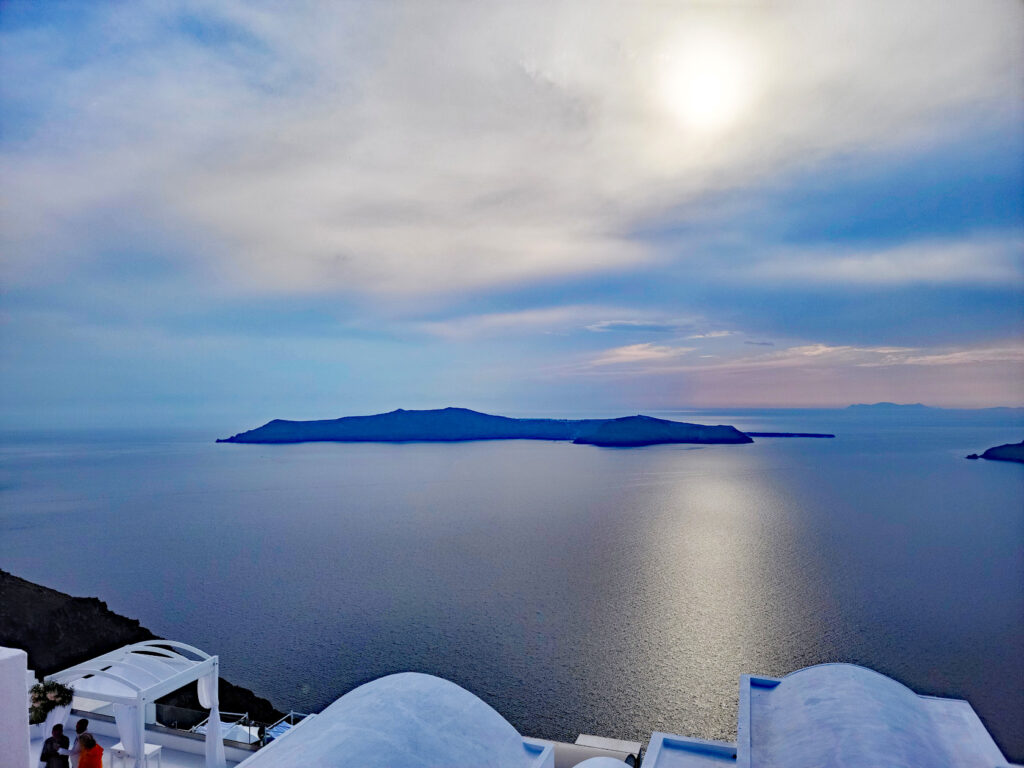
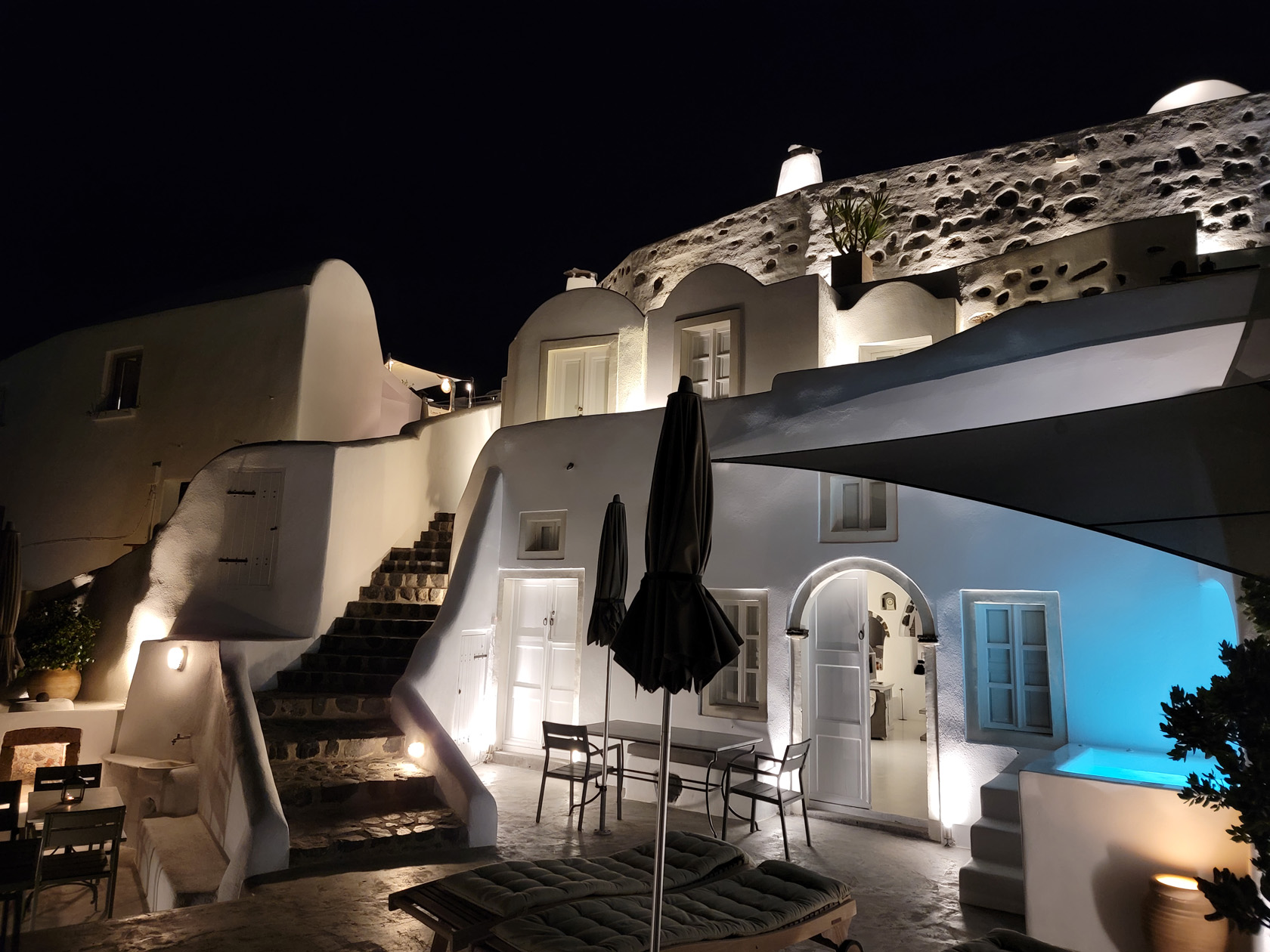
Imerovigli, Santorini – Heliotopos Hotel
It is actually amazing, how after such a catastrophe, that individuals would continue to build on such notorious ground. Though one can imagine, that after a few hundred years with the volcano’s silence, they probably could not resist planting in the rich volcanic soil.
The Heliotopos Hotel
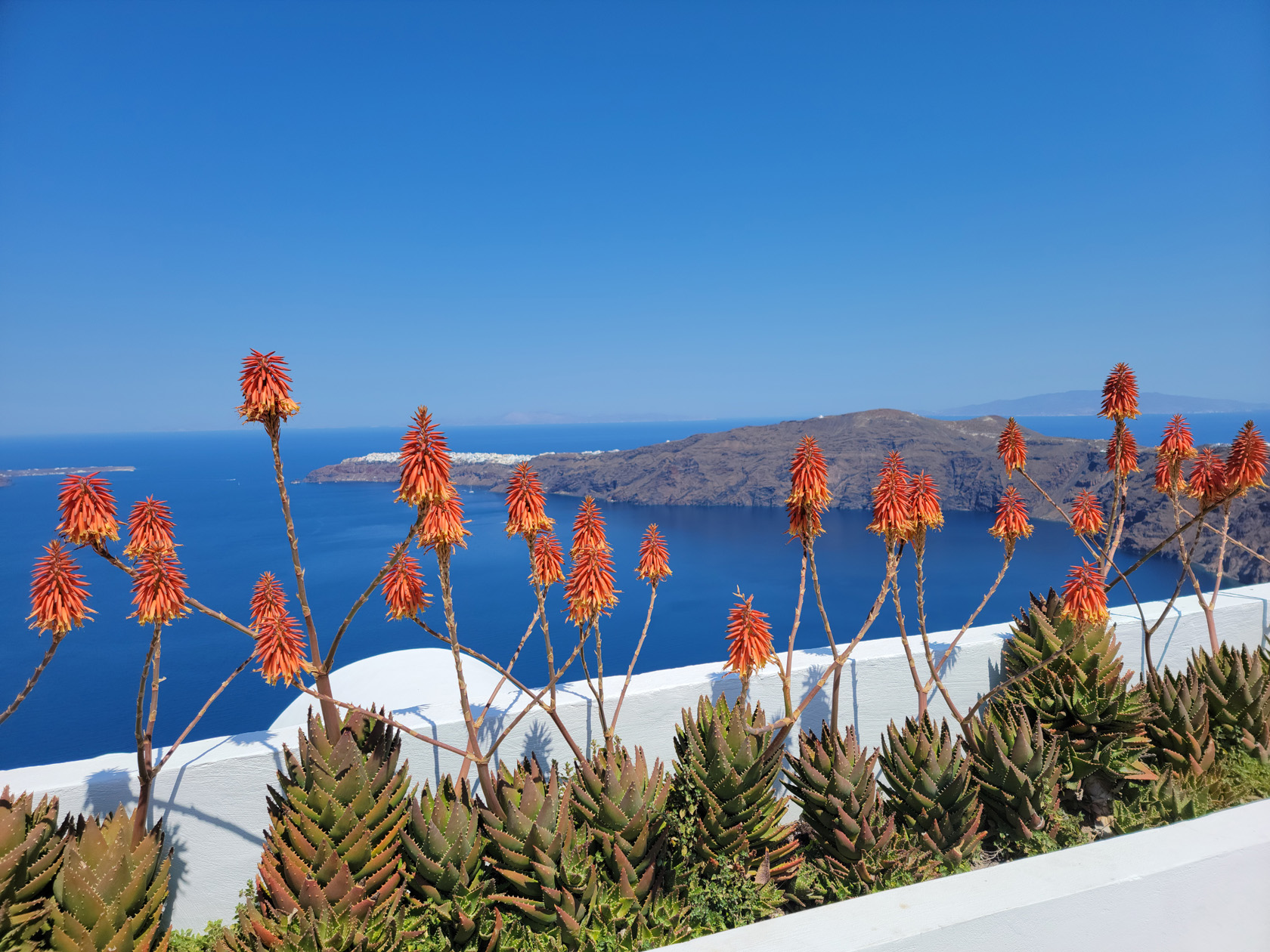
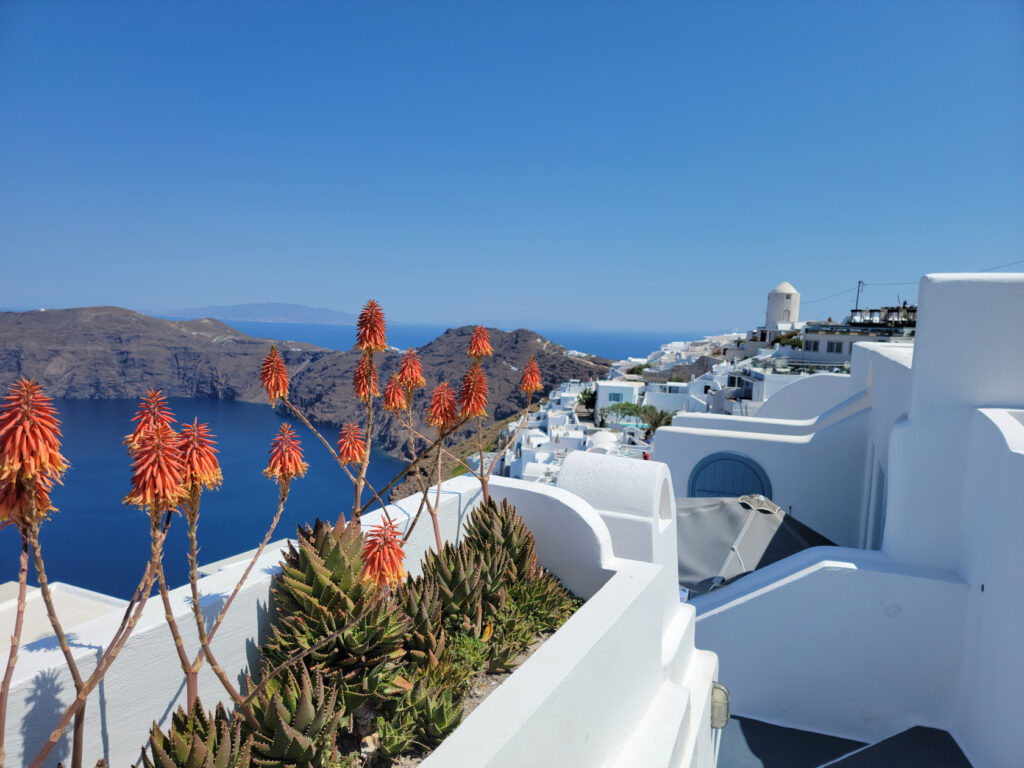
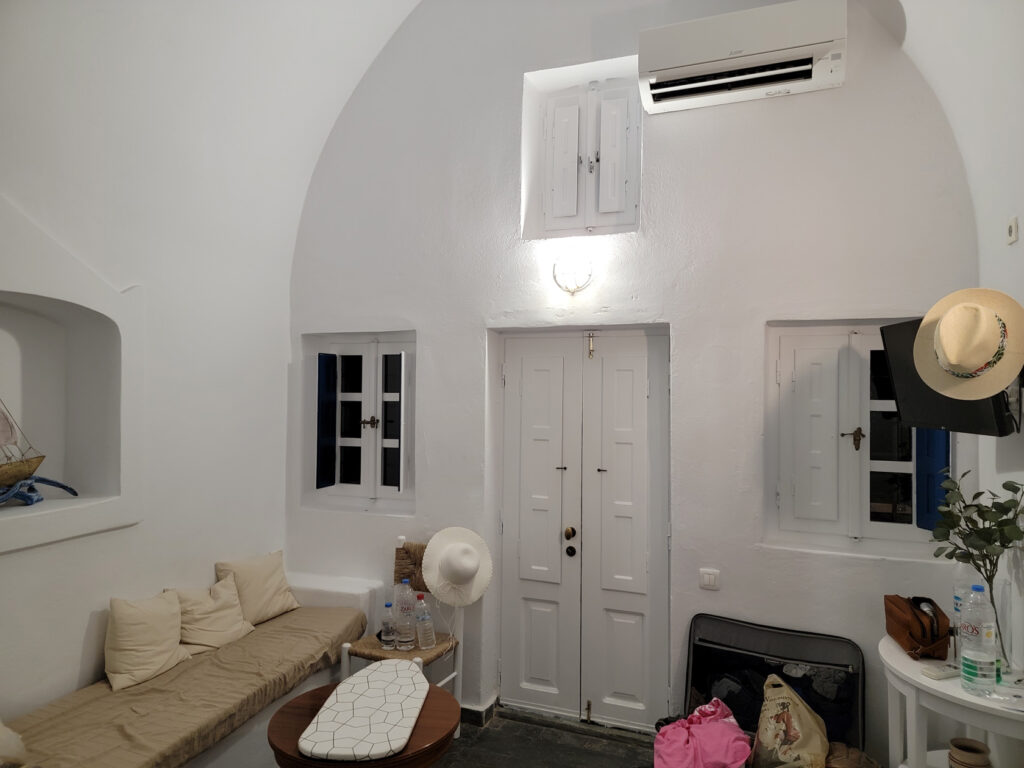
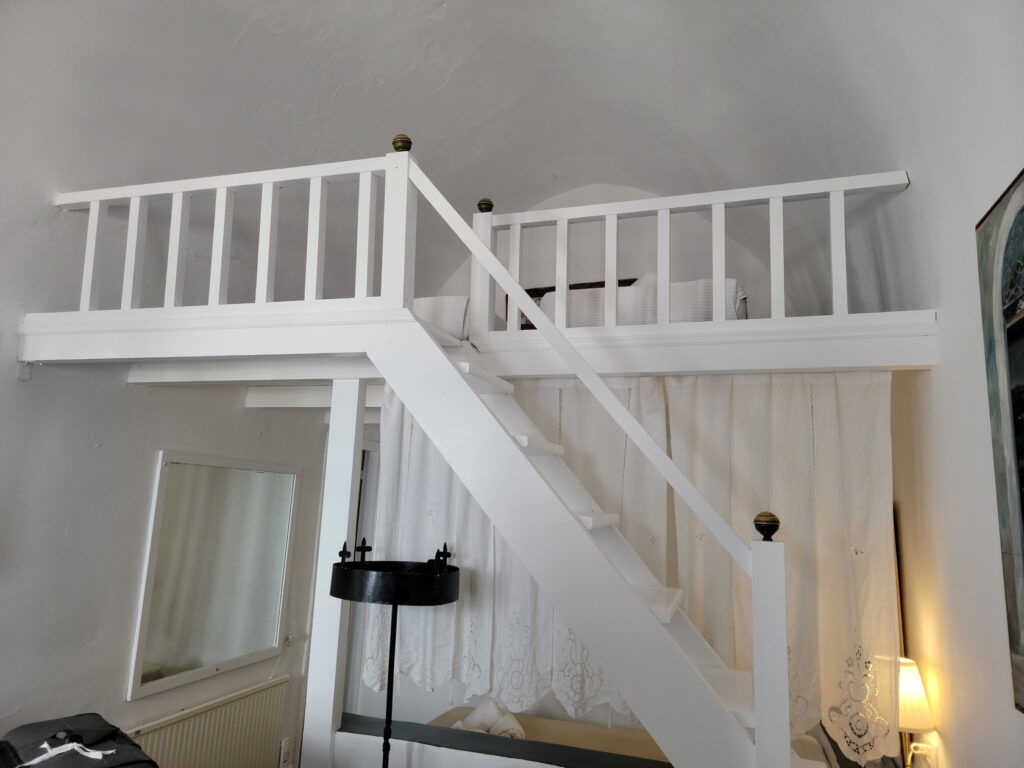
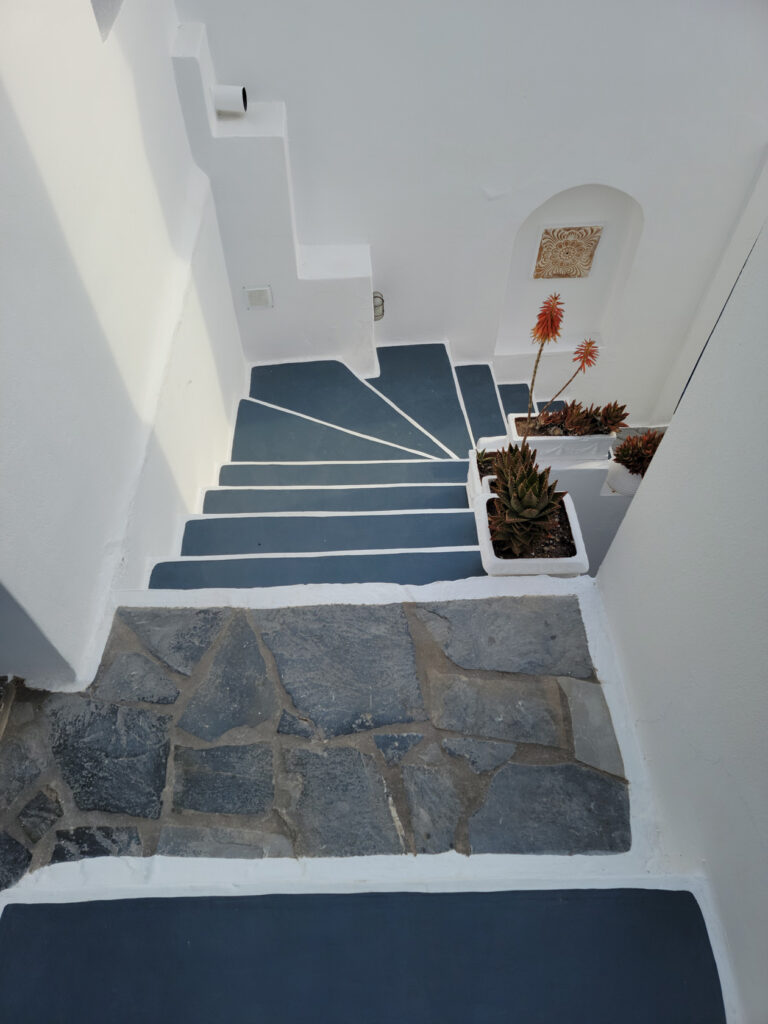
We stayed at the Heliotopos Hotel in Imerovigli, which is strategically located on the footpath to Thira, for those wishing that early morning walk, or just access to the island path that actually goes from Thira all the way to Oia.
Imerovigli, Santorini – Heliotopos Hotel
Imerovigli, Santorini – Heliotopos Hotel
Imerovigli, Santorini – Heliotopos Hotel
Imerovigli, Santorini – Heliotopos Hotel
Imerovigli, Santorini – Heliotopos Hotel
Imerovigli, Santorini – Heliotopos Hotel
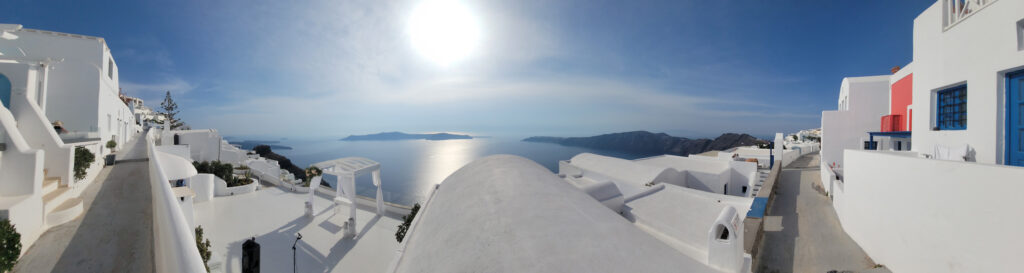
Imerovigli, Santorini – Heliotopos Hotel – Panorama
Imerovigli, Santorini – Heliotopos Hotel
Imerovigli, Santorini – Heliotopos Hotel
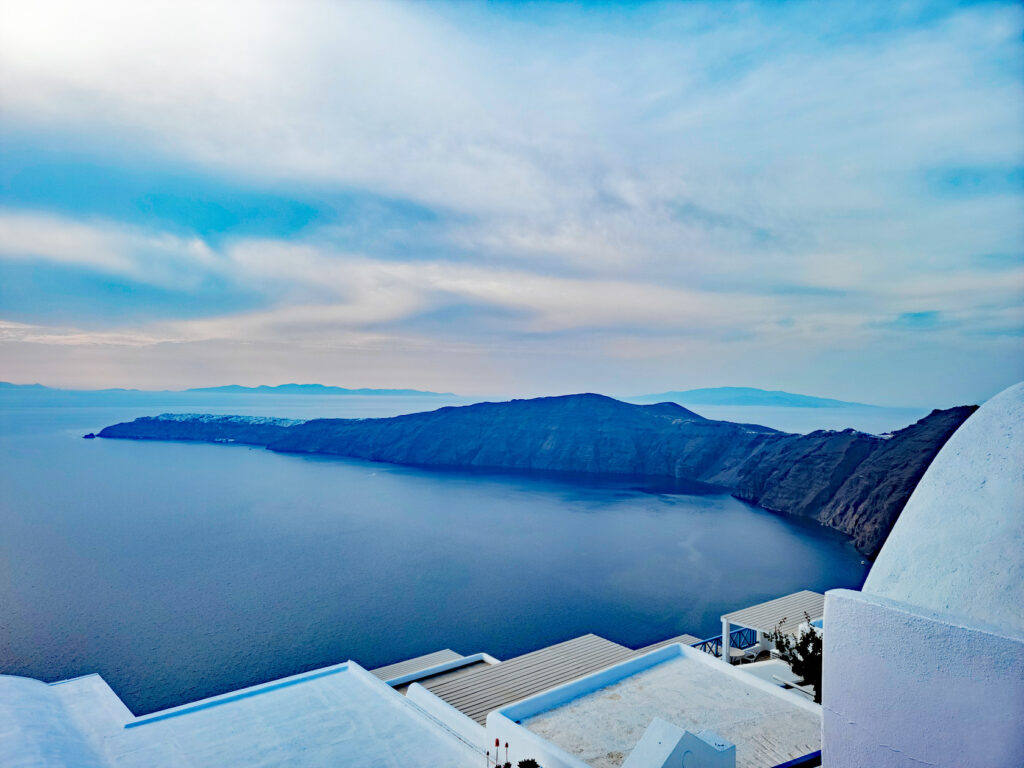
Imerovigli, Santorini – Heliotopos Hotel – Caldera Wall
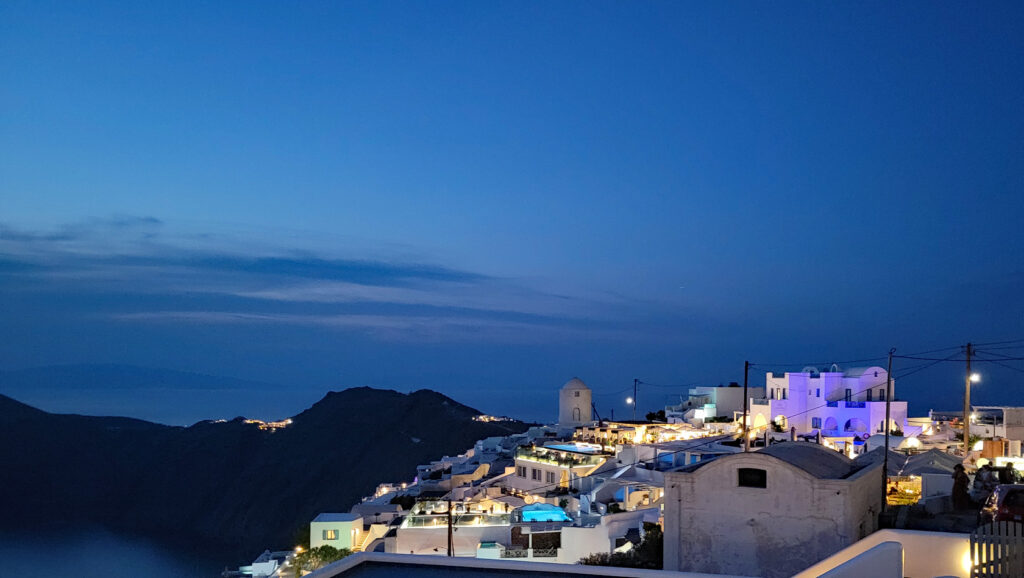
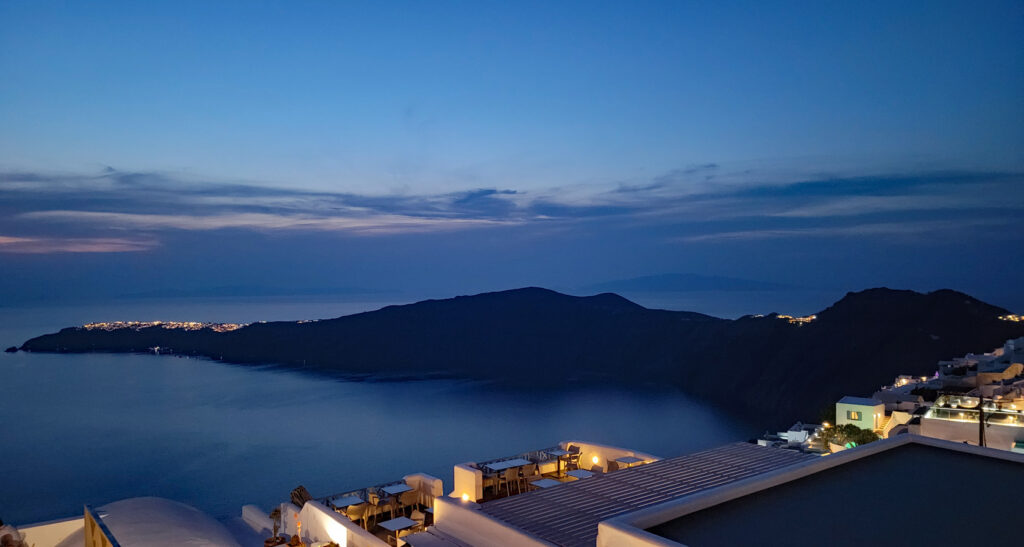
Imerovigli, Santorini – Heliotopos Hotel – After Sunset
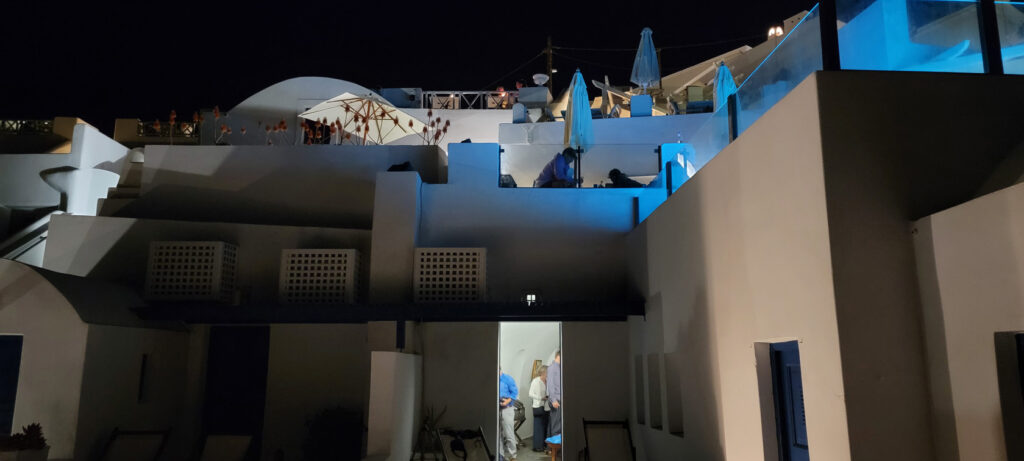
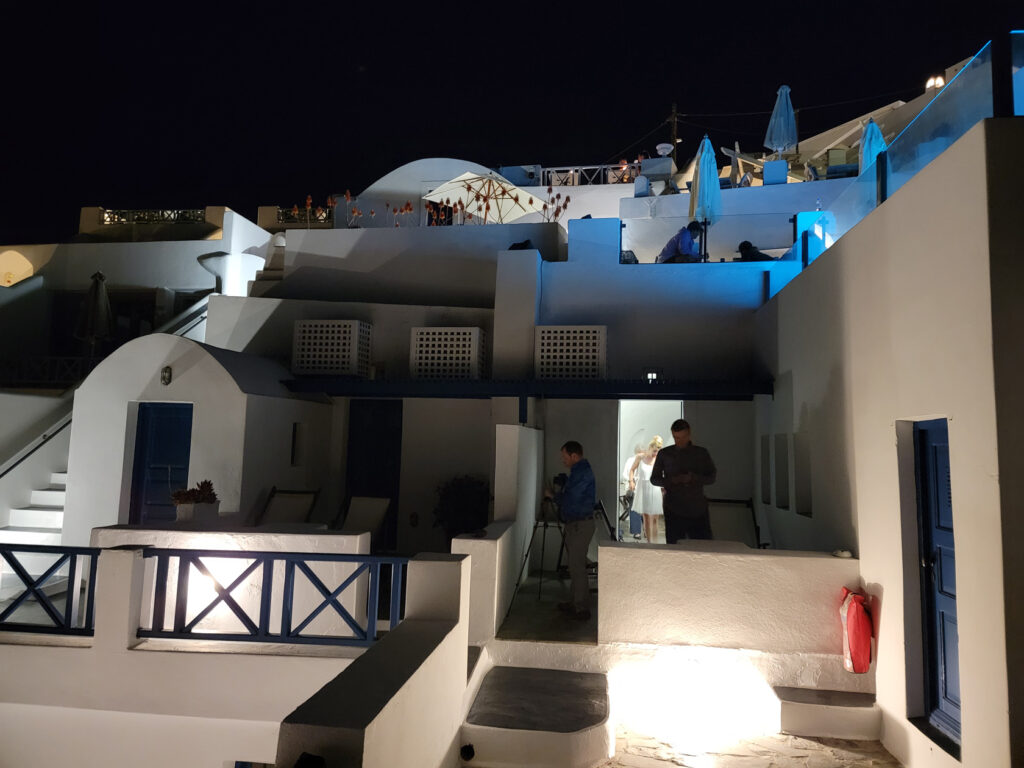
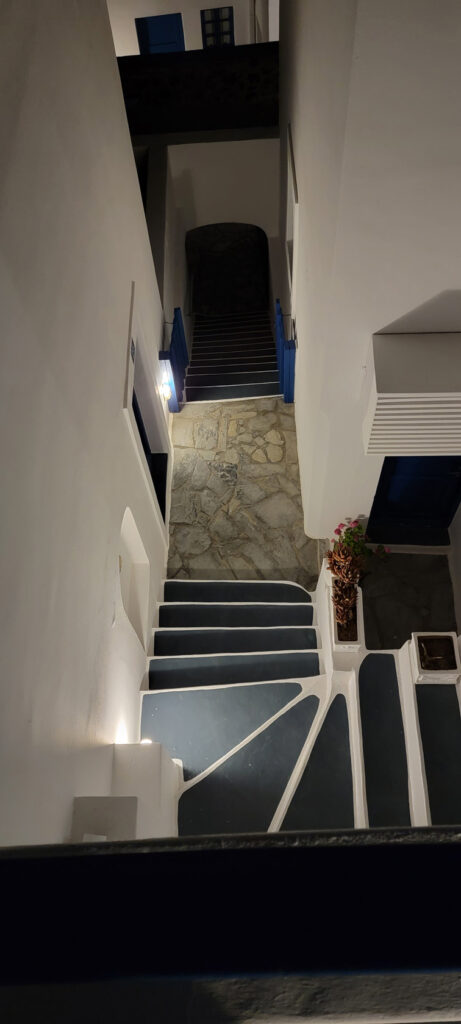
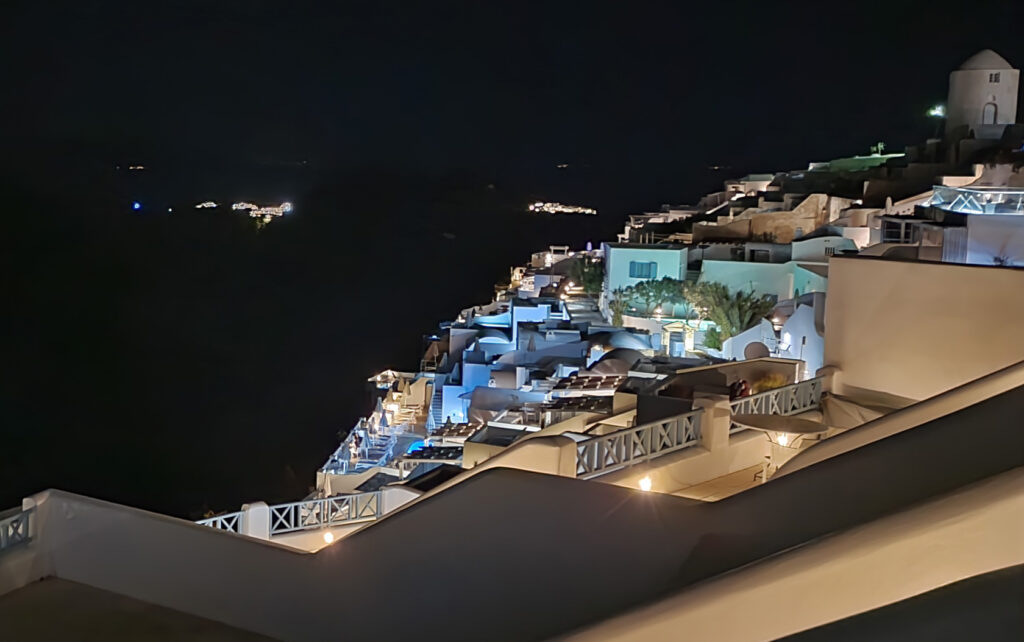
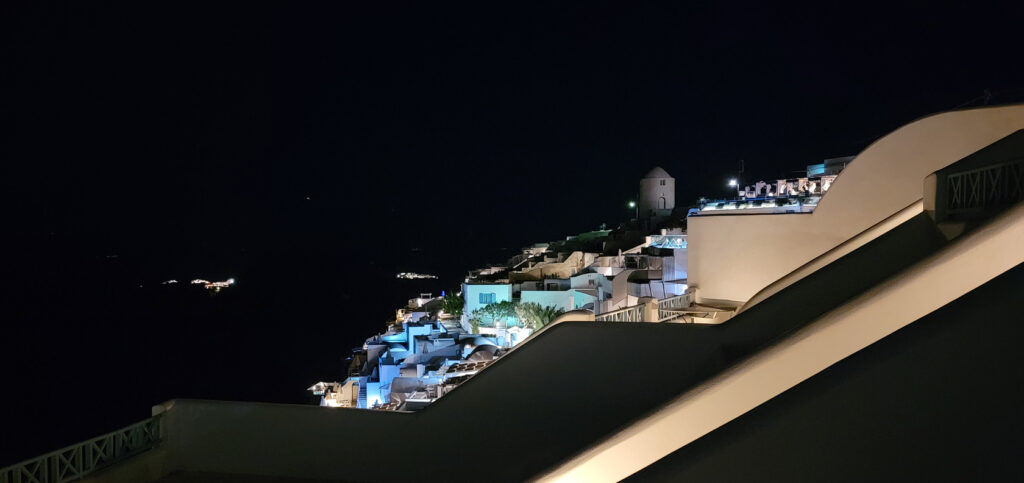
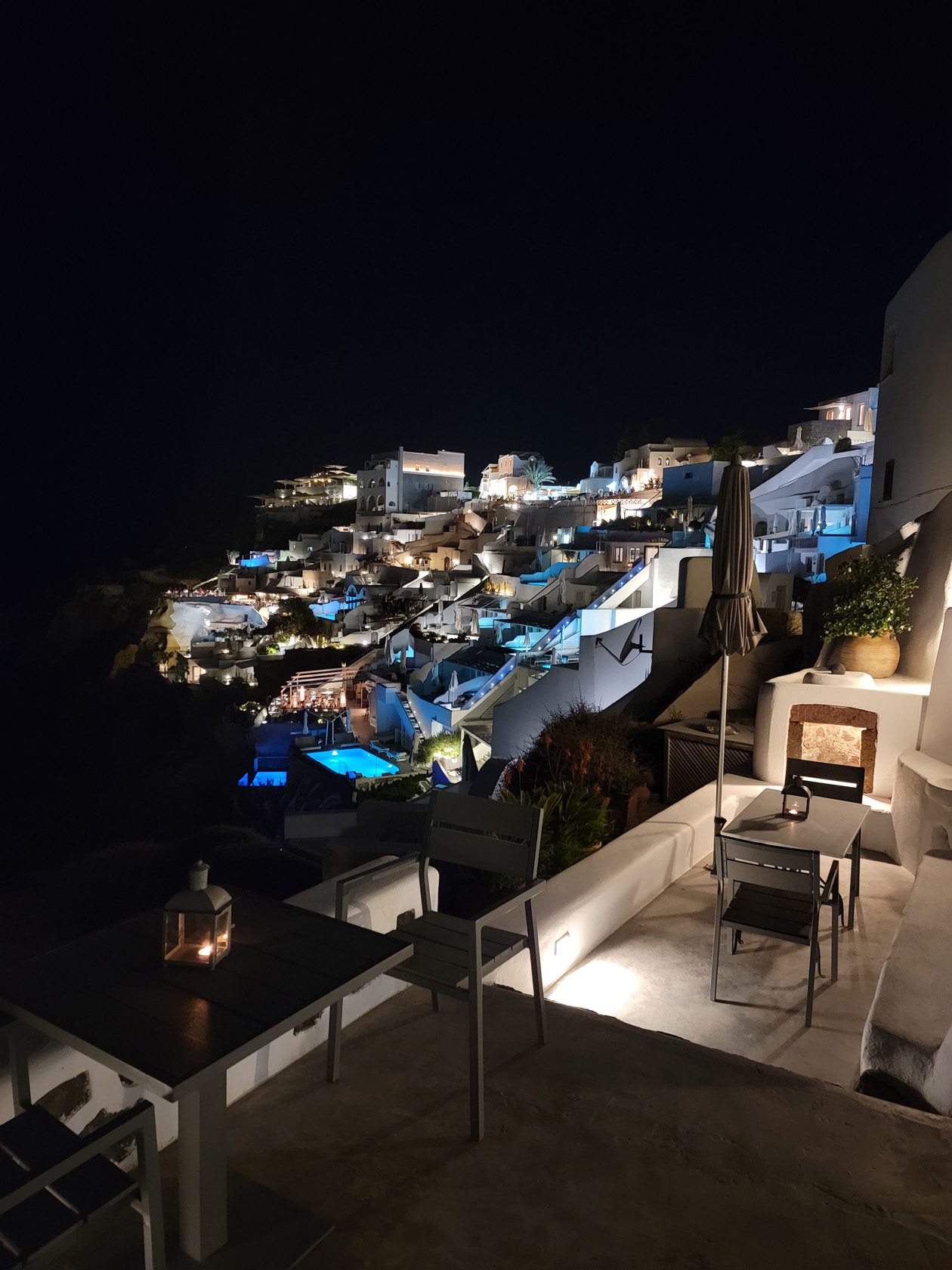
Imerovigli, Santorini – Heliotopos Hotel – At Night
Imerovigli, Santorini – Heliotopos Hotel – At Night
Imerovigli, Santorini – Heliotopos Hotel – At Night
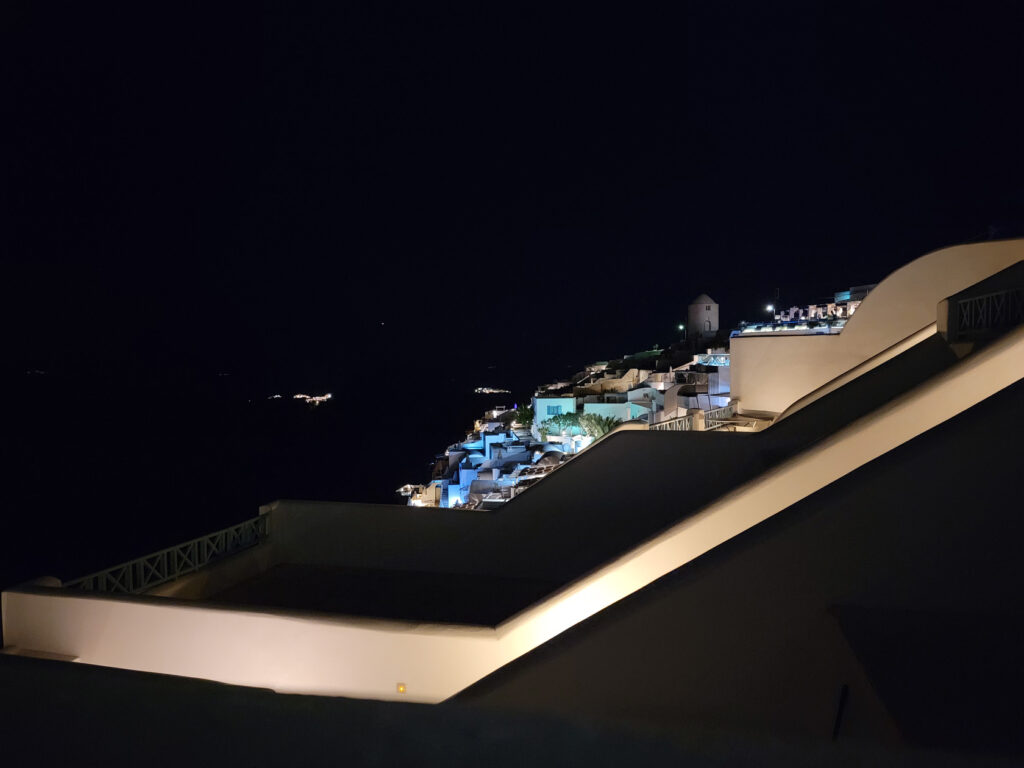
Imerovigli, Santorini – Heliotopos Hotel – Oia At Night
Imerovigli, Santorini – Heliotopos Hotel – At Night
Imerovigli, Santorini – Heliotopos Hotel – At Night
Imerovigli, Santorini – Heliotopos Hotel – At Night
Imerovigli, Santorini – Blue Domes and Churches
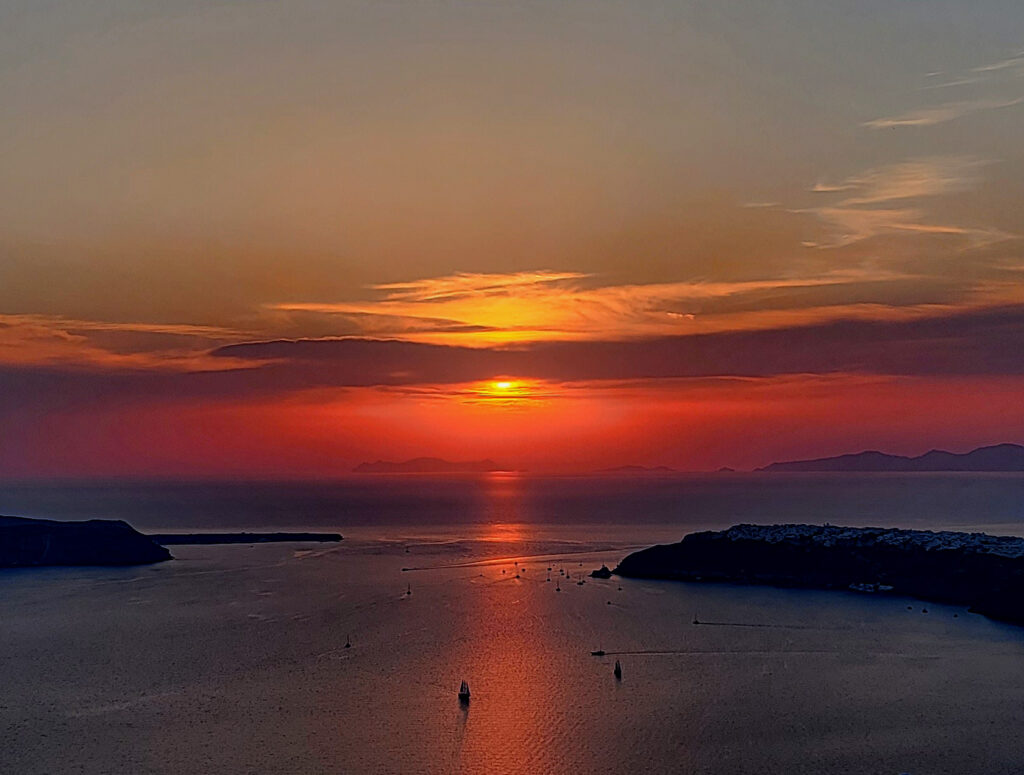
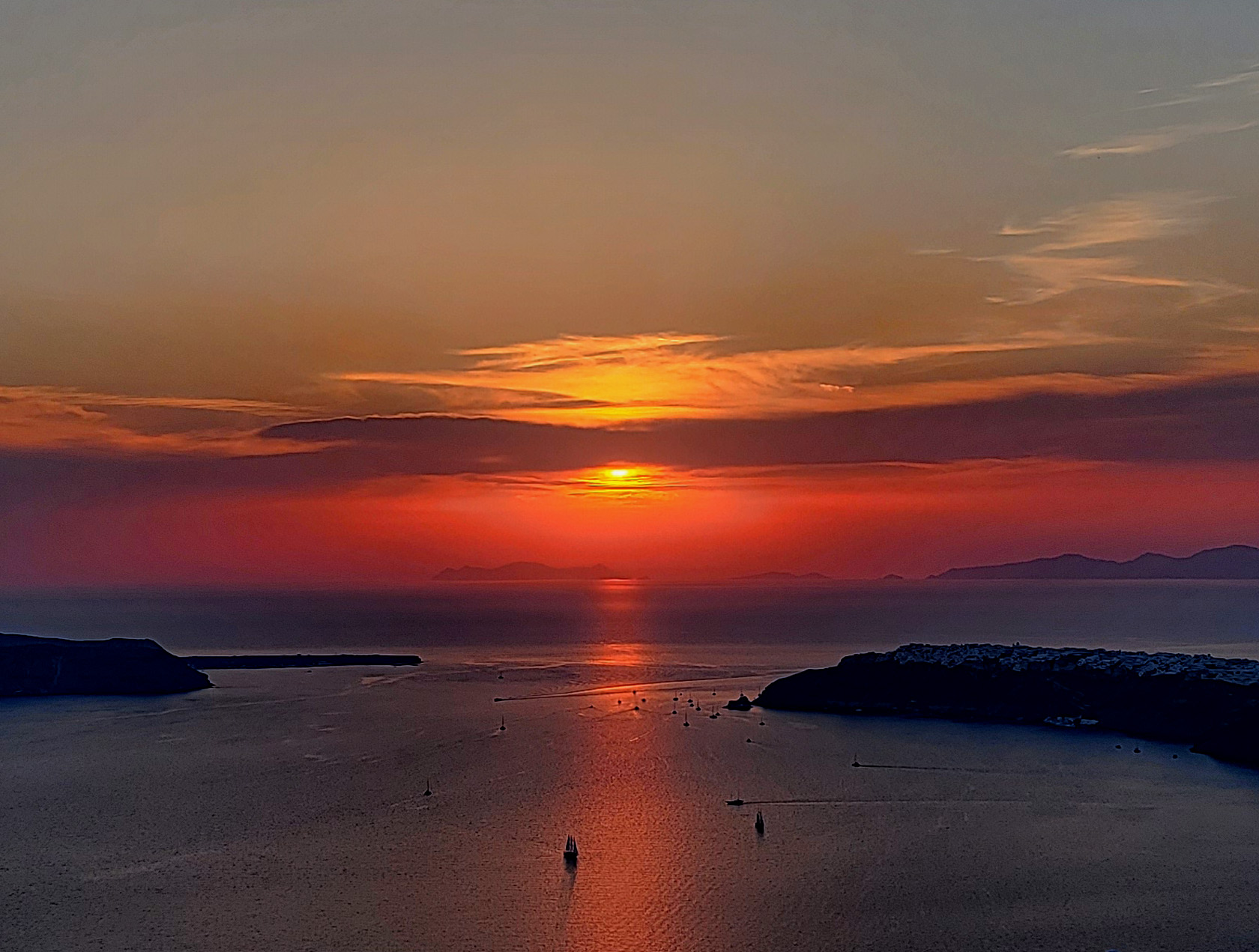
Imerovigli, Santorini – A Sunset
Imerovigli, Santorini – The Moon
Imerovigli, Santorini – At Night
Imerovigli, Santorini – At Night
Skaros Rock
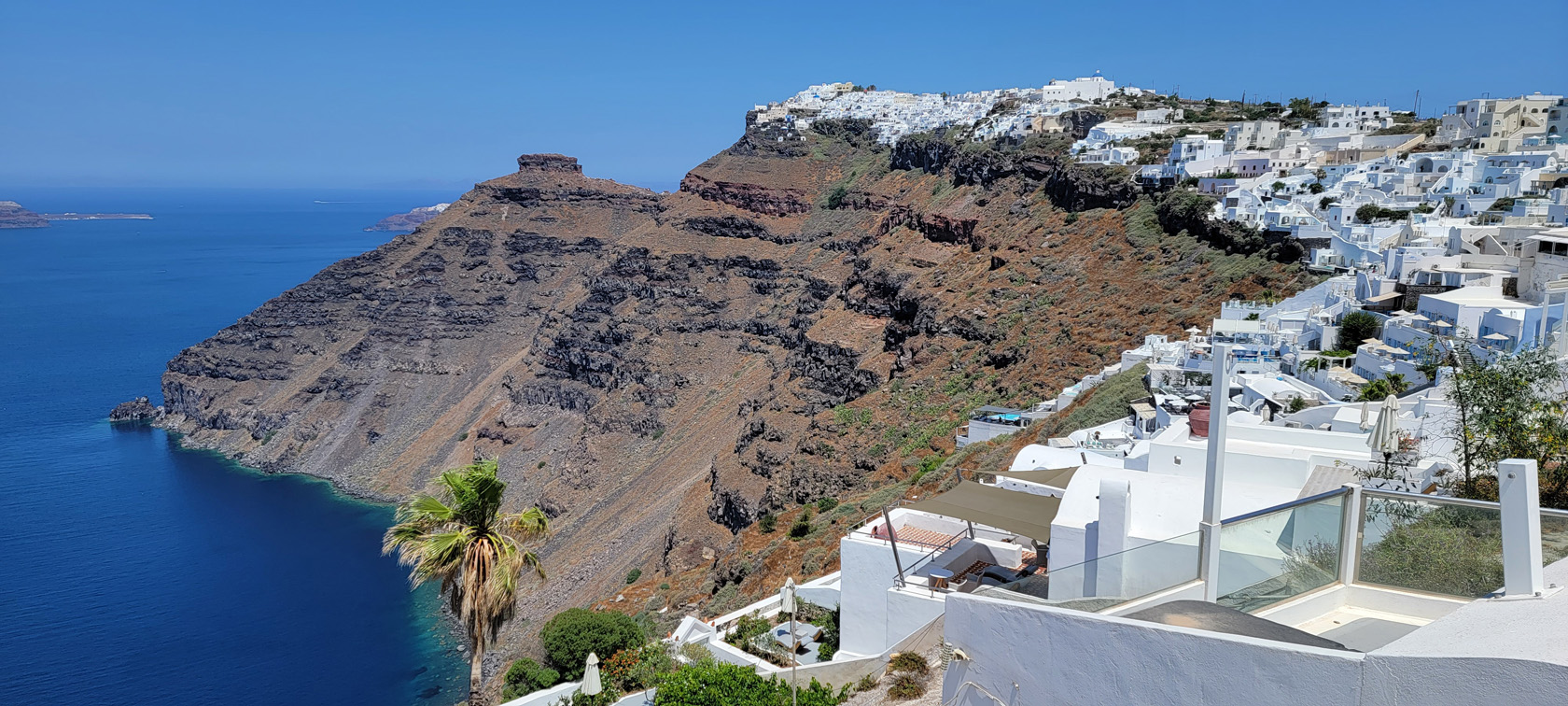
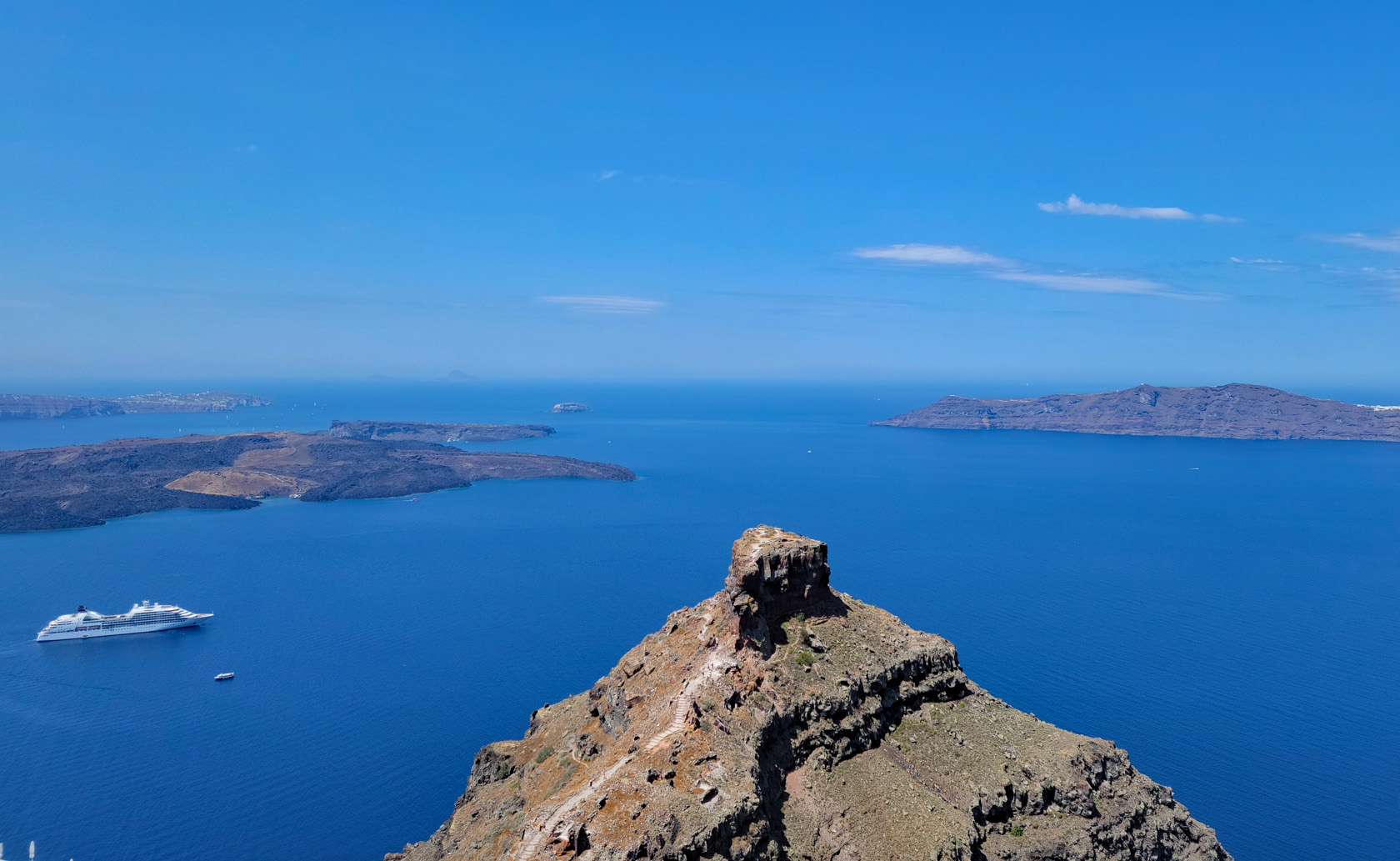
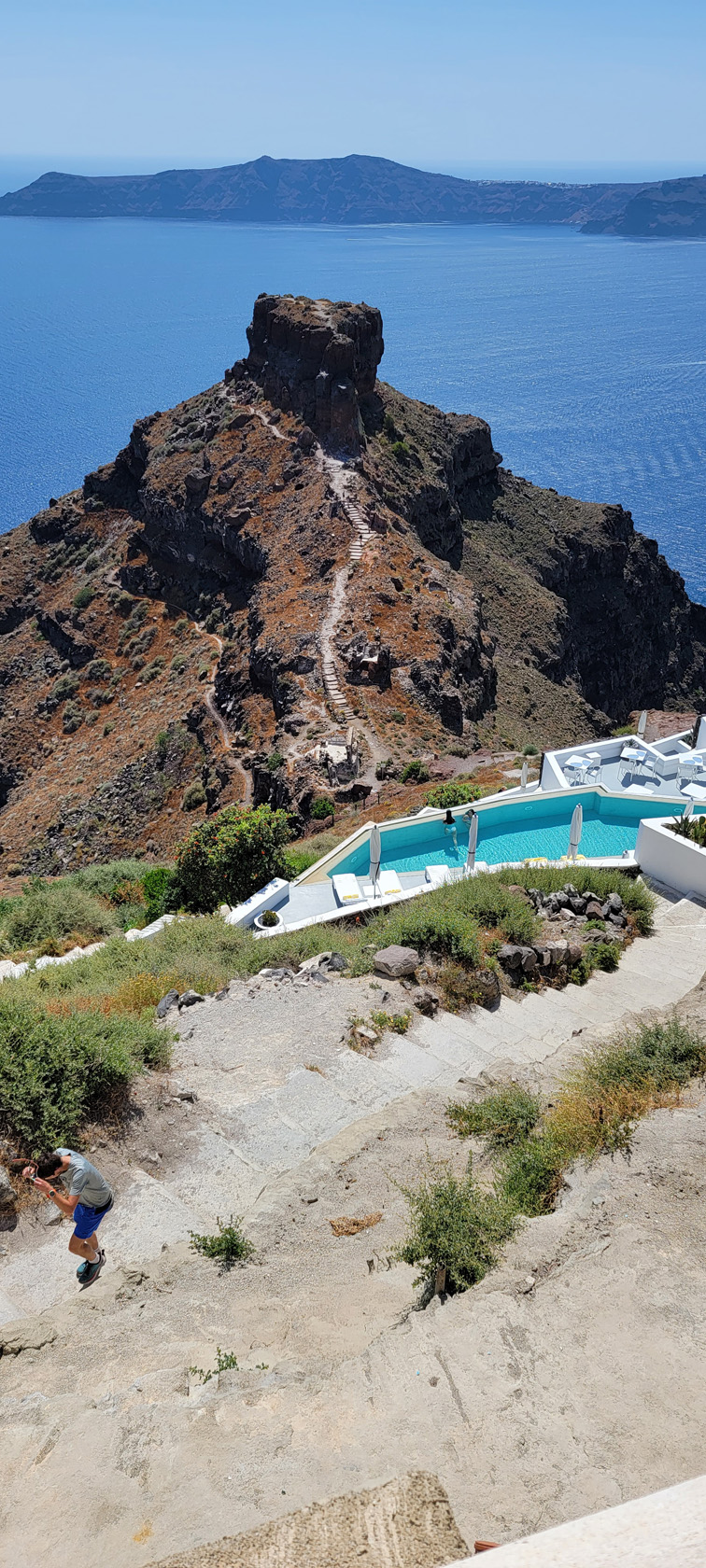
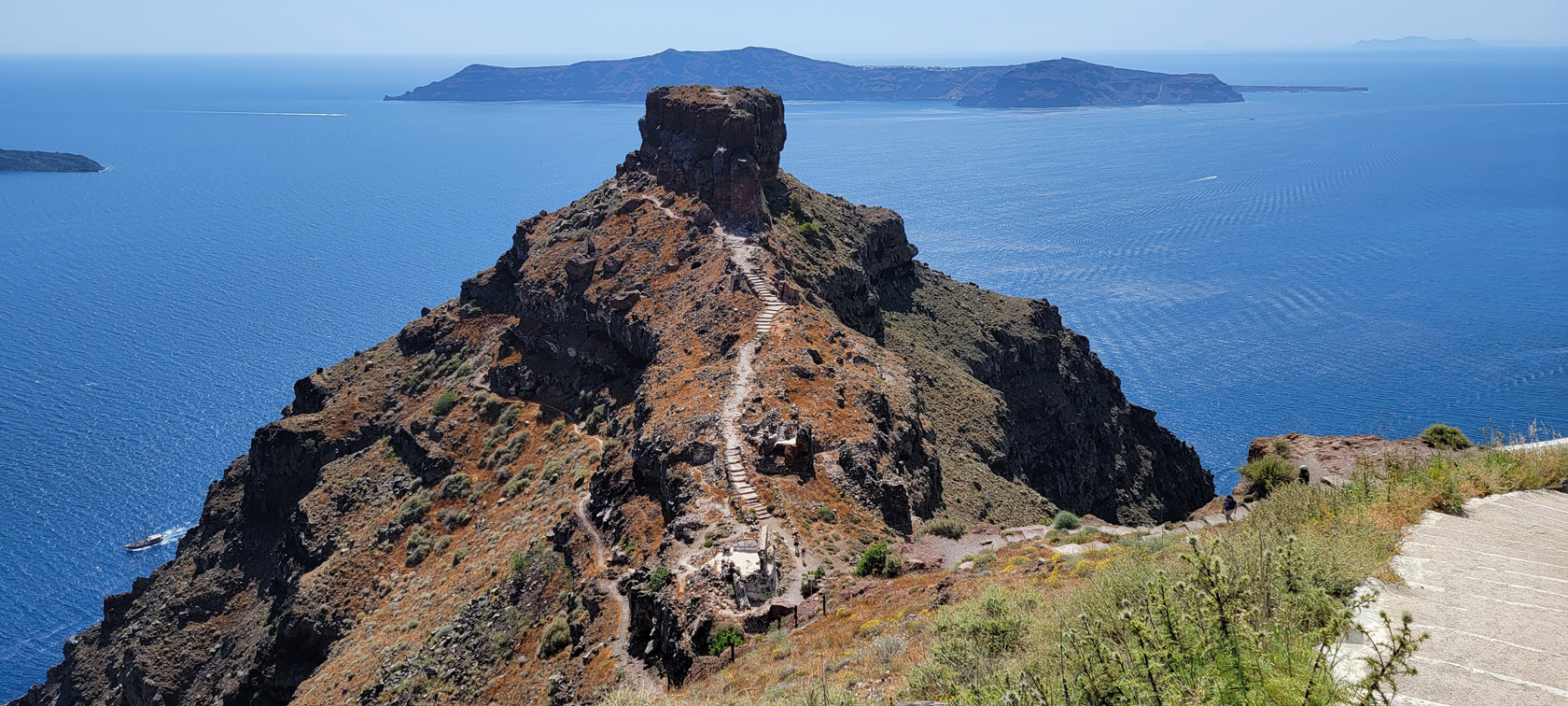
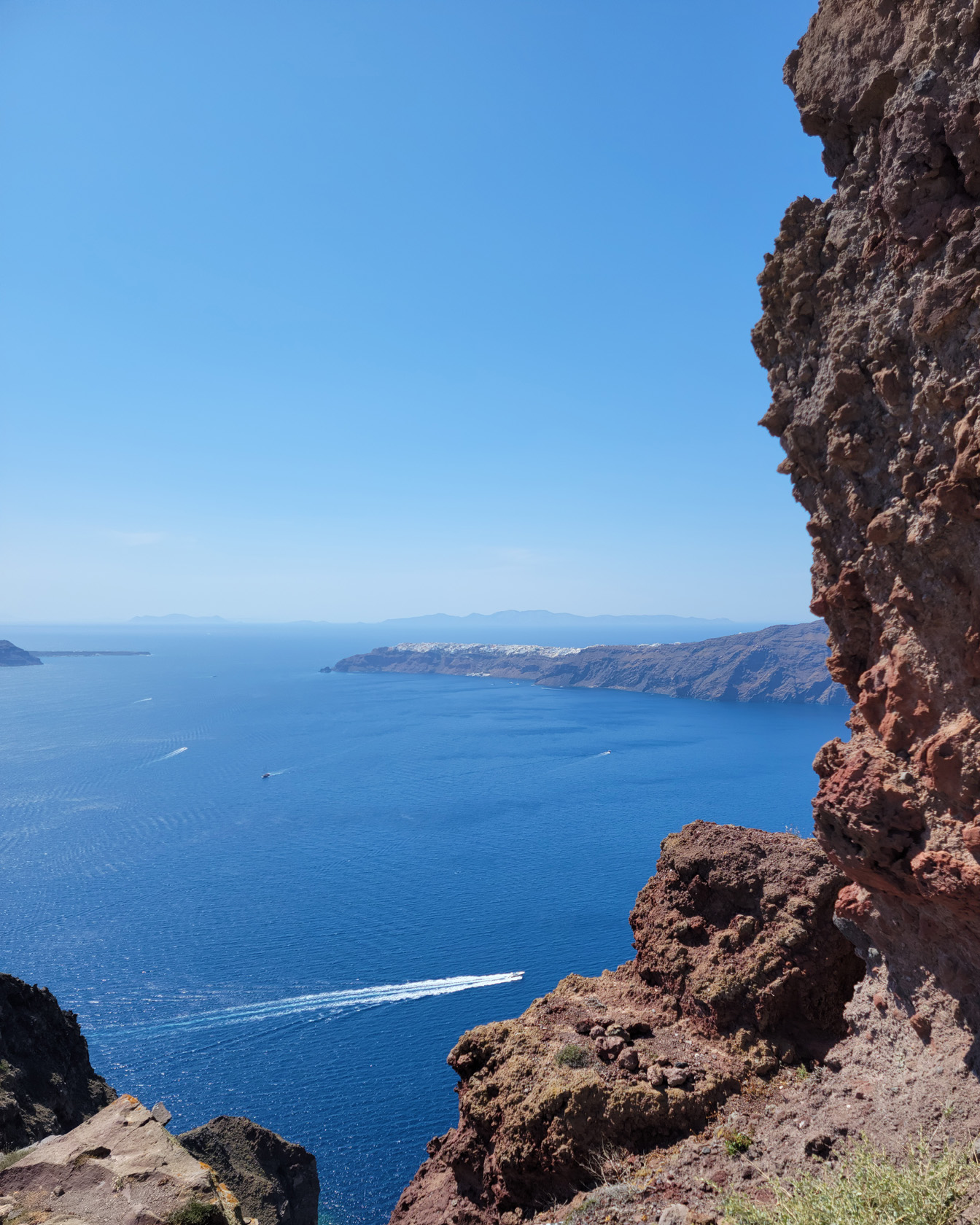
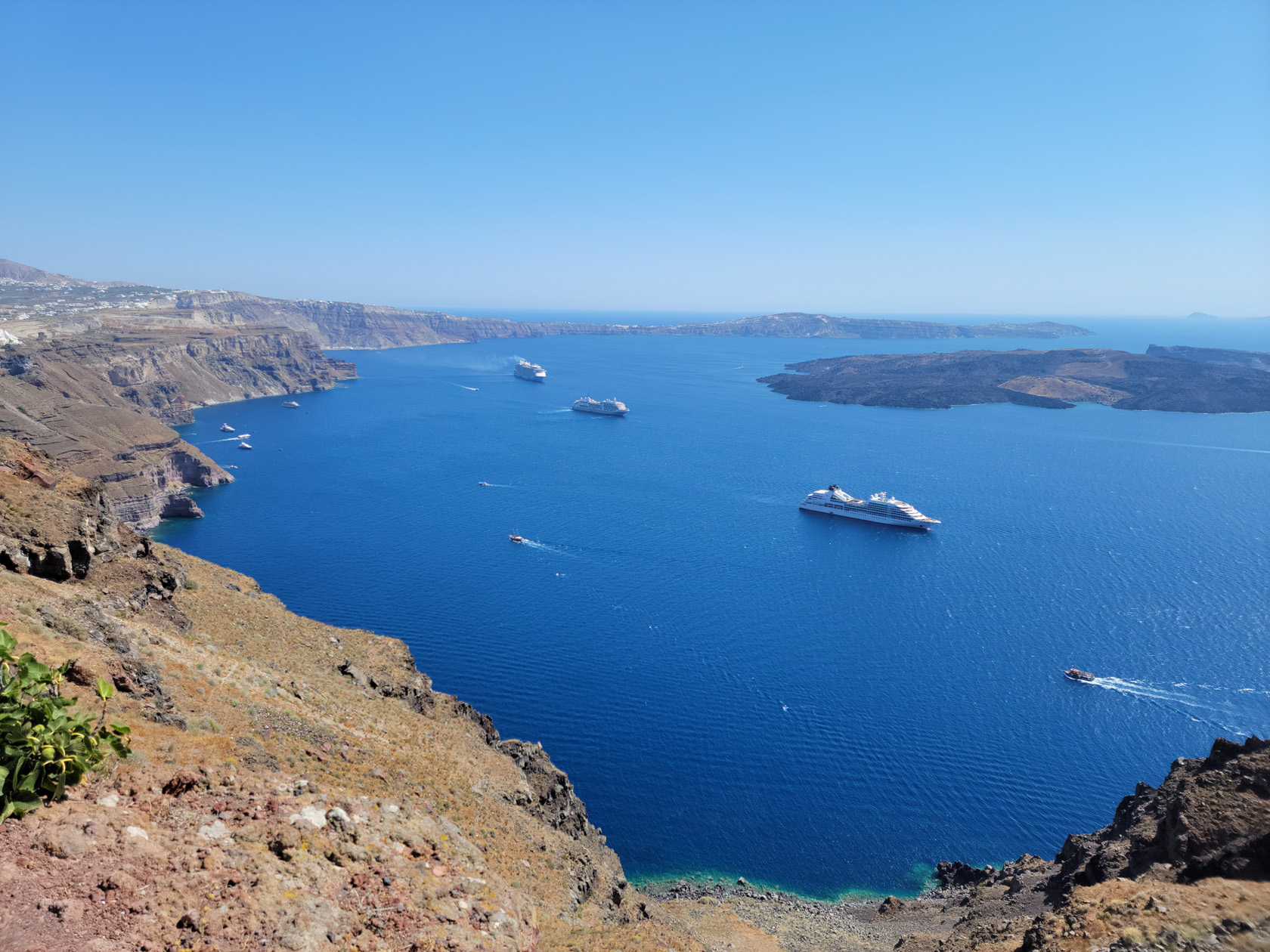
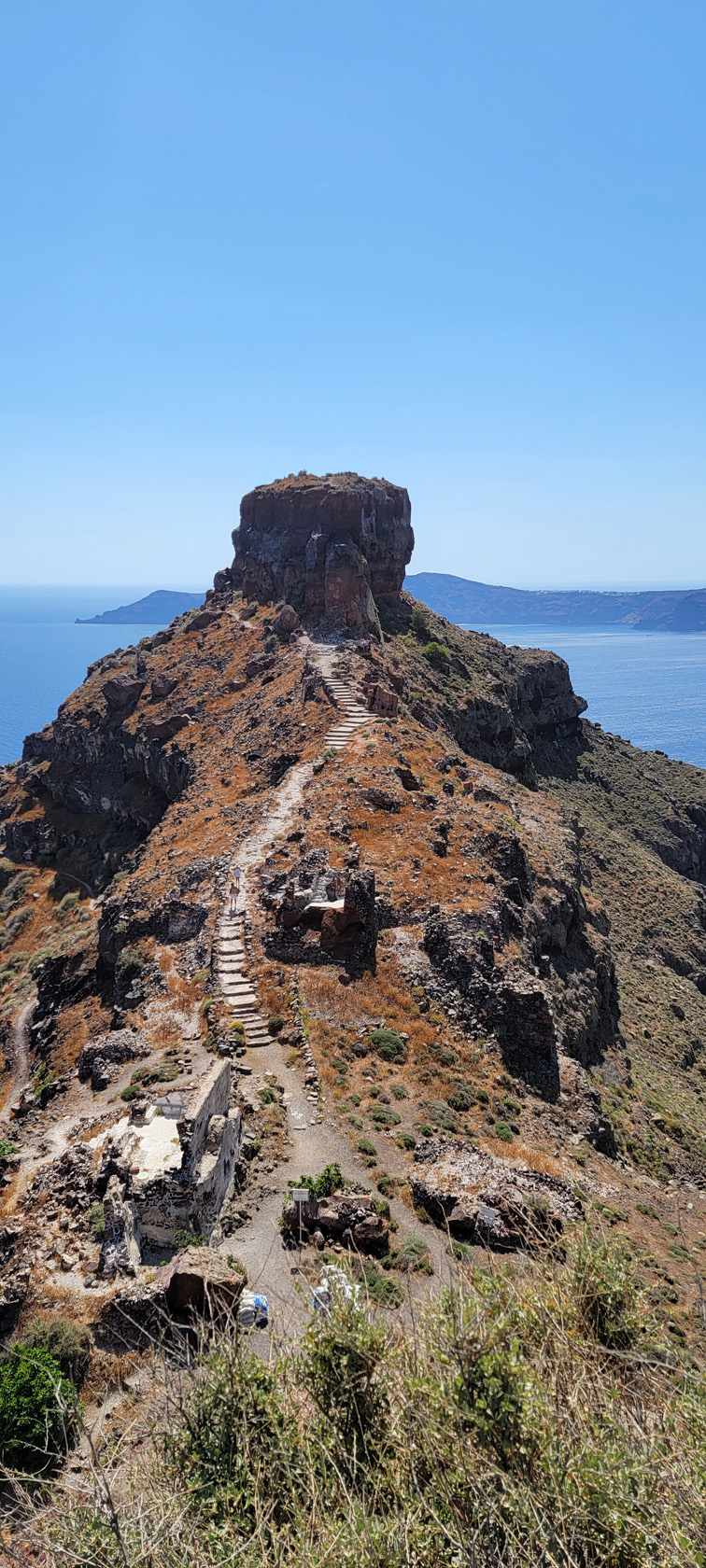
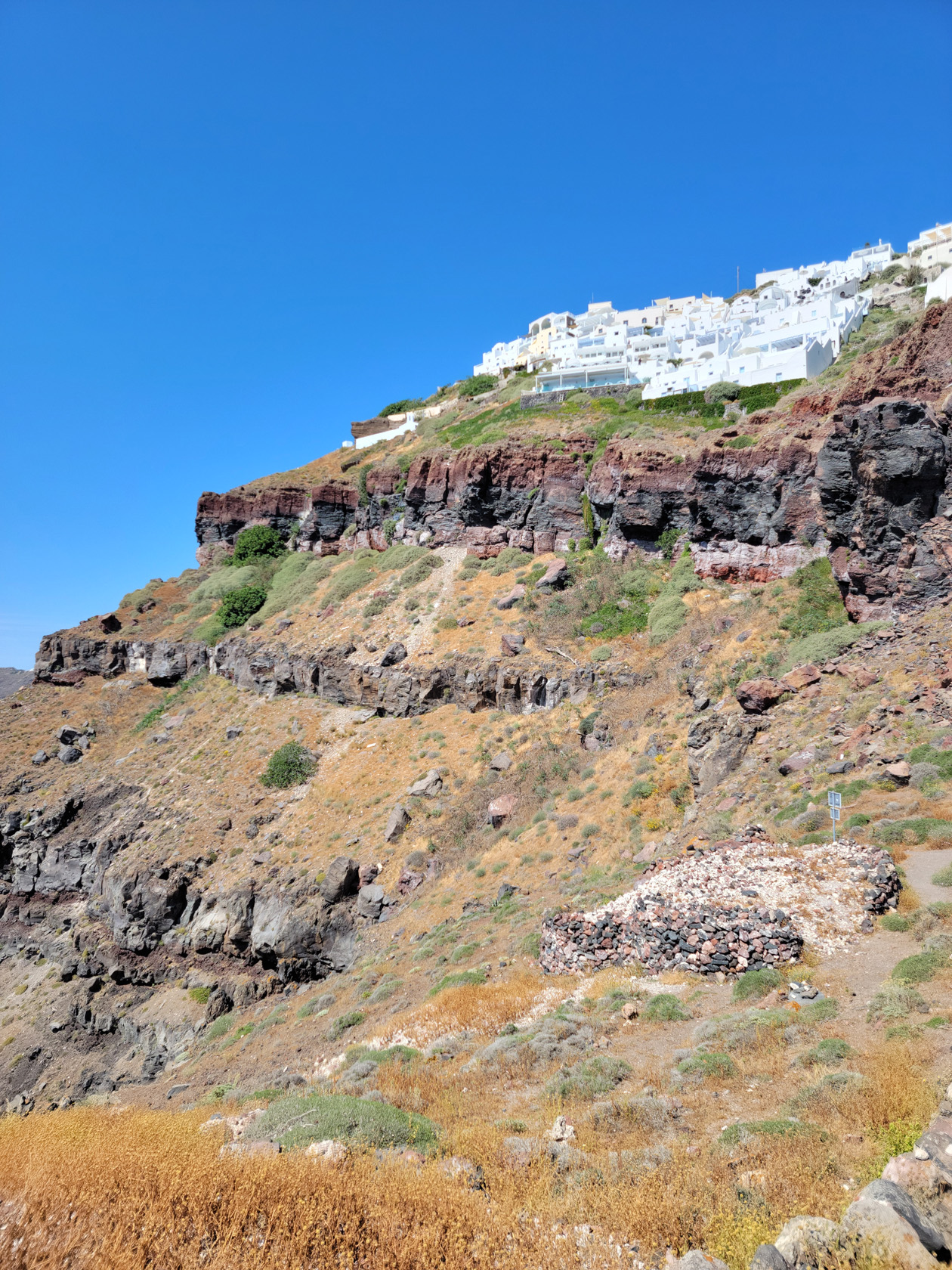
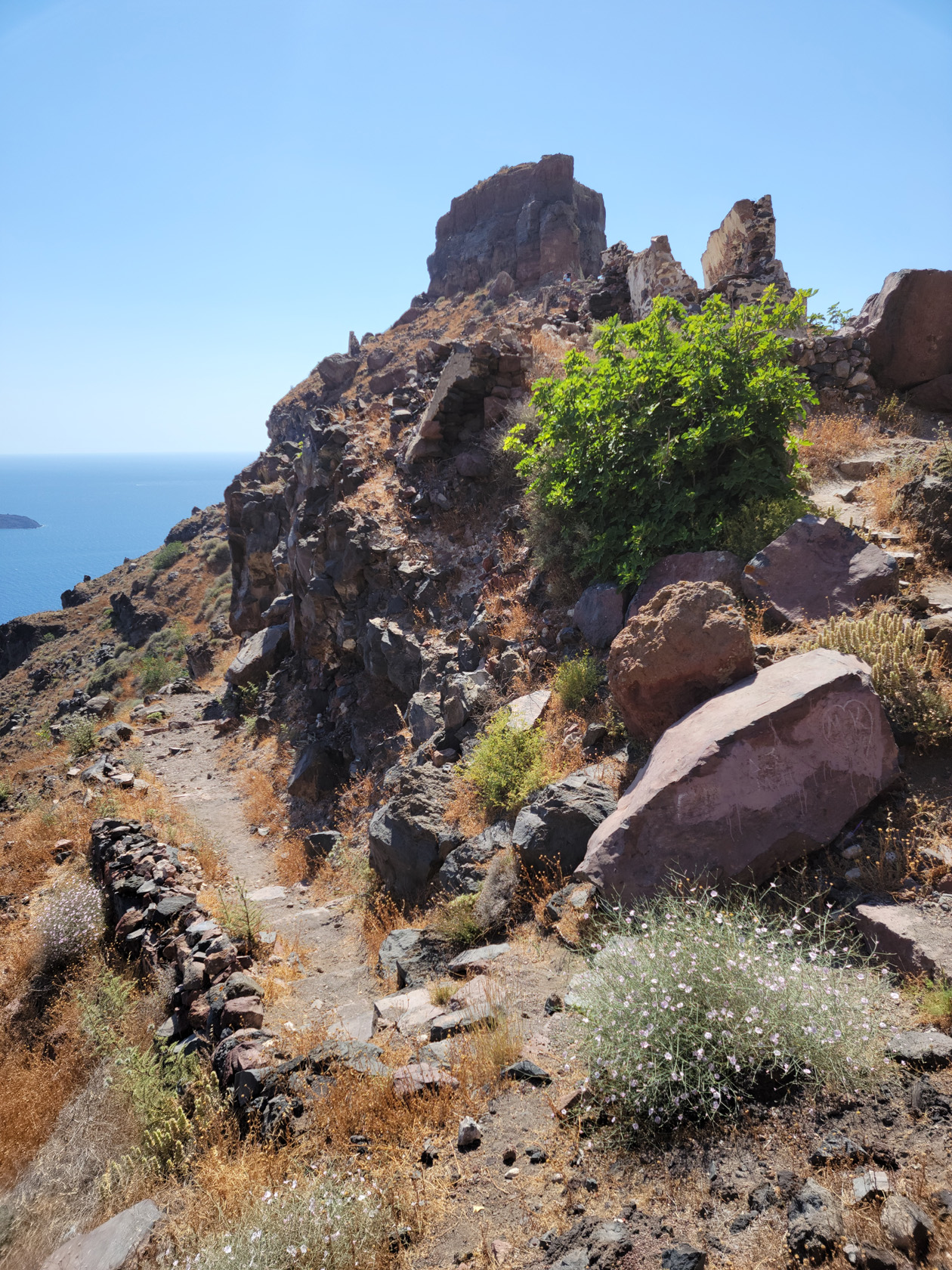
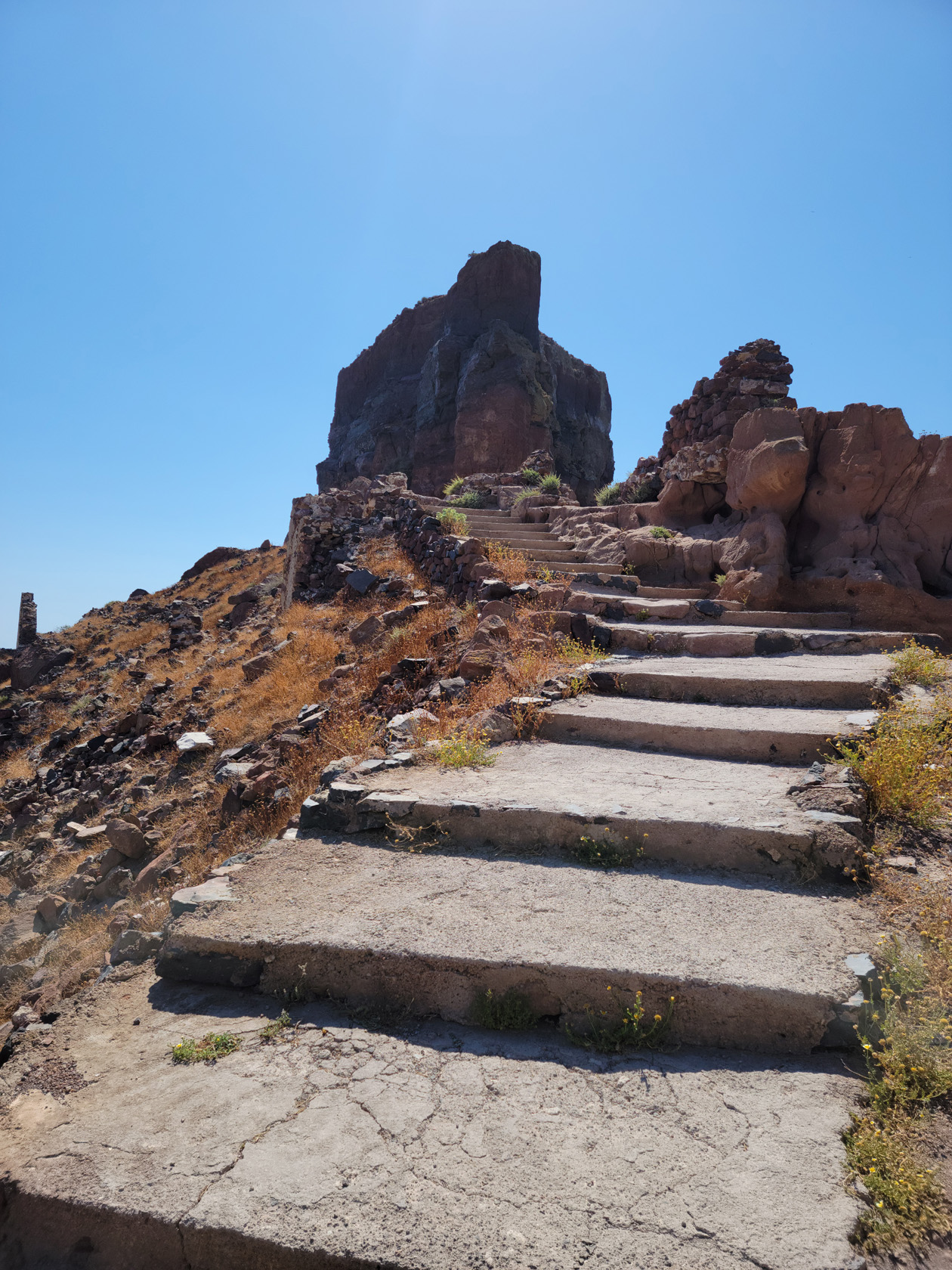
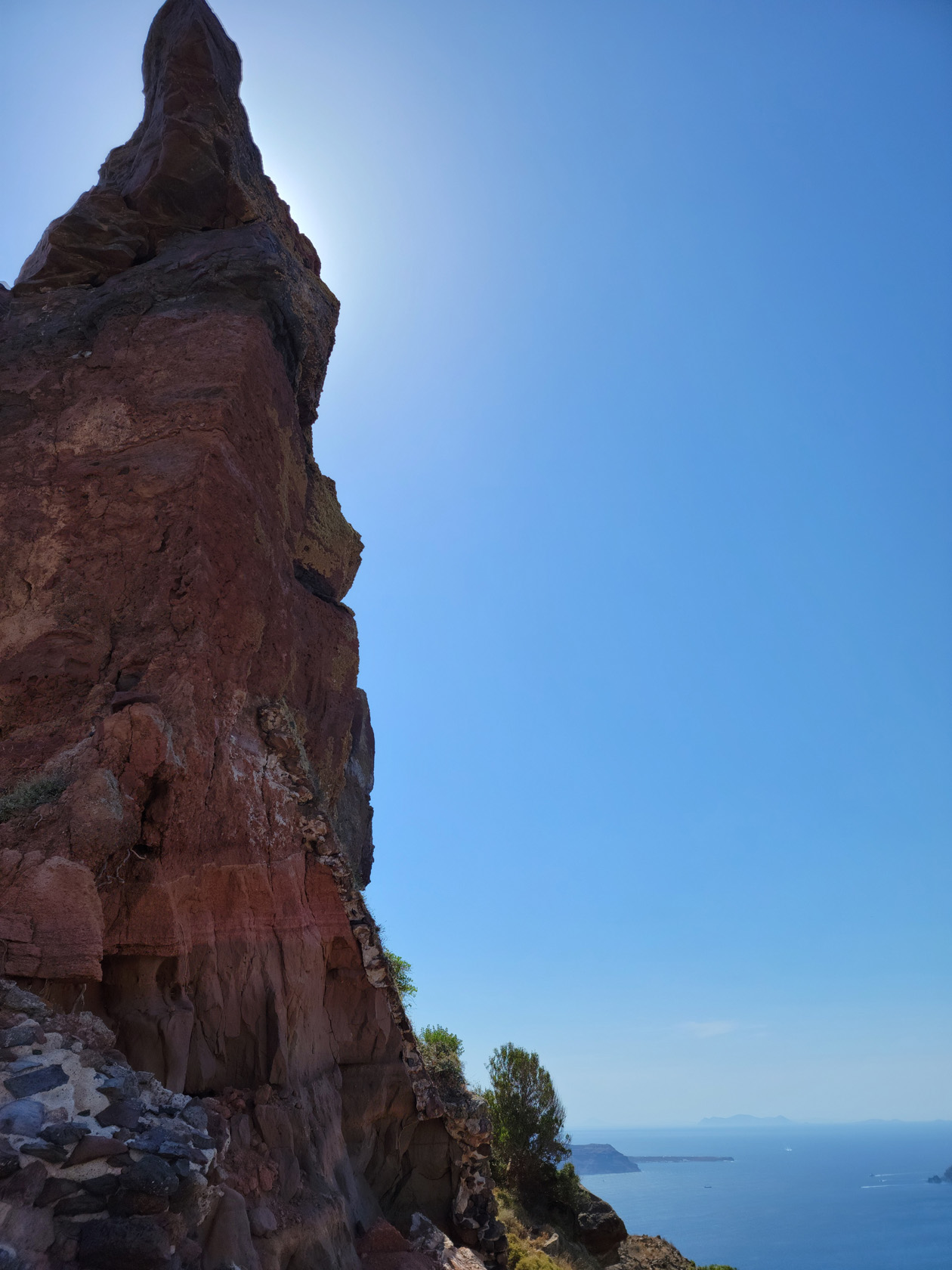
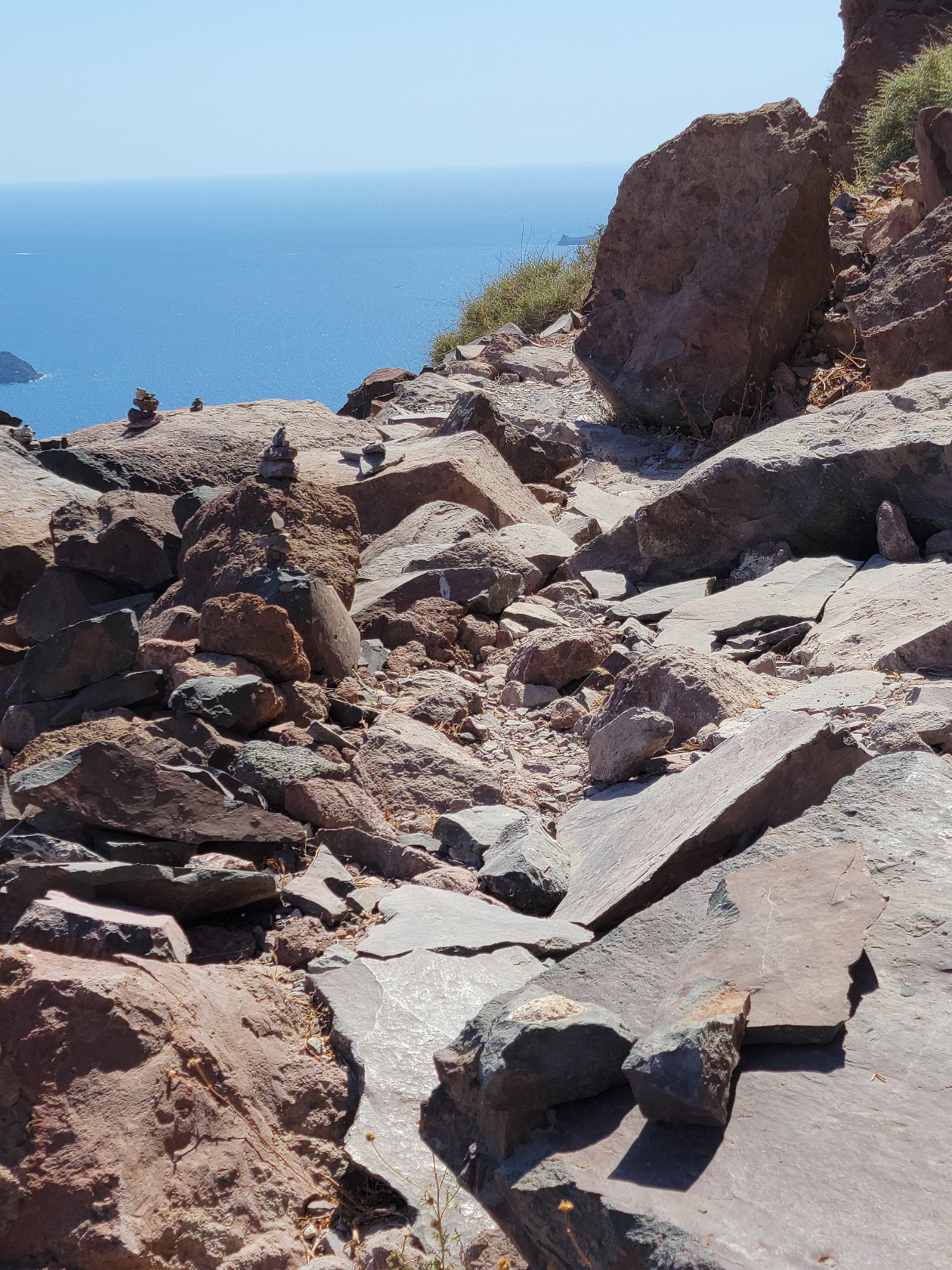
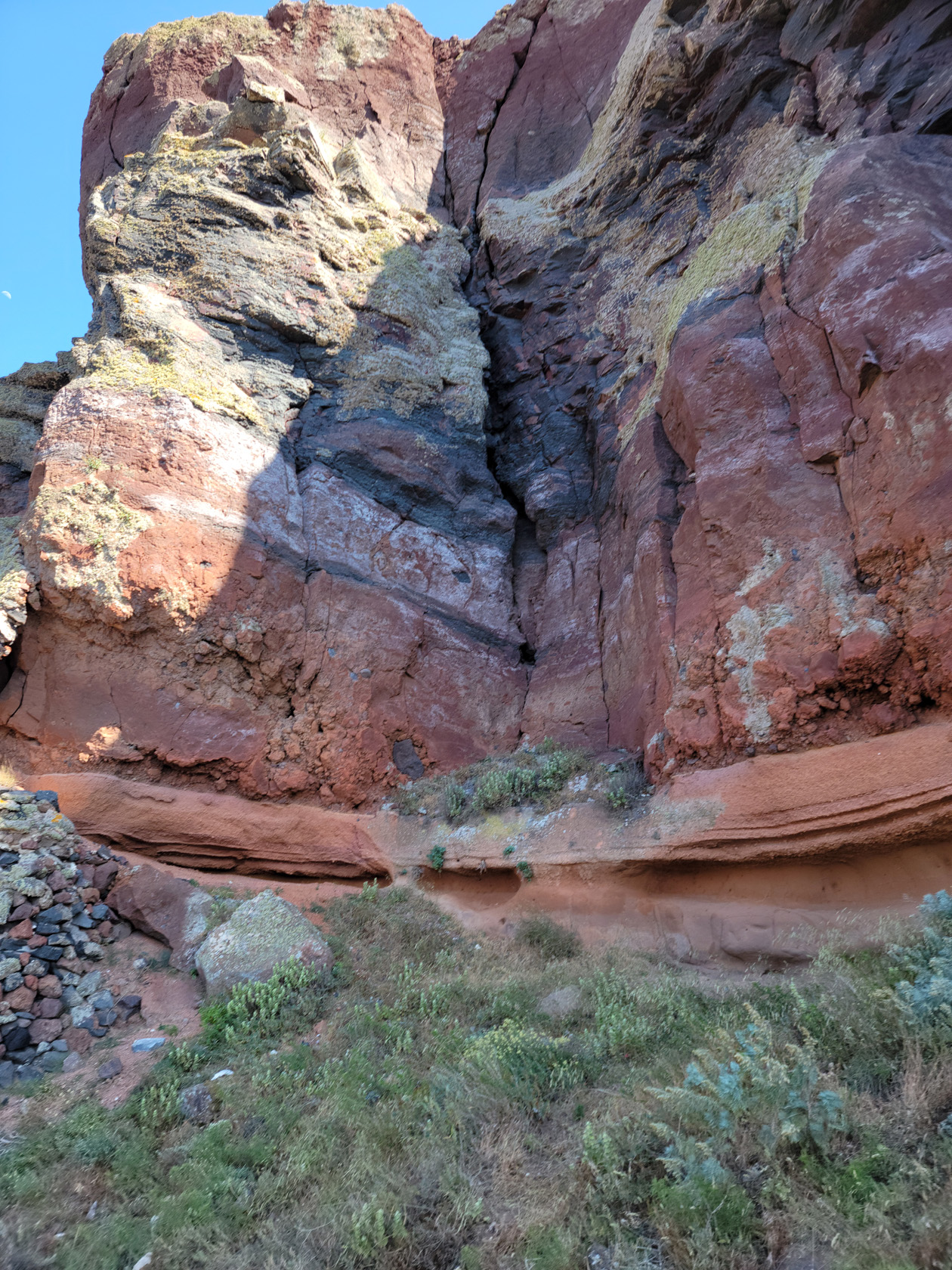
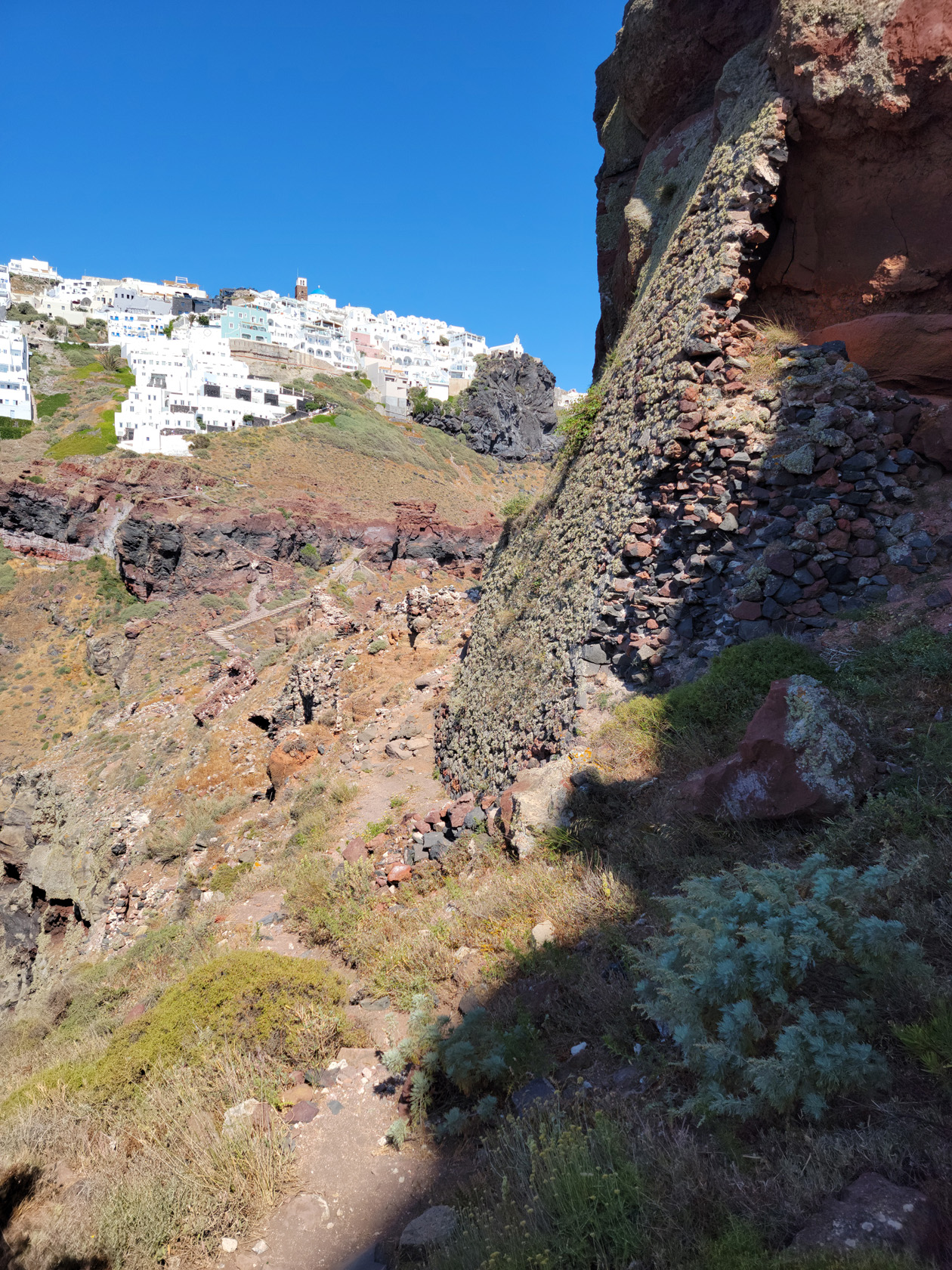
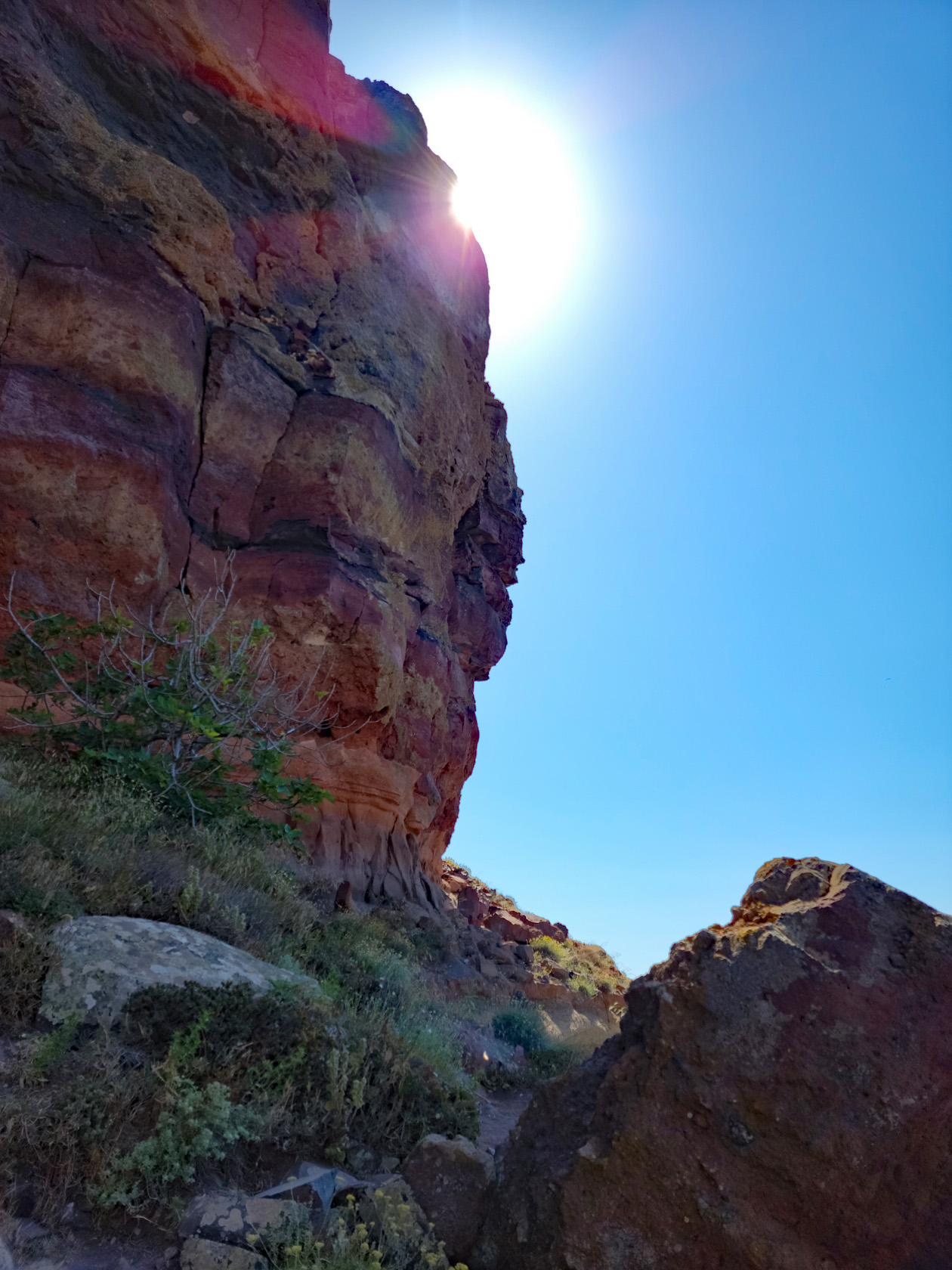
A short twenty minute hike from hotel was Skaros Rock. A broken piece of caldera that looks more like a mesa than anything belonging to a volcano.
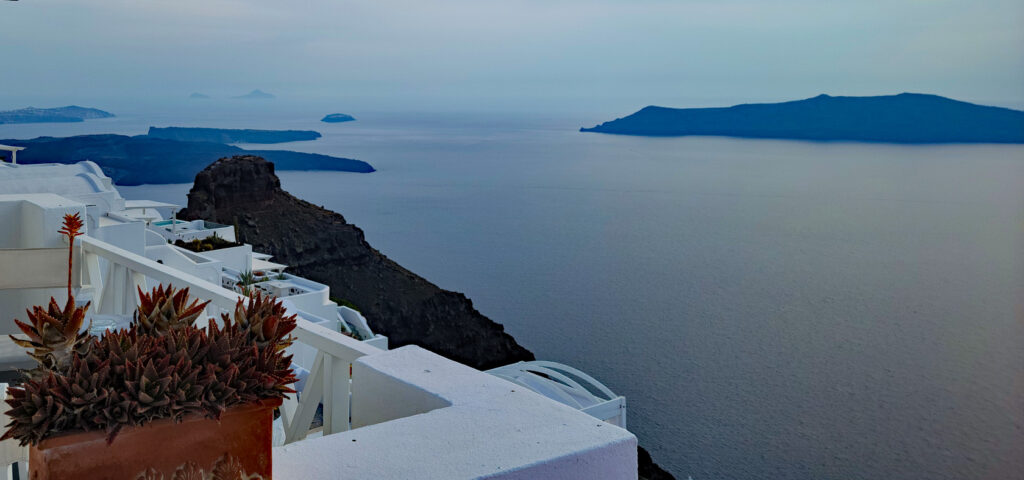
Thira, Santorini – Skaros Rock
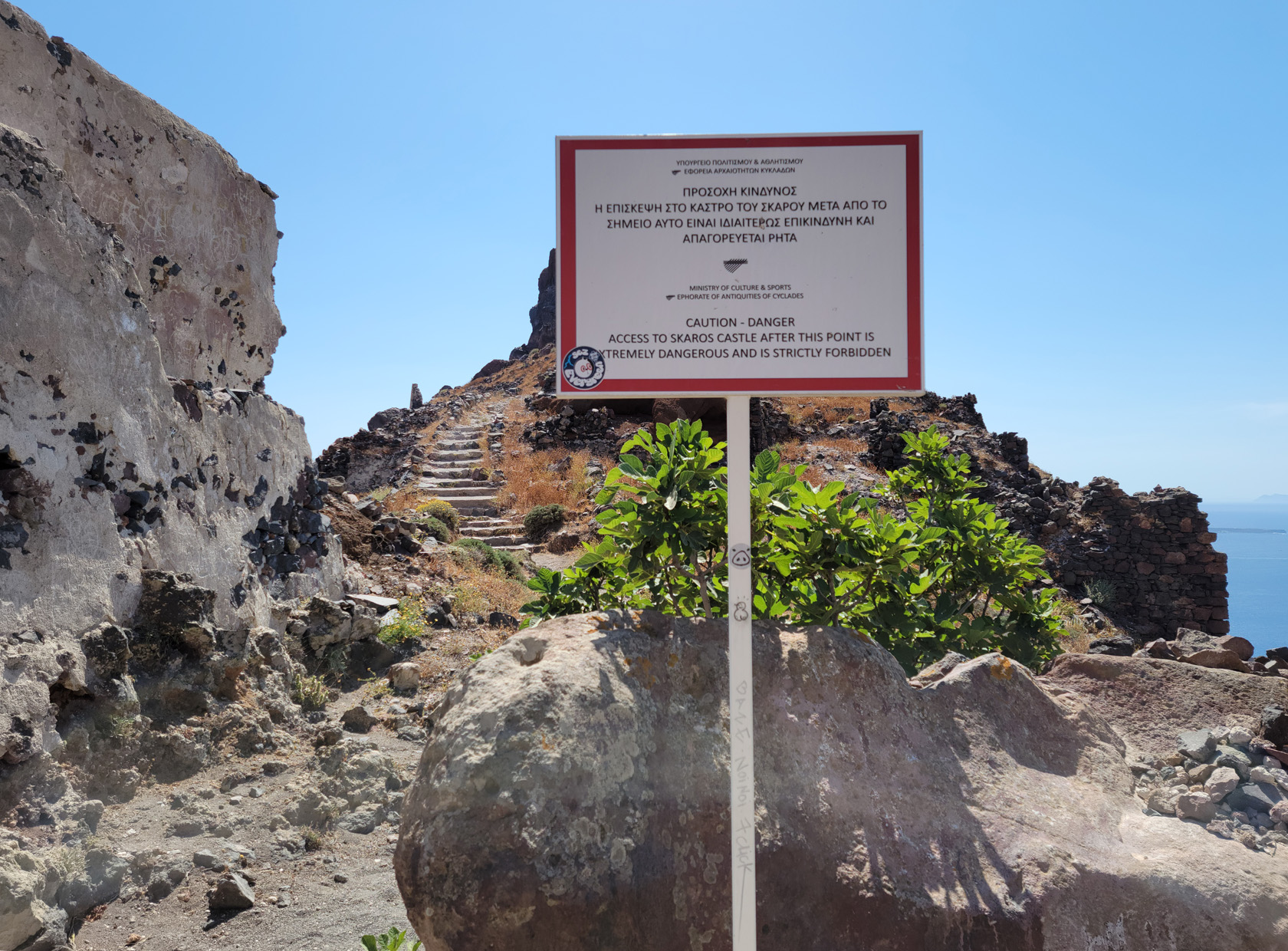
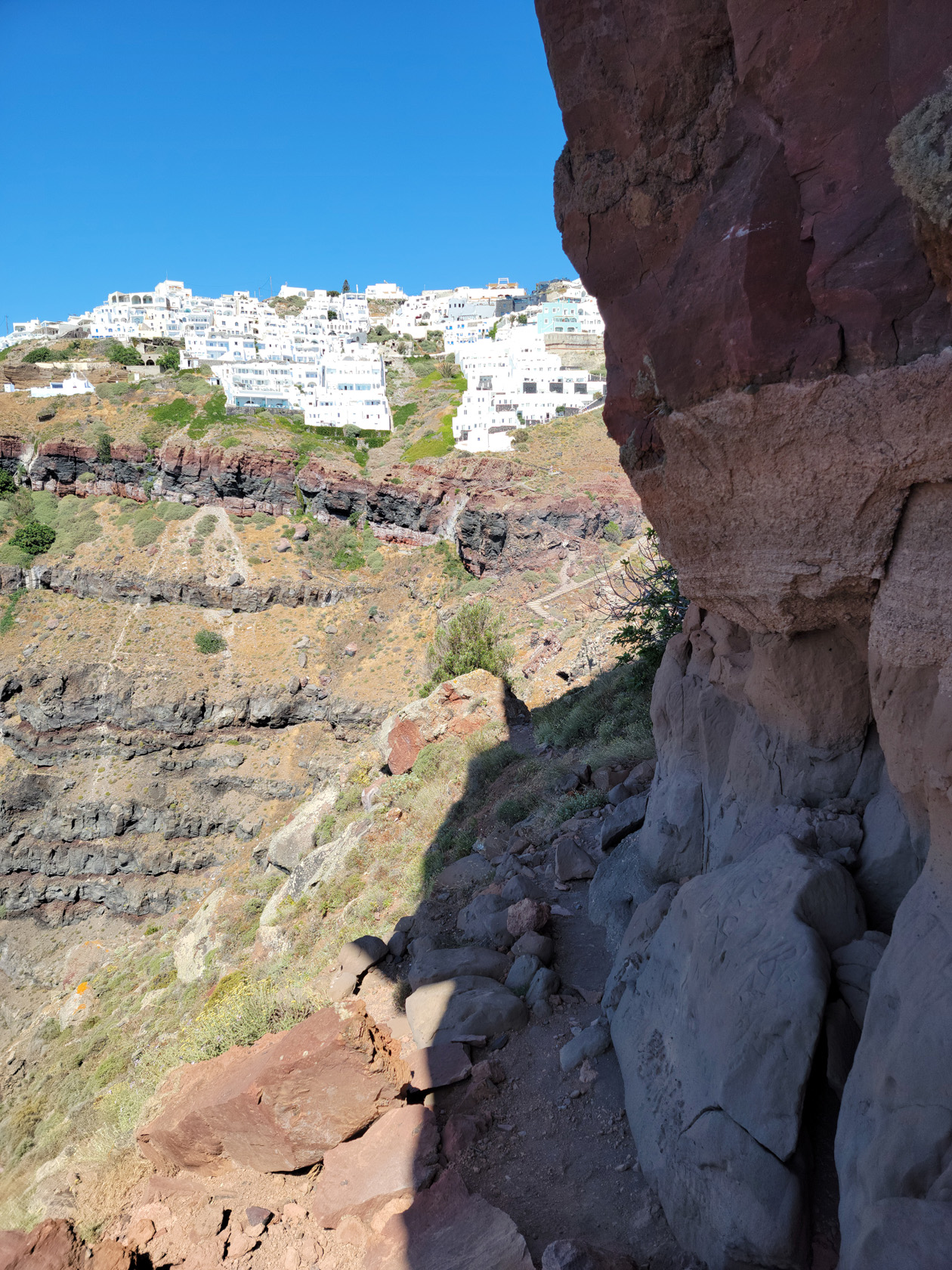
Though thoroughly signed as dangerous, there is nothing preventing anyone from hiking the path around the rocky projection. Read all the signs carefully and make your own decision.
Imerovigli, Santorini – Skaros Rock Hike – The Rock
Imerovigli, Santorini – Skaros Rock Hike
Imerovigli, Santorini – Skaros Rock Hike
Imerovigli, Santorini – Skaros Rock Hike
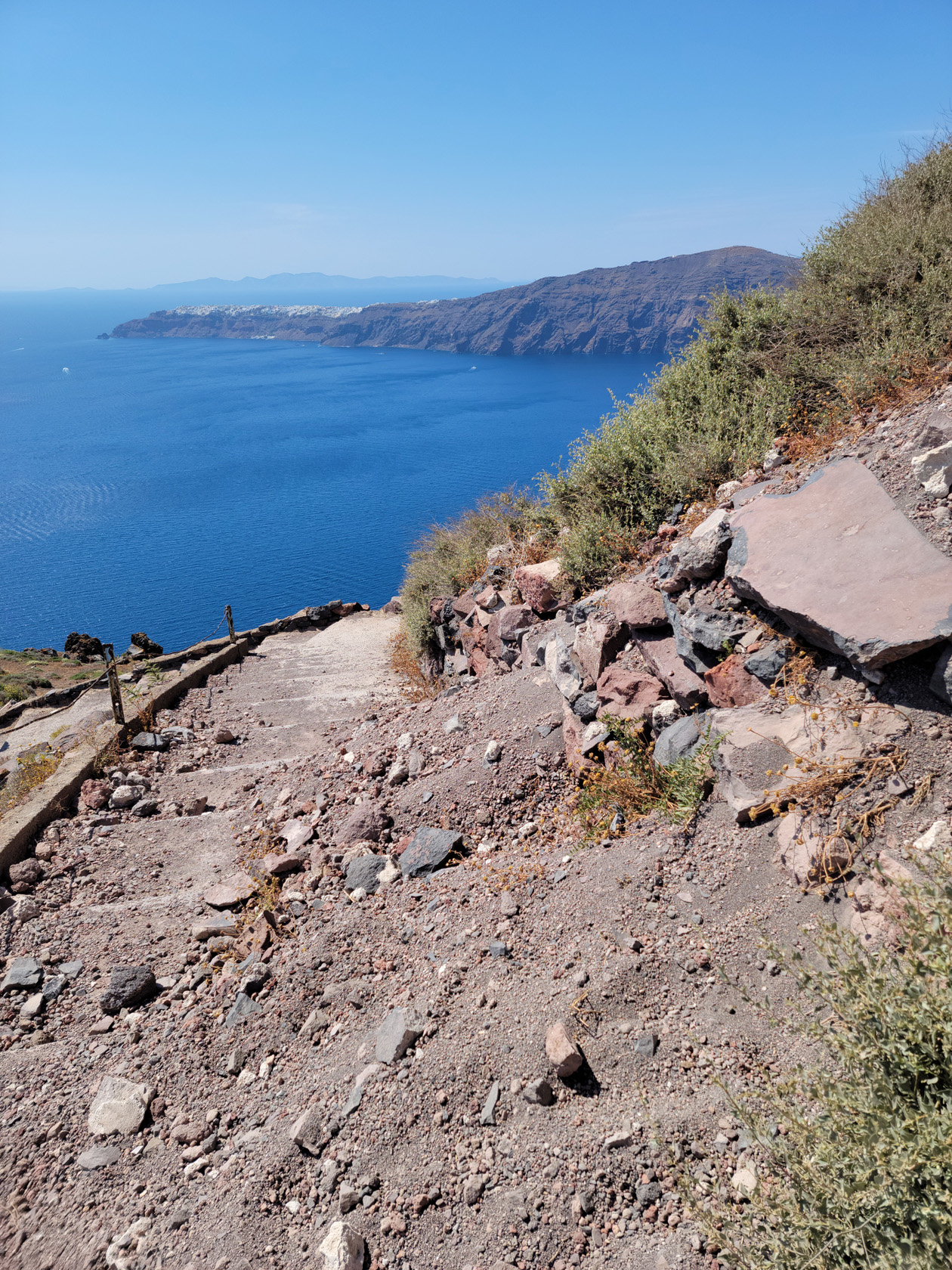
Imerovigli, Santorini – Skaros Rock Hike – 93 Steps down, walk, 75 more steps down, walk, 55 steps up
Imerovigli, Santorini – Skaros Rock Hike
Imerovigli, Santorini – Skaros Rock Hike – Oia
Imerovigli, Santorini – Skaros Rock Hike – Cruise Ships
Imerovigli, Santorini – Skaros Rock Hike – The Rock
Imerovigli, Santorini – Skaros Rock Hike
Imerovigli, Santorini – Skaros Rock Hike
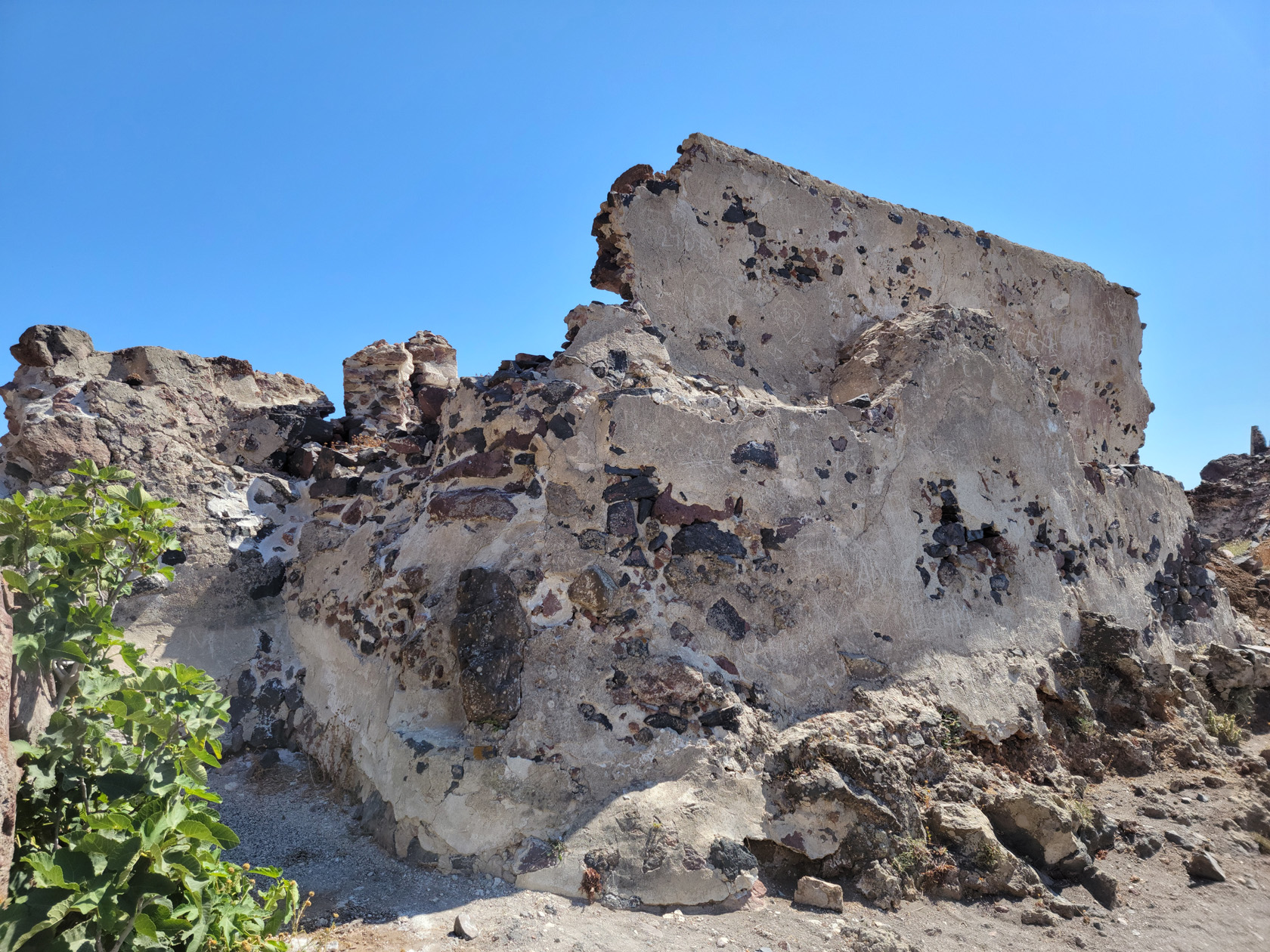
Imerovigli, Santorini – Skaros Rock Hike – Old Fortress
Imerovigli, Santorini – Skaros Rock Hike – Danger
Imerovigli, Santorini – Skaros Rock Hike – More Fallen Rock
Imerovigli, Santorini – Skaros Rock Hike – Cruise Ships
Imerovigli, Santorini – Skaros Rock Hike
Imerovigli, Santorini – Skaros Rock Hike
Imerovigli, Santorini – Skaros Rock
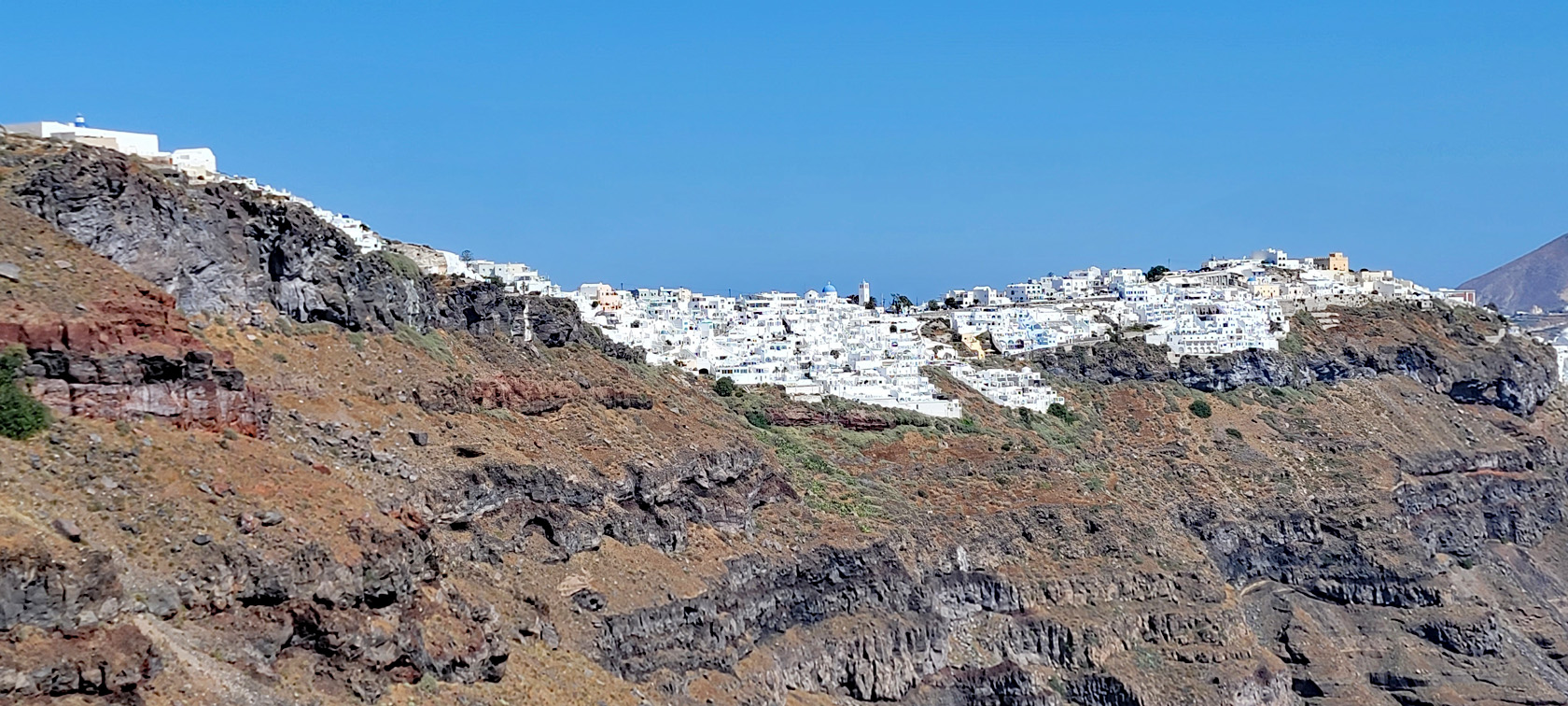
Imerovigli, Santorini – Skaros Rock Hike – Thira
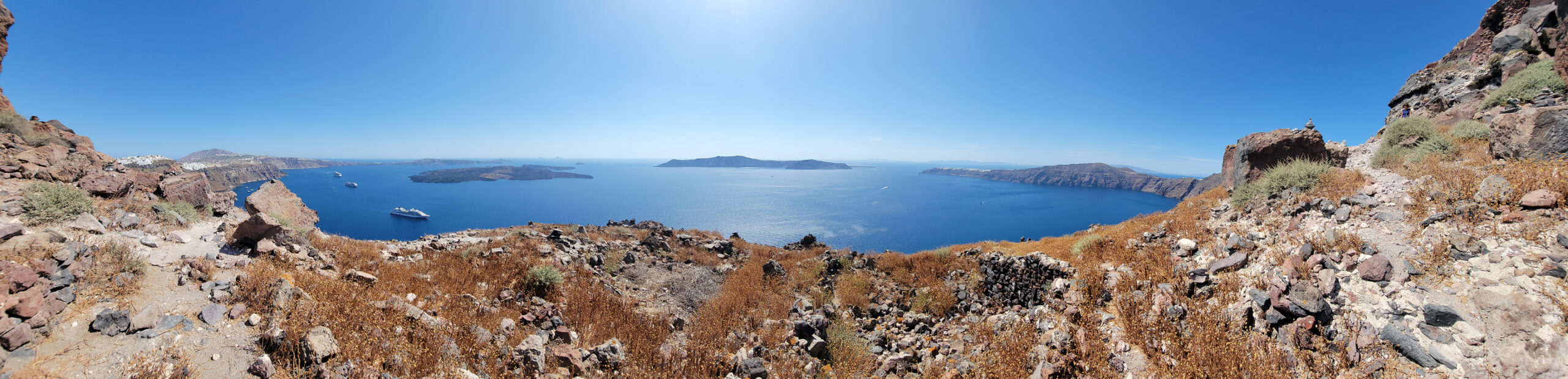
Imerovigli, Santorini – Skaros Rock Hike – Panorama
Imerovigli, Santorini – Skaros Rock Hike
Imerovigli, Santorini – Skaros Rock Hike
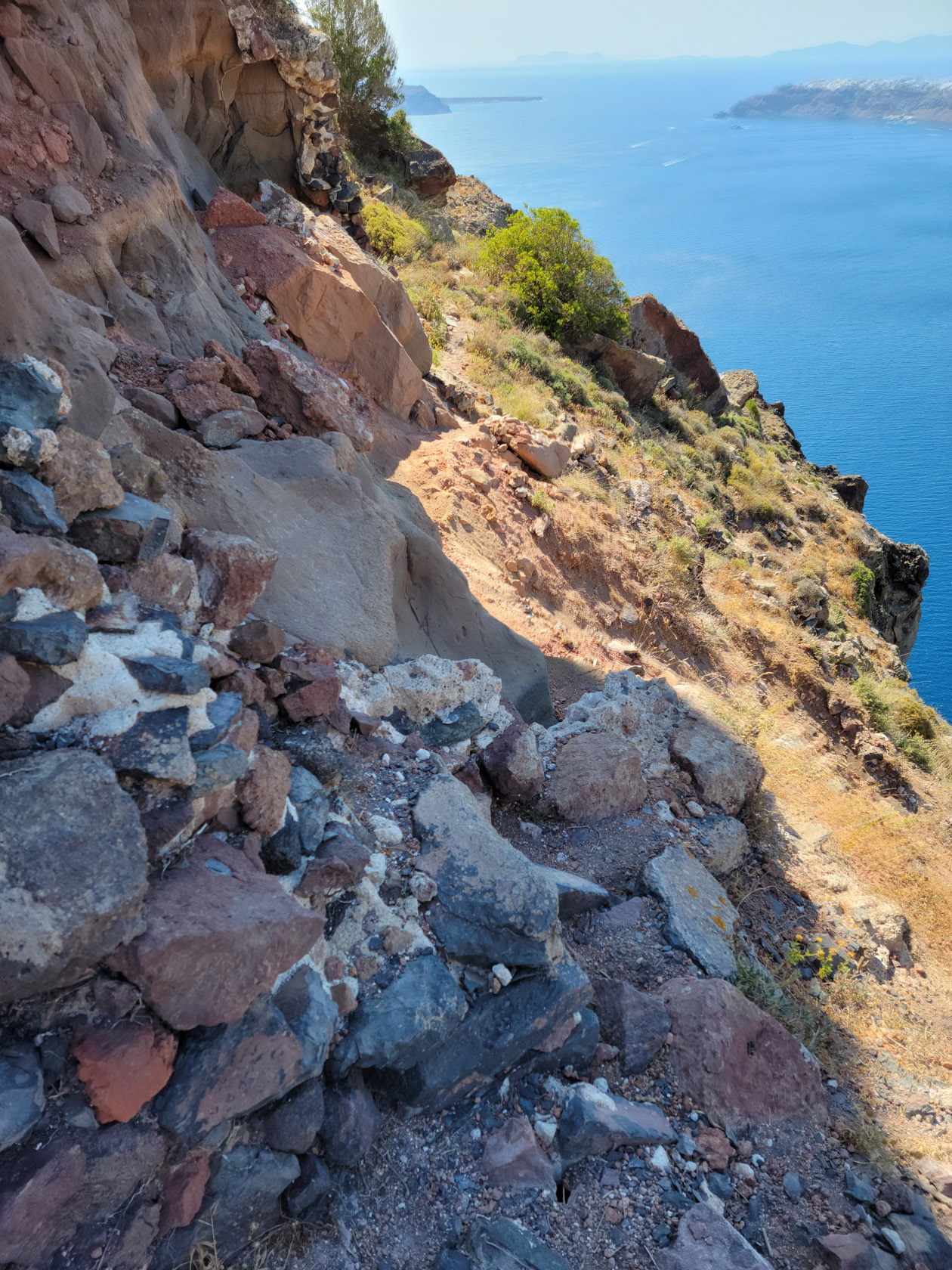
Imerovigli, Santorini – Skaros Rock Hike – Fallen Rock Danger
Imerovigli, Santorini – Skaros Rock Hike
Imerovigli, Santorini – Skaros Rock Hike
Imerovigli, Santorini – Skaros Rock Hike
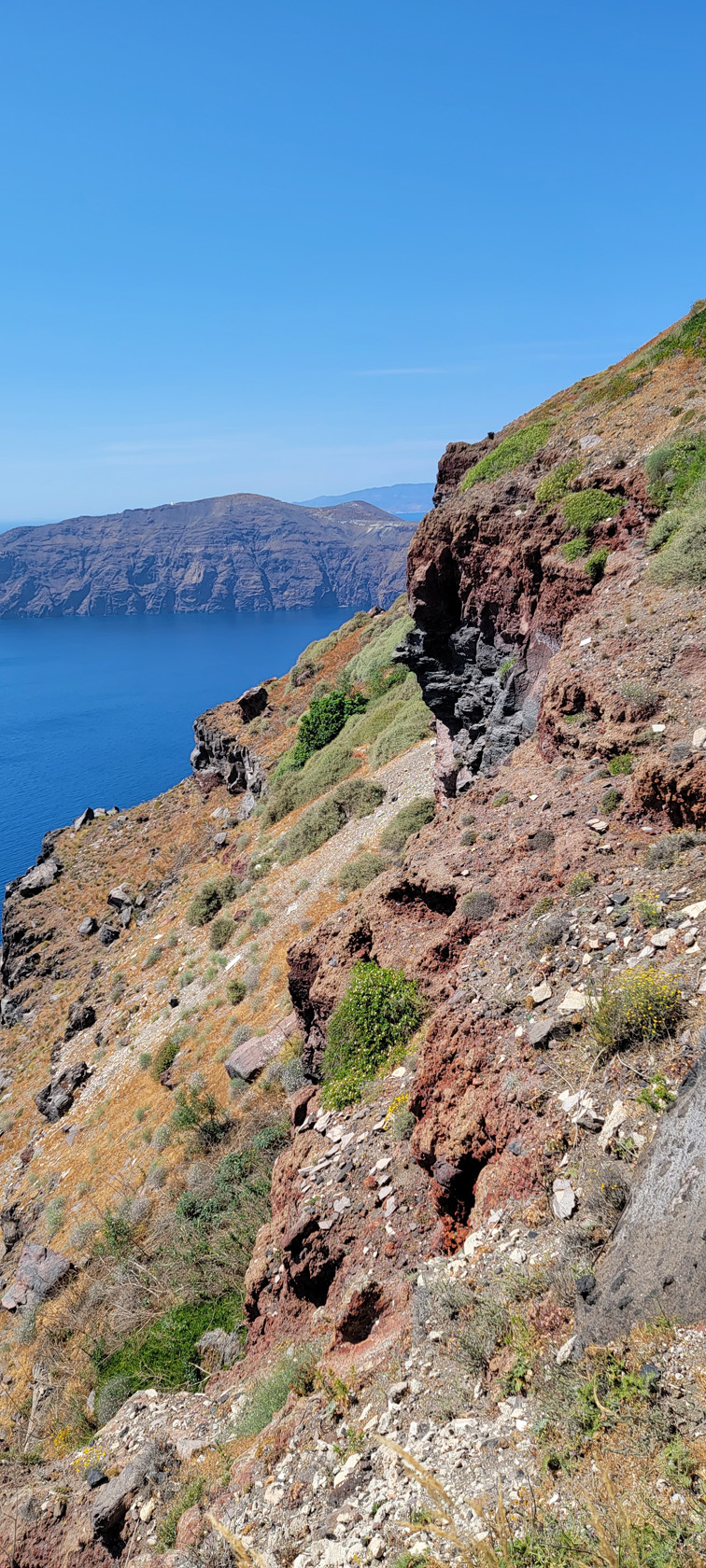
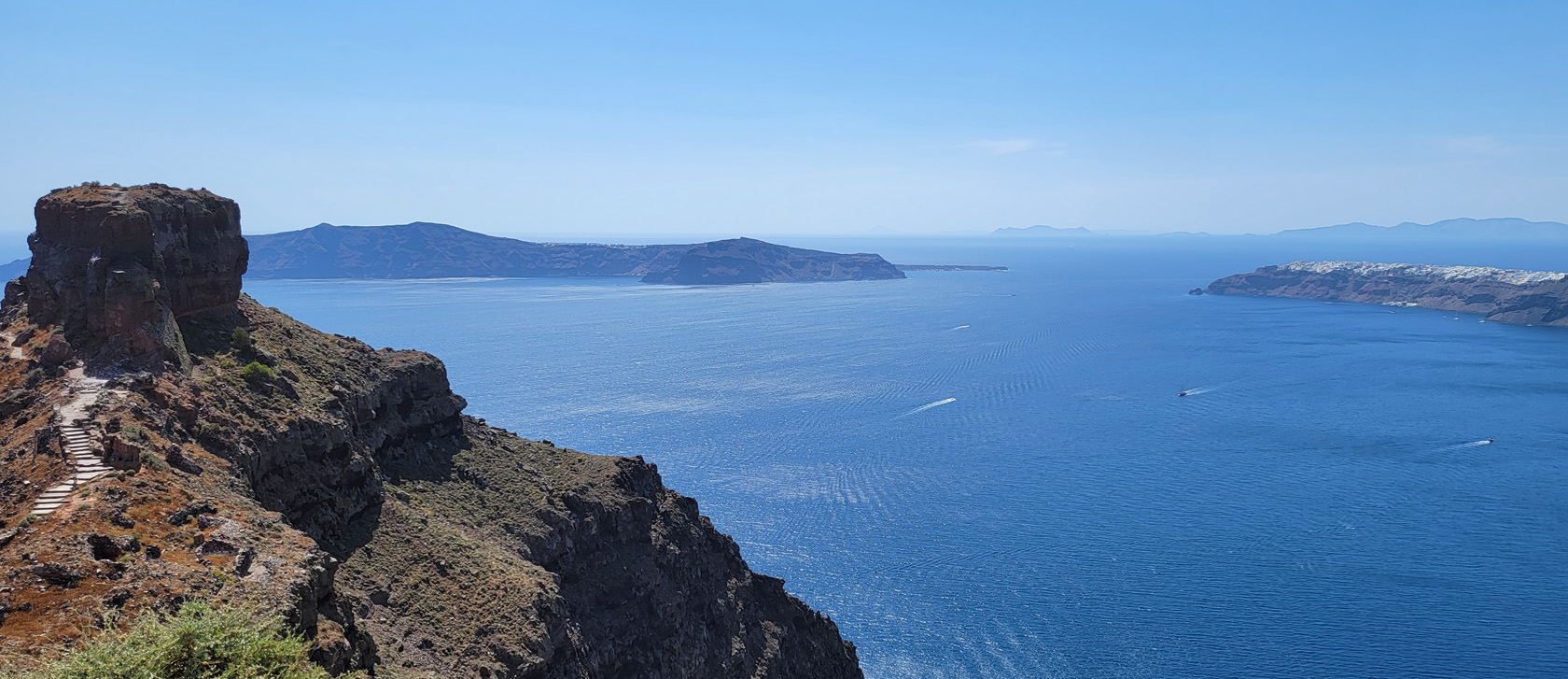
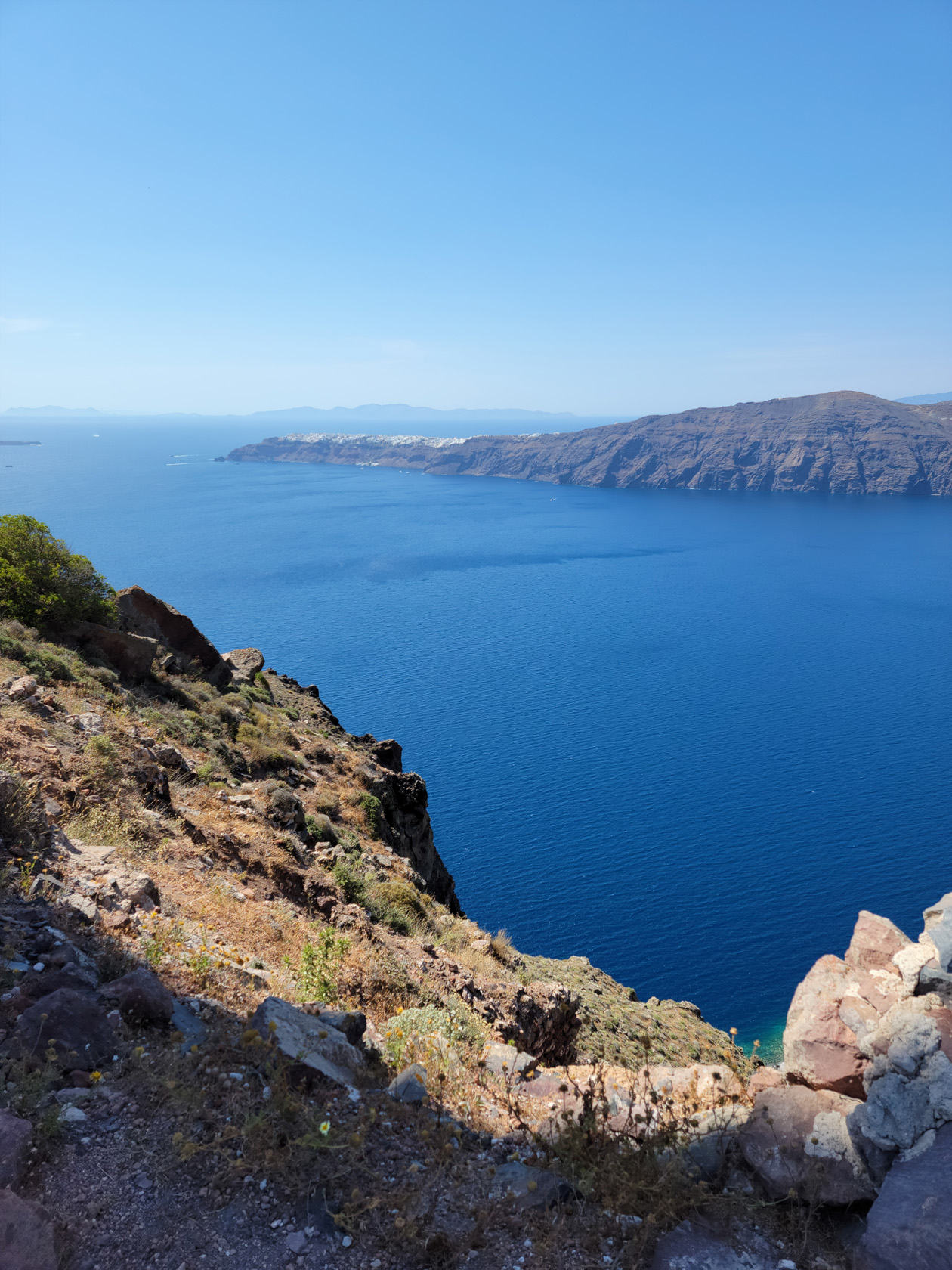
Imerovigli, Santorini – Caldera
I would caution, the north side is a bit challenging for anyone with balance or other issues, one misstep and one could fall pretty far, perhaps leading to death or serious injury.
Oia – Caldera Cutie
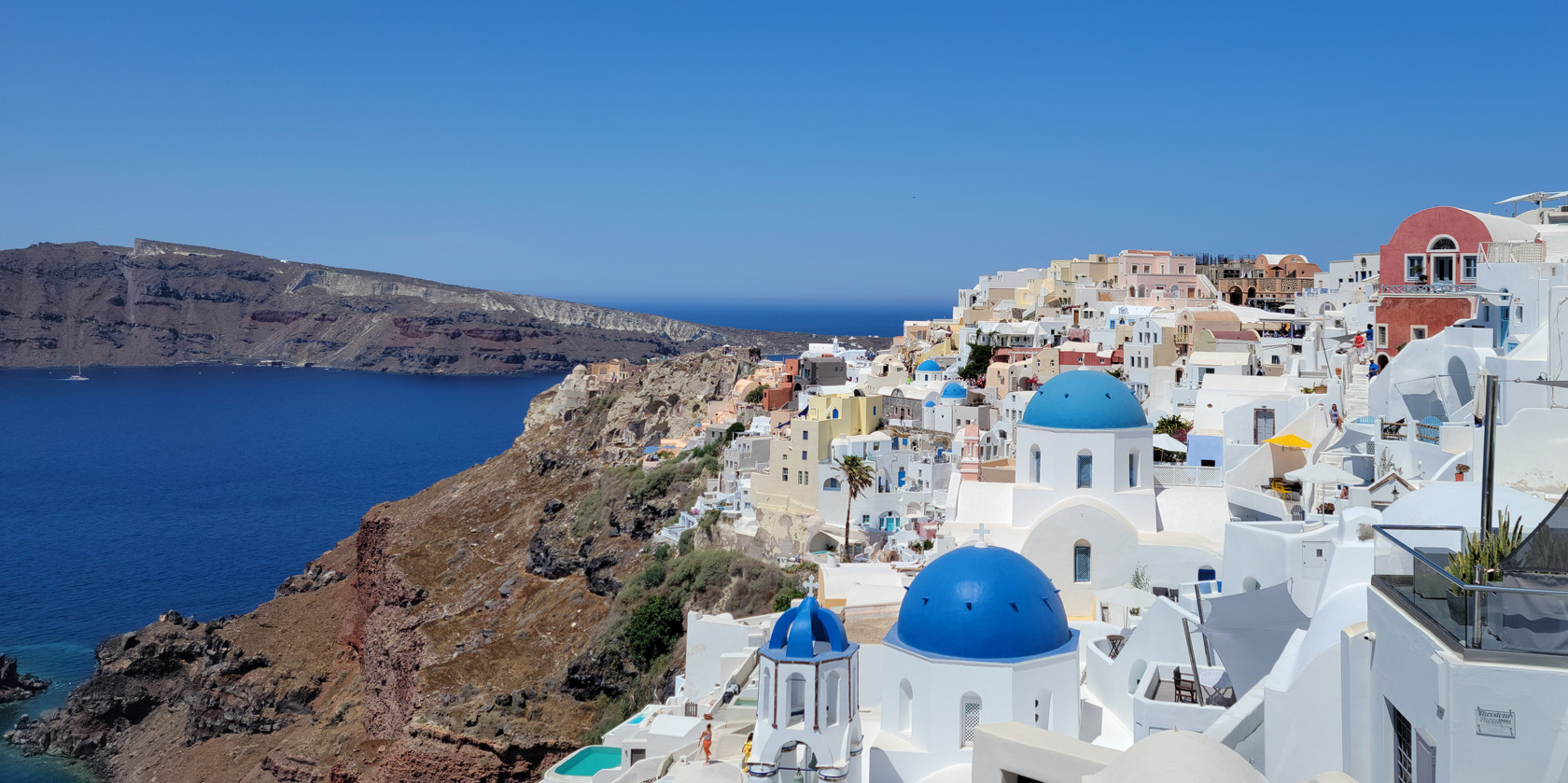
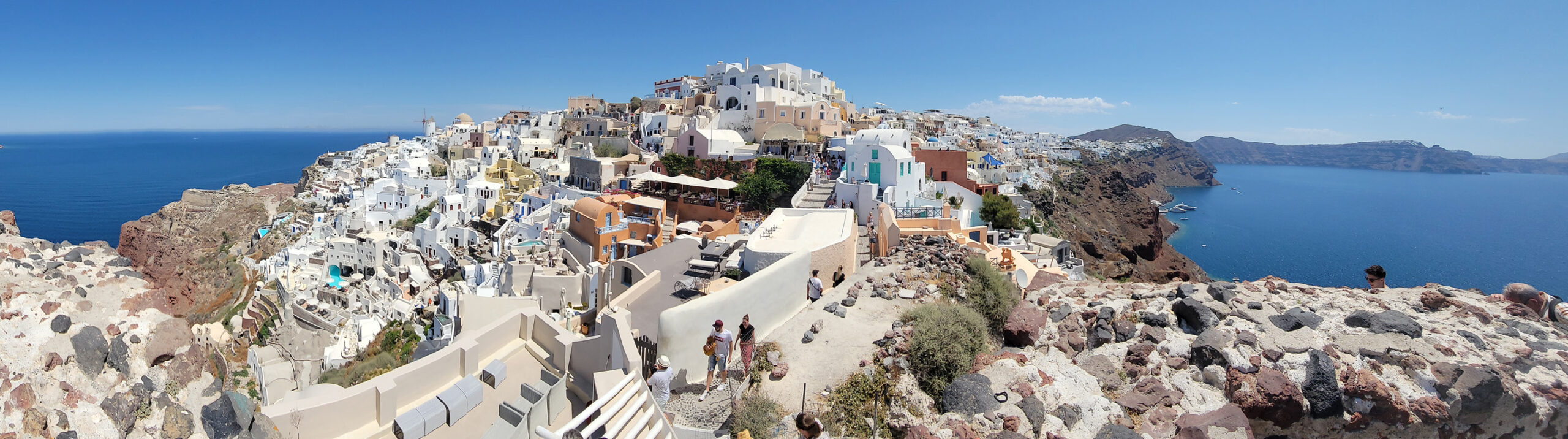
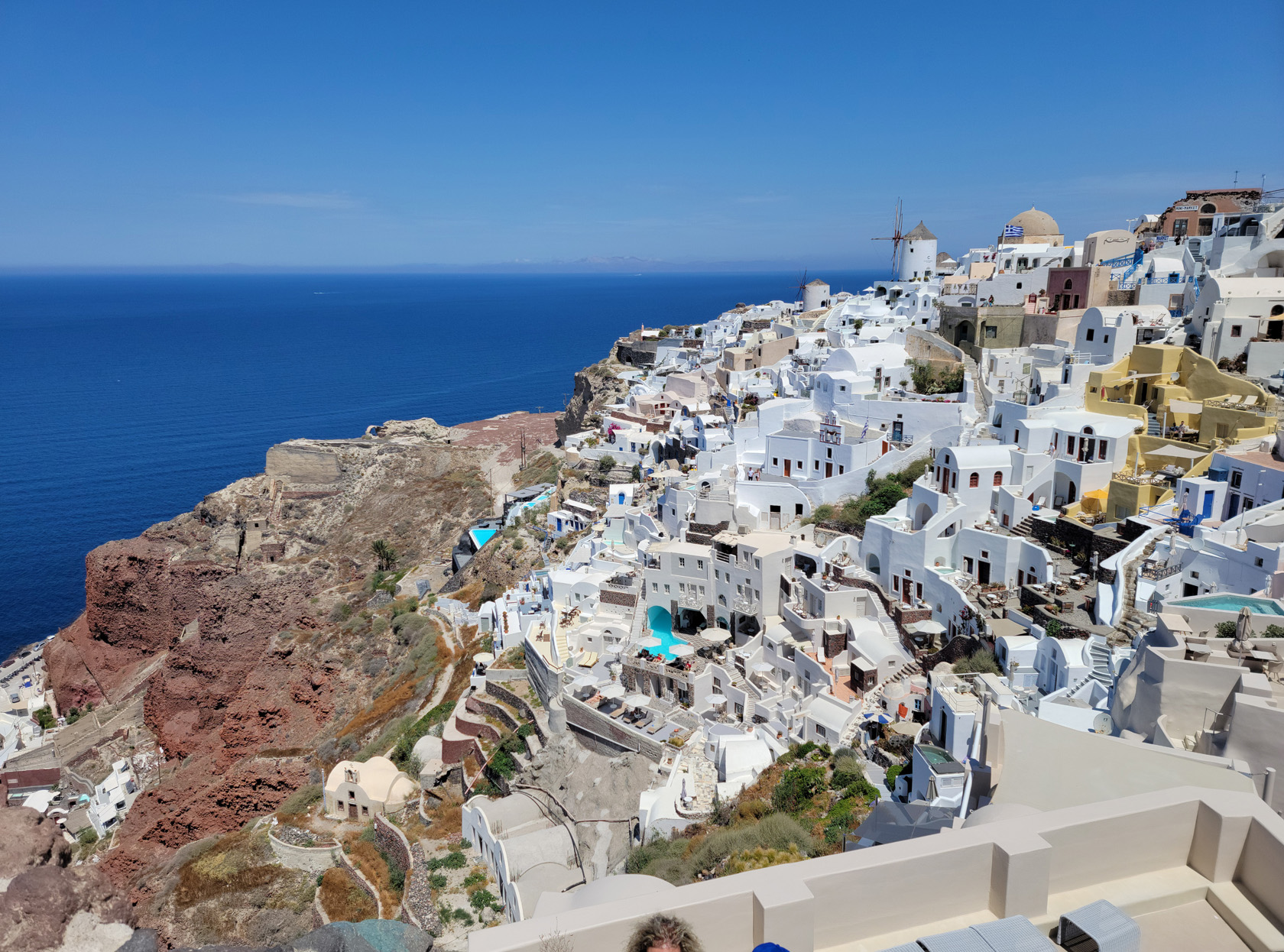
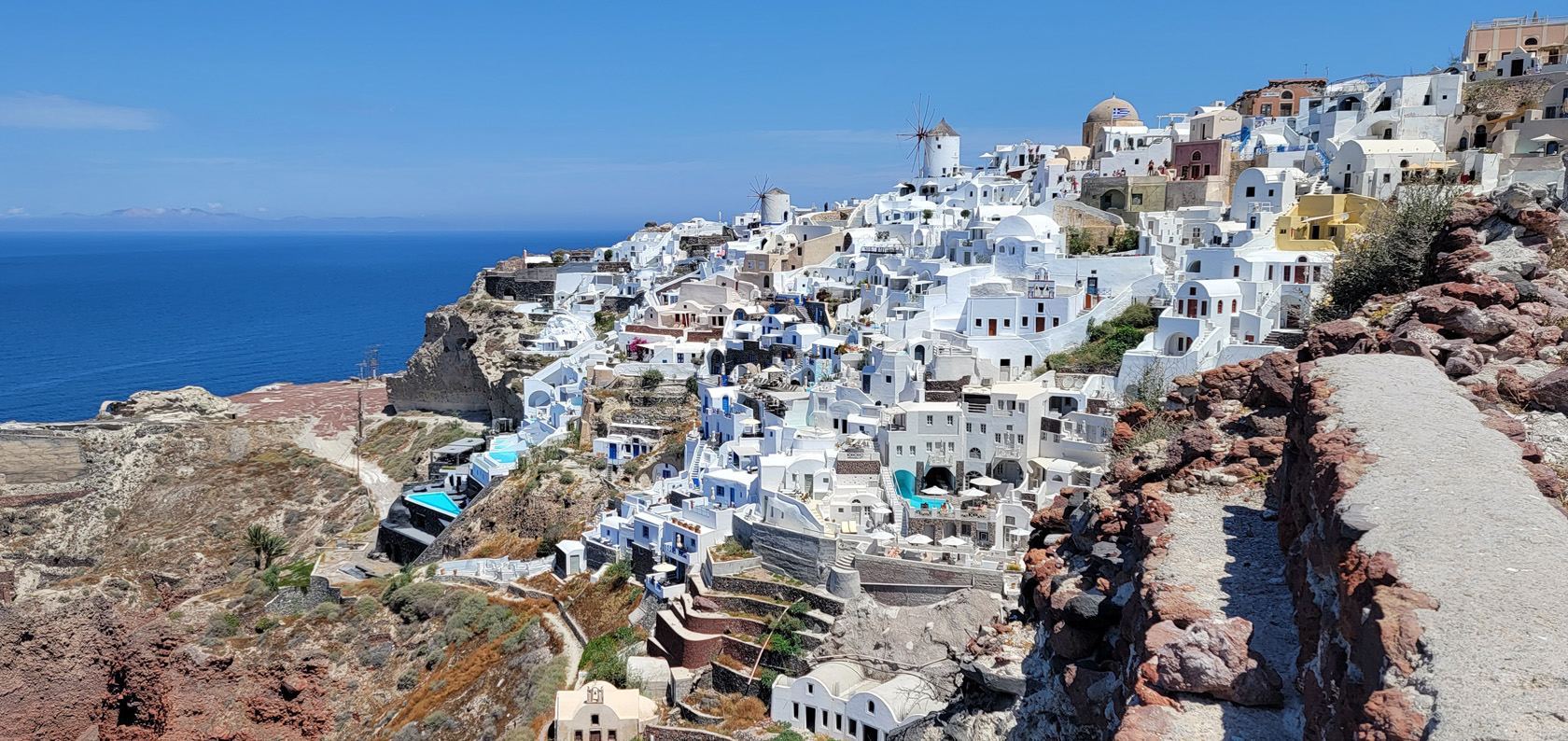
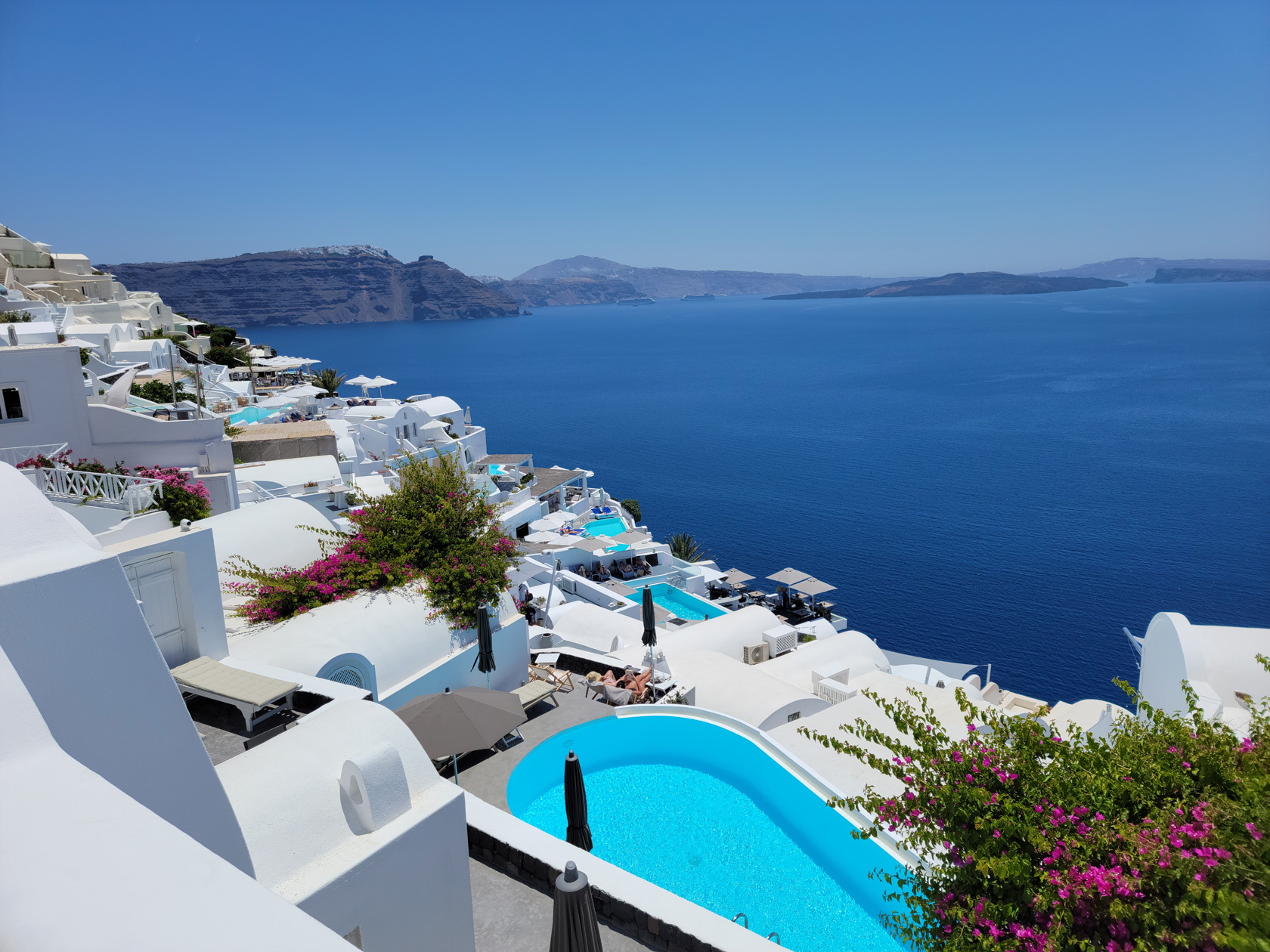
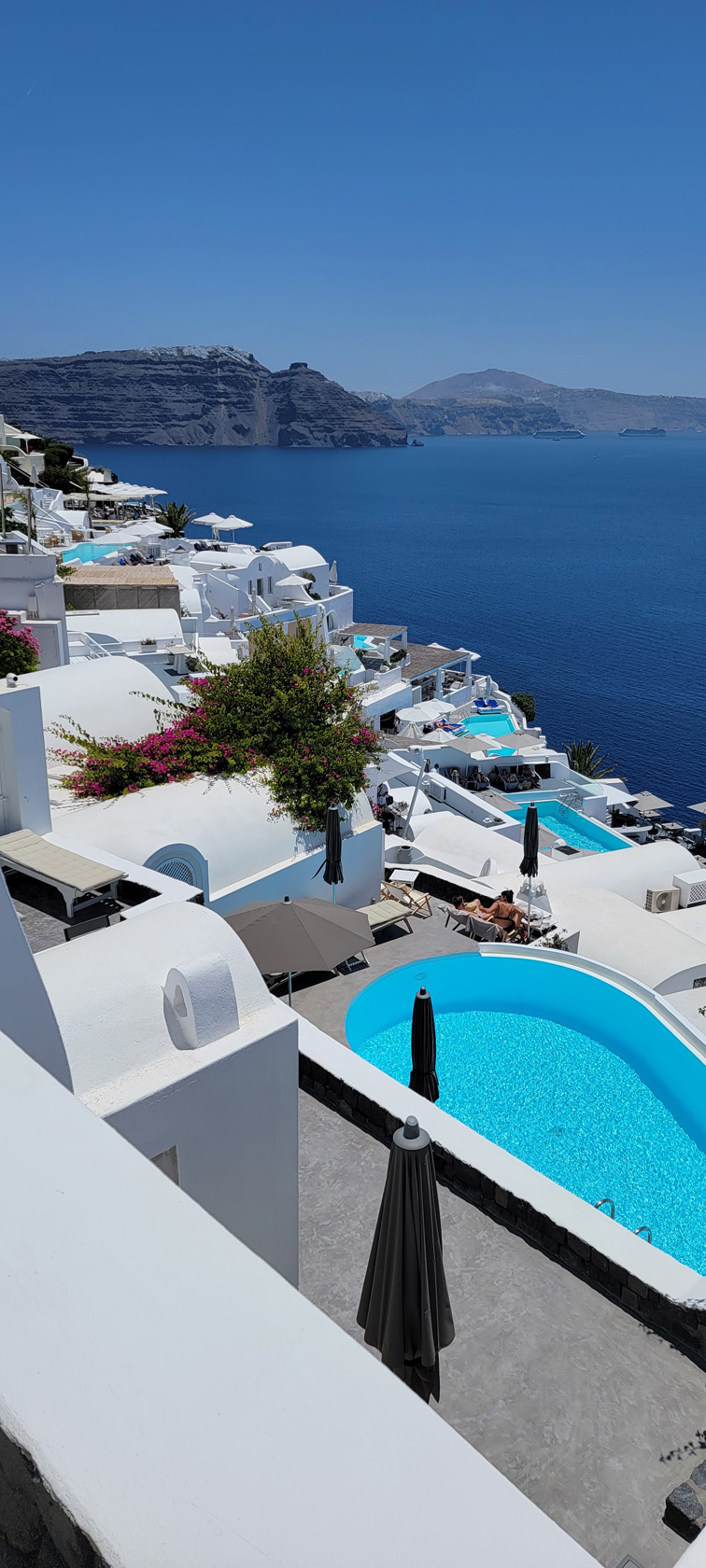
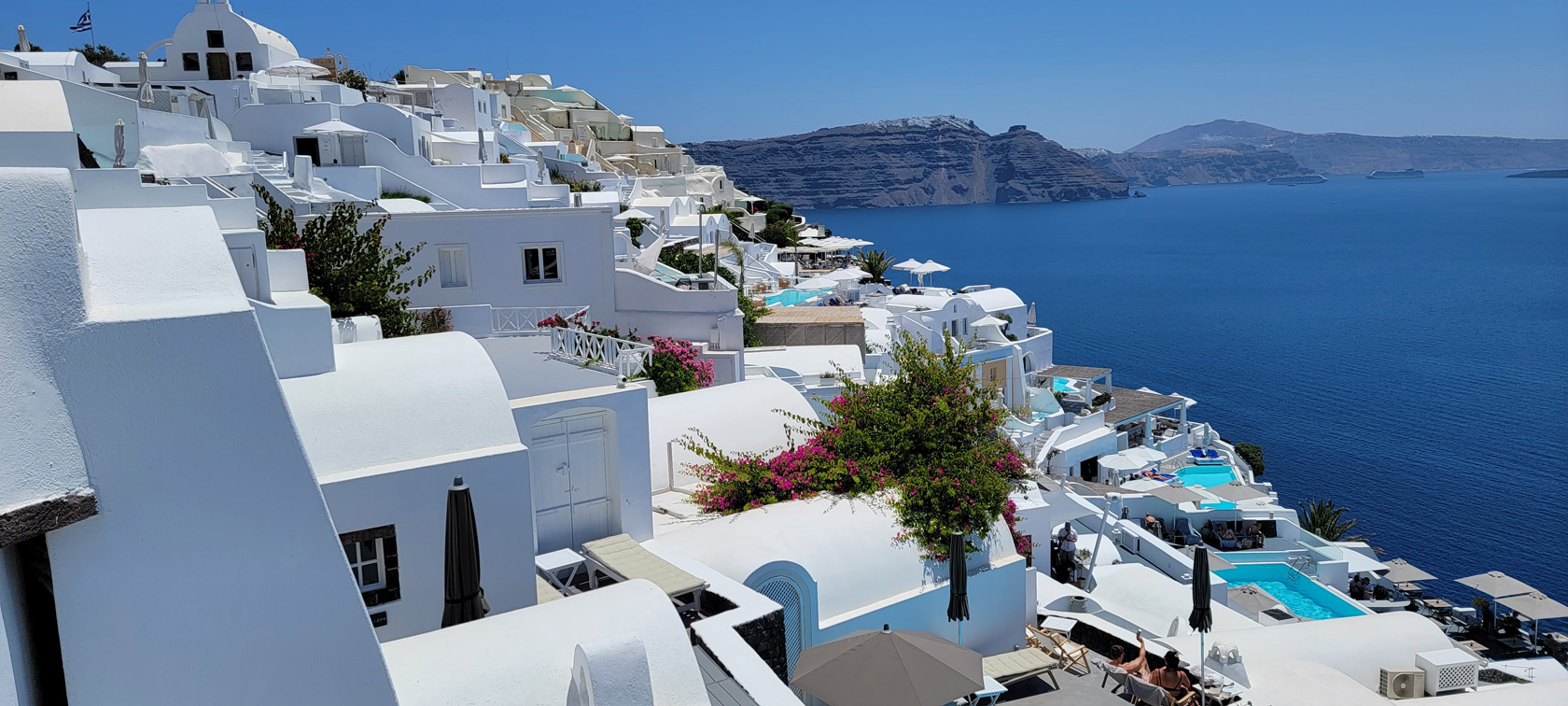
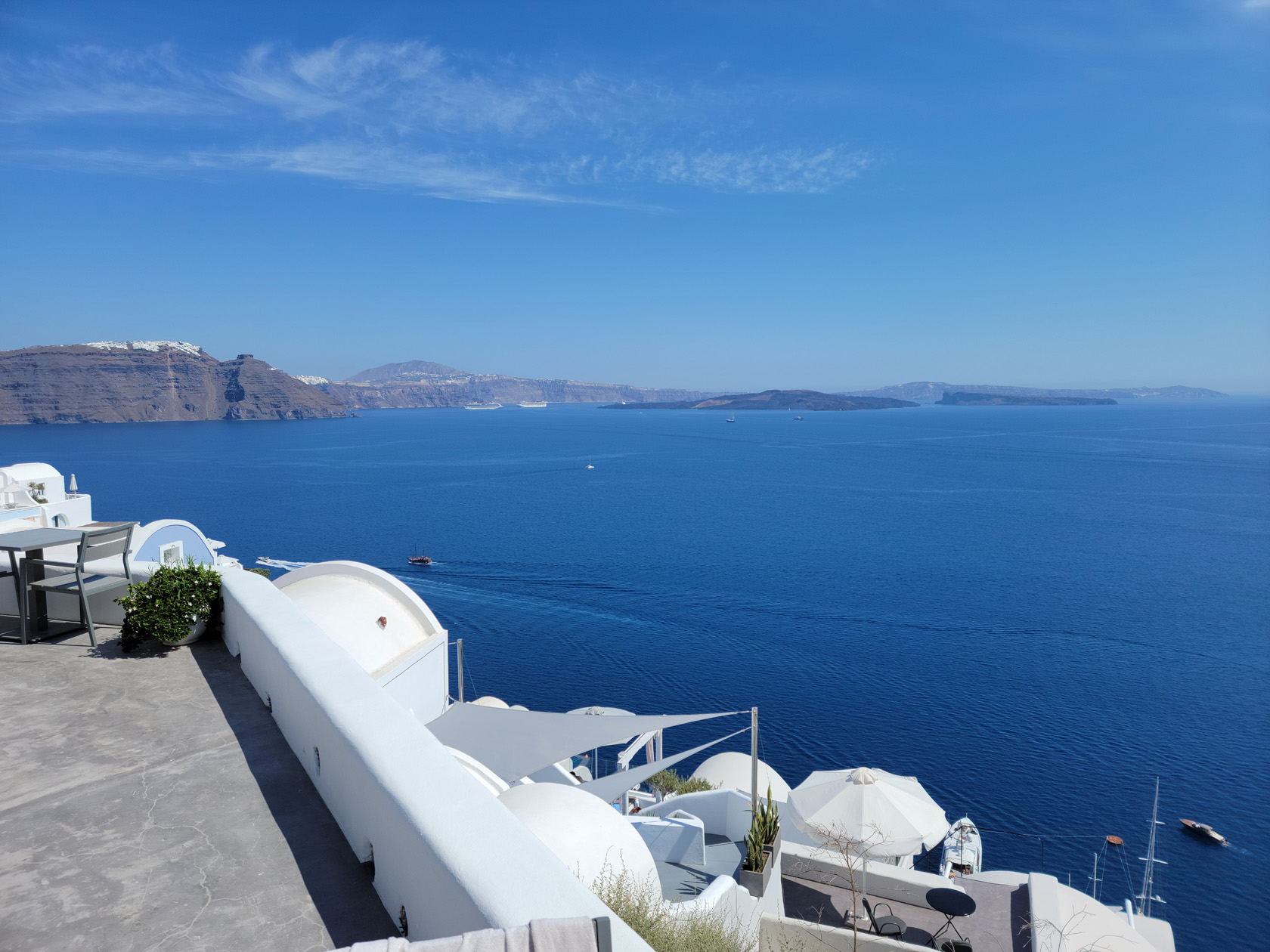
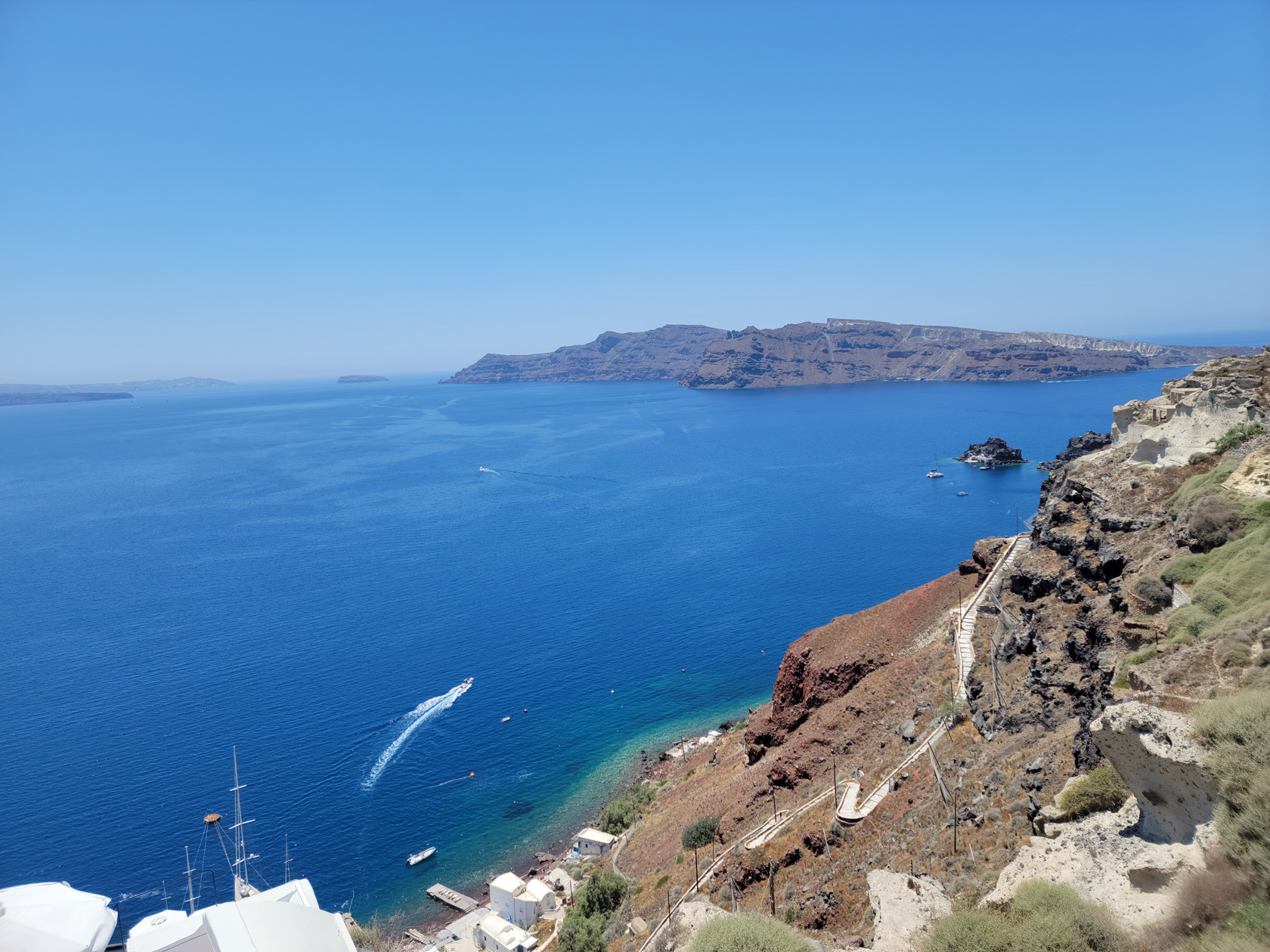
A Greek jewel clad in white wash and white marble is essentially what Oia is to those who visit its tourist filled streets and alleys. Make no mistake, if you visit Oia, there will be crowds; all trying to get that perfect social media photograph. This is especially the case in the evening, when they are all out trying to get their sunset pictures.
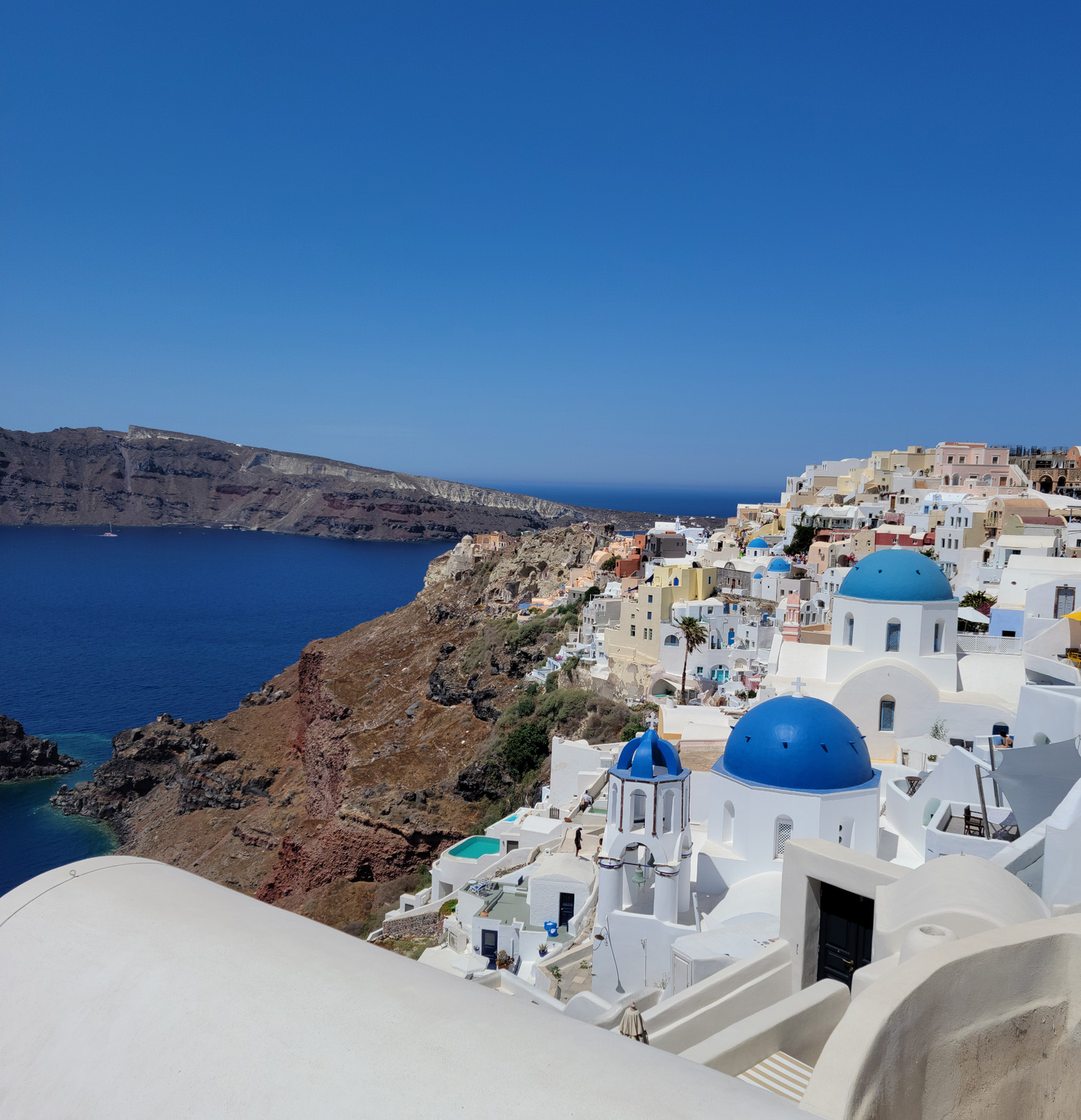
Oia, Santorini – The Three Blue Domes
There is not a lot of real estate in Oia, so some will find it very confining. But it is worth a visit, though I would not spend more than a few days here. Boredom being defined here as a slow Oia drip. If I had to do it over again I would probably just visit it for the day and perhaps have one evening dinner there, the rest is just too touristy for me.
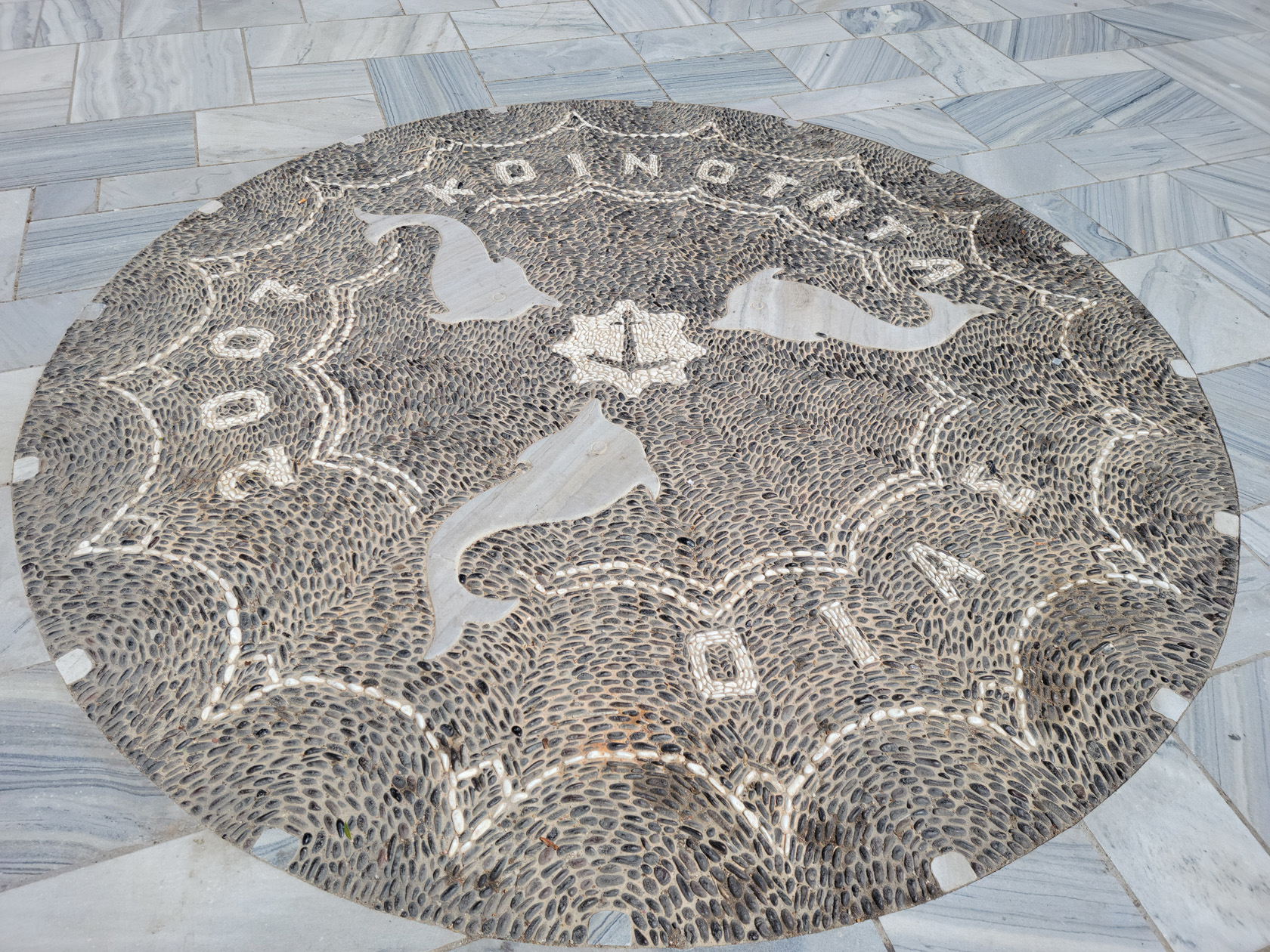
Oia, Santorini – Town Emblem
Oia, Santorini – Ericka and Gabi
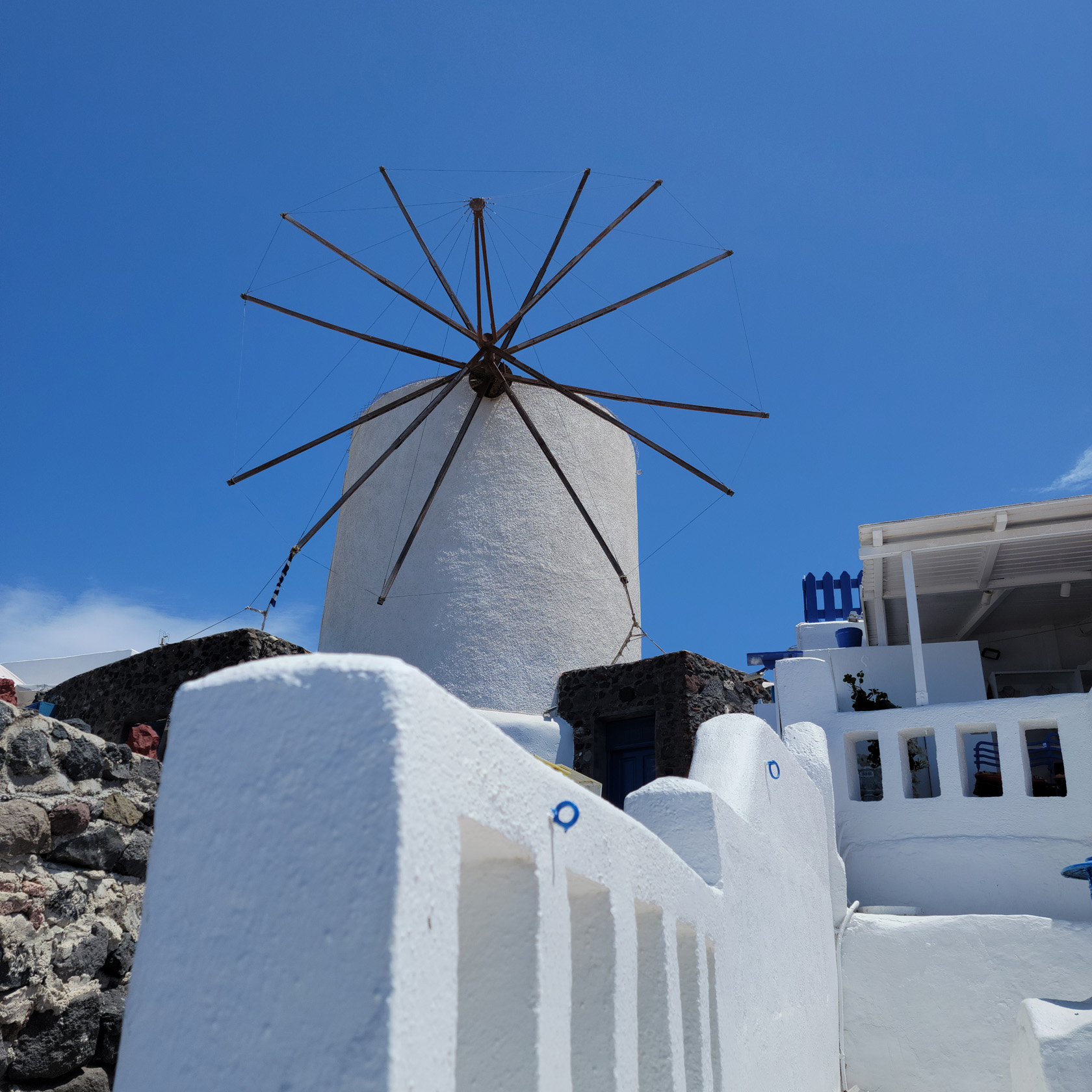
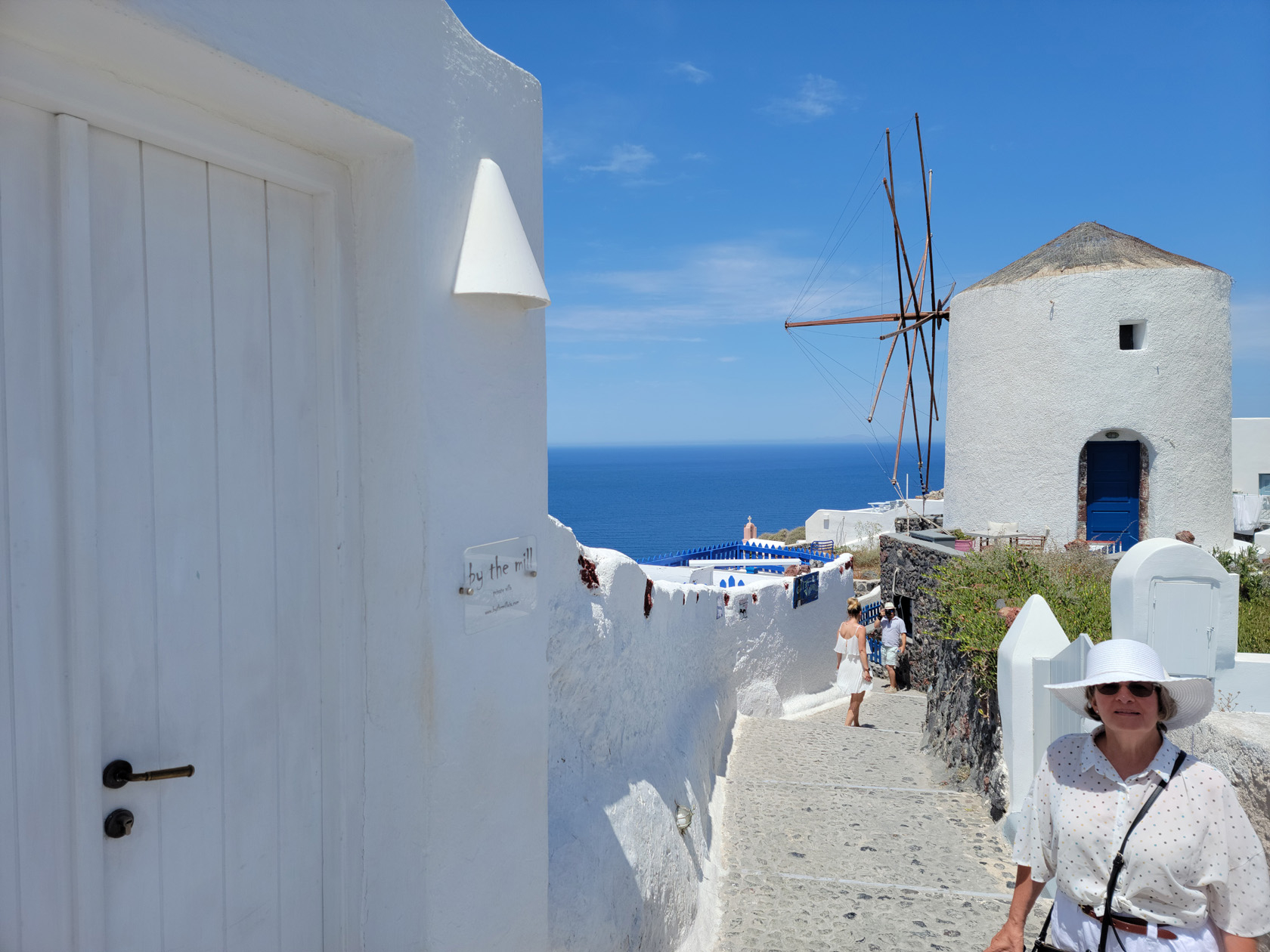
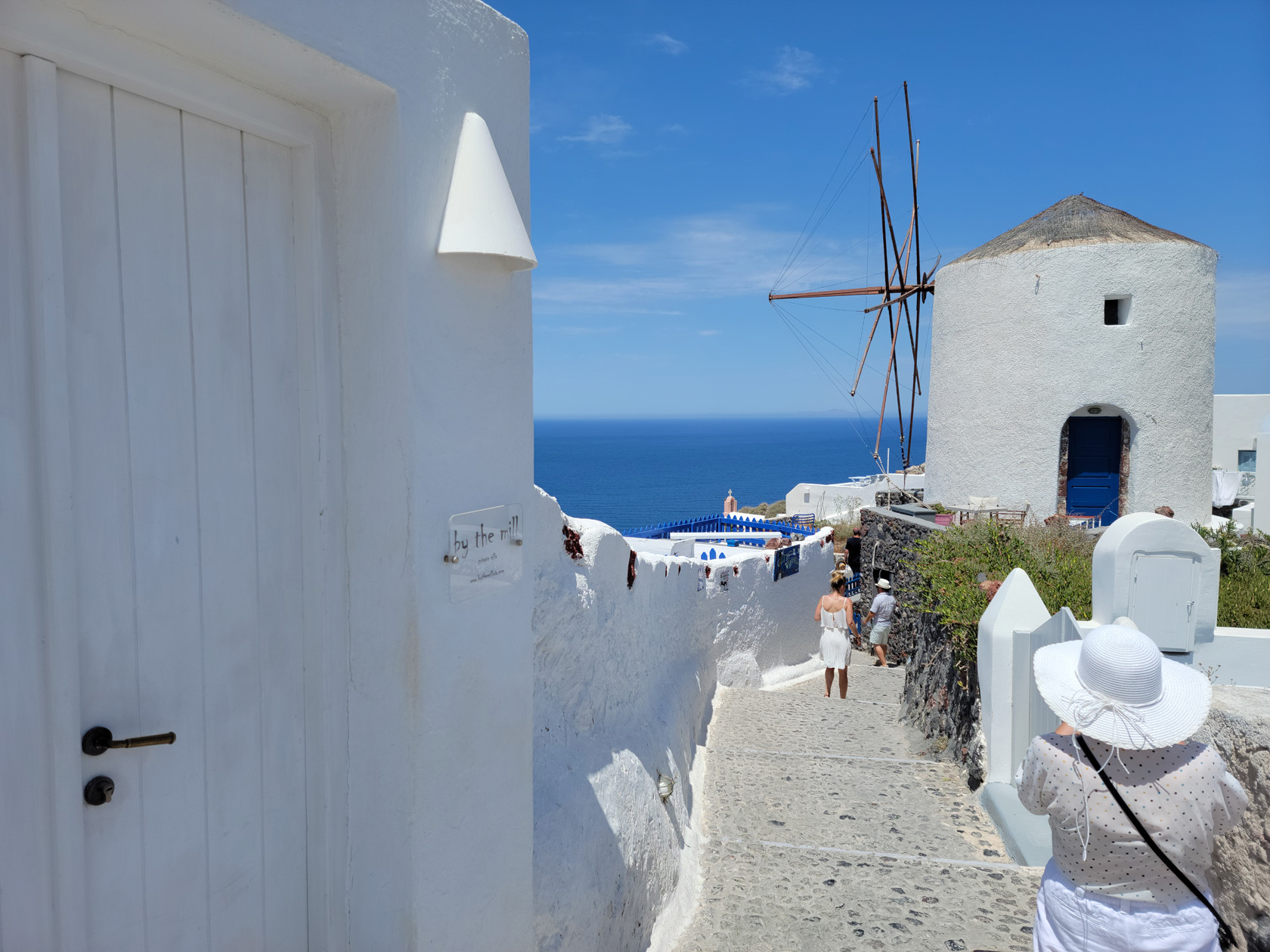
Oia, Santorini – Old Windmill
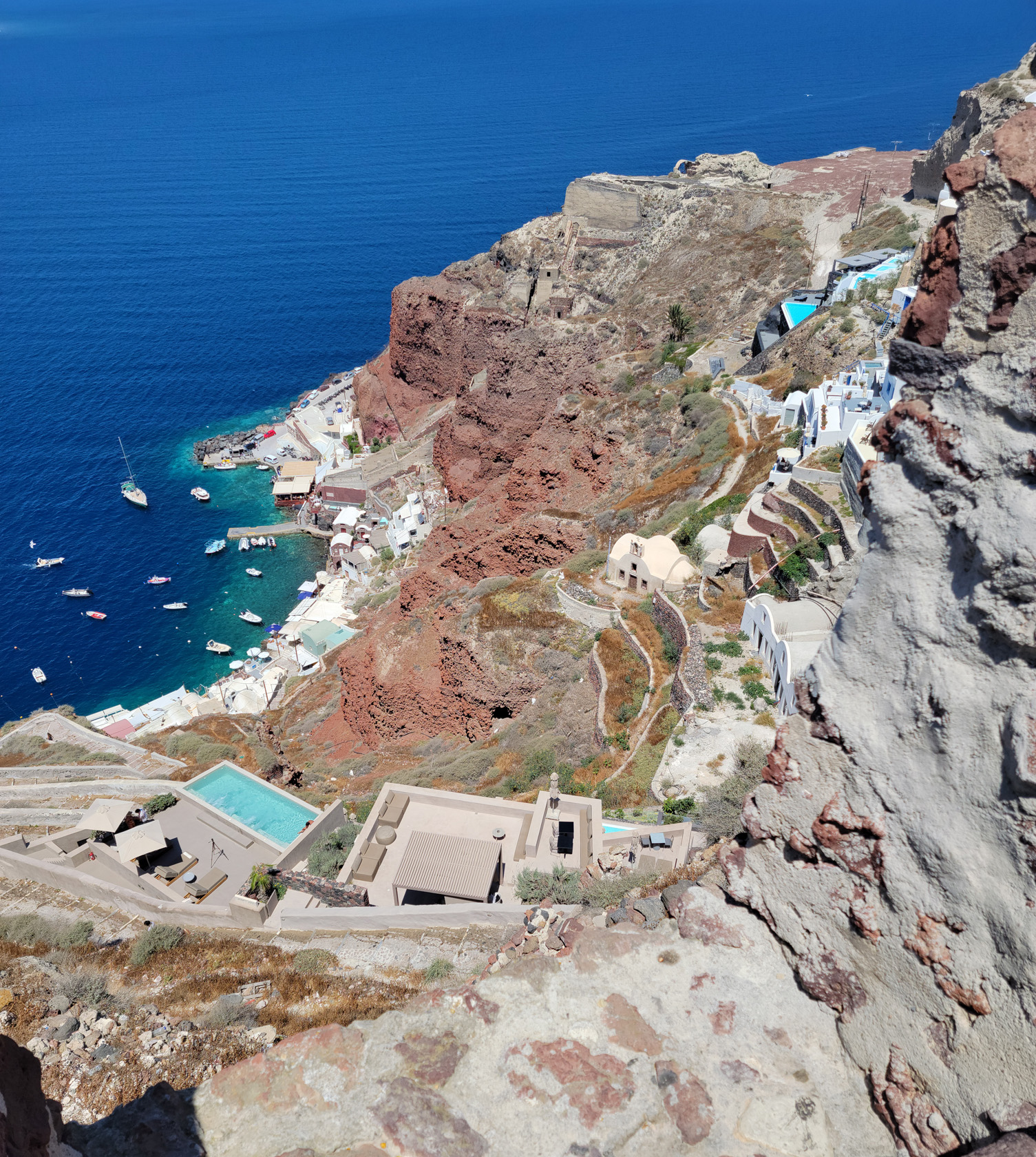
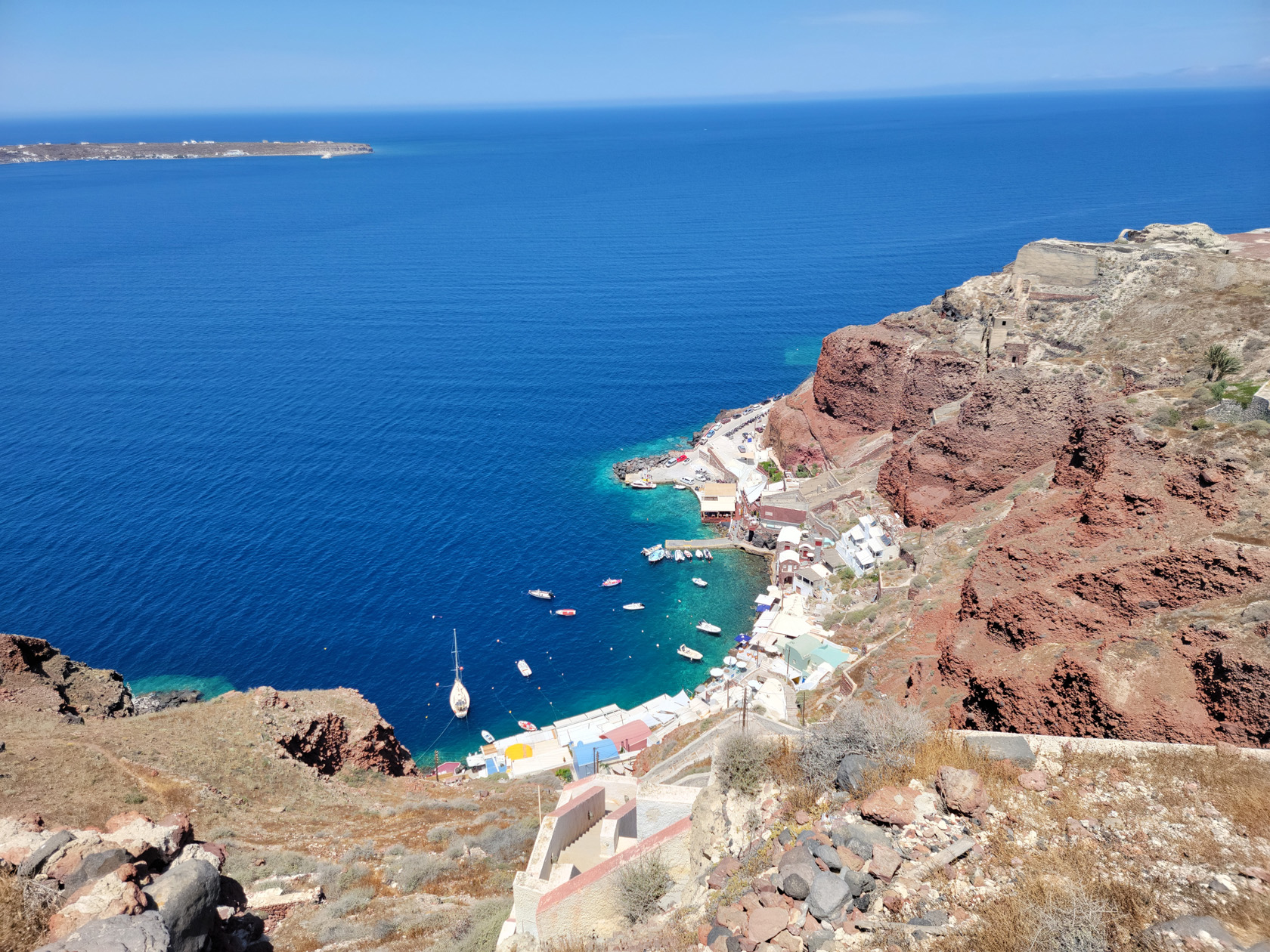
Oia, Santorini – The Oia Steps and Harbor
Oia, Santorini – The Three Blue Domes
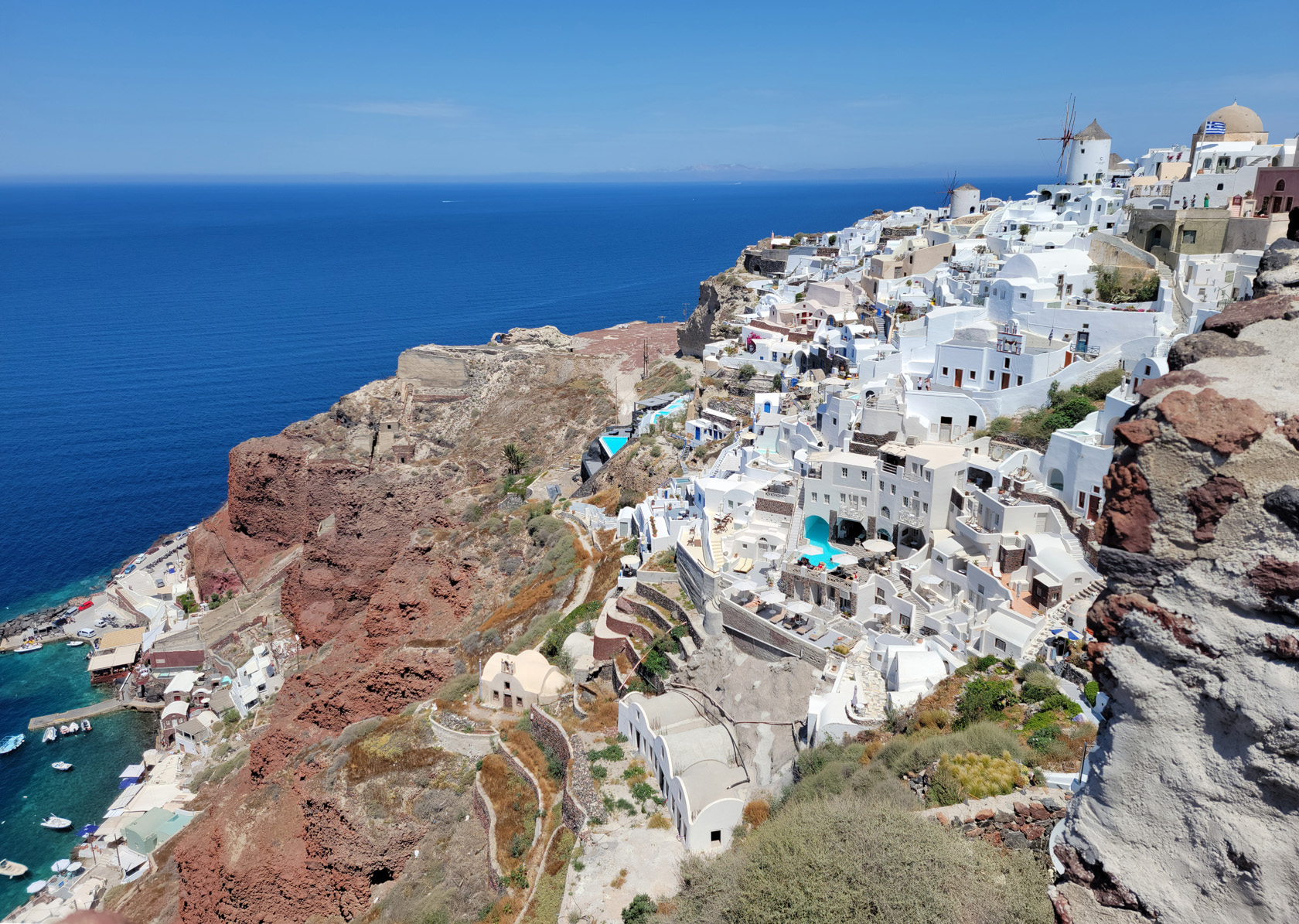
Oia, Santorini – View From Castle
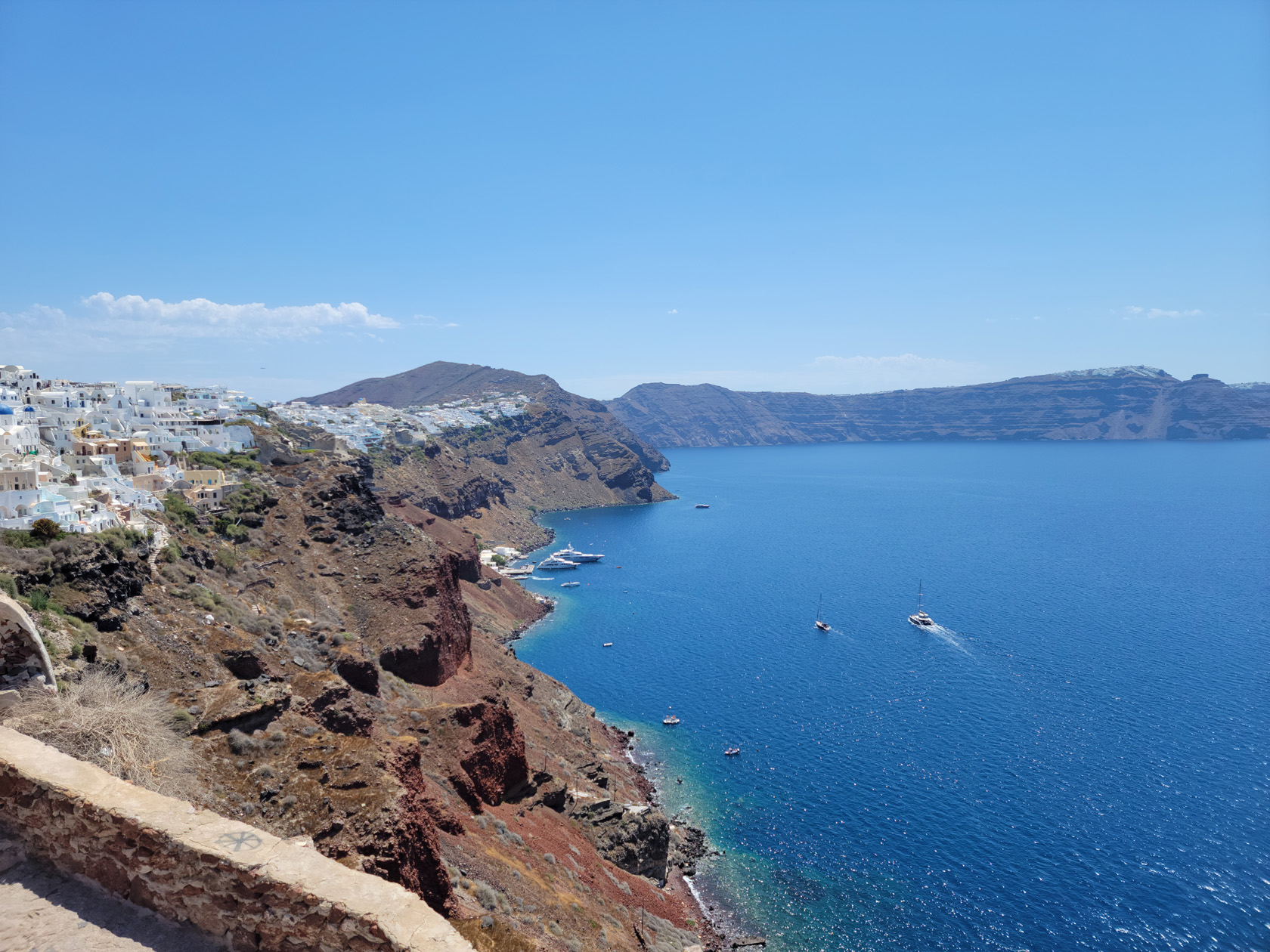
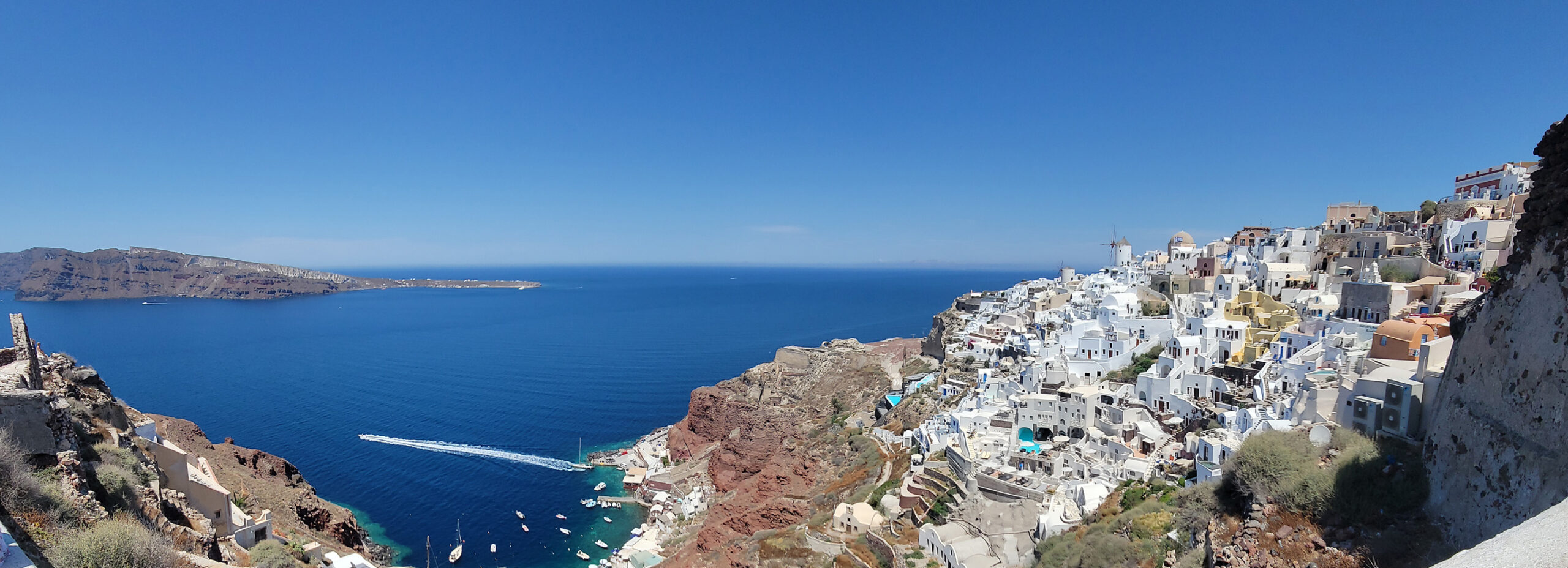
Oia, Santorini – Panorama
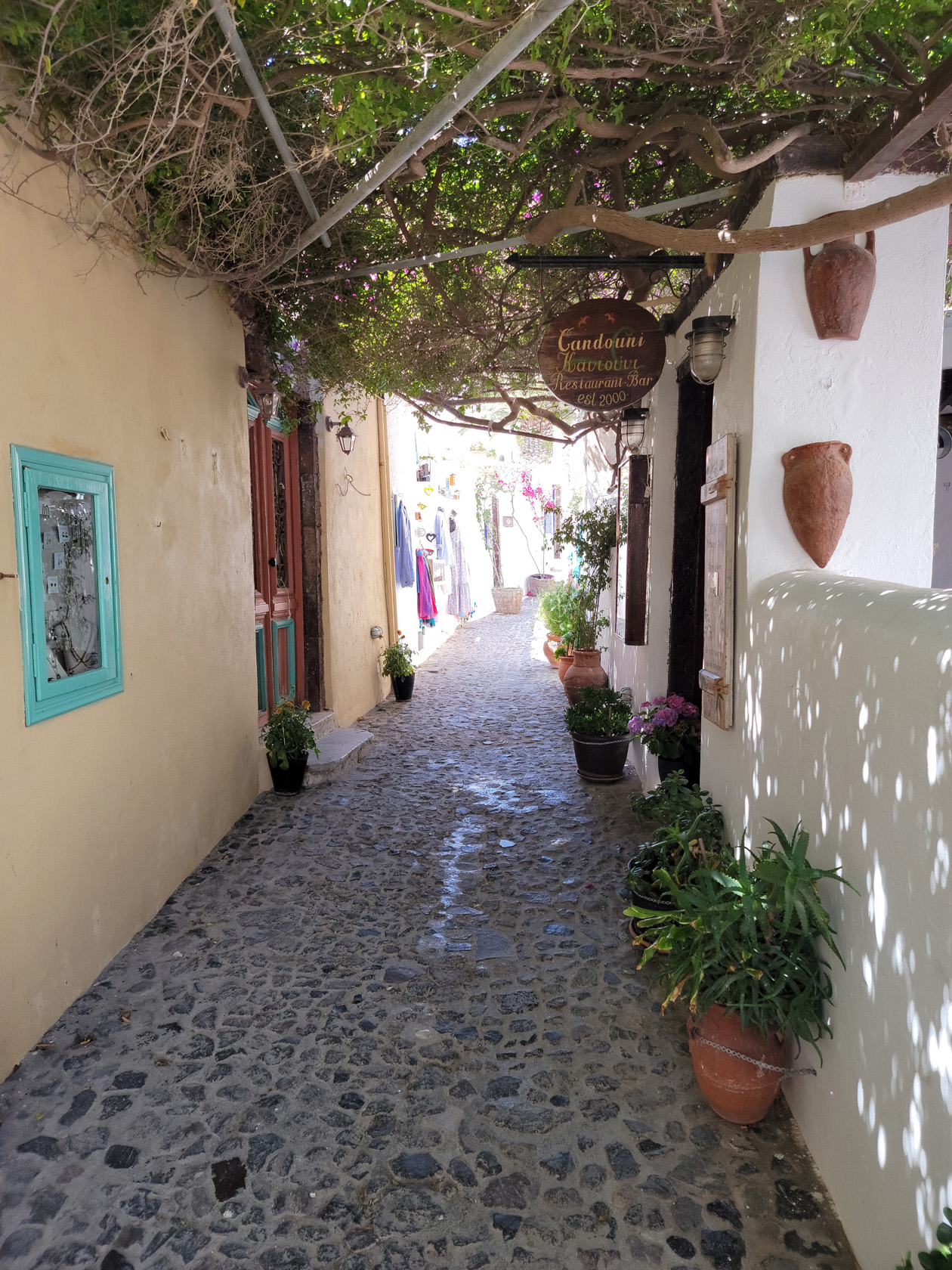
Oia, Santorini – Alley
Oia, Santorini – Old Windmill
Oia, Santorini – Looking Toward Old Windmill
Oia, Santorini – Old Windmill
Oia, Santorini – Panorama
Oia, Santorini – Looking Toward Old Windmill
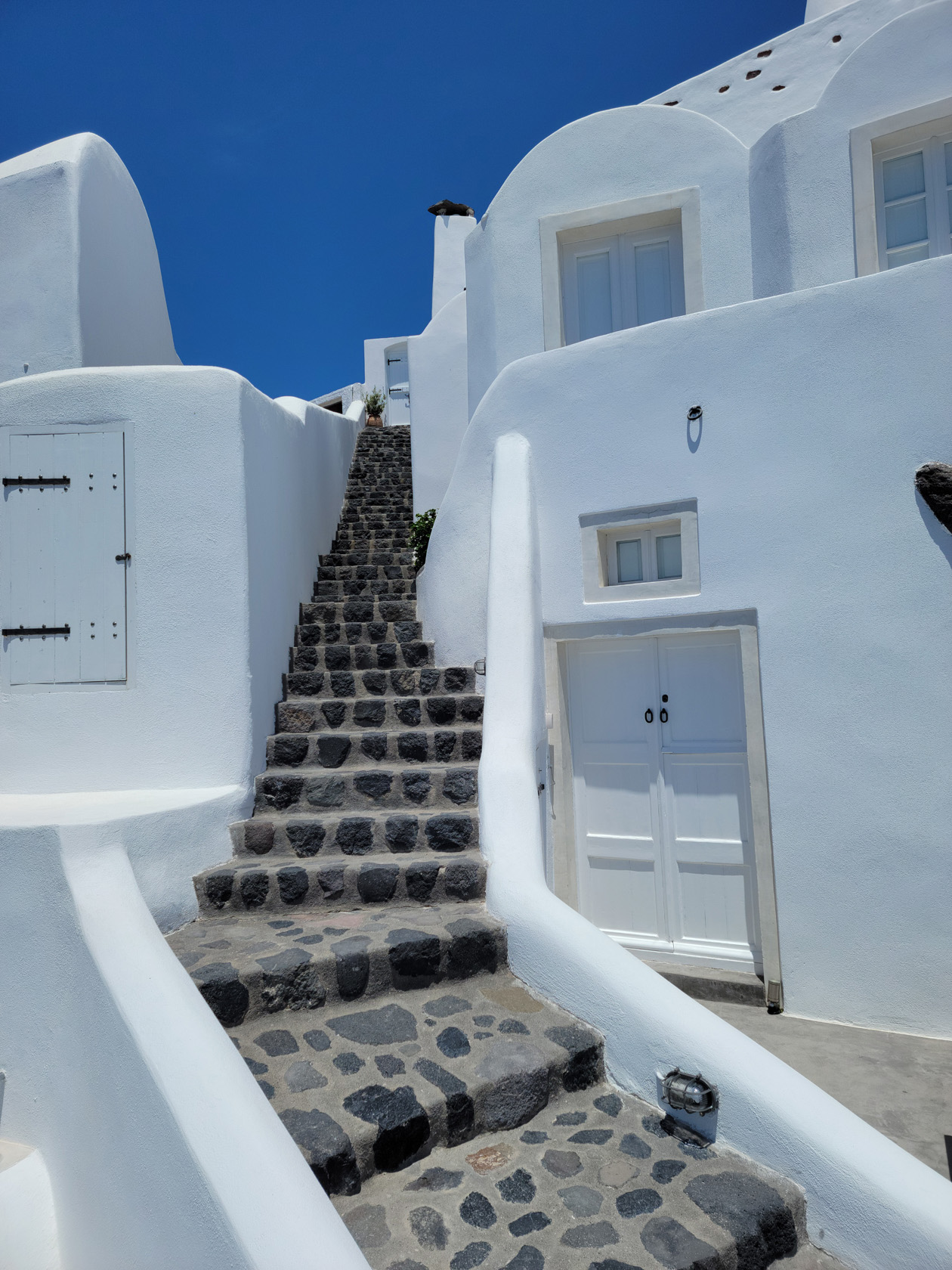
Oia, Santorini – Typical Building Color Scheme
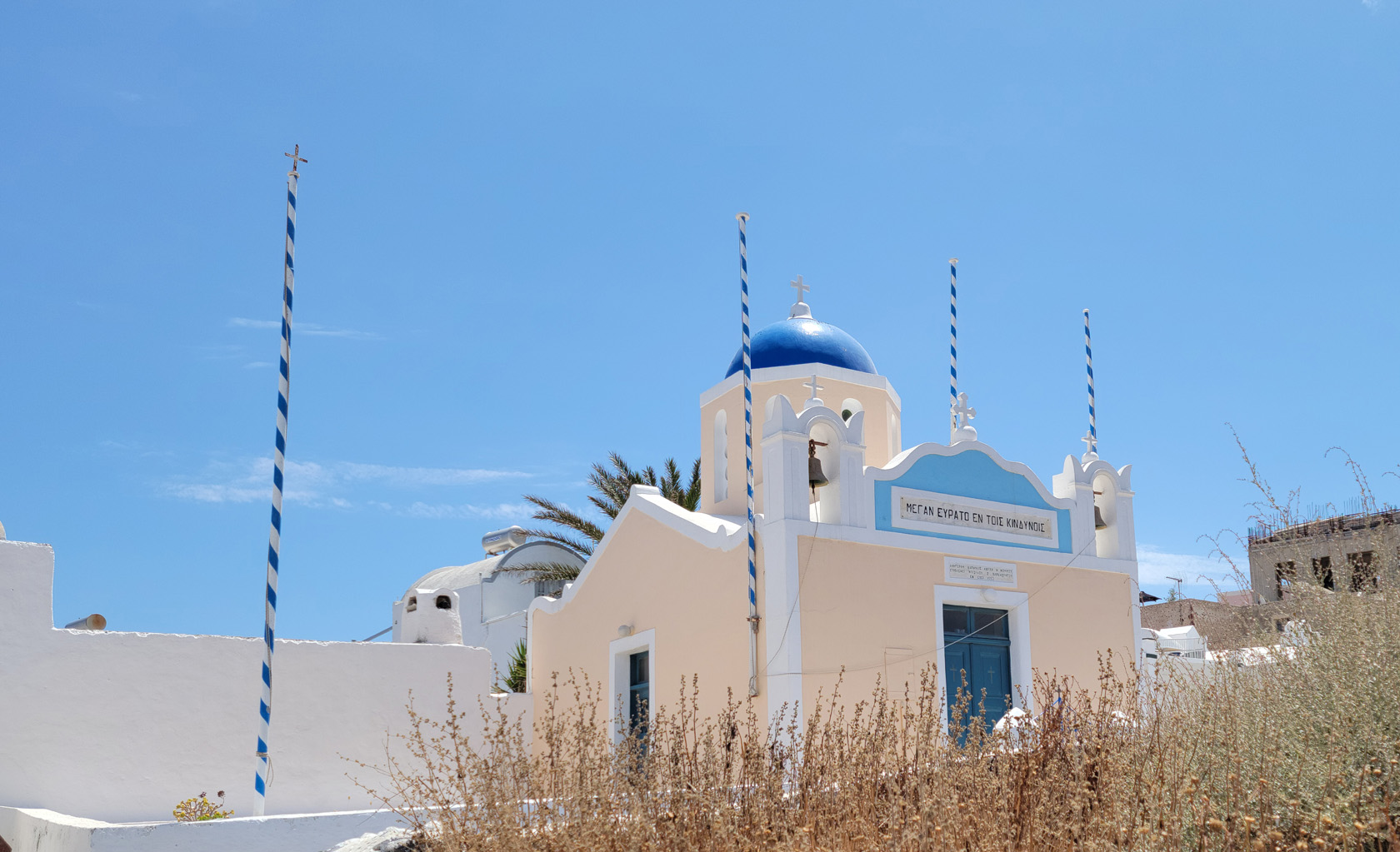
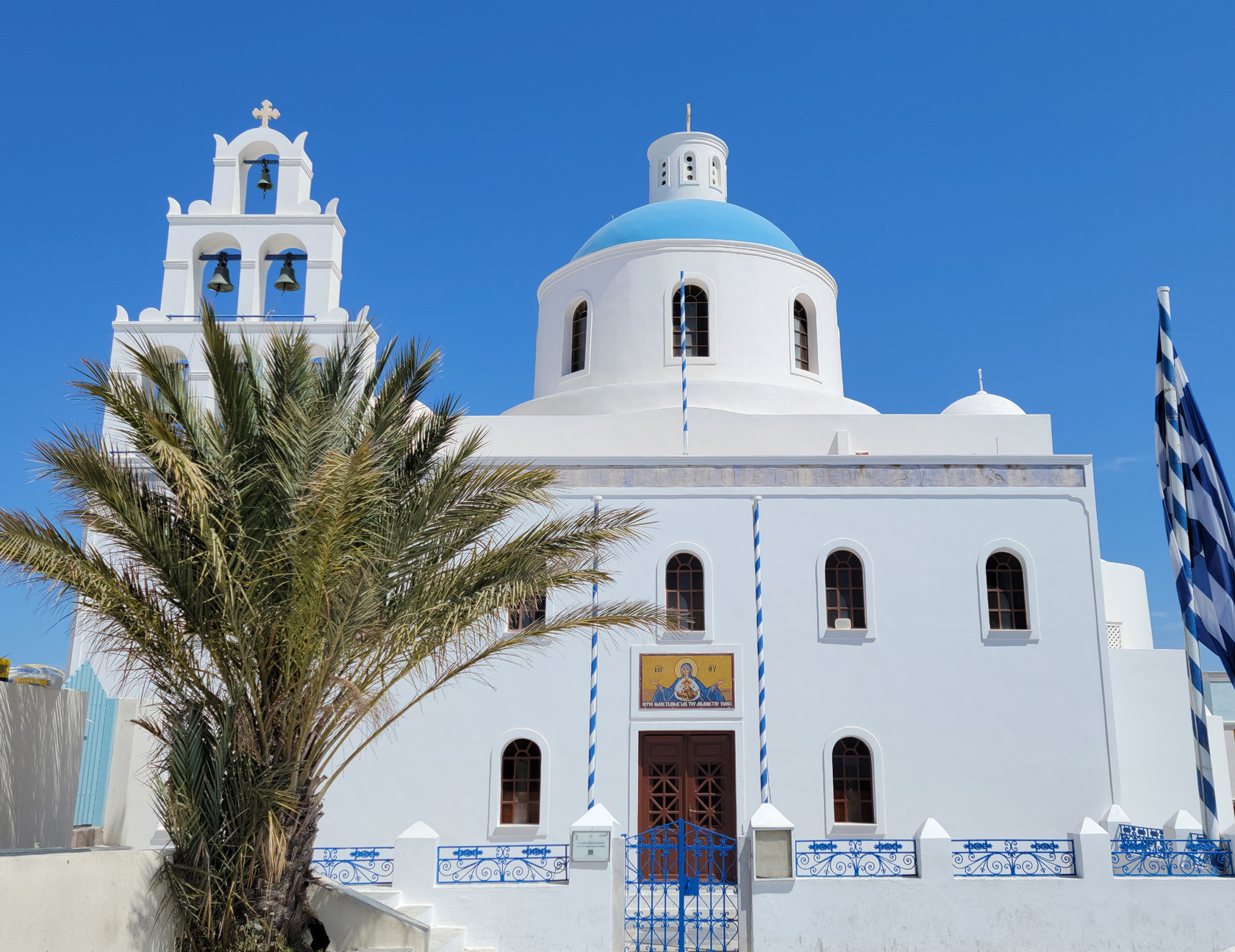
Oia, Santorini – Church of Panagia Akathistos Hymn
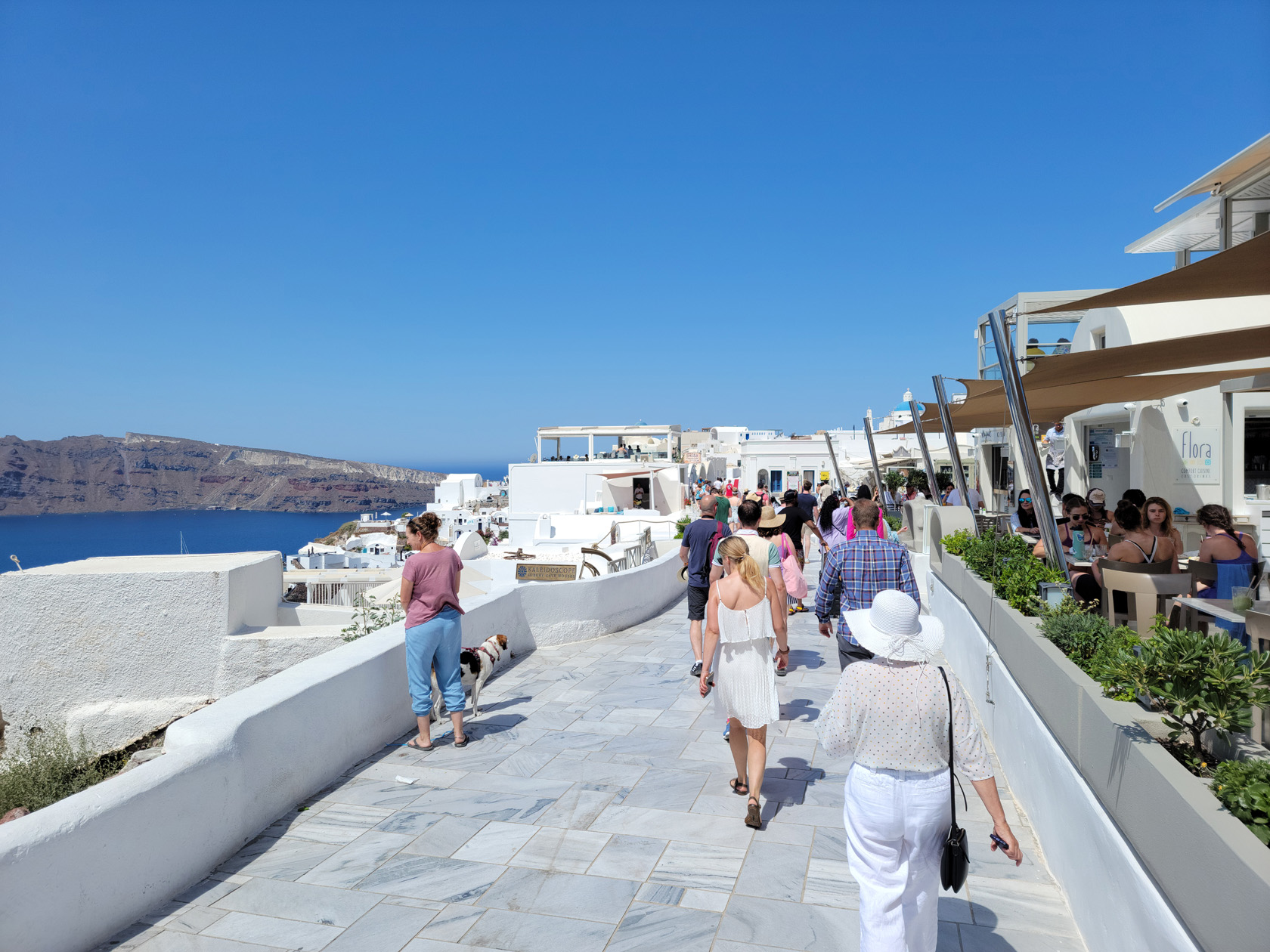
Oia, Santorini – Nik. Nomikou Marble Pedestrian Way
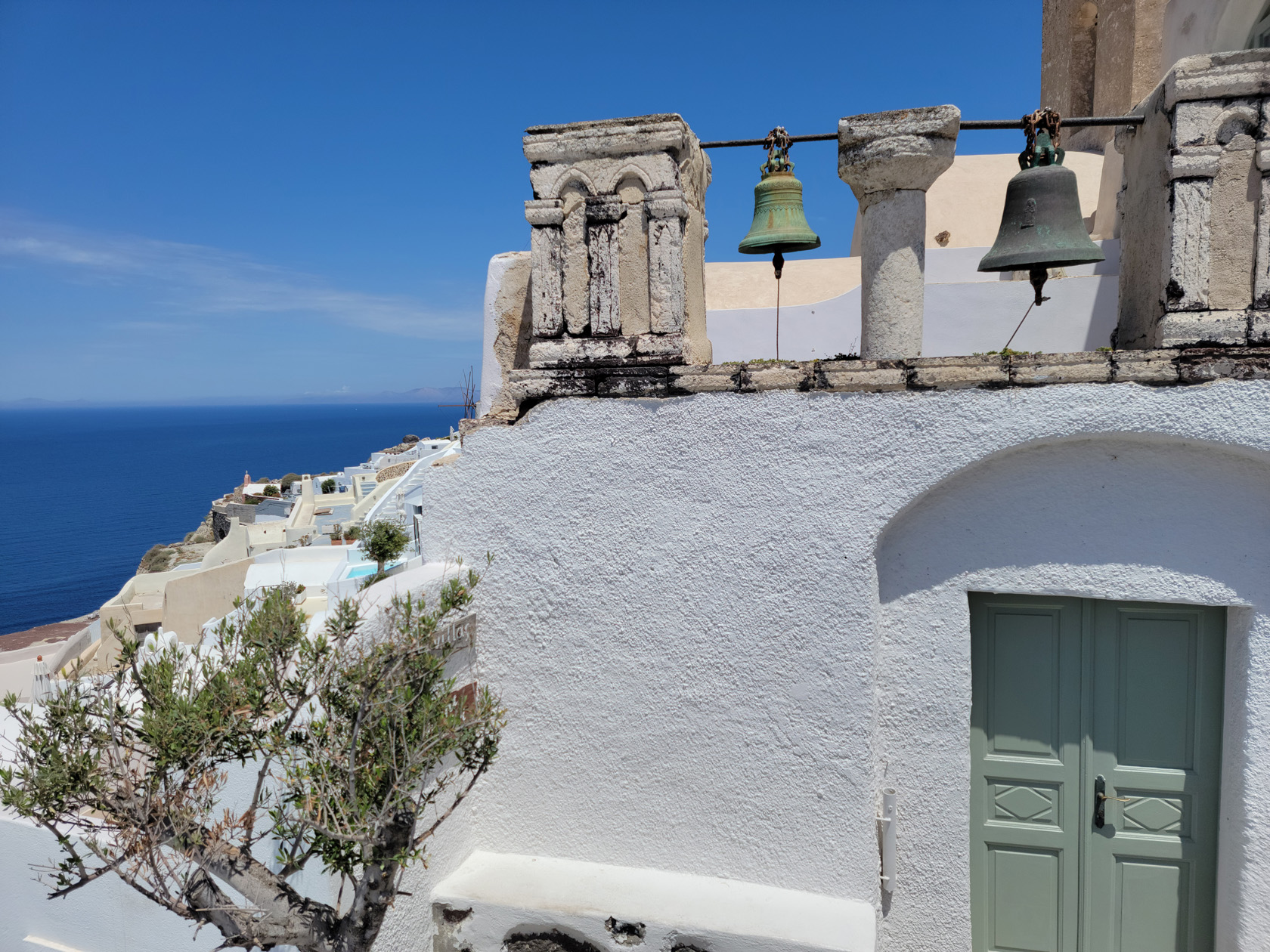
Oia, Santorini – Old Church and Bronze Bells
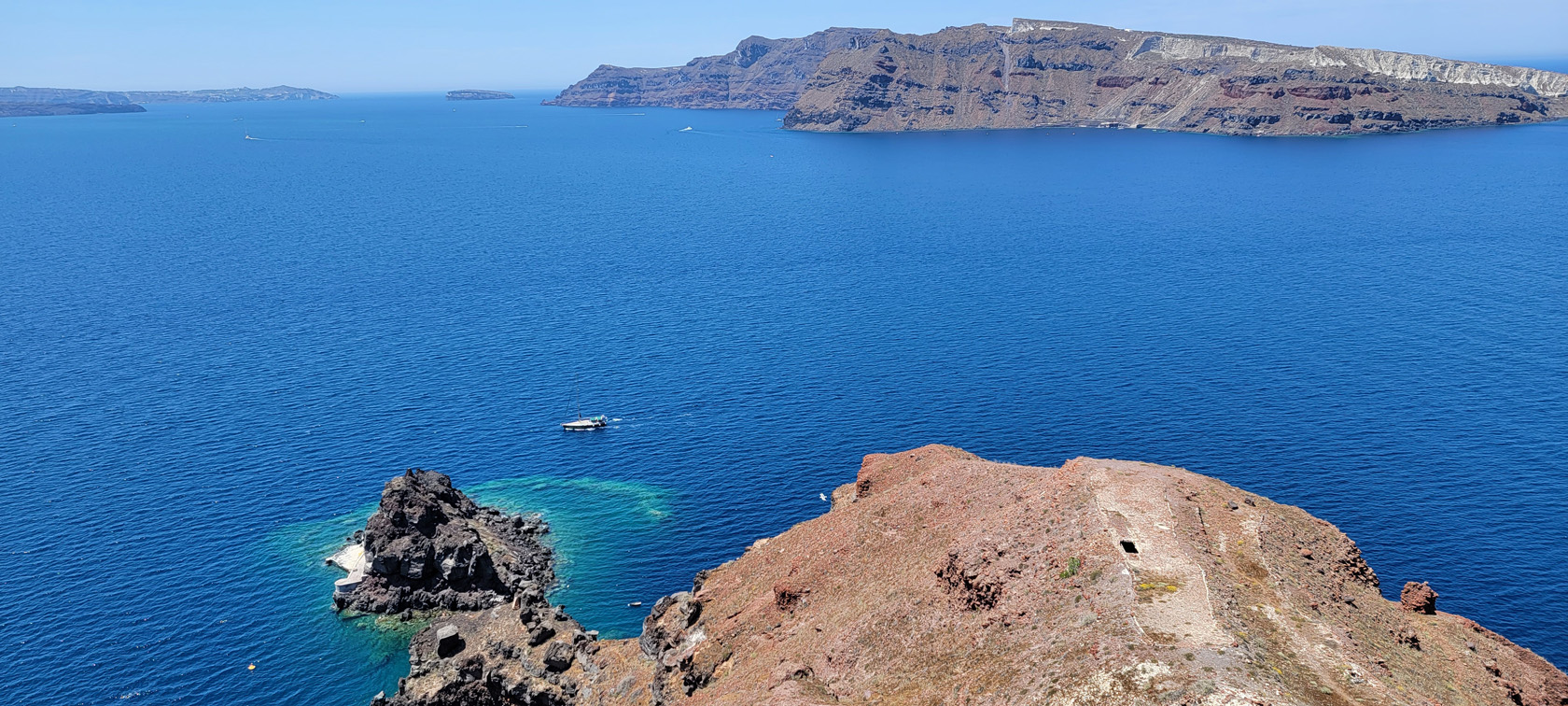
Oia, Santorini – View of Thirasia
Oia, Santorini – From Castle
Oia, Santorini – Parekklesio Church from Castle
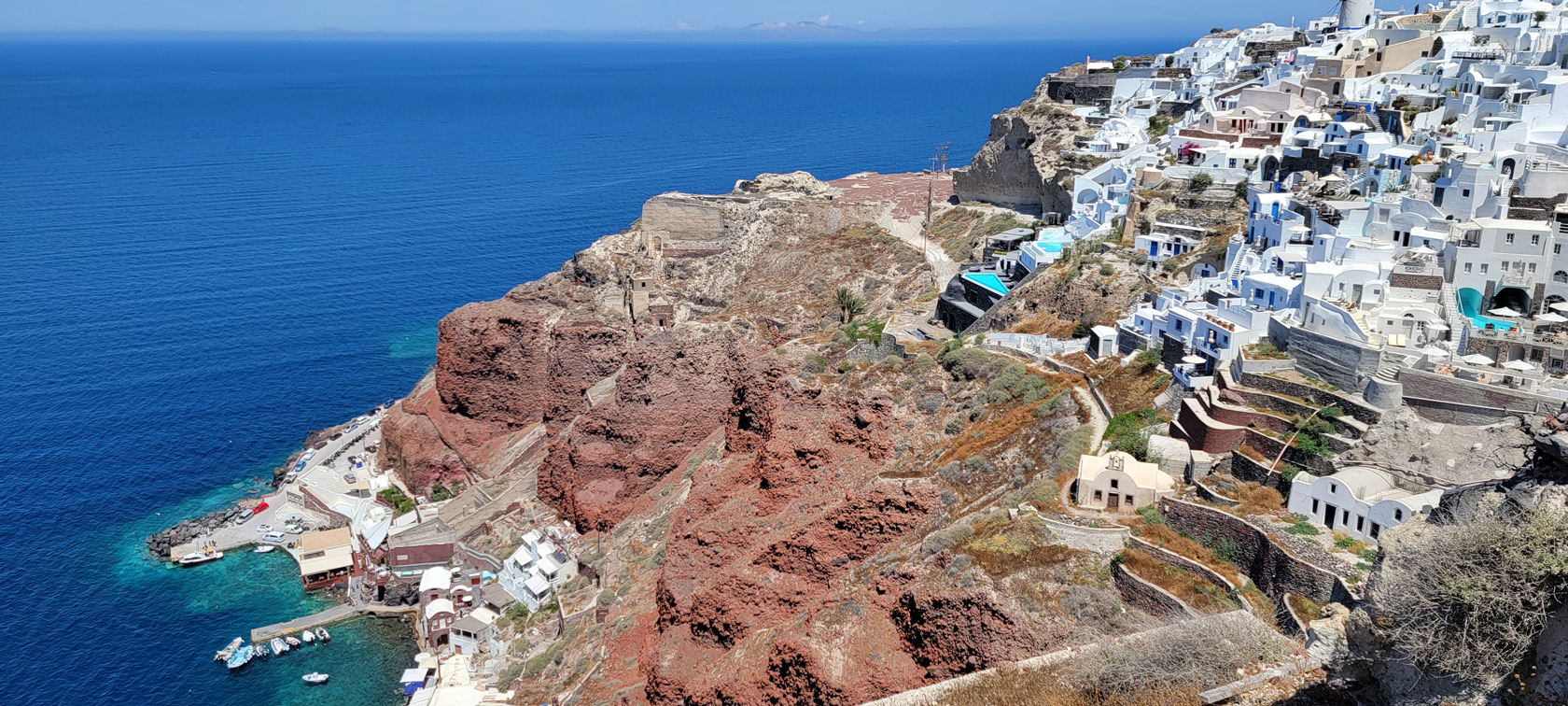
Oia, Santorini – Small Harbor by Oia Steps
The Atrina Cavana 1894 Hotel
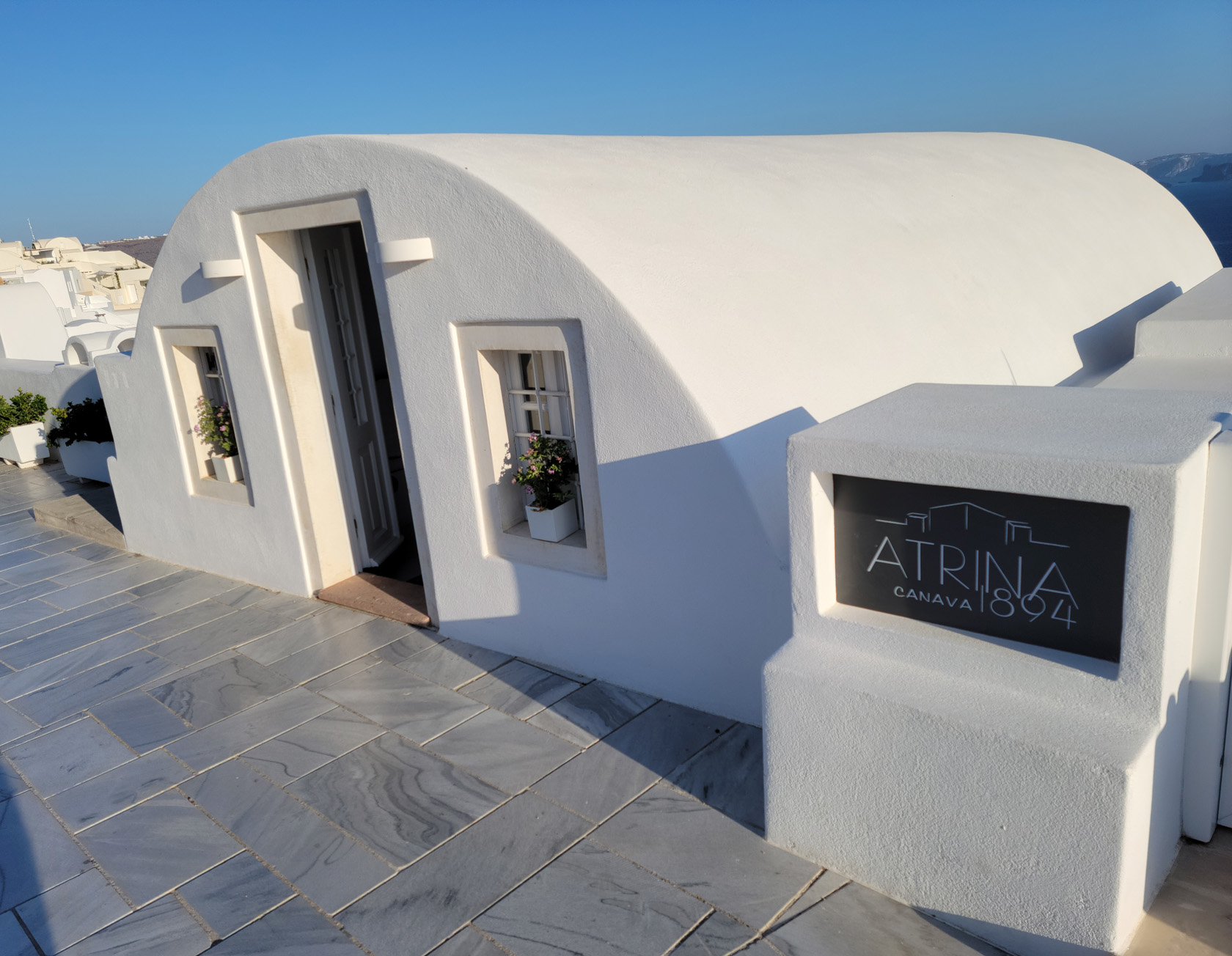
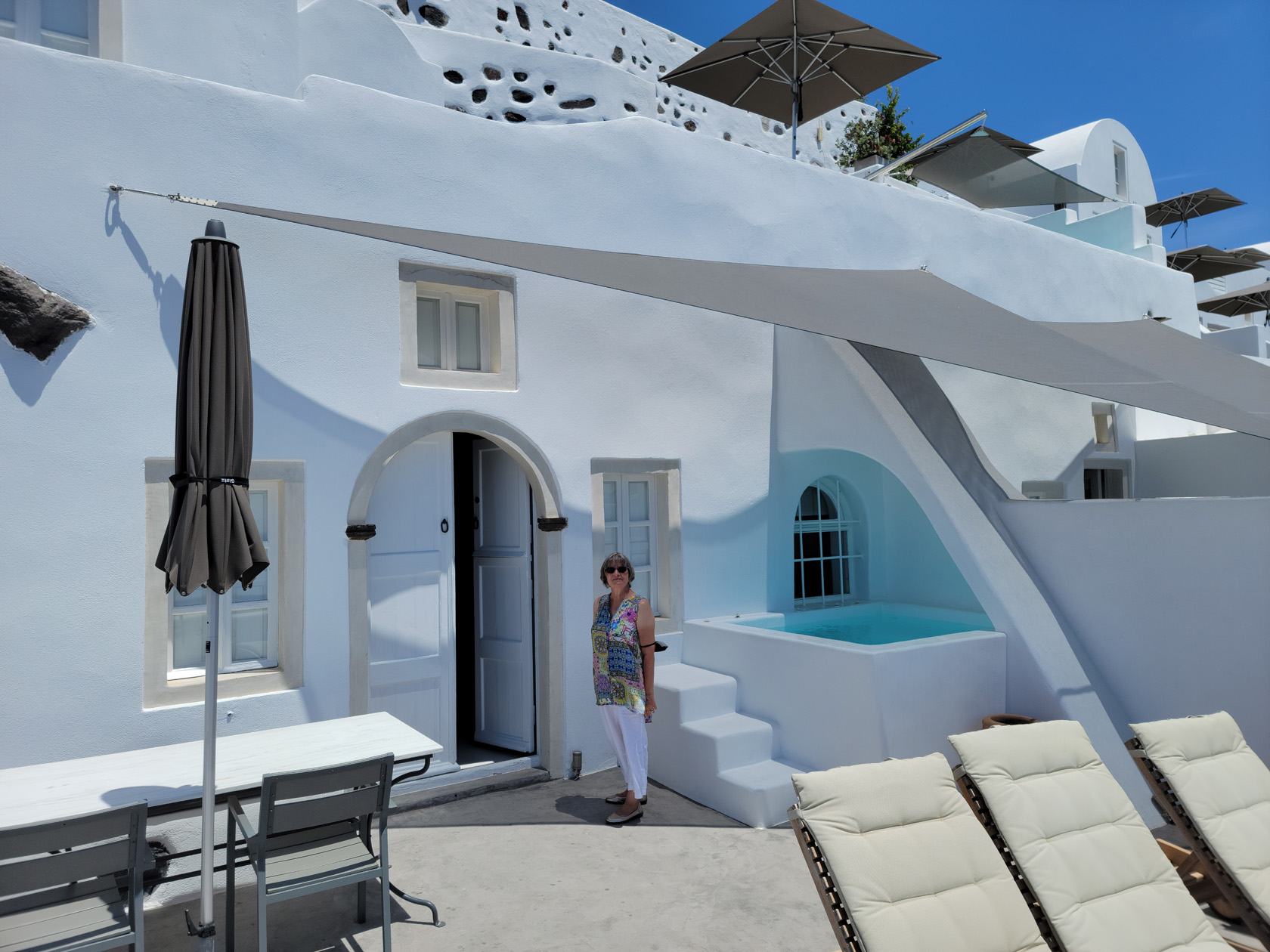
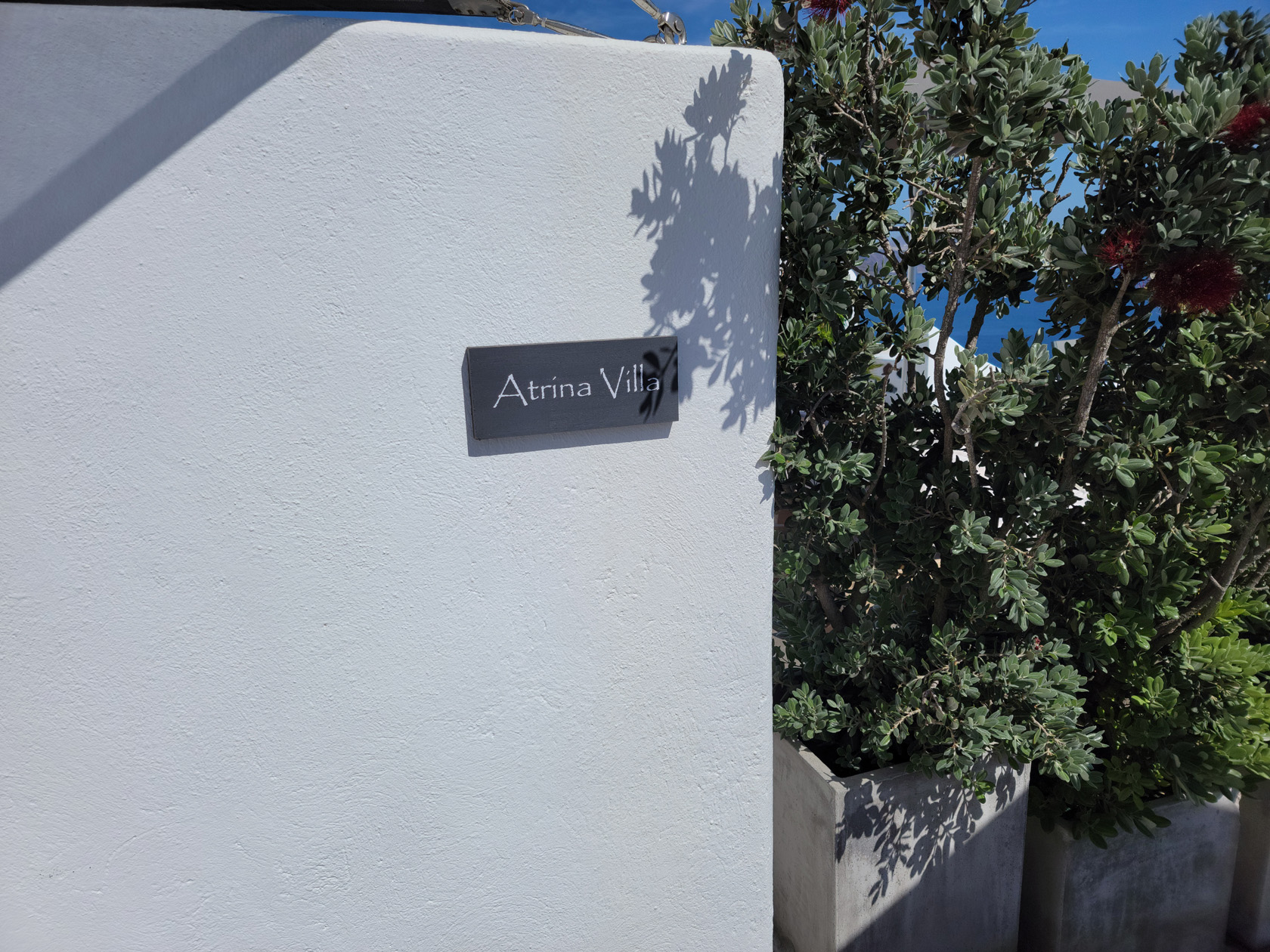
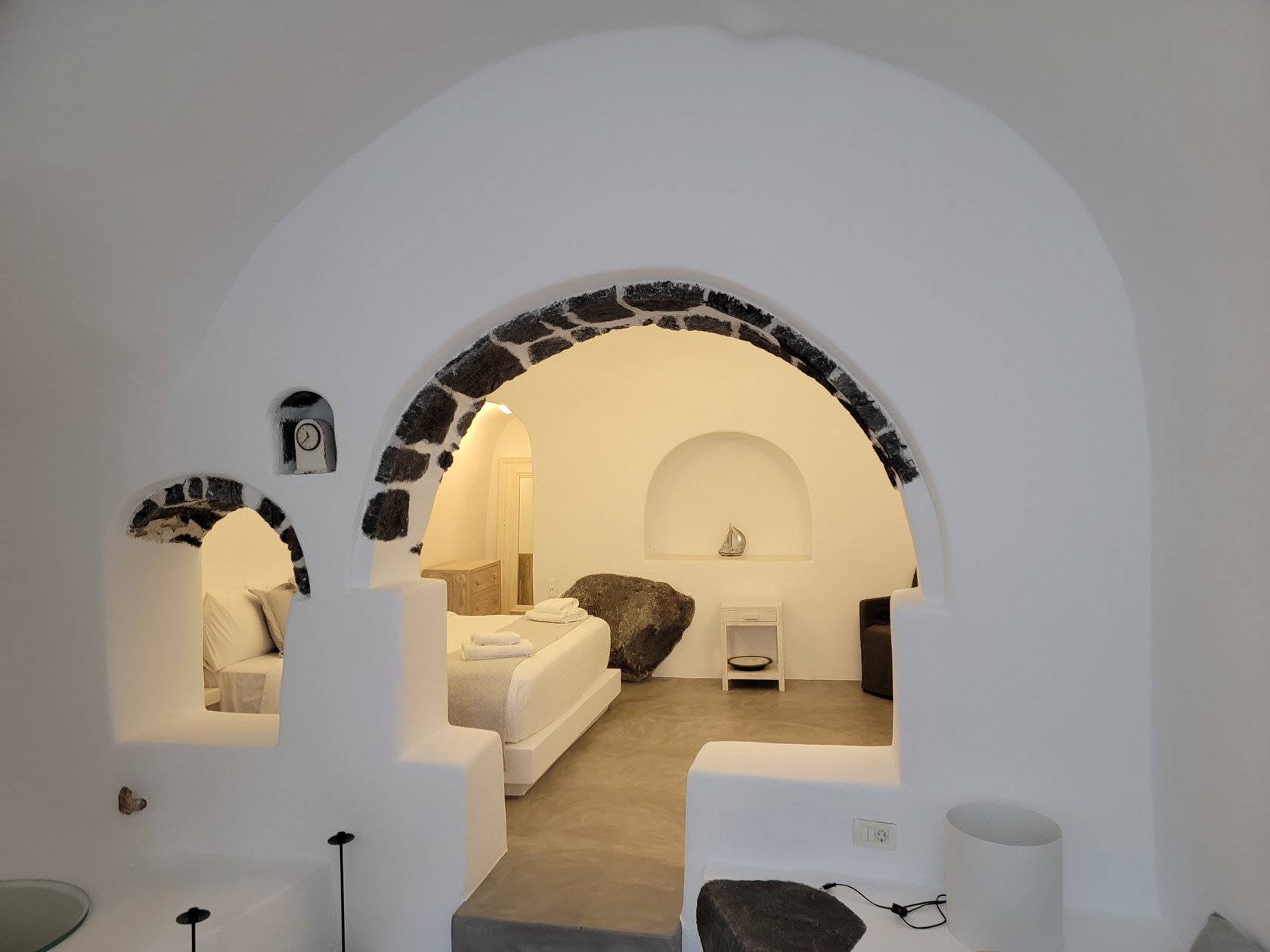
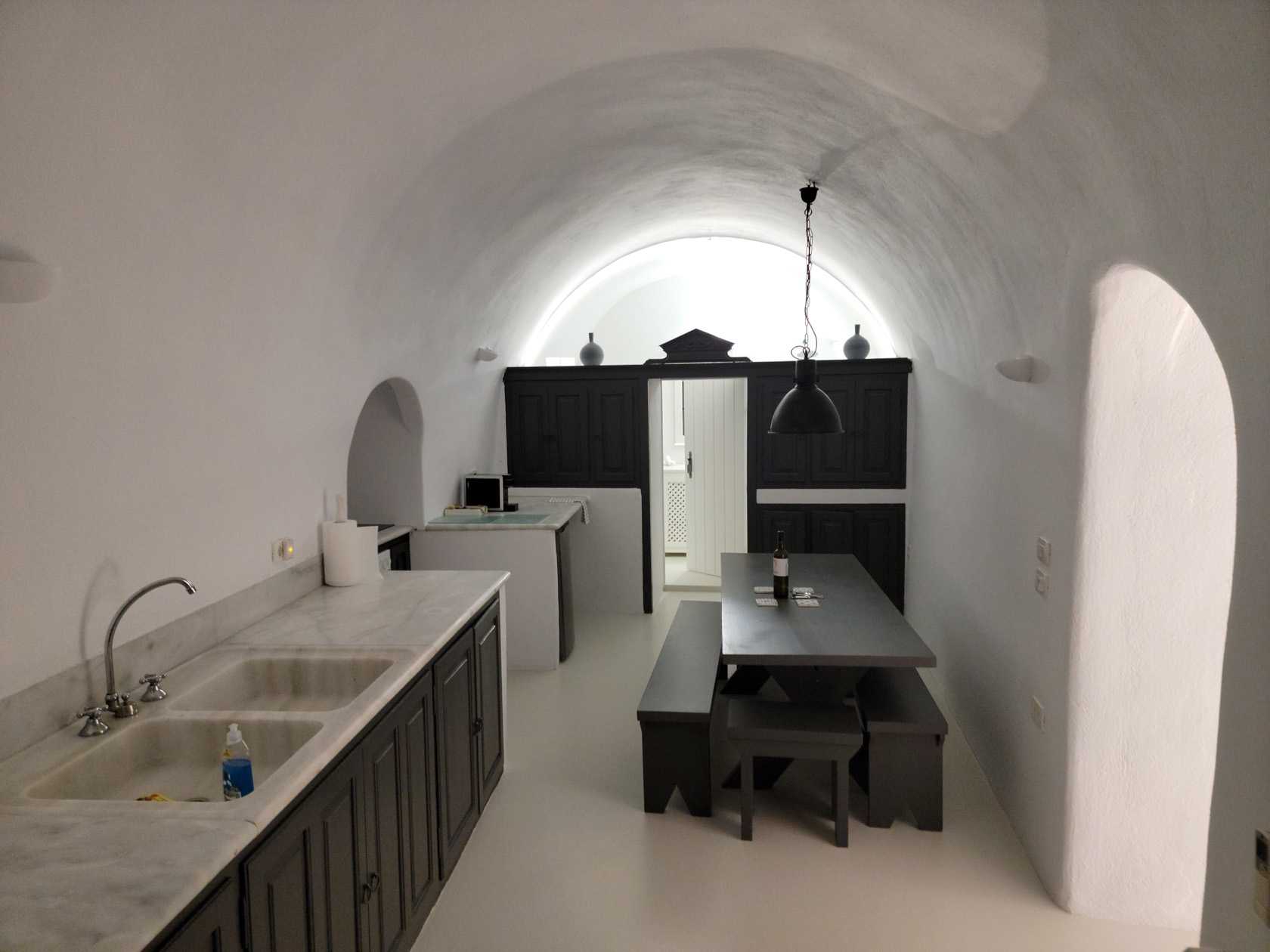
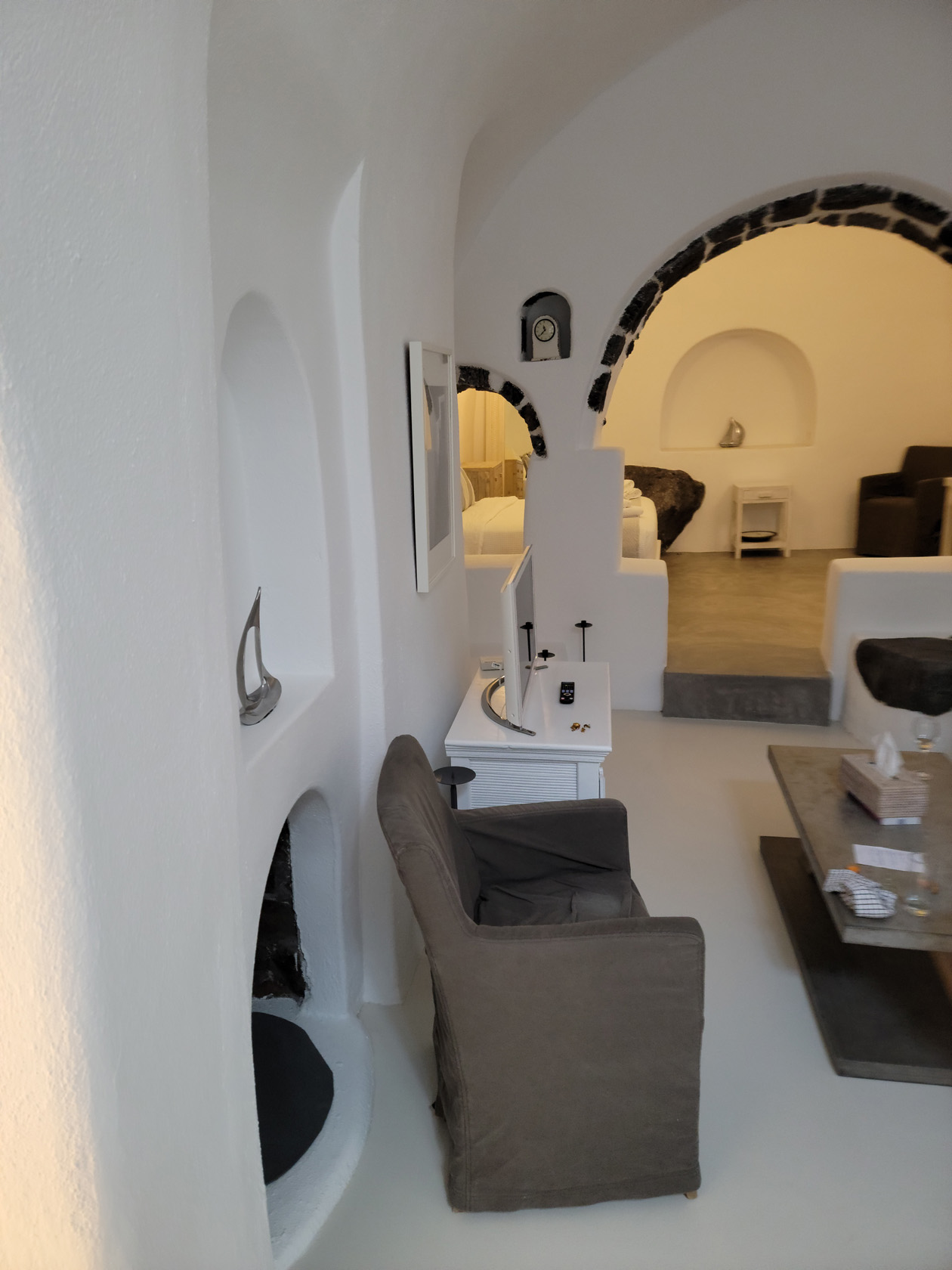
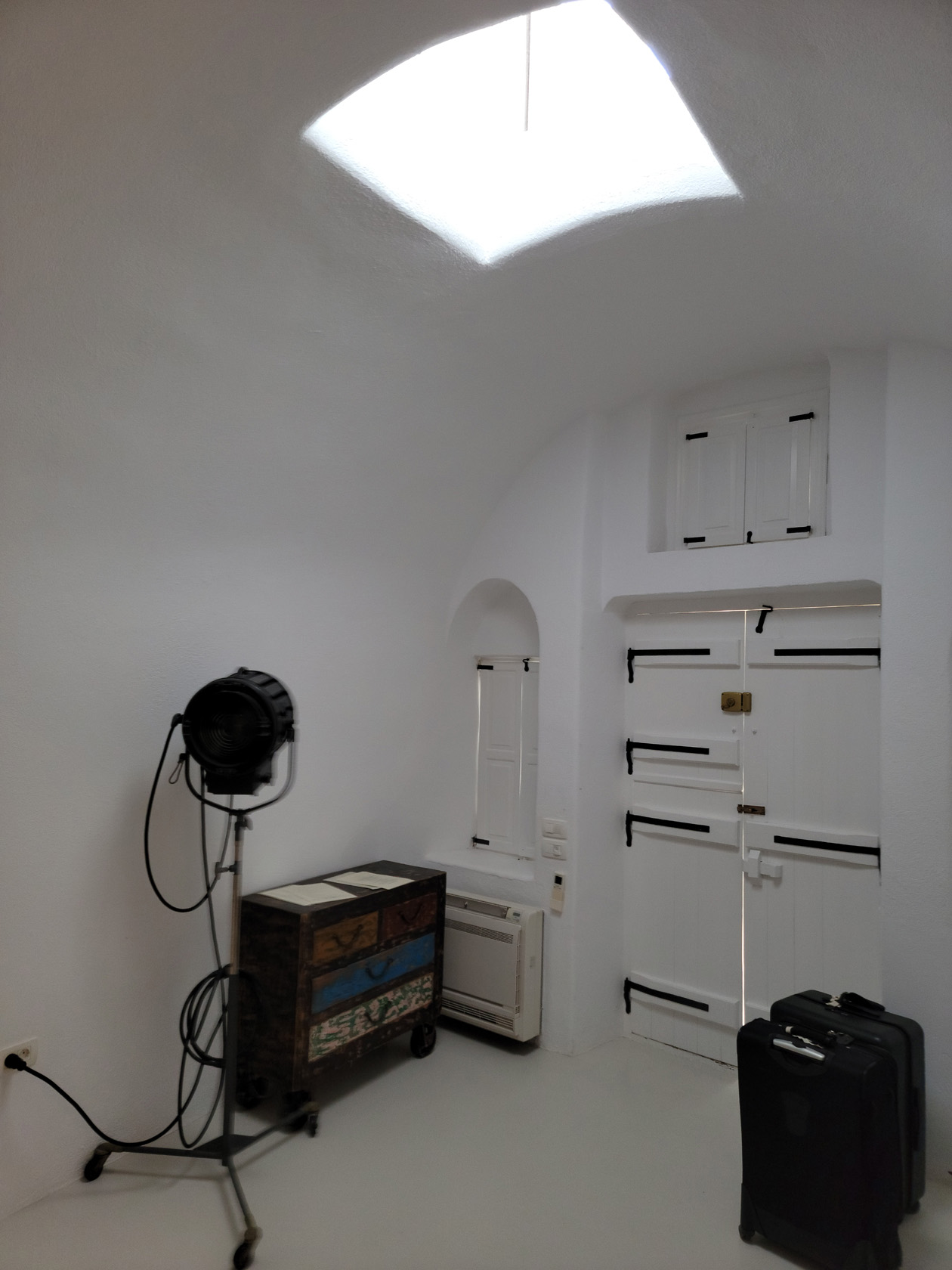
We stayed at the Atrina Cavana 1894 in the Atrina Villa for our anniversary. It was very spacious and has all the amenities one should need, it even has a kitchenette for those who wish to cook in on occasion.
Oia, Santorini – Atrina Canava 1894 – Entrance
Oia, Santorini – Atrina Canava Villa – Patti
Oia, Santorini – Atrina Canava Villa
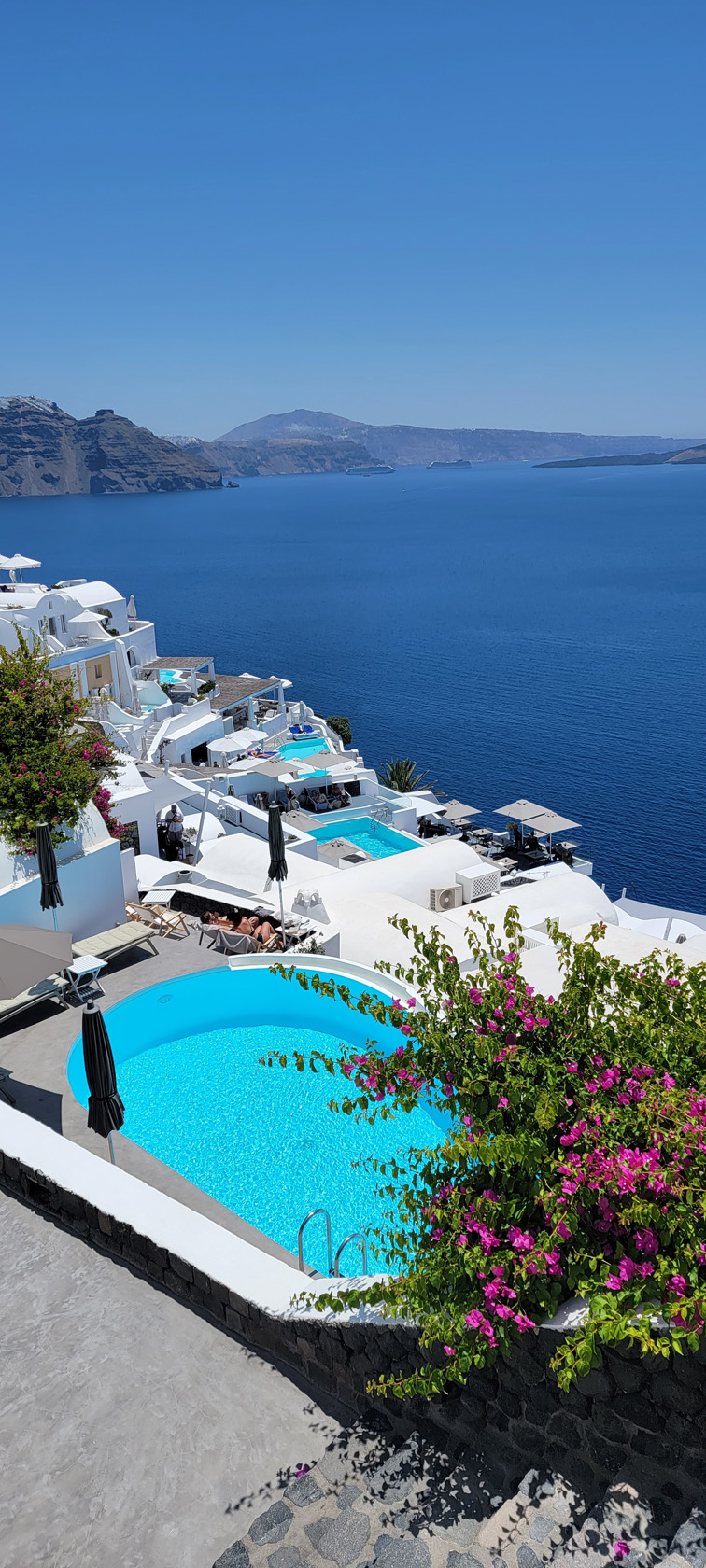
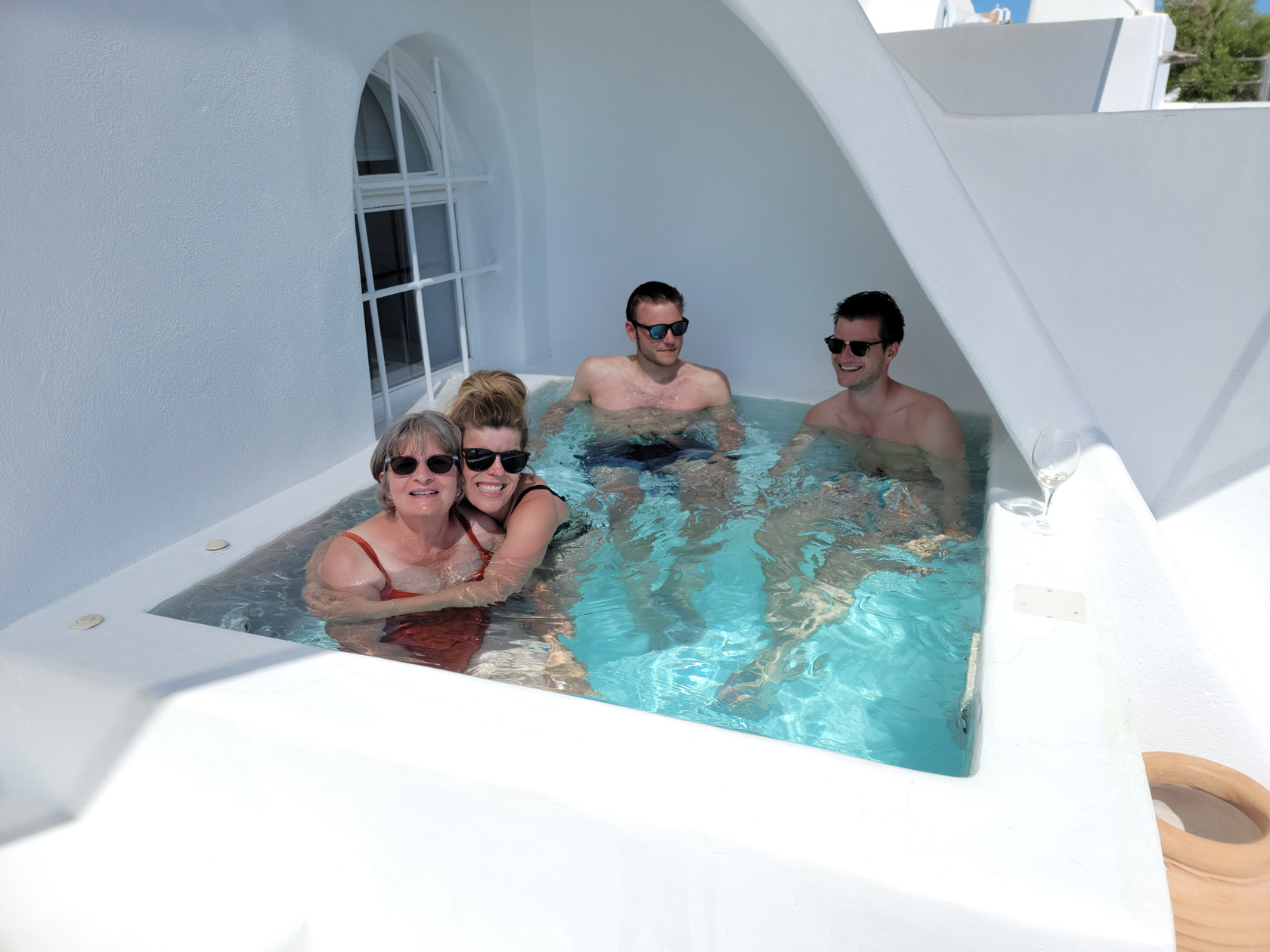
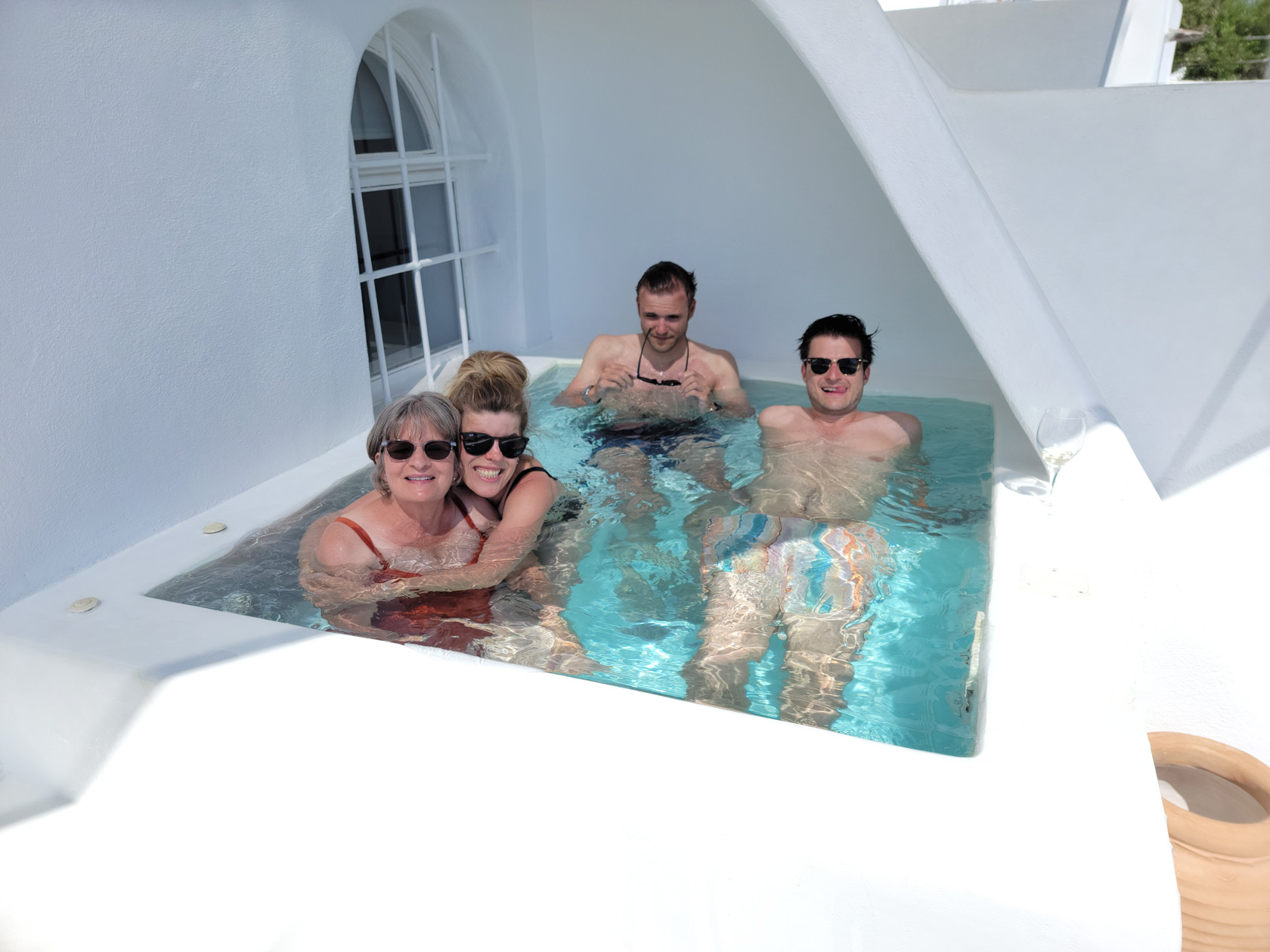
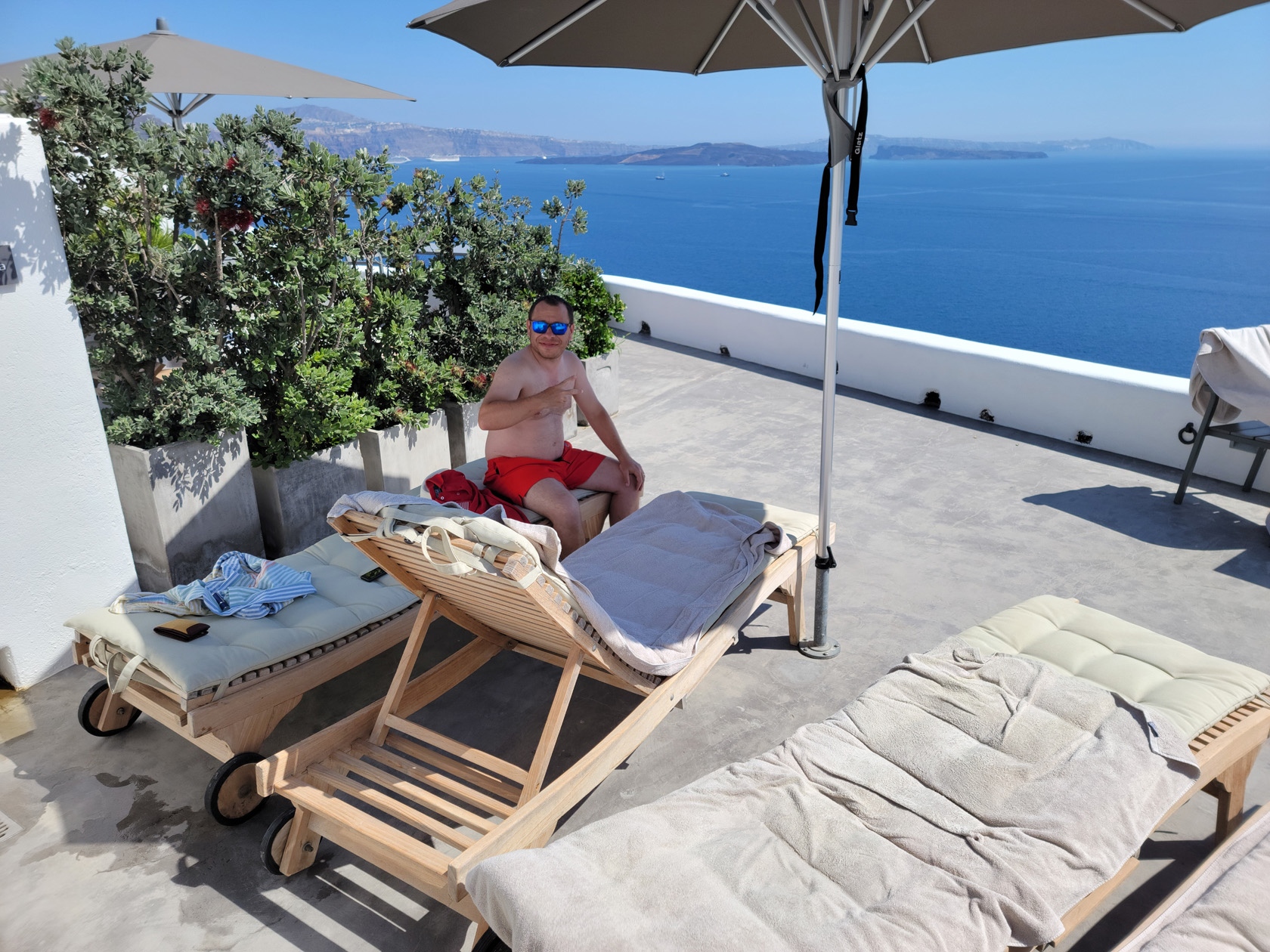
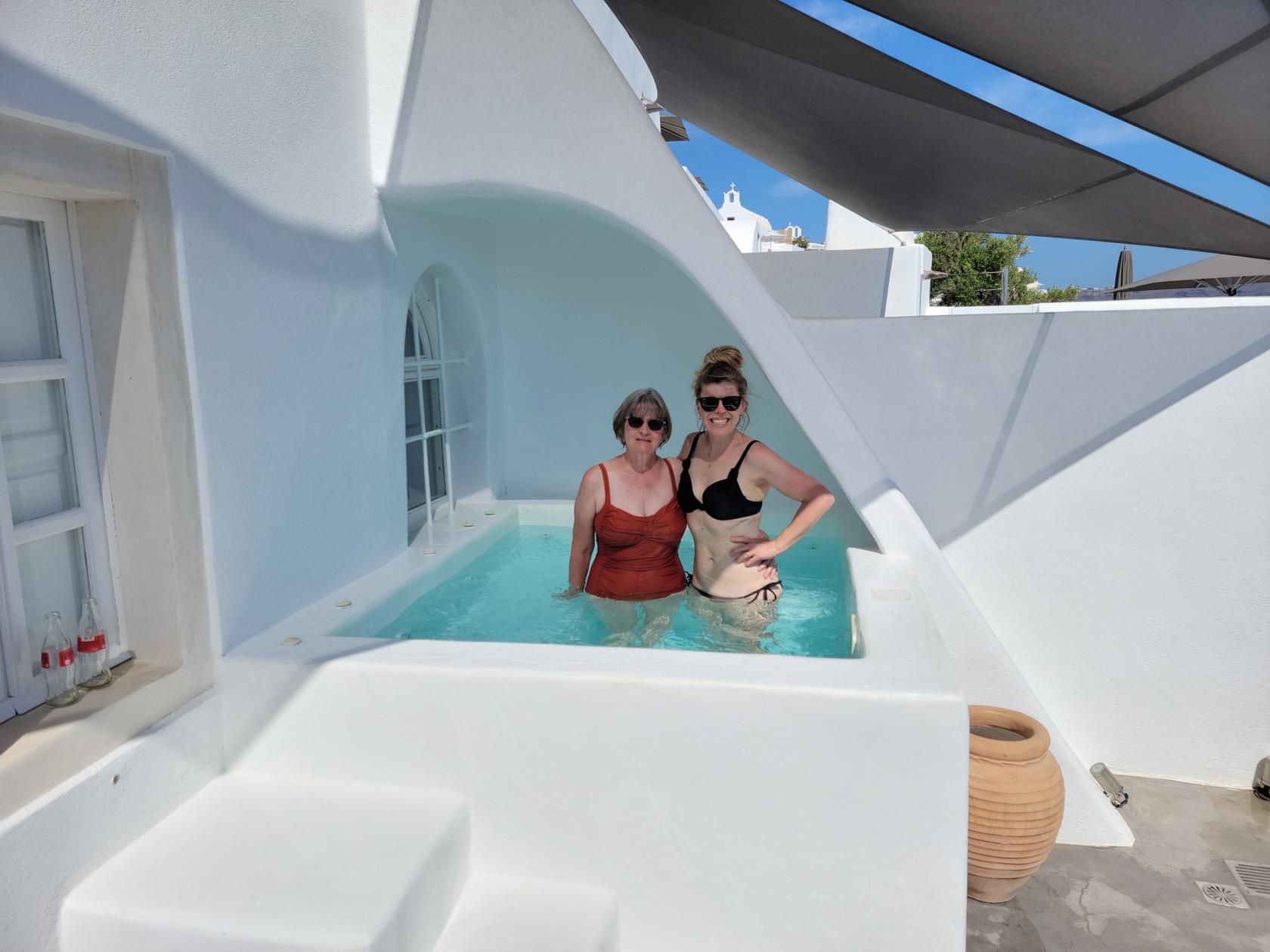
Since real estate is at a premium, not all hotels in Oia have pools, our hotel was probably an exception. Not only did we have access to a pool, but we also had a hot tub with our villa that all of us took advantage. The pool was actually a bit cold and the surface was very slippery. We had fun anyway.
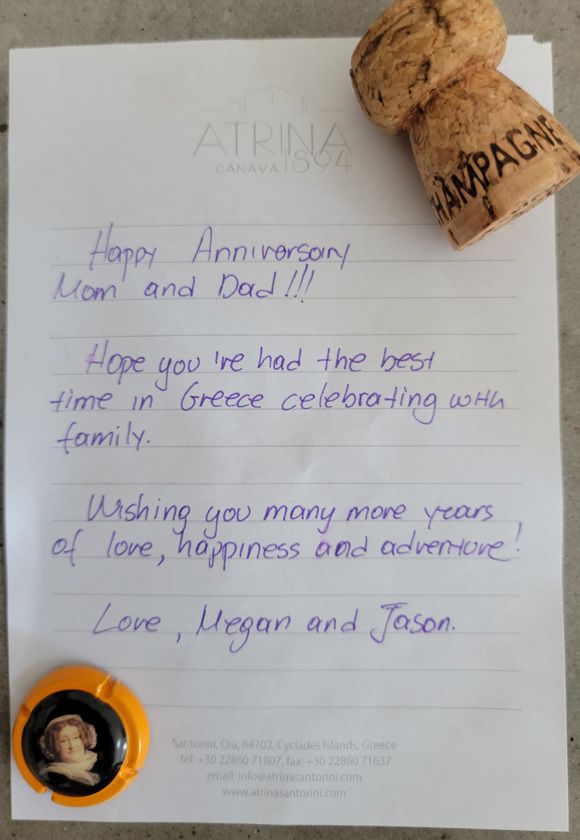
Oia, Santorini – Atrina Canava Villa – Anniversary Message and Champagne
Oia, Santorini – Atrina Canava Villa – Bedroom
Oia, Santorini – Atrina Canava Villa – Kitchen and Extra Bathroom
Oia, Santorini – Atrina Canava Villa – Fireplace, Living Room and Bedroom
Oia, Santorini – Atrina Canava Villa – Kitchen Entrance
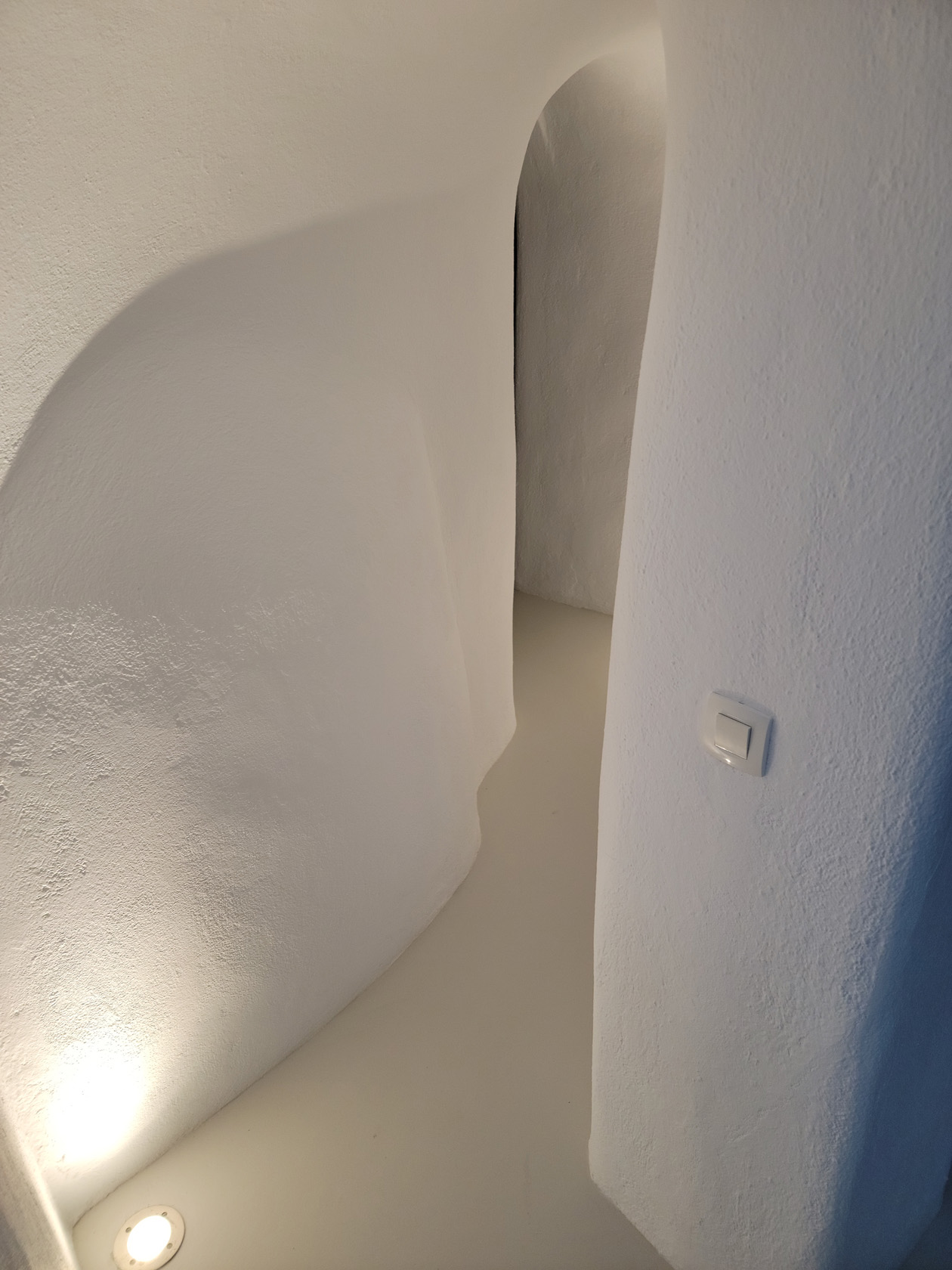
Oia, Santorini – Atrina Canava Villa – Connecting Hallway
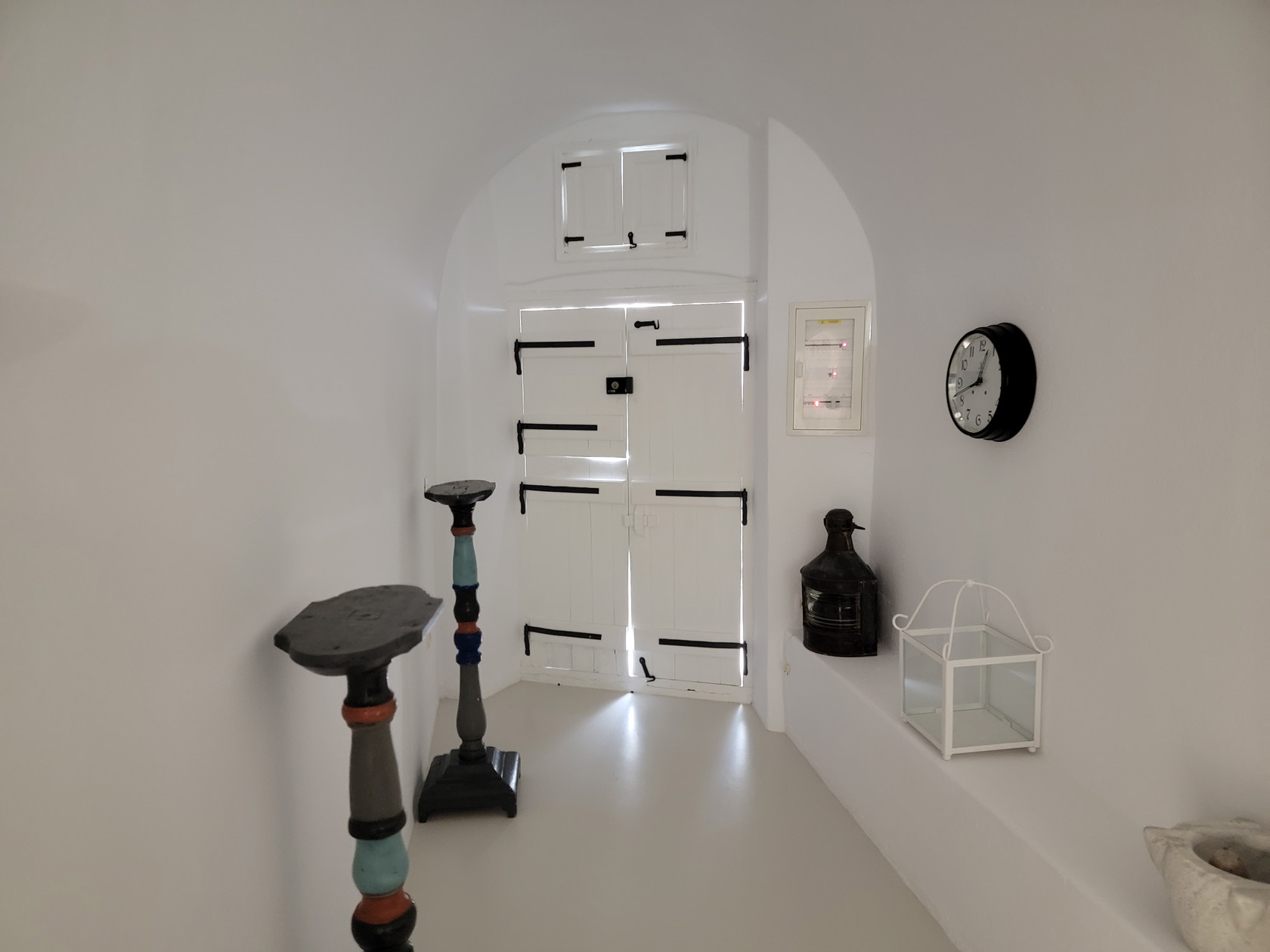
Oia, Santorini – Atrina Canava Villa – Private Entrance
Oia, Santorini – Atrina Canava 1894
Oia, Santorini – Atrina Canava 1894 Pool
Oia, Santorini – Atrina Canava Villa – Patti, Ericka, Tristan and Dana
Oia, Santorini – Atrina Canava 1894 Pool
Oia, Santorini – Atrina Canava Villa – Patti, Ericka, Tristan and Dana
Oia, Santorini – Atrina Canava Villa
Oia, Santorini – Atrina Canava Villa – Gabi
Oia, Santorini – Atrina Canava Villa
Oia, Santorini – Atrina Canava Villa – Patti and Ericka
Oia, Santorini – Atrina Canava Villa – Stairs to Dock
Oia, Santorini – Atrina Canava Villa – Cliffside
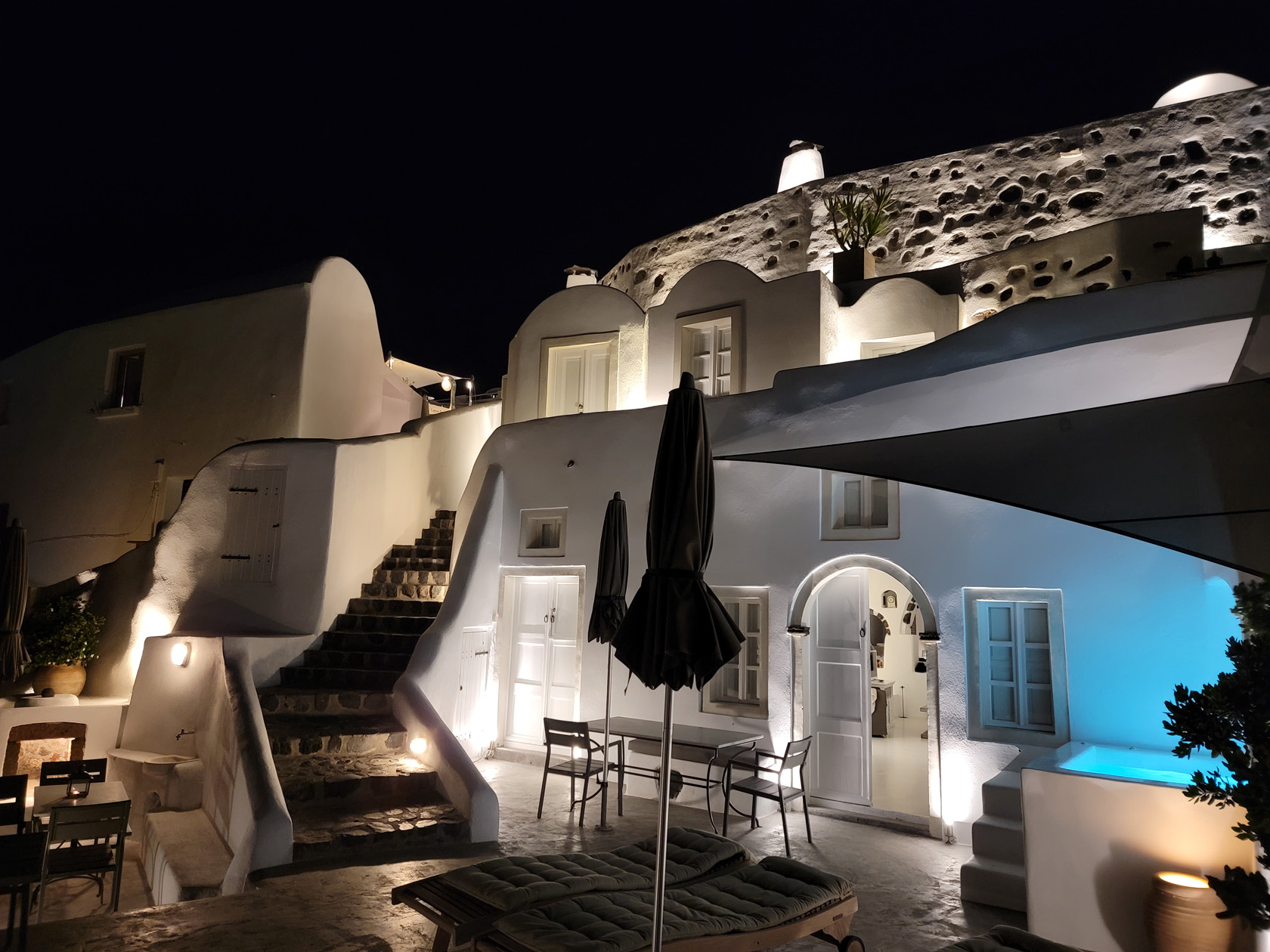
Oia, Santorini – Atrina Canava Villa – At Night
Oia, Santorini – Atrina Canava Villa – At Night
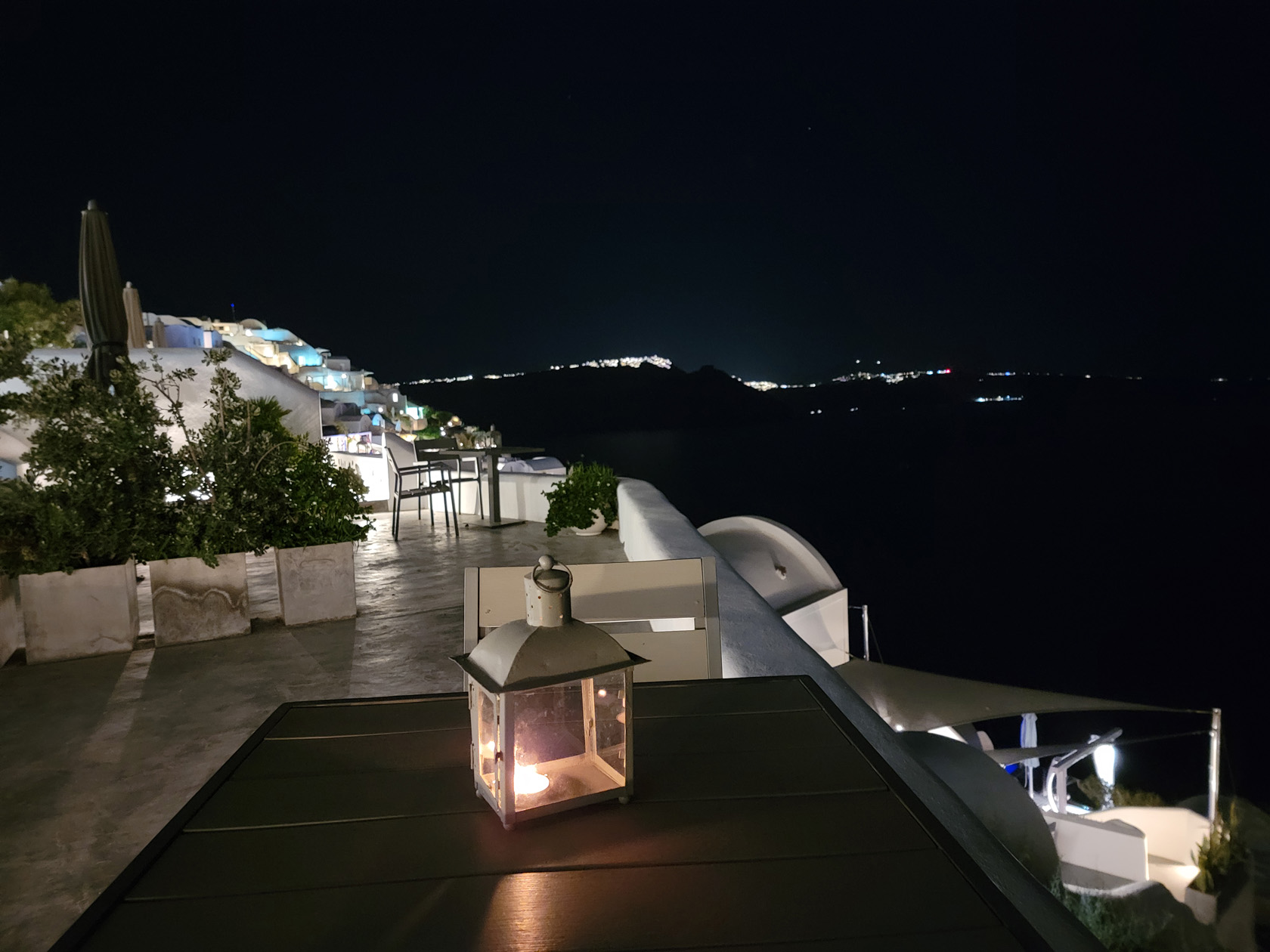
Oia, Santorini – Atrina Canava Villa – At Night
Oia, Santorini – Atrina Canava Villa – At Night
Oia, Santorini – Atrina Canava 1894 Entrance
Restaurants
There are many good restaurants in Santorini, probably only during tourist season, since many do not open until late May or early June. Many cruise ships also visit the island starting in June and ferry passengers near Thira, so it is best to make reservations, at least if you are staying on the island and know your itinerary.
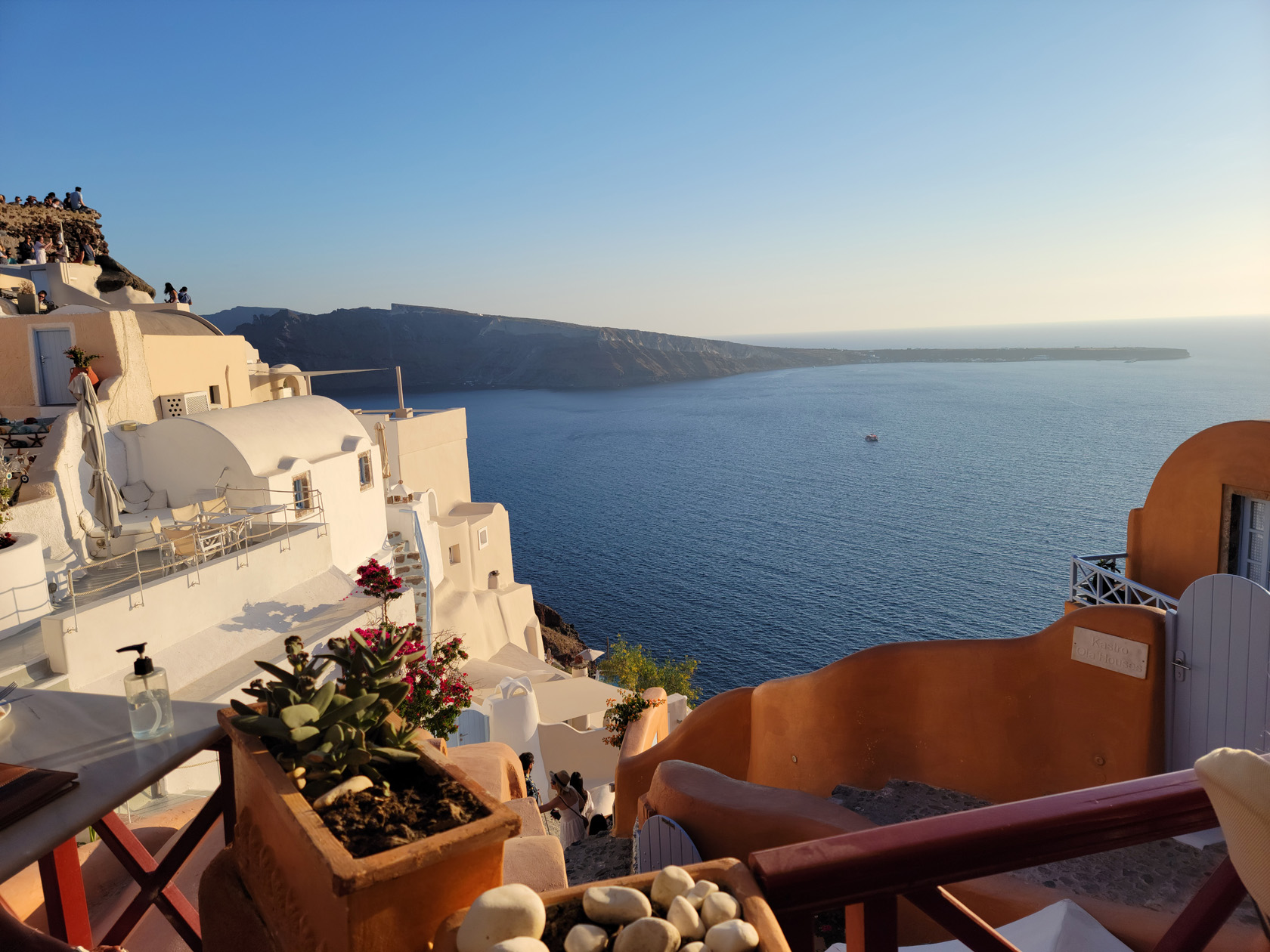
Imerovigli, Santorini – Sunset from Avocado Restaurant
Finding a place in Thira, Imerovigli or Oia, at least one that has both a sunset view and exceptional food, may be challenging, but not impossible. We actually were able to do both, here are a few that we visited for either lunch or dinner.
Avocado
Situated in Imerovigli and not necessarily one of the best places to view a sunset, the Avocado restaurant has good food and a pretty good wine list. We chose it, because it was very close to our hotel and we were all a bit tired.
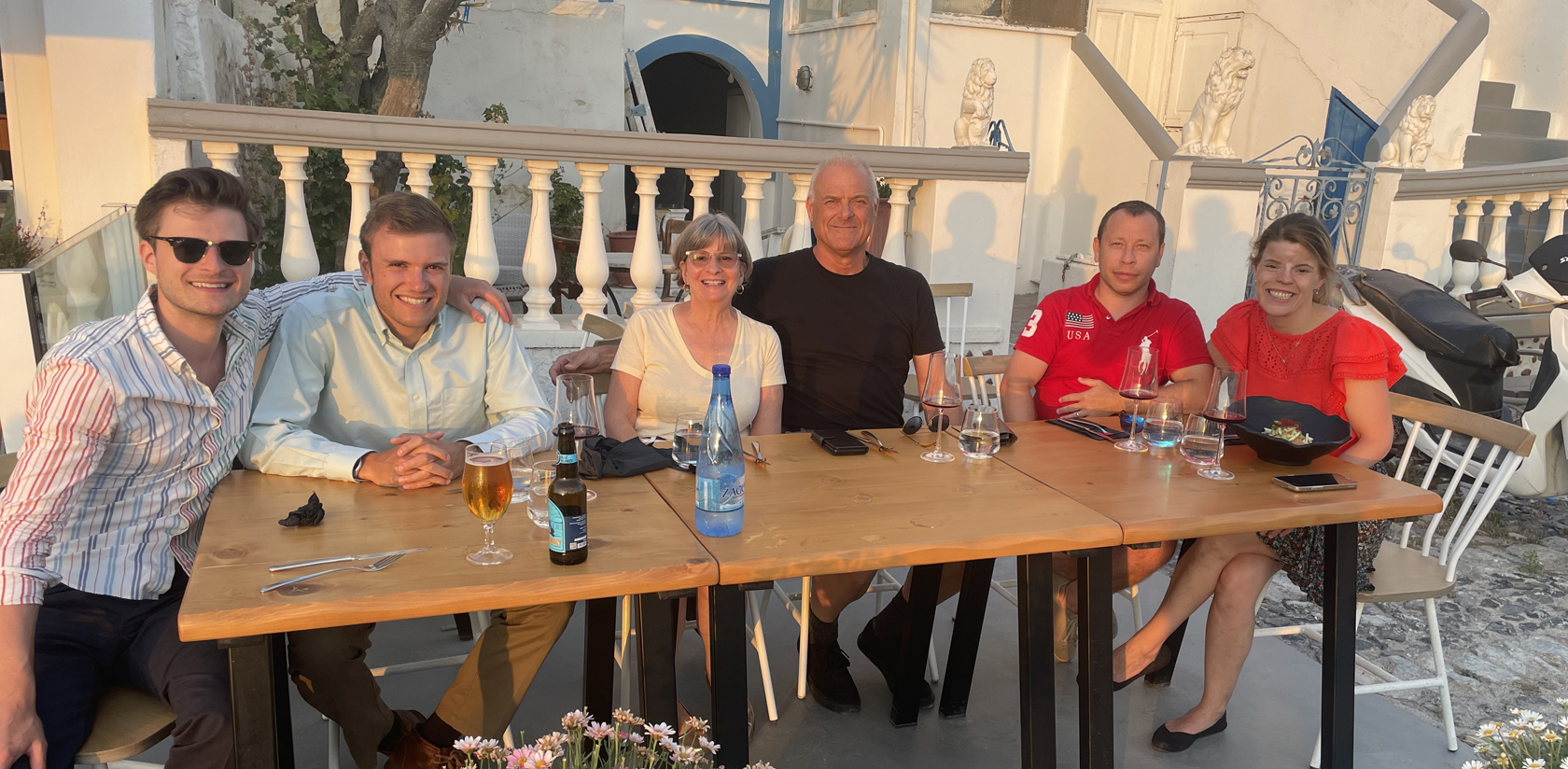
Avocado Restaurant – Group Photograph
The service was as expected and since we sat outside, we were able to enjoy the sunset and had a very nice evening eating and talking.
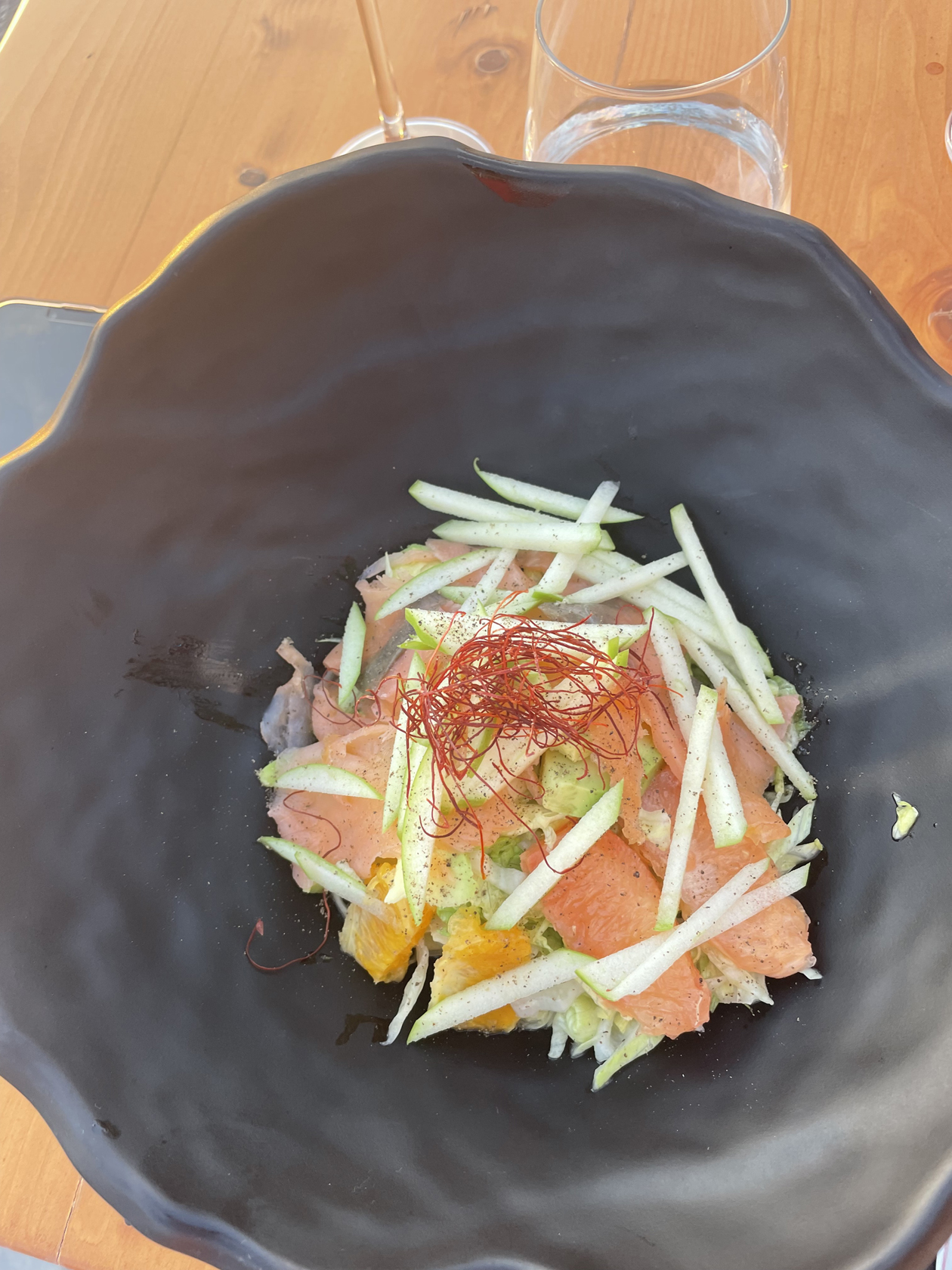
Avocado Restaurant – Salmon Salad
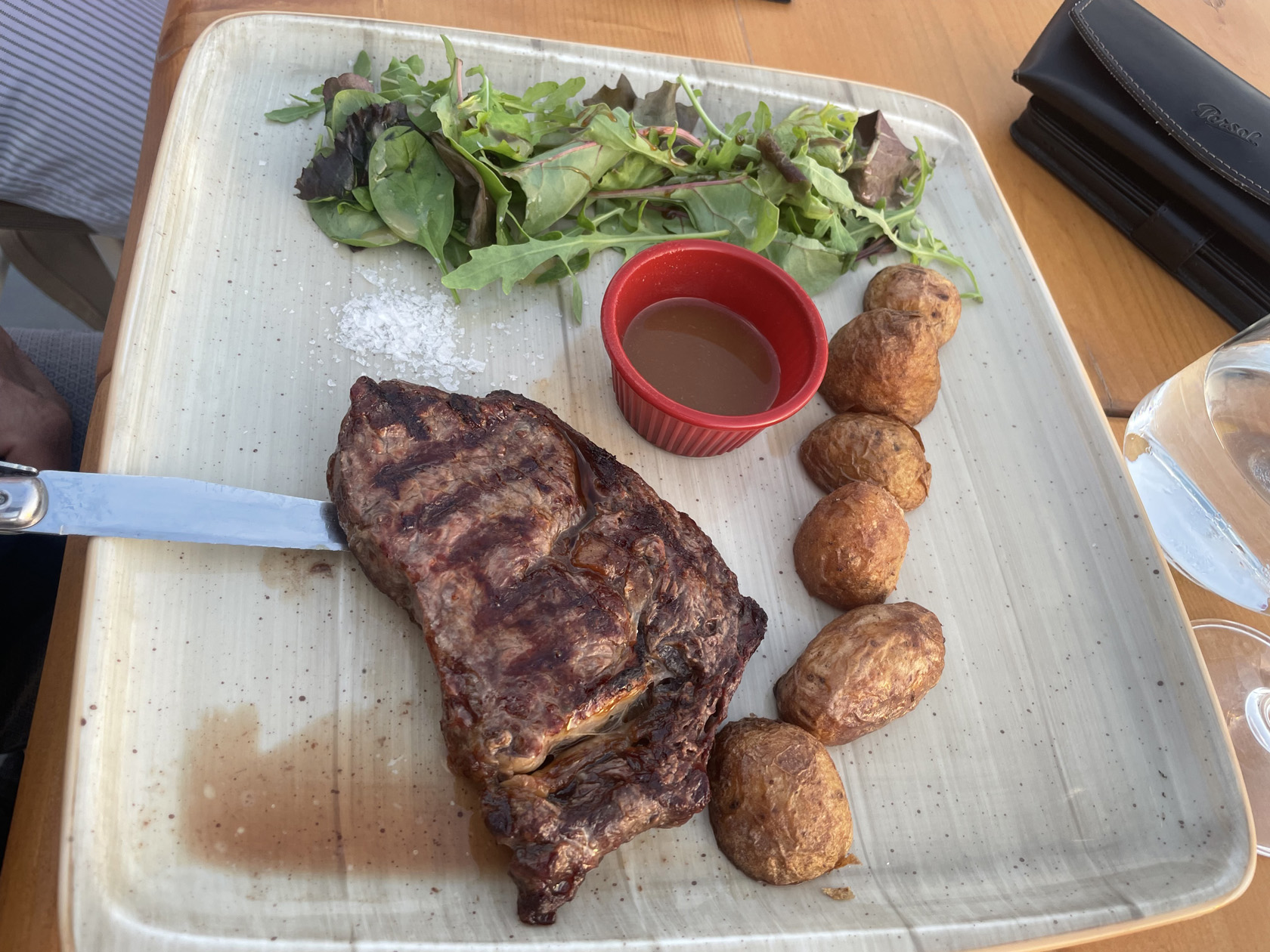
Avocado Restaurant – Ribeye with Potatoes
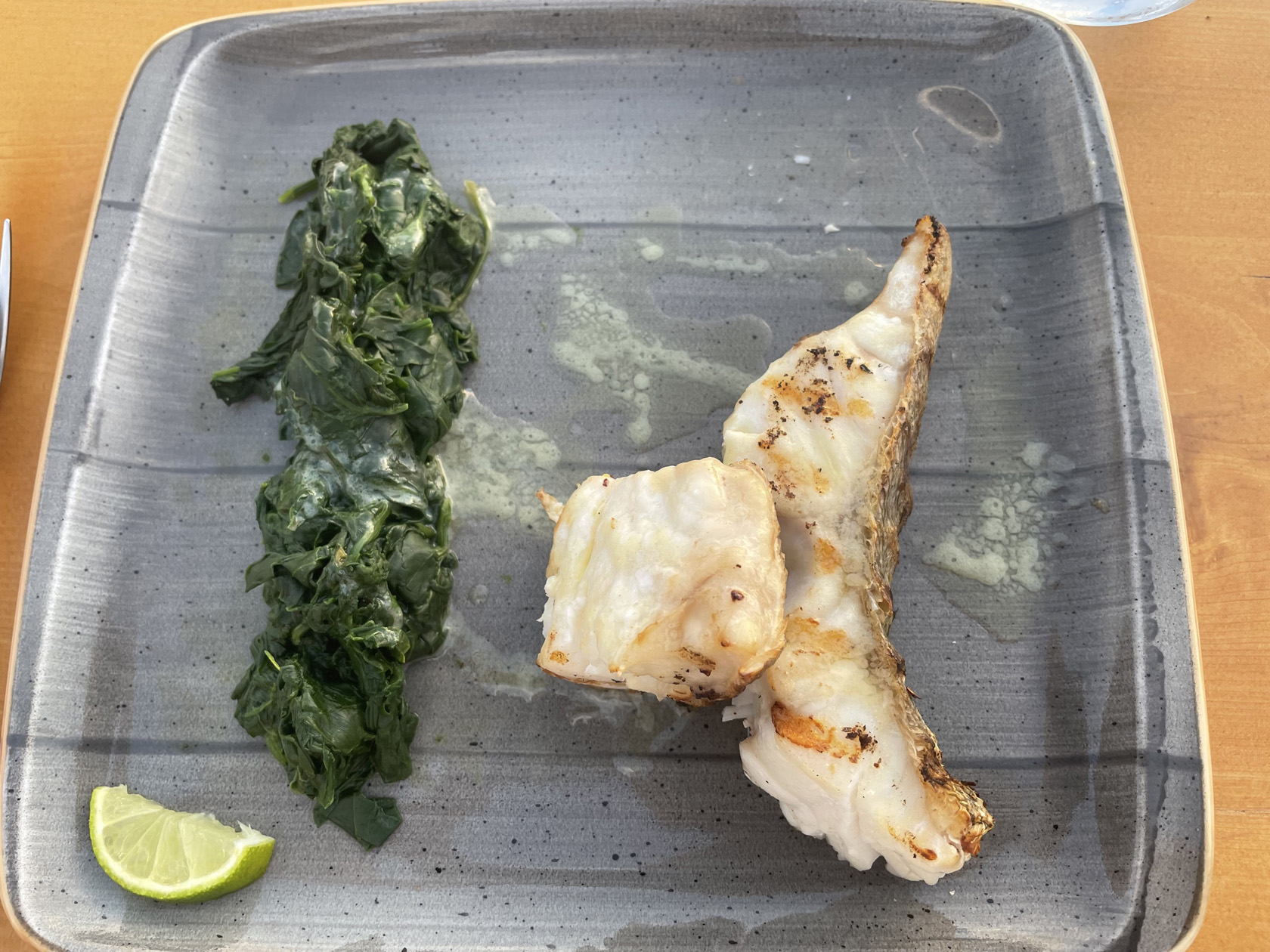
Avocado Restaurant – Snapper with Spinach
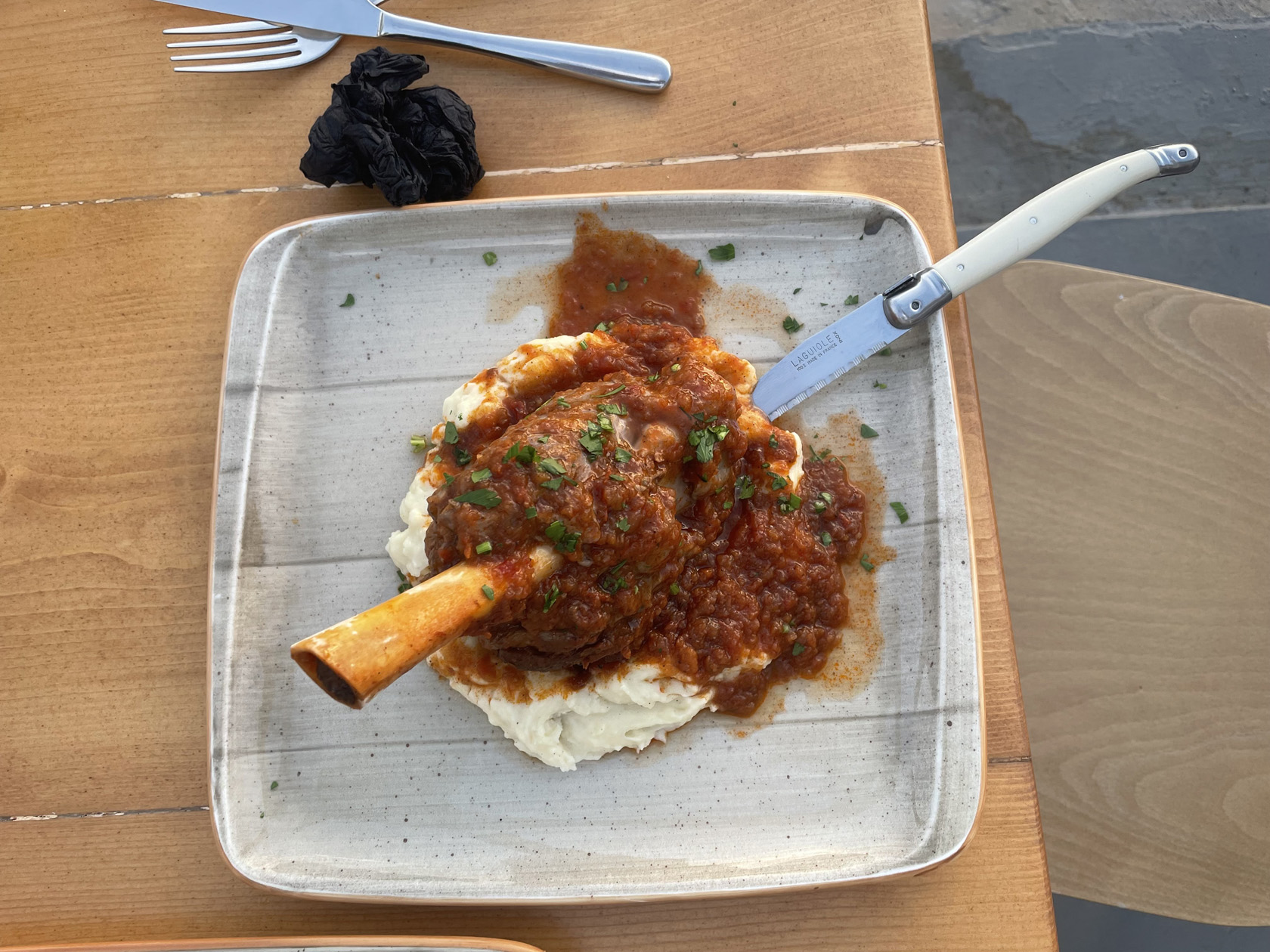
Avocado Restaurant – Lamb Shank on Potatoes
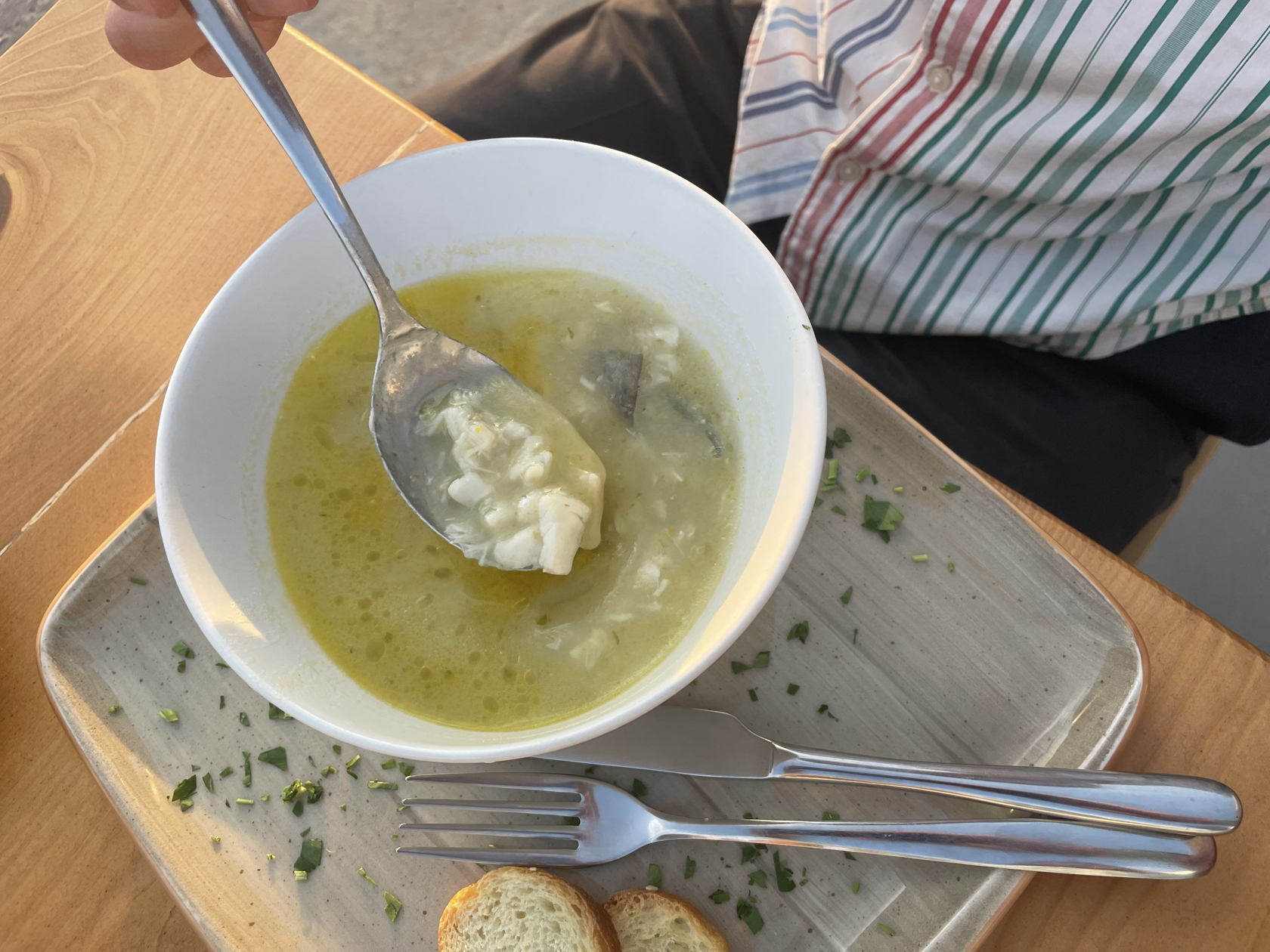
Avocado Restaurant – Soup
Kastro Restaurant
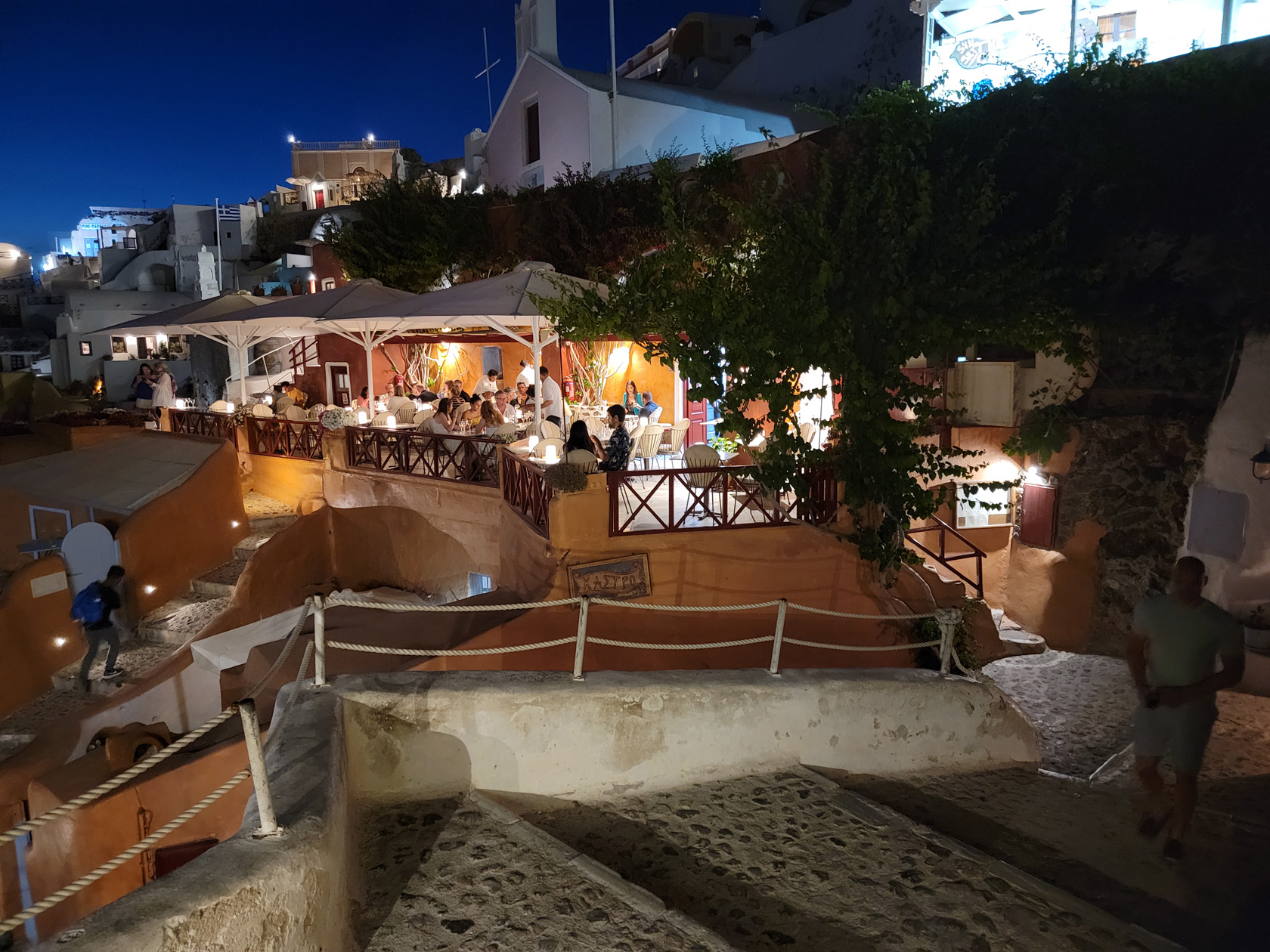
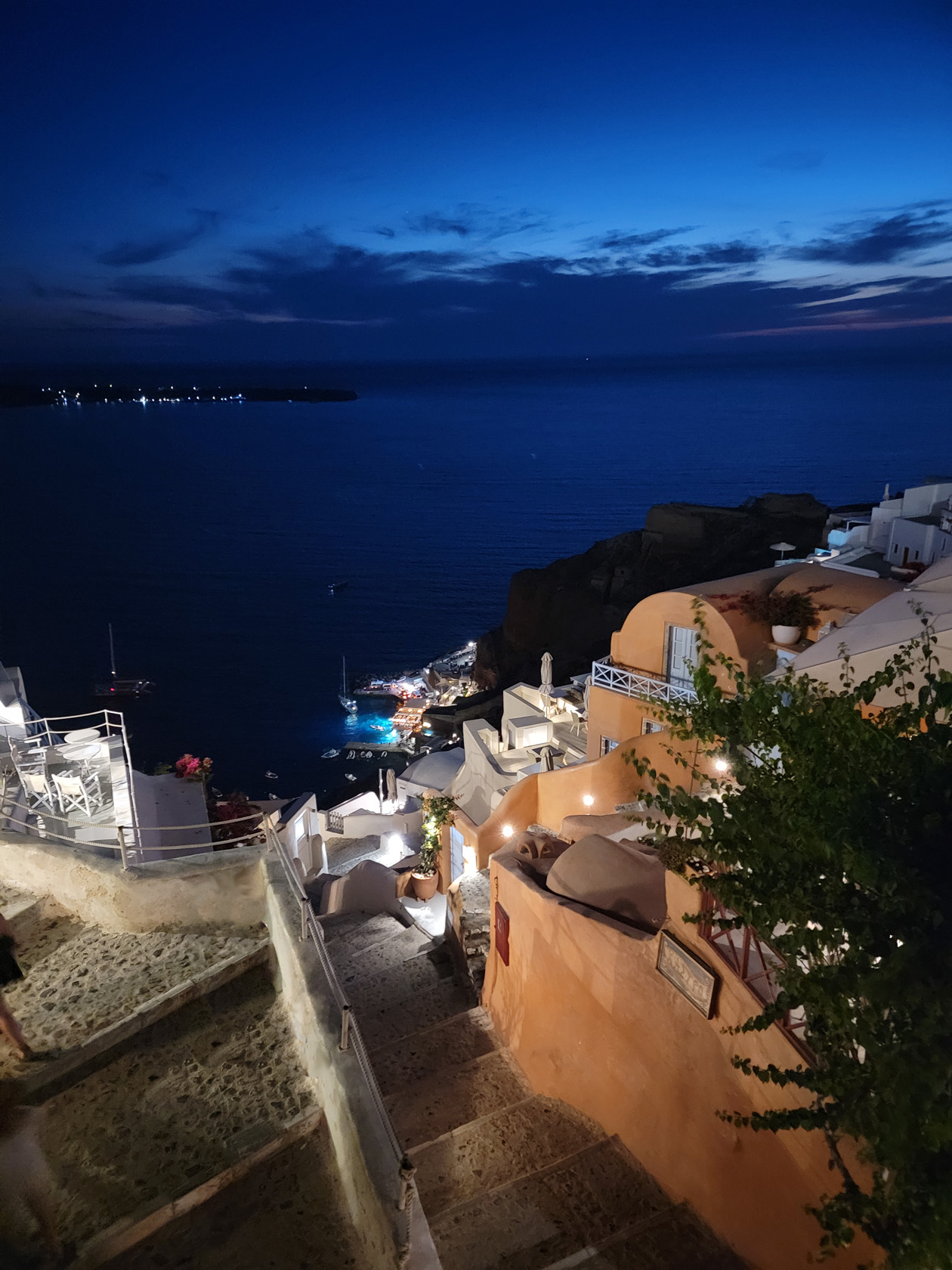
The Kastro restaurant in Oia is known for its amazing sunset venue. Book at table during the summer for around 7:30 and you will have it long enough to the enjoy a beautiful sunset in Oia. The view of the caldera is just fantastic and the food is not bad either. Personally, I didn’t take any sunset photographs here, since I think the sunsets from Imerovigli are better.
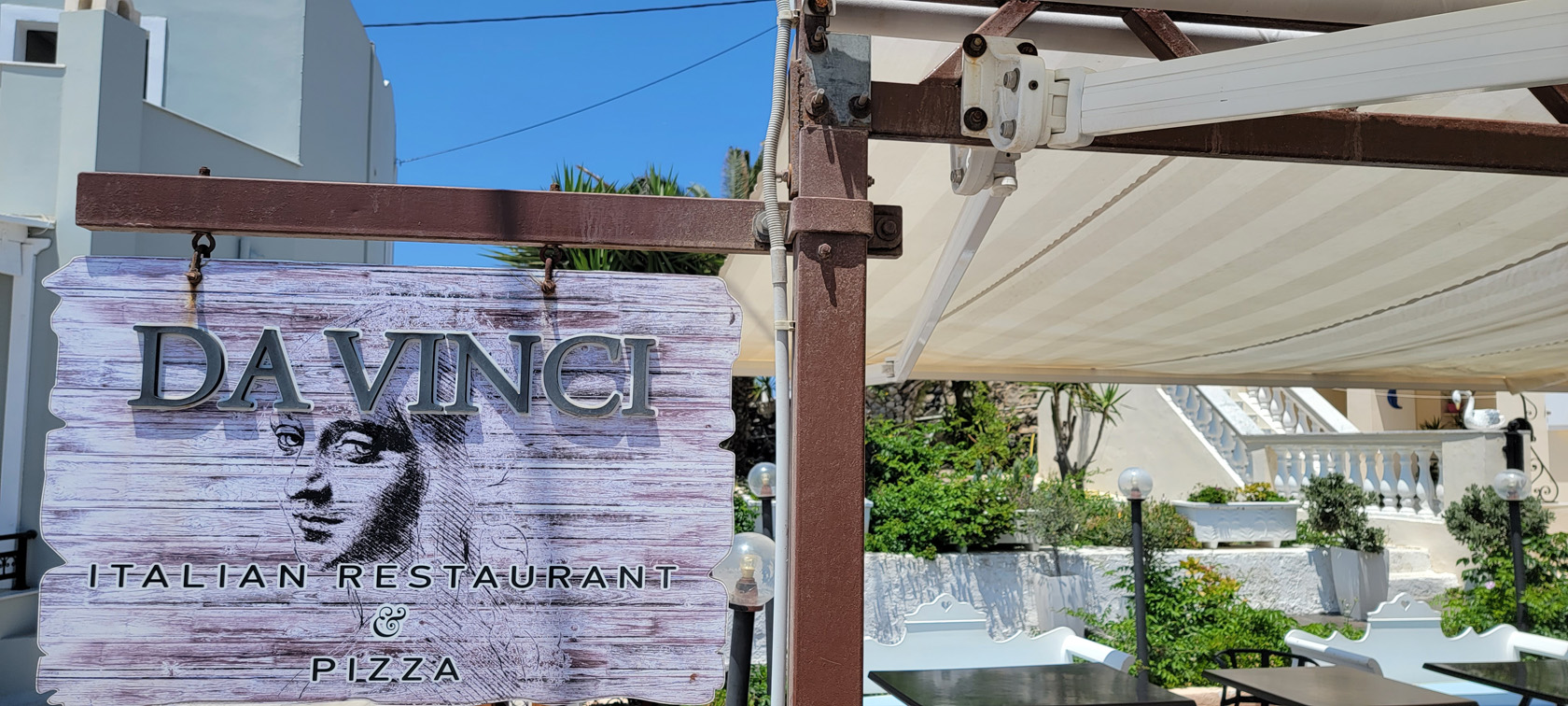
Needing a break from all of the Greek food we found an Italian restaurant called DaVinci’s in Thira. They make traditional Italian food and pizza, as well as the expected Greek gyro or souvlaki. We stopped here for lunch and had a very good meal, at very reasonable prices.
Imerovigli, Santorini – Da Vinci Restaurant
Alexios
A quick change in our plans during our last evening on Santorini led us to Alexios in Oia. Closer to our hotel, it too has a very good outside patio on which to view the sunset. The food was traditional Greek and okay, but at this point I had already seen enough Greek food, which honestly is a bit too meat-centric for my taste.
Alexios Restaurant – Patti and Ericka
Alexios Restaurant – Patti, Ericka and Tristan
Alexios Restaurant – Sailing Ships
Alexios Restaurant – Main Pedestrian Way
Pitogyros Traditional Grill House
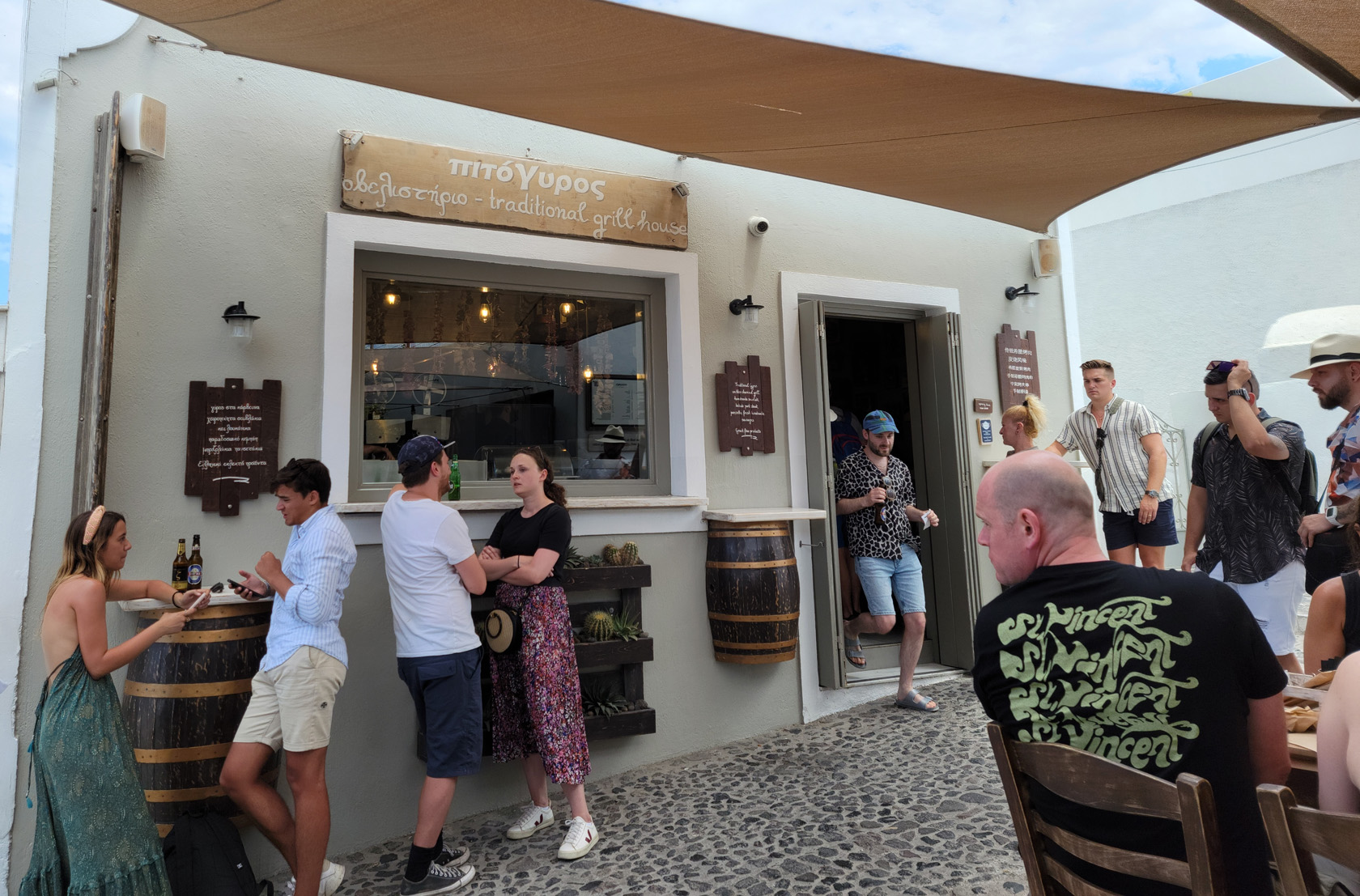
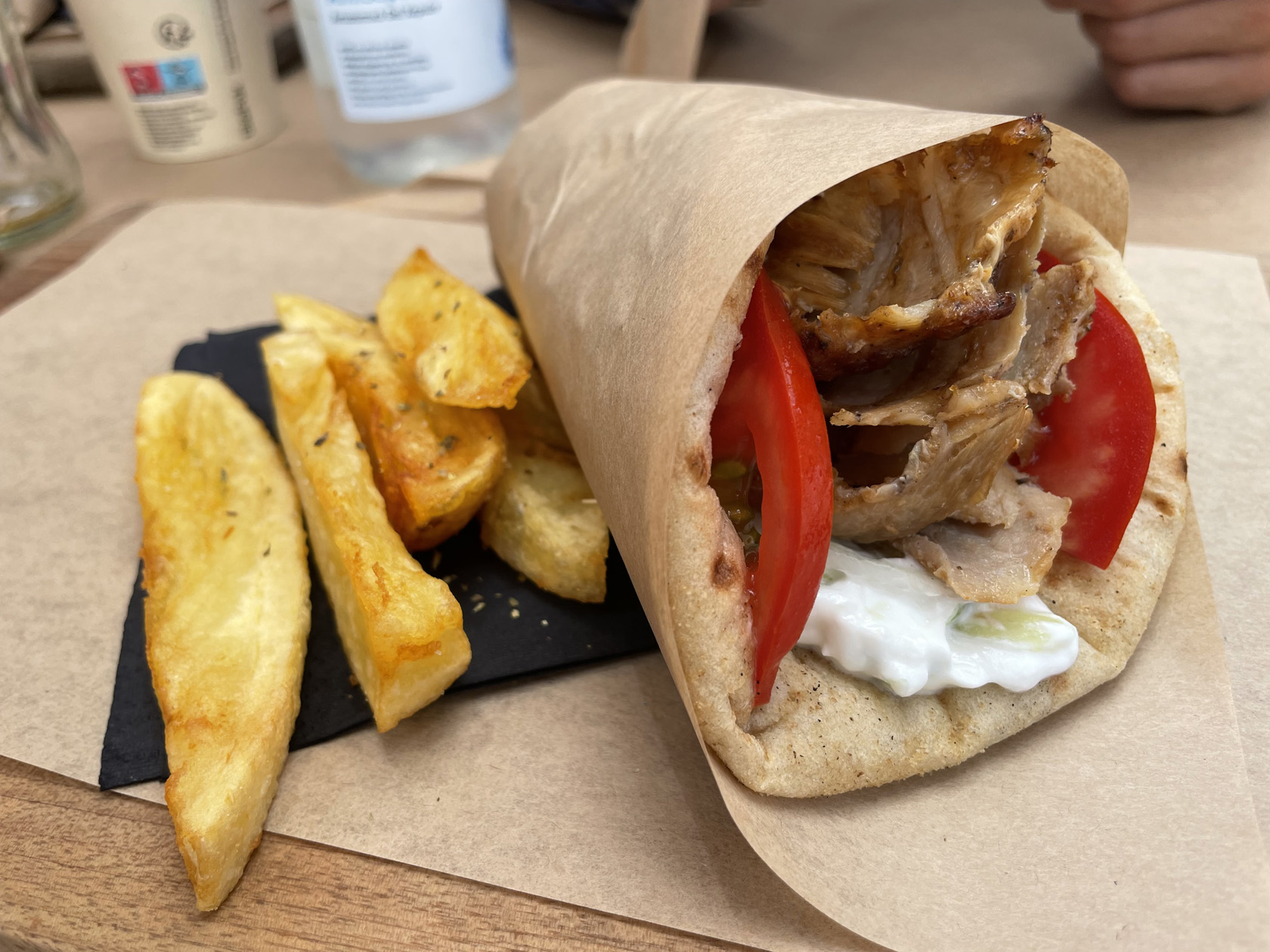
I will be honest, I am not sure what a traditional grill house is in Greece or on Santorini. But, if the number of people trying to get into this place at any given time is any indication, they seem to have named the place right at least. At Pitogyros in Oia, the food is mostly traditional meat gyros and souvlaki served in a pita or a platter, as well as other dishes. Most dishes are served with french fries, with the exception of their salads. A very inexpensive place to eat, if you can get a place to sit. We waited for thirty minutes before our party of six were seated, which honestly probably was not that bad, considering it was around two o’clock in the afternoon.
Pitogyros Traditional Grill House – Front
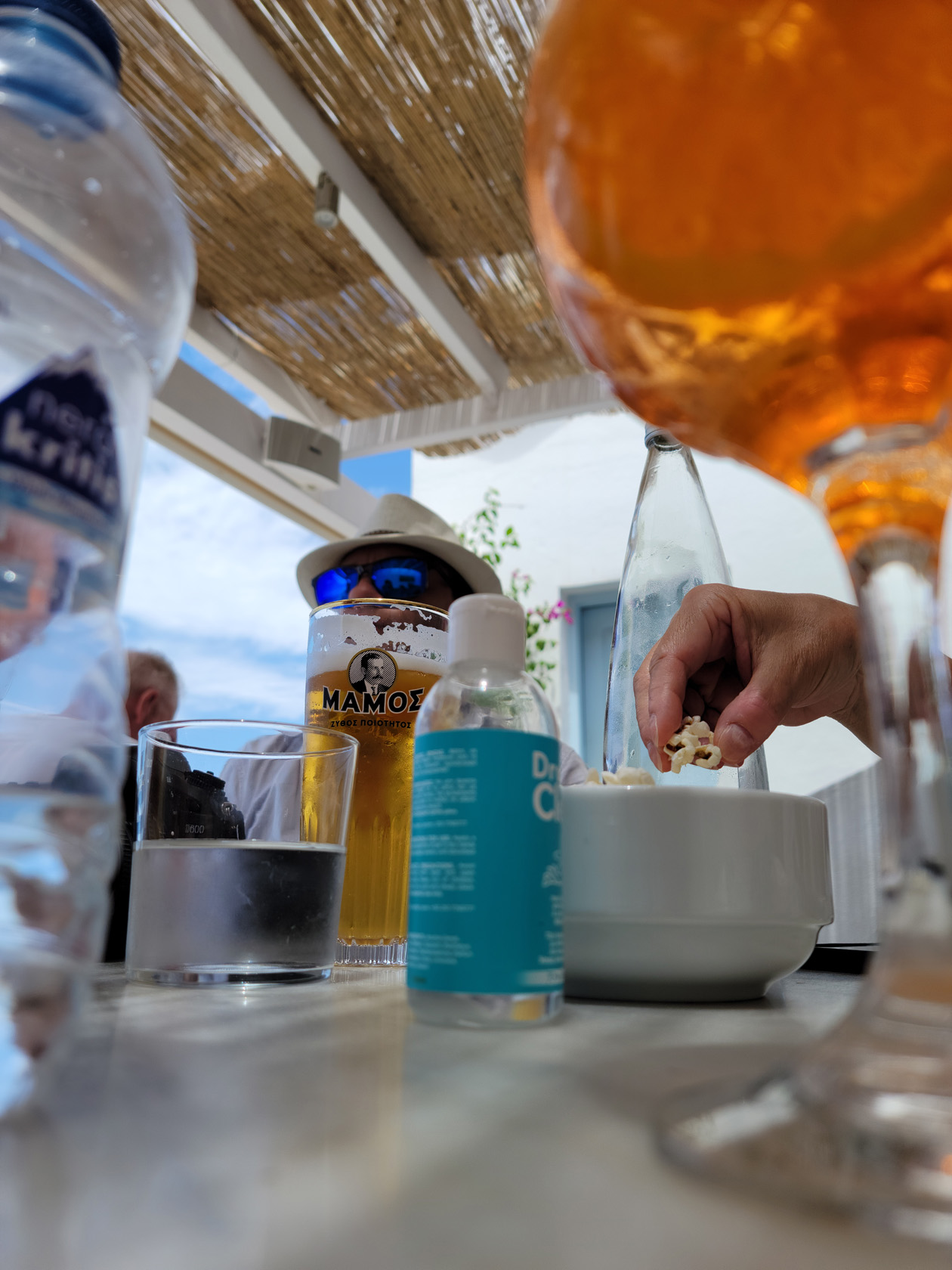
Pitogyros Traditional Grill House – Our Table
Pitogyros Traditional Grill House – Pita Gyros with Fries
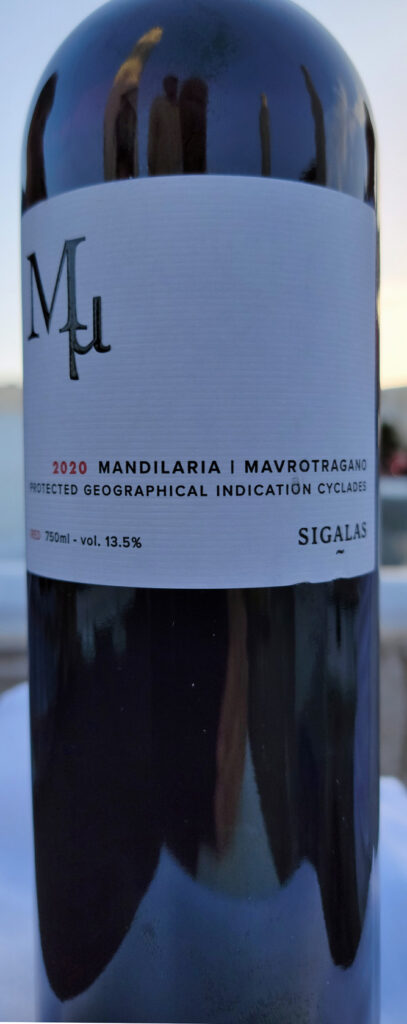
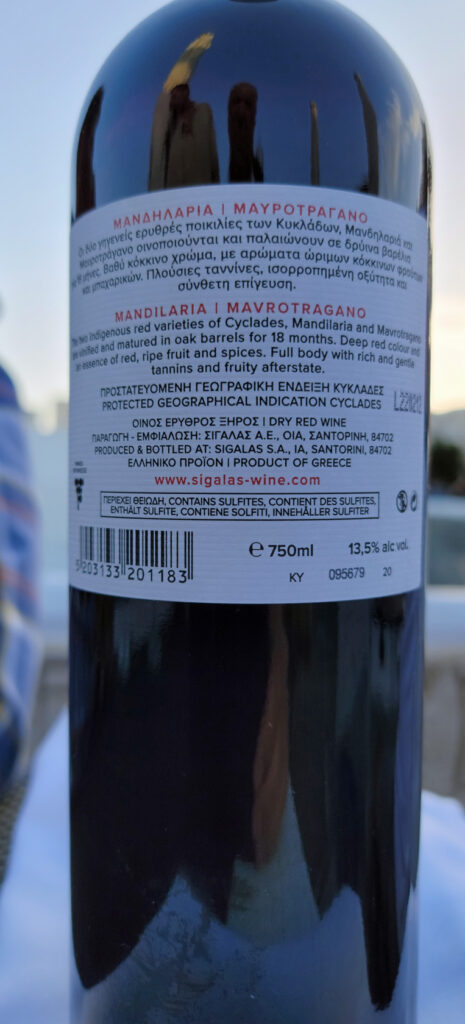
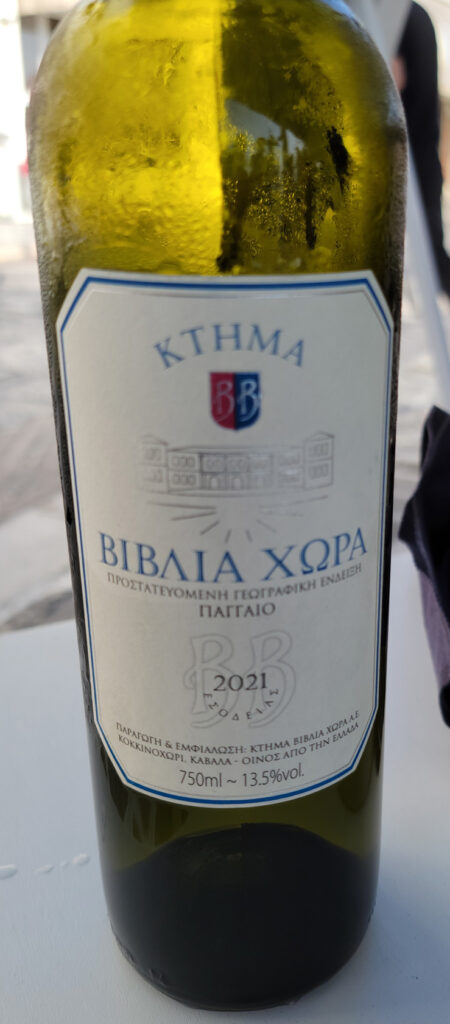
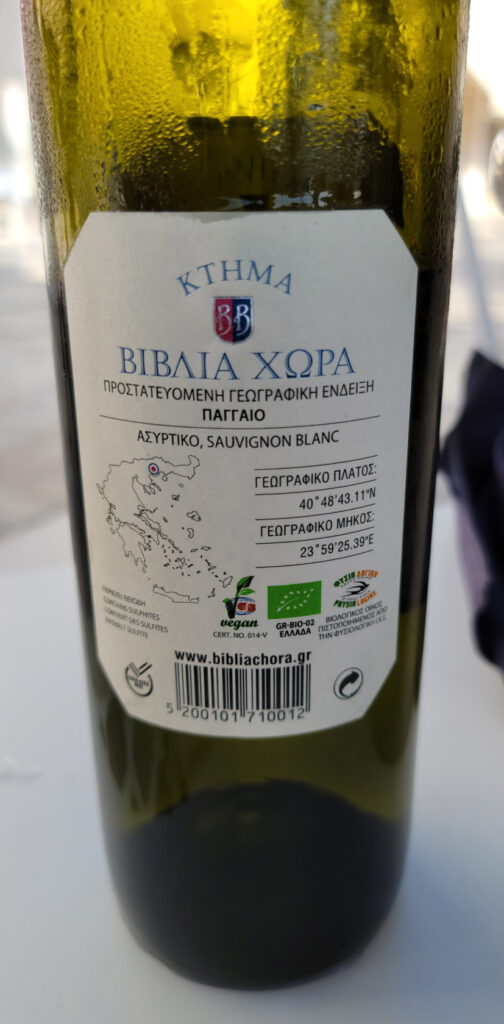
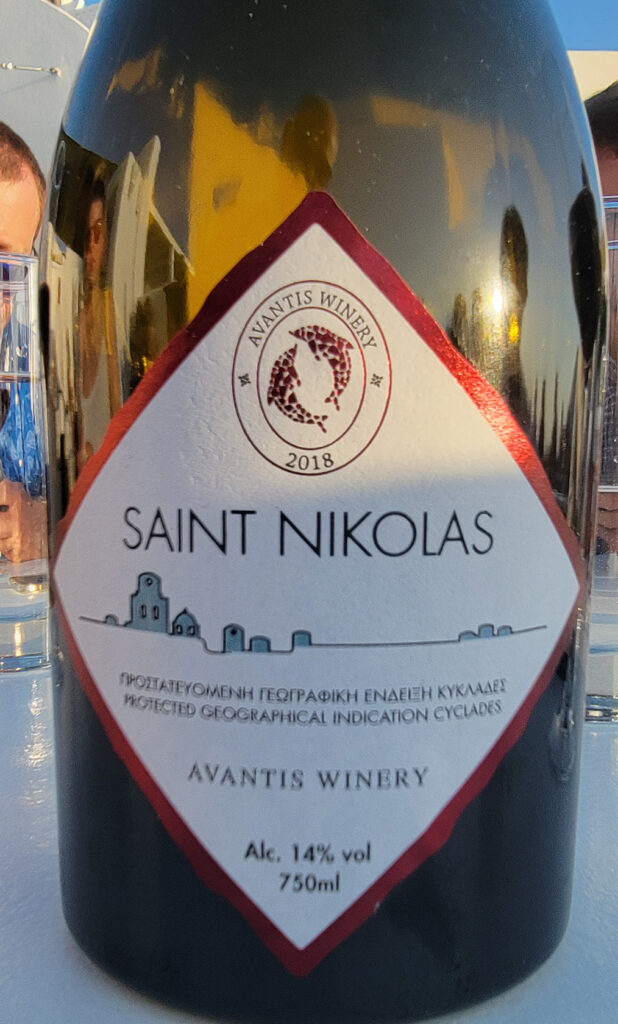
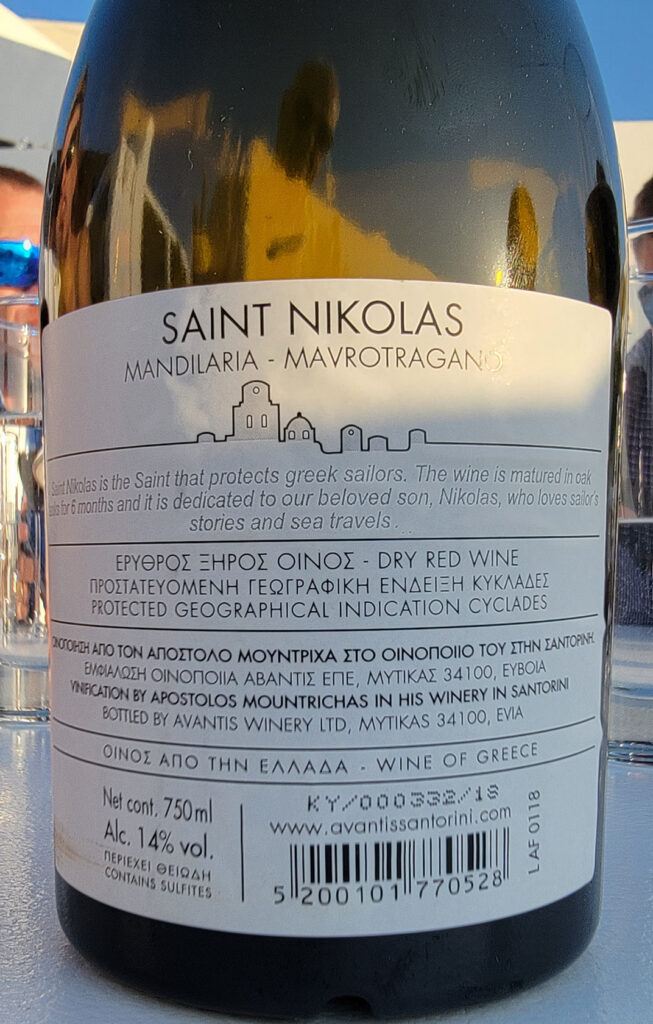
Wines
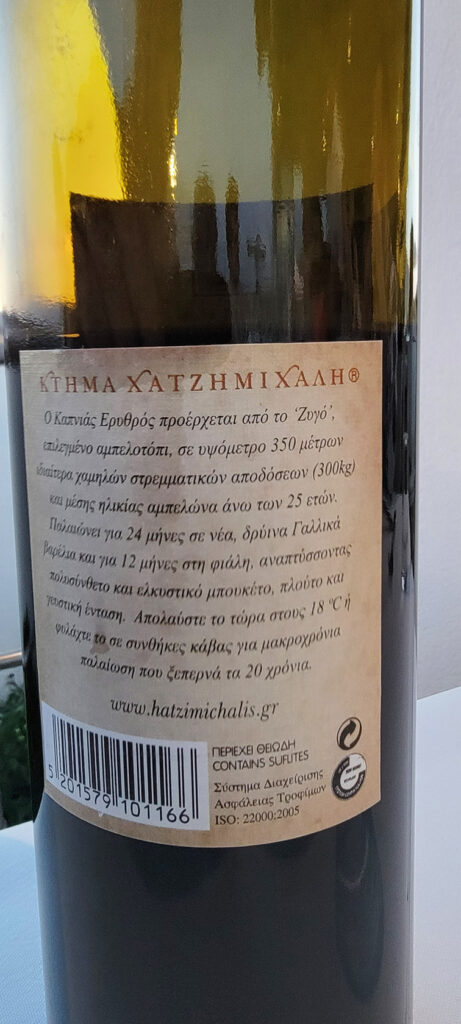
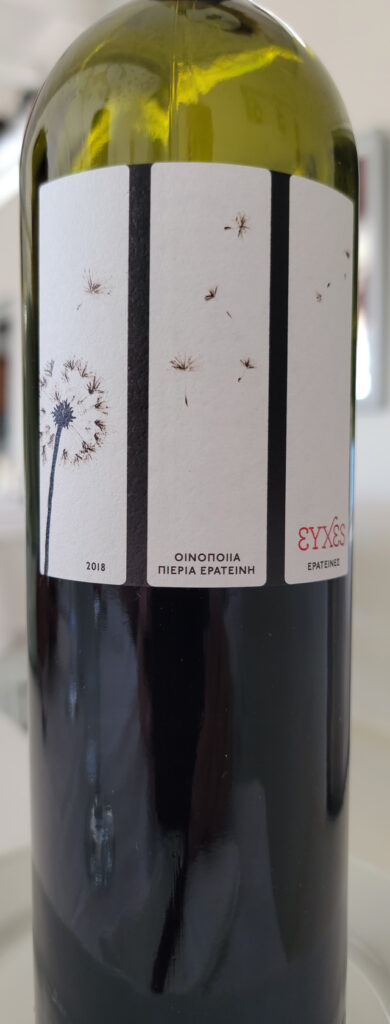
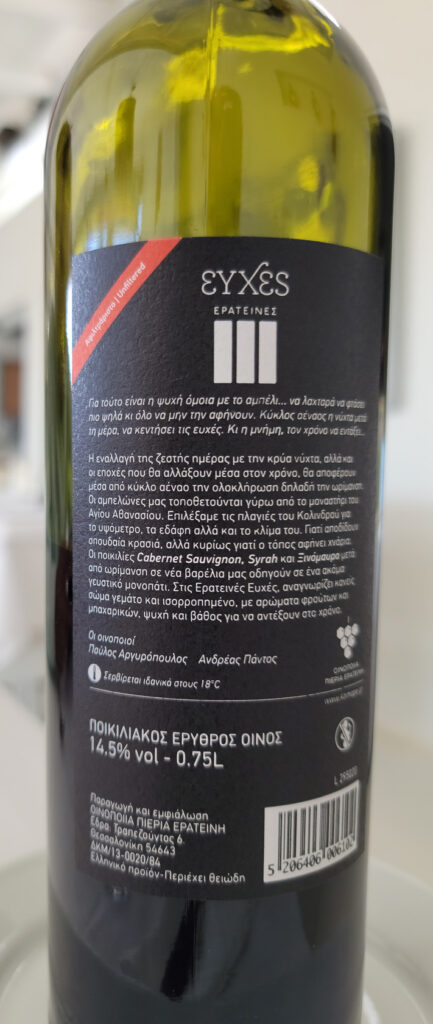
We drank the following wines while on Santorini, along with a few others. But, we feel the following deserve mention.
We finally left Santorini and dropped our sons off at the airport for their flight back to the United States. Of course, the weather had been beautiful for two weeks and we were not complaining. But as Greece would have it, it threw one last punch at us before they left. While we were sitting having lunch in Athens with Ericka and Gabi, thunderstorms had moved in and it poured, subsequently delaying their flight from the airport. Though the delay was over an hour, it luckily did not impact their connecting flight and they made it home perhaps just a little later than expected. After all of the other travel horror stories we have been hearing about, we considered ourselves lucky, even after everything that had happened.
Post Script
If you have any heard horror stories about traveling as of late, they are not fiction, they are probably TRUE. Traveling, due to latent affects of combating Covid, the war in Ukraine and other things, has turned traveling into a true hell.
If you have the ability to wait, I would do so, at least until certain things like airline staffing have been reconciled.
If you cannot wait and have connections, I would suggest booking any initial flights to your destination for a day early. This may cause extra expense and staying overnight in a hotel, but it might save you the headache of missing an important connection, especially on long haul flights that have multiple connections or even a international cruise.
Do NOT trust anything your airline or train service will tell you, it only takes one thunderstorm or some last minute strike to start a massive backlog these days. Good luck!
Well, we had just barely left Athens on our way to Naxos Island, when I discovered the feeling that my phone was not in my back pocket. That usually was not so alarming, since when traveling I often take it out and put it in my backpack, so I wouldn’t forget it in what ever form of transportation we were using. I got no further then reaching for my backpack’s zipper, when a dreadful calm came over me. I knew exactly where it was – and it was not with me.
I looked at my wife, with a short pause and a sigh, then told her that I had left my phone back at the hotel. She retorted immediately if I were sure, I responded that I was and that it was actually worse than I had originally thought. Not only had I forgotten my phone, but I had forgotten to take all our money and valuables out of the hotel room’s safe. Exasperated, I immediately informed our private shuttle driver what had happened and that we had to turn around. He assured us not to worry and that all we be alright.
We quickly called the hotel reception what had happened and they responded that they had been trying to get in touch with us. We then let the driver, who speaks very good English and of course Greek, to help explain the situation. We figured out all of the logistics, so that while he continued to take us to the airport, one of the driver’s colleagues drove to the hotel and picked up all of our stuff (after giving him the security code to the safe). With the hotel staff overseeing everything, they sealed our stuff in a bag and the driver was off to the airport. In less than an hour, we were back in possession of my phone and the rest of our travel documents and money. Wow, that was the first time that has ever happened.
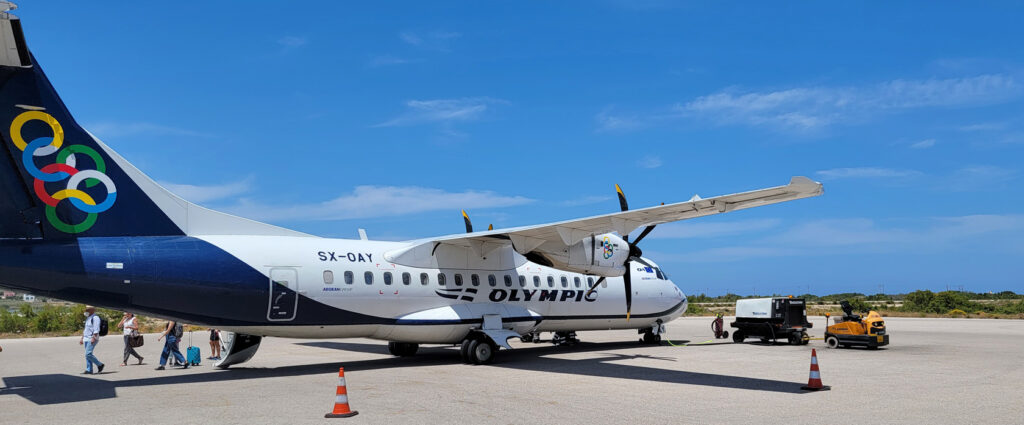
In the meantime, while we were waiting and much to our delight, our flight had been delayed by an hour and twenty minutes. So, we felt comfortable that we had plenty of time to wait for the driver, then check in and check all our baggage for Naxos. As soon as the driver returned and we had all of our stuff, we obtained our tickets and started to check in our luggage at the self-service counter, waiting on line like everyone else. However, just as we were next in line, I noticed that the flight was no longer delayed, it was on time; how can that happen?!
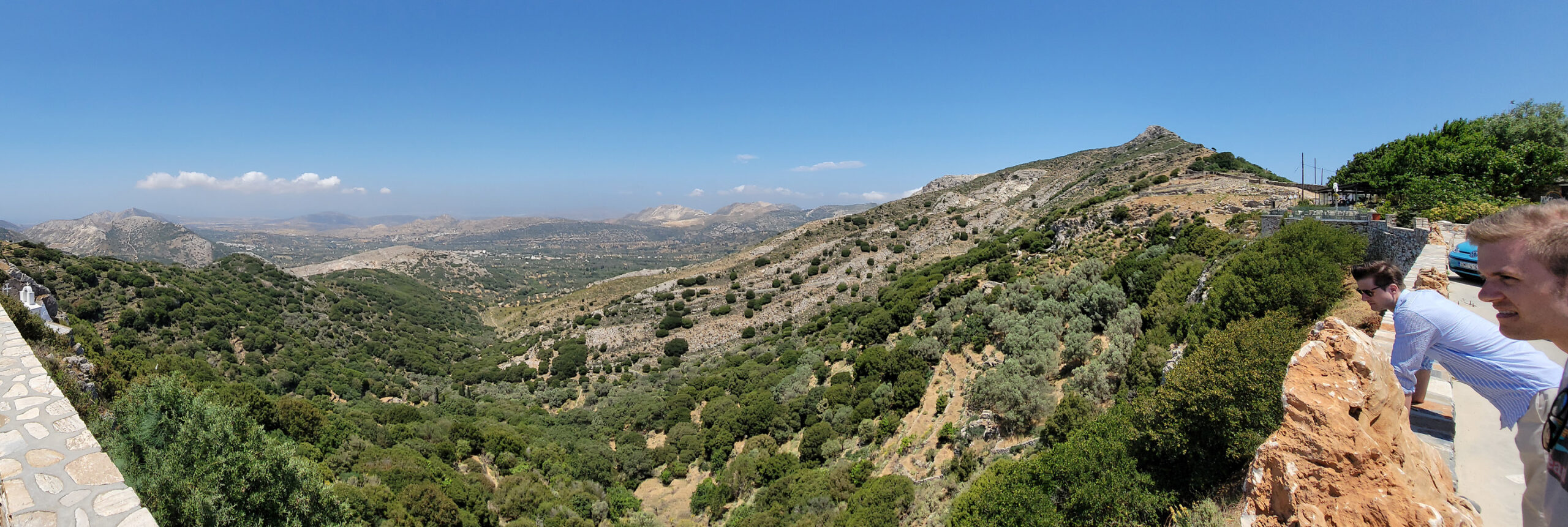
Panorama of Naxos Hills
This left us about thirty minutes to finish baggage self-check in and board the aircraft. Undaunted we pushed on. Two of us were successful self checking our baggage, but as soon as the boarding time for the aircraft arrived, the software locked the rest of us out. What a nightmare. The attendant for Aegean Airlines quickly realized the issue and got us over to another counter so our bags got checked in immediately, with all the proper RUSH stickers applied to them, and we were on our way through security.
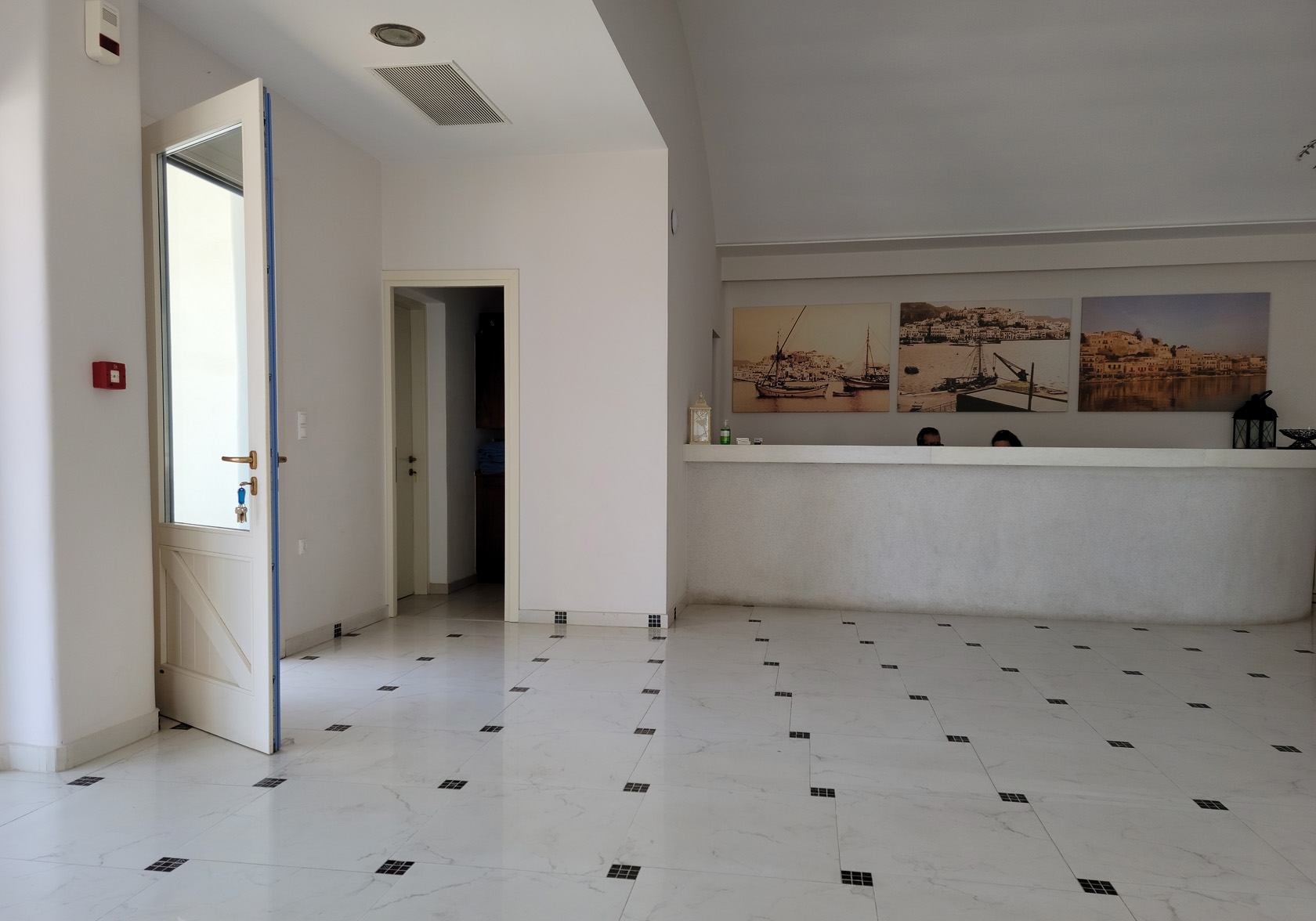
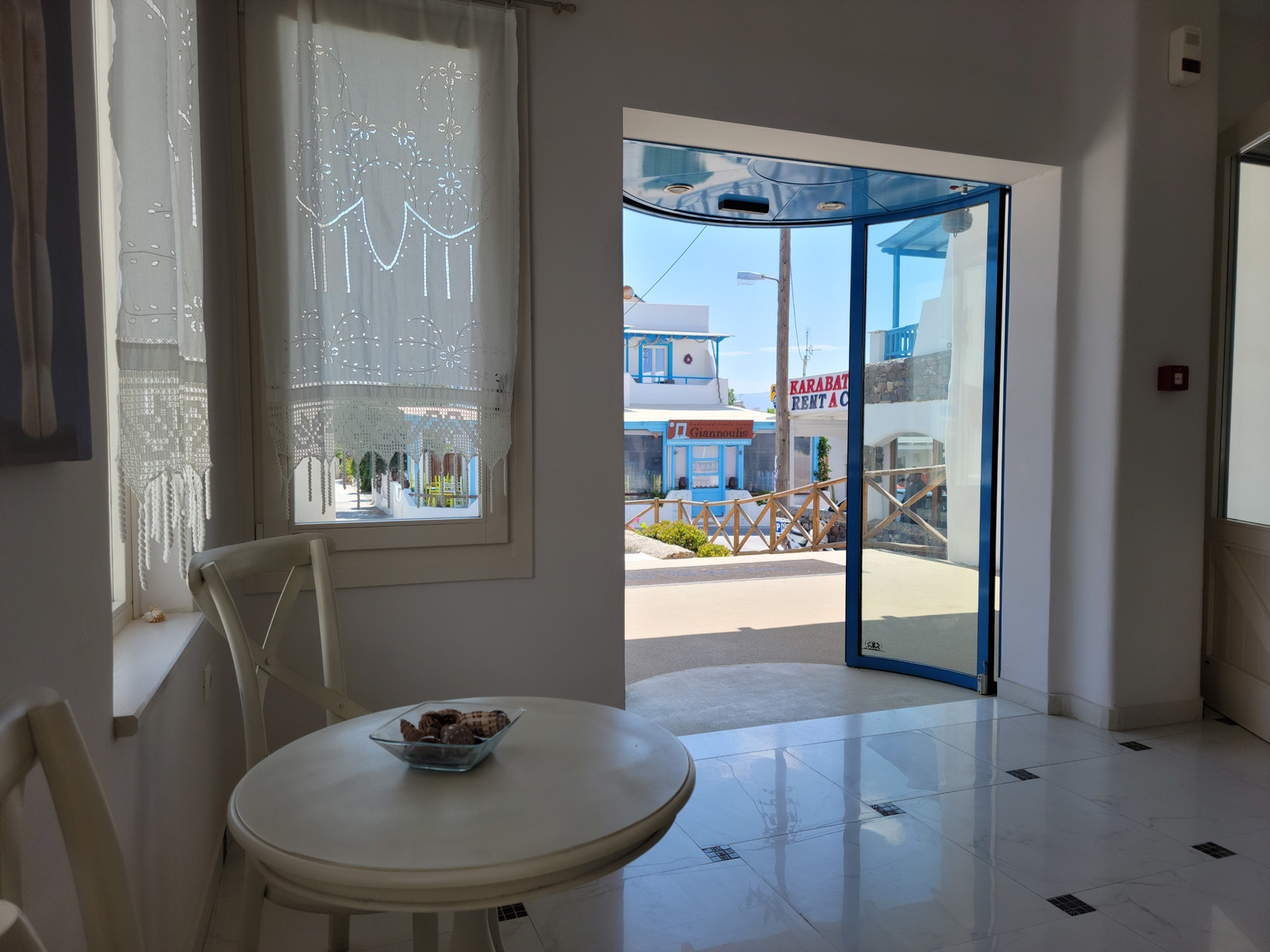
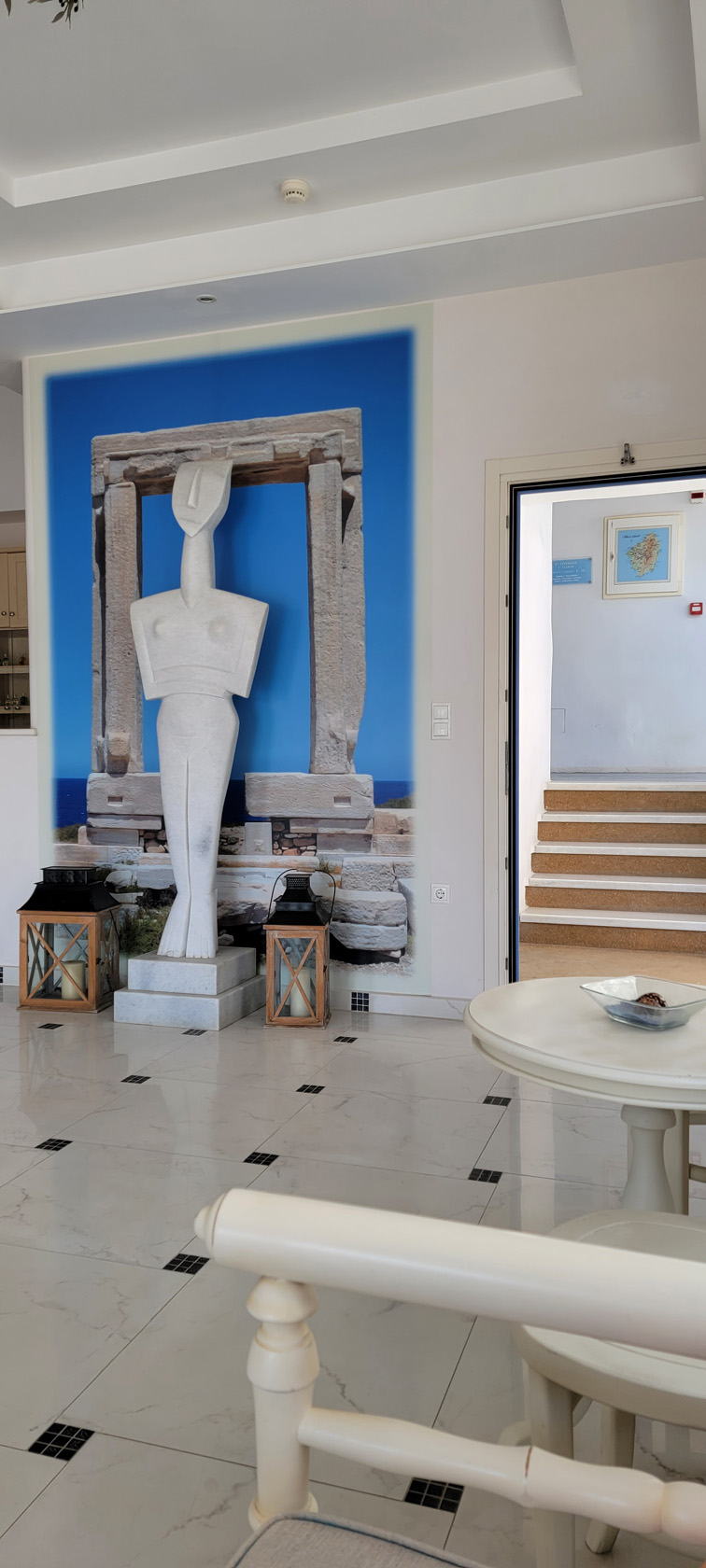
Naxos Island Hotel – Lobby
Naxos Island Hotel – Lobby
Naxos Island Hotel – Lobby
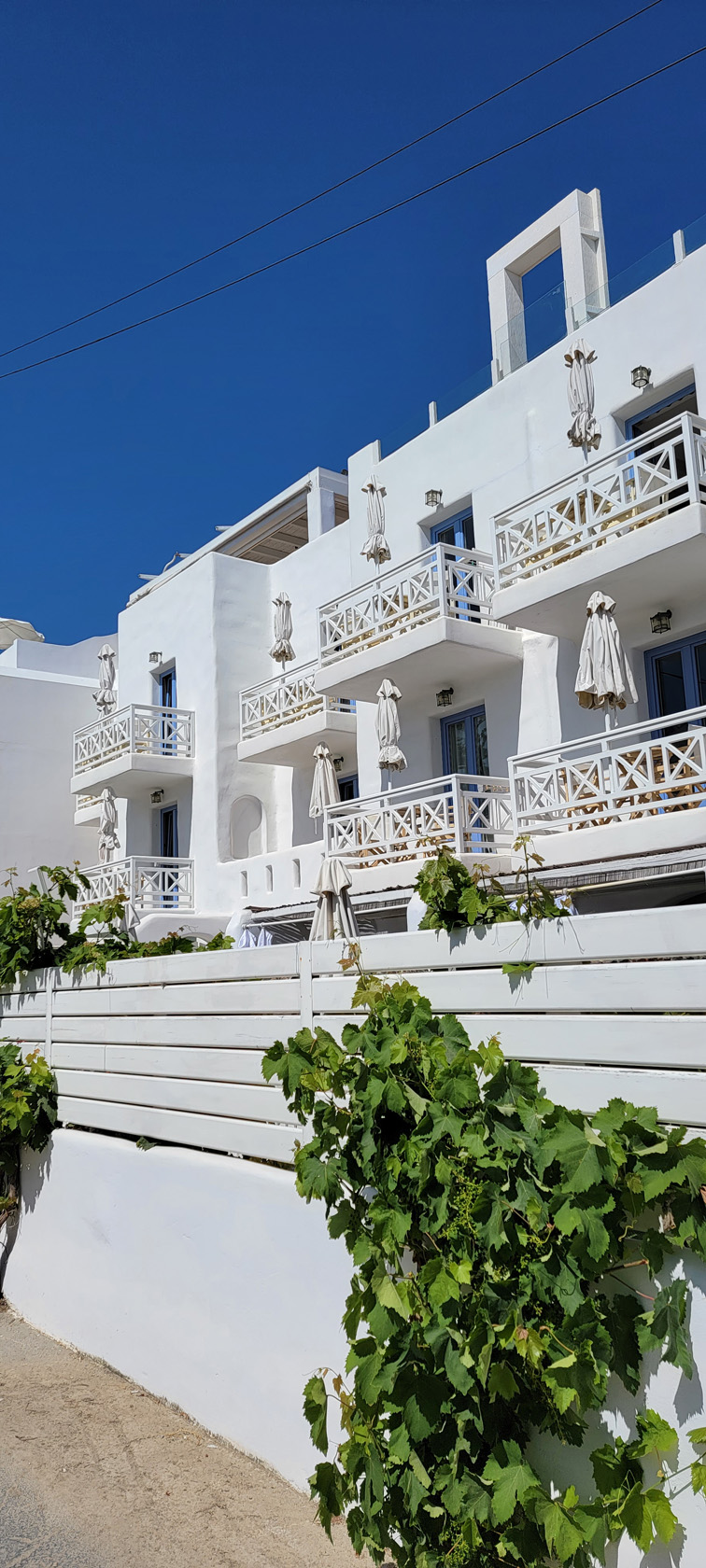
Naxos Island Hotel
Naxos Island Hotel
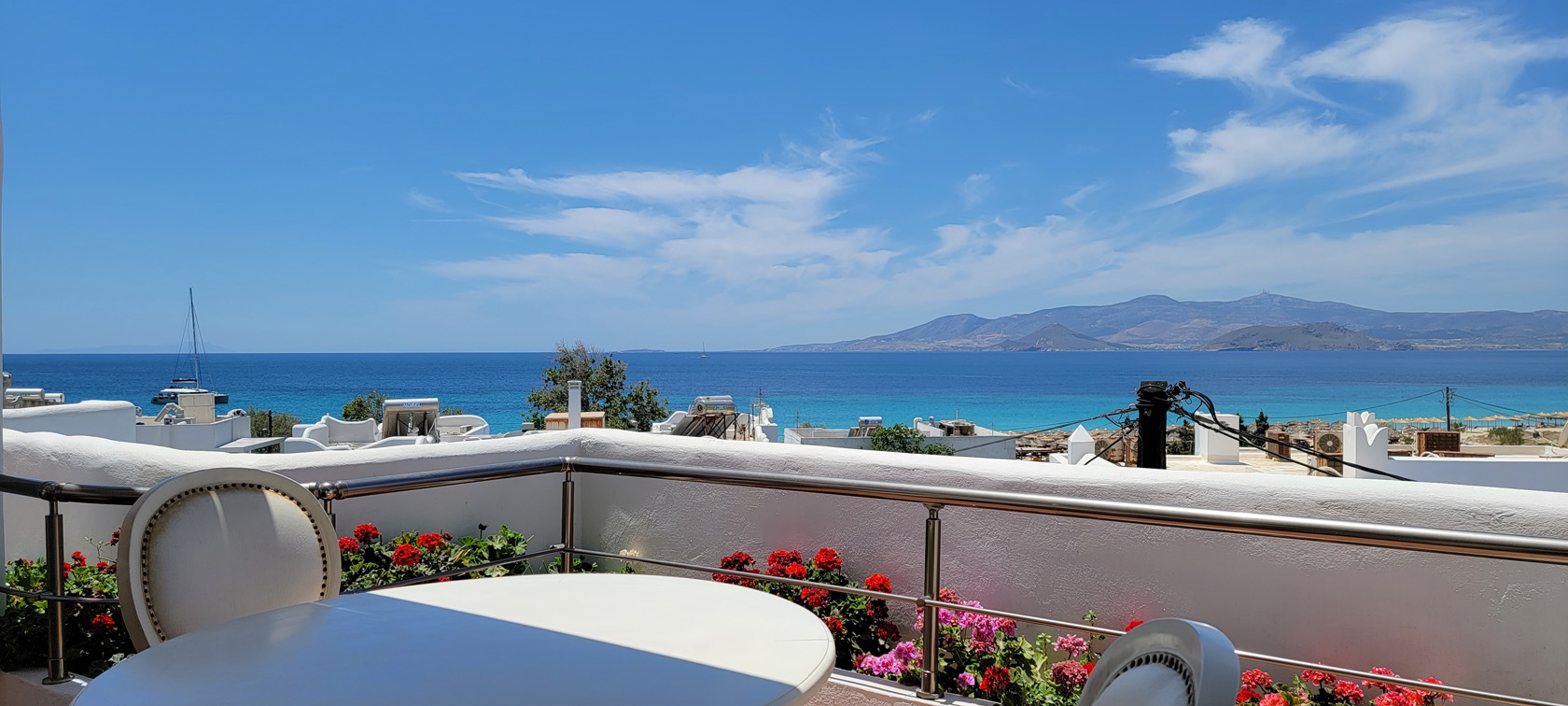
Naxos Island Hotel – View From Rooftop Terrace Restaurant
Needless to say, we made our flight and were soon enjoying the hospitality of our hosts at the Naxos Island Hotel. Since our flight was on time, we arrived before the appropriate check in time, but no worries, our rooms were ready and we were hustled to our rooms, bags and all by our hosts. After a quick refresh, we went to lunch. It was time to really be on vacation, but we were all still wondering, what else could go wrong? Unfortunately, things would uncharacteristically continue to happen to us.
Naxos – The Island
The largest of the Cyclodaes, Naxos is a large oblong island with a central mountainous region with peaks high enough to create their own weather. The island is known for its beaches, most of which are sandy, but the type of sand created from eroded rock and not from reefs, it is therefore fairly coarse to walk on and can become very hot in the sun, so bring your sandals.
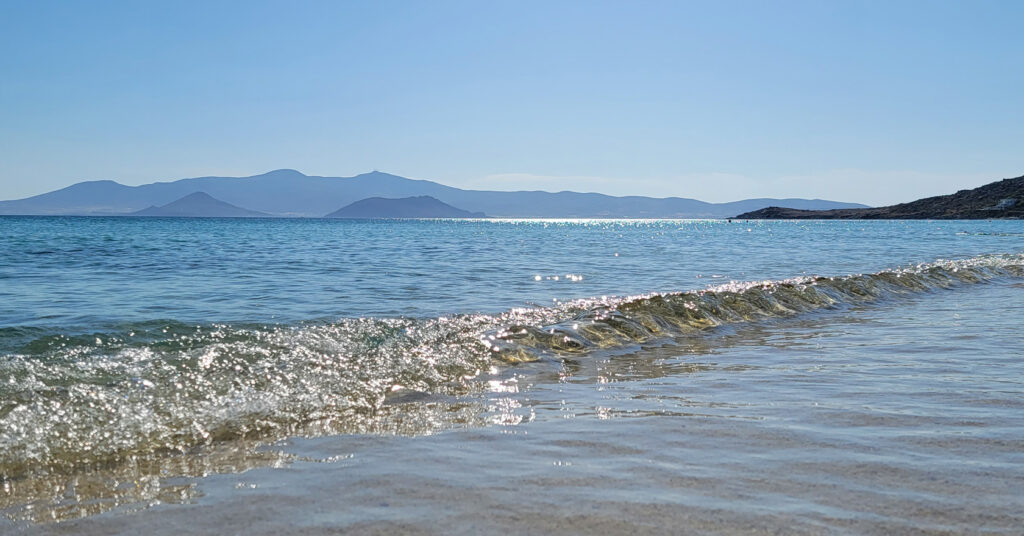
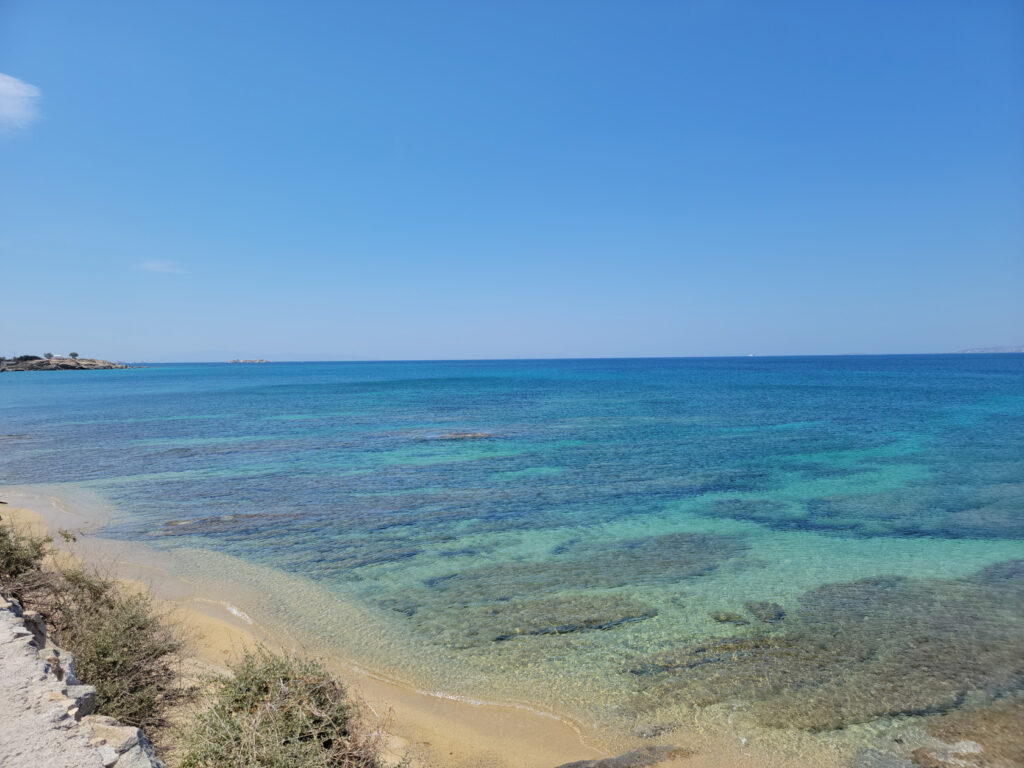
Paros Island – From The Beach
The Beach – A View From The Water
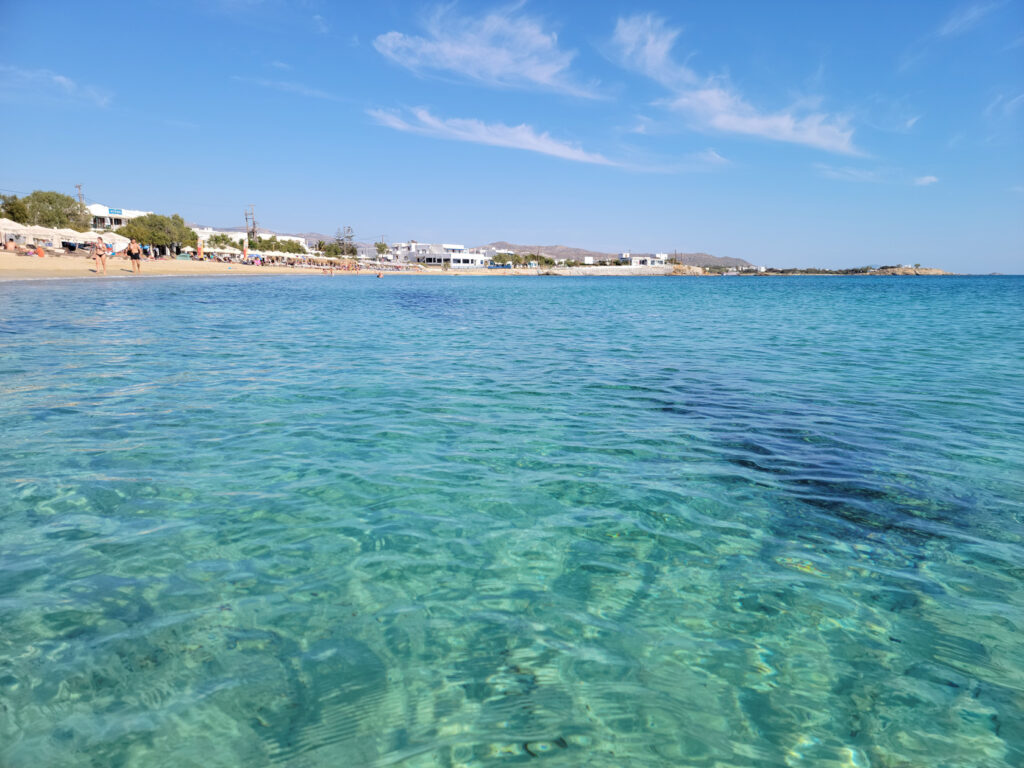
The Blue Aegean Sea
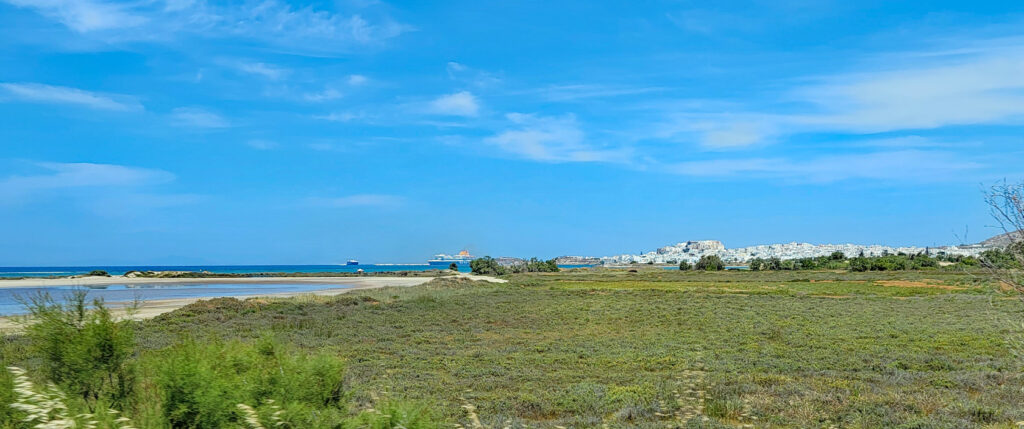
Naxos City – From Airport Road
Cycling Naxos
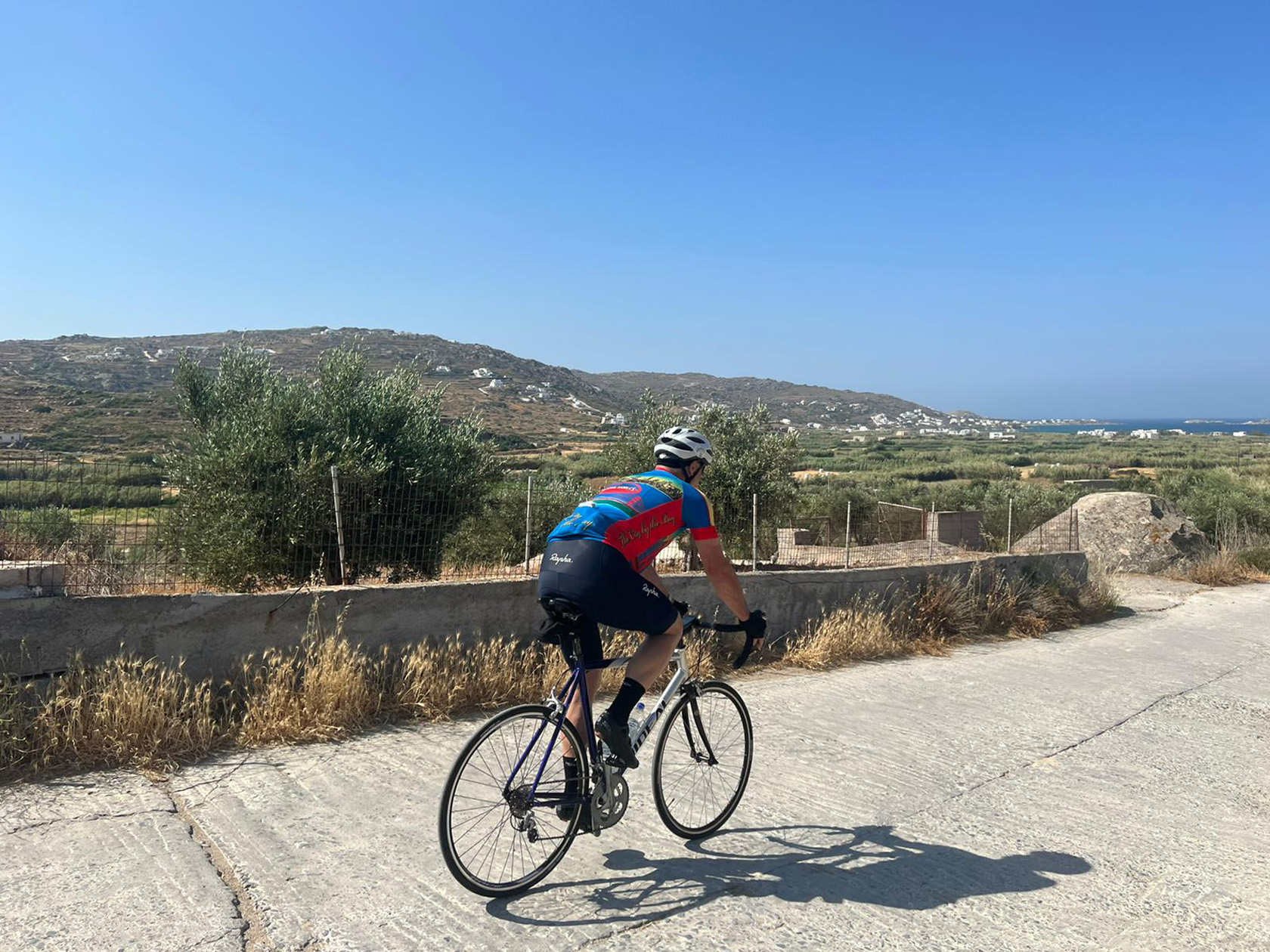
For the adventurous, or those just wishing to get out and explore, Naxos offers some fairly good cycling. There are a few places where you can rent bicycles. However, if you are looking for something more advanced, you should reserve your equipment before you leave.
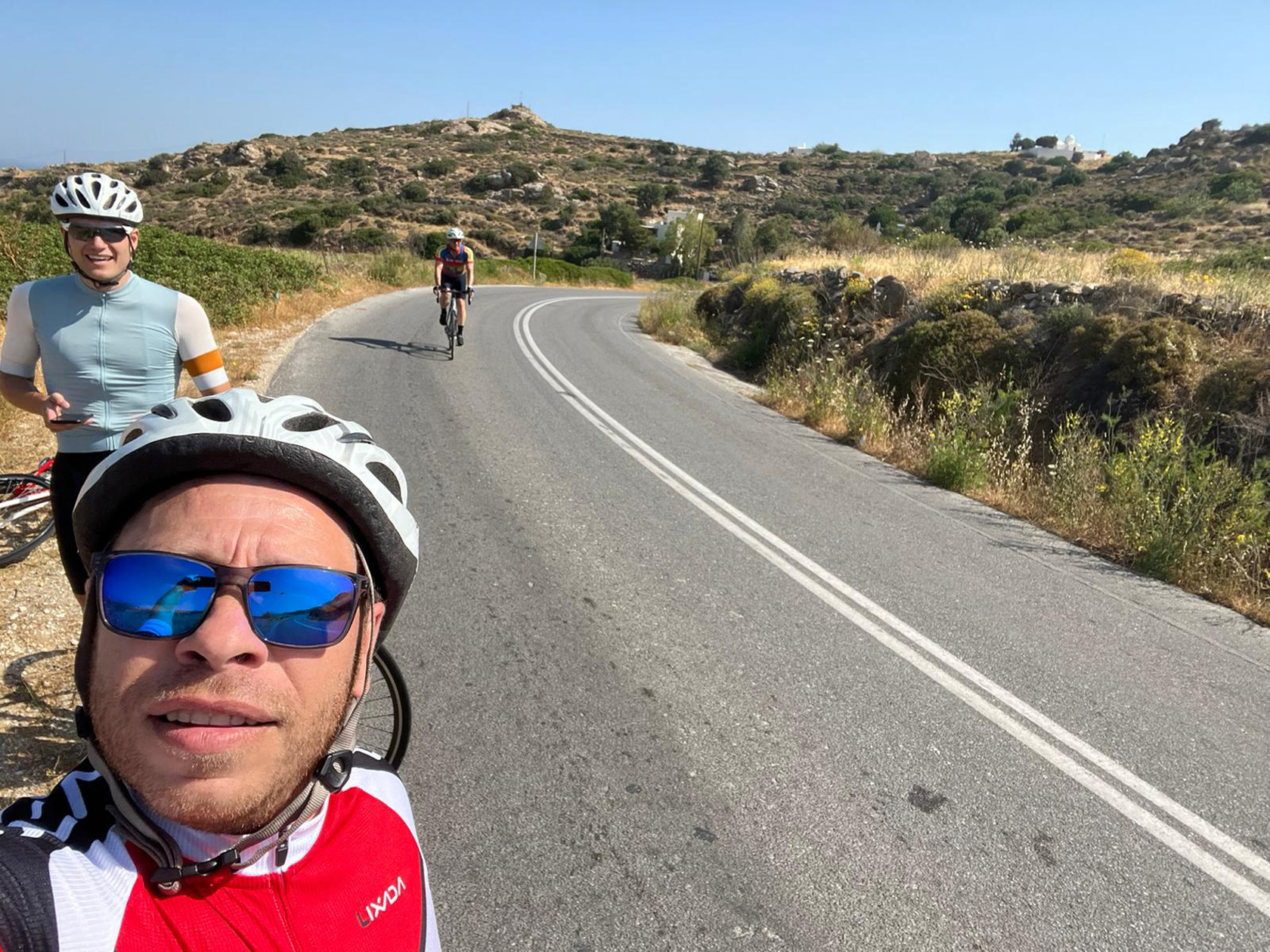
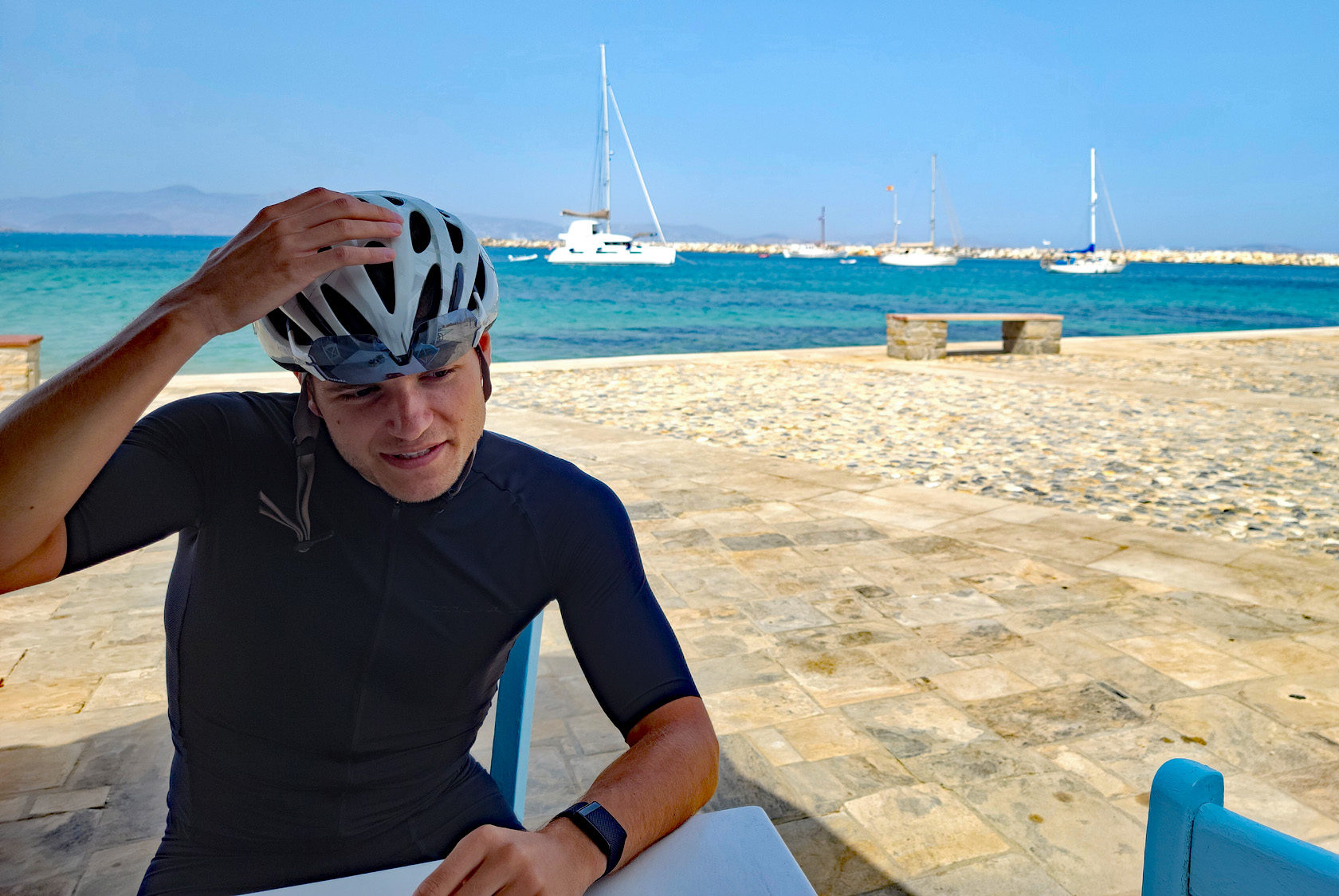
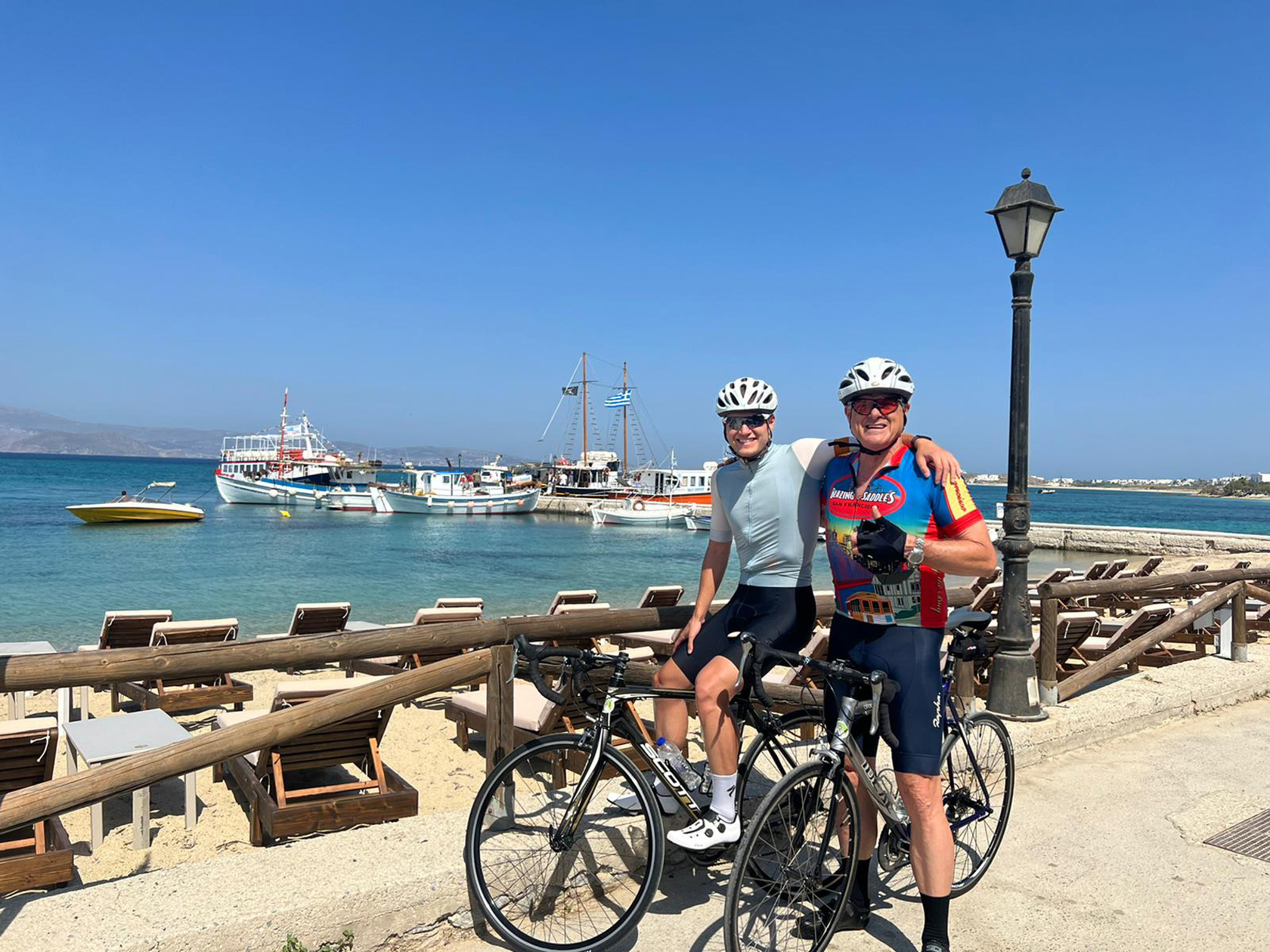
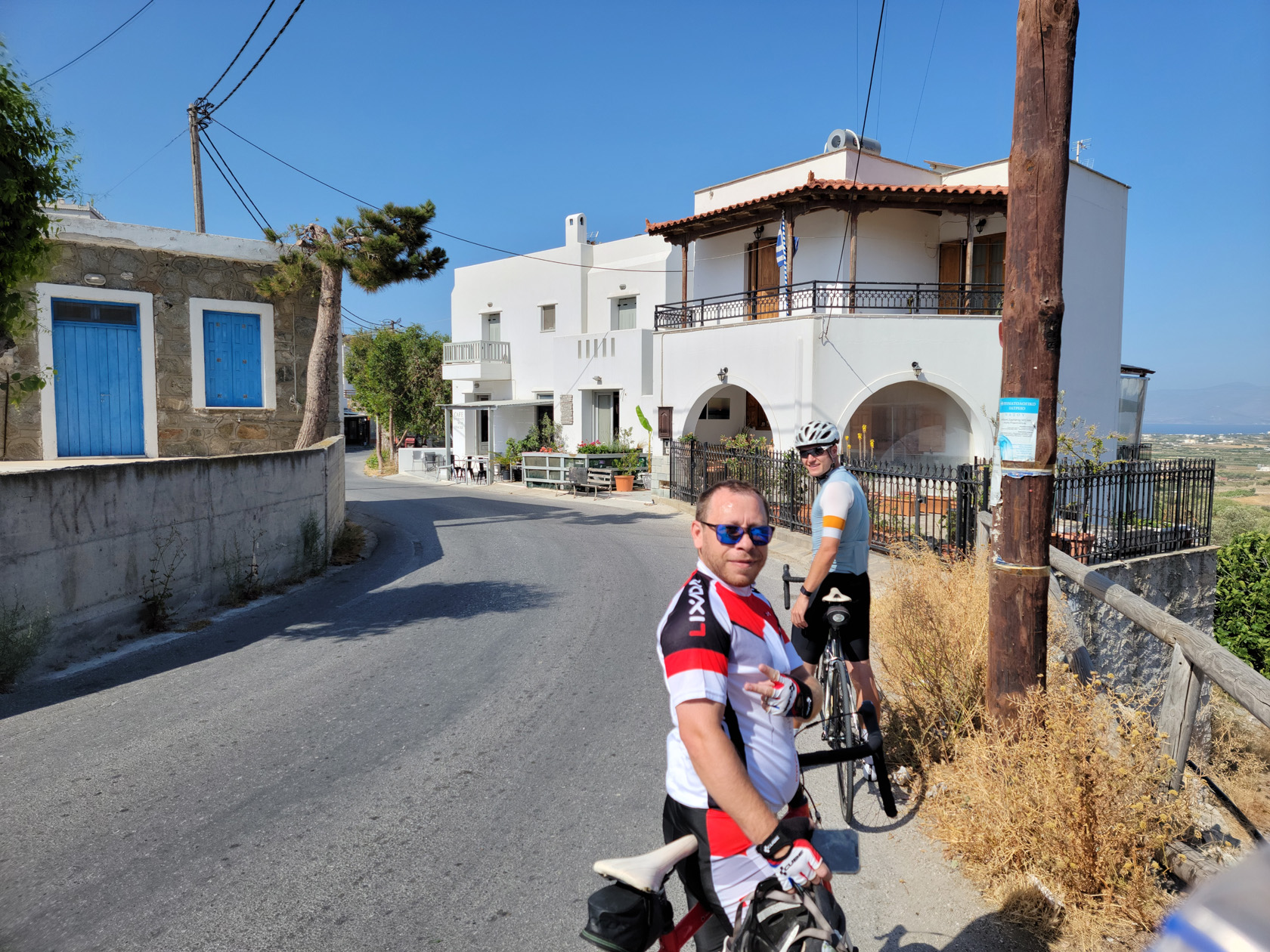
Cycling Naxos – Gabi, Tristan and Erick – Day 1
We rented our road bikes from Naxos Bikes and were not disappointed. Though a bit dated, all of the bikes performed as stated. The owners were eager to supply enough tubes, pumps and other equipment (helmets) as needed. The only thing we had to bring were our own clothes, shoes and Garmins. They delivered and picked up right at our hotel for a modest fee, so we didn’t have to worry about getting into town prior to our ride.
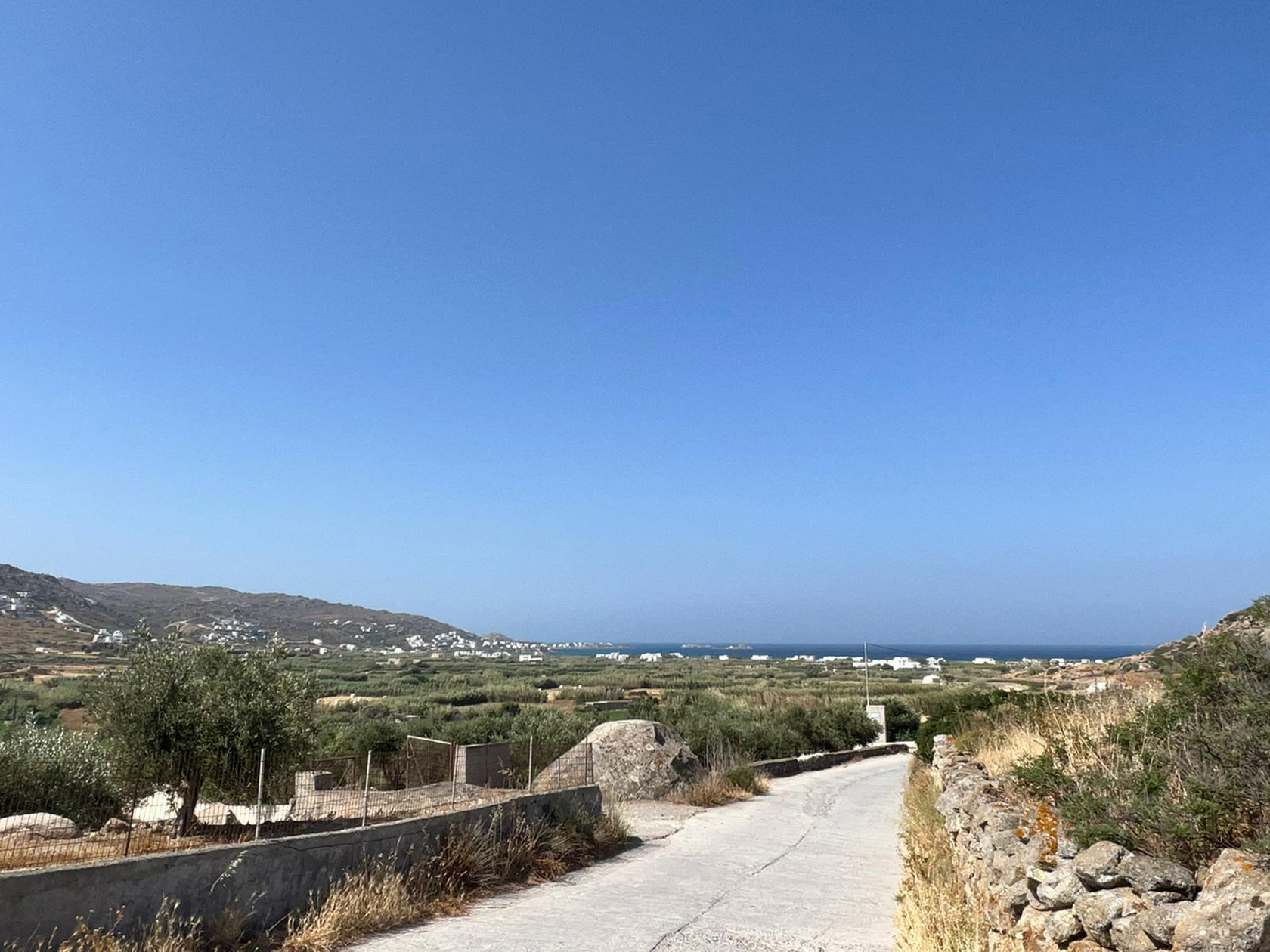
We really enjoyed touring Naxos, though I would suggest planning your route before you leave your hotel, as not all roads are suitable for road bikes (if you make a wrong turn, you will see what I mean).
Naxos – The City
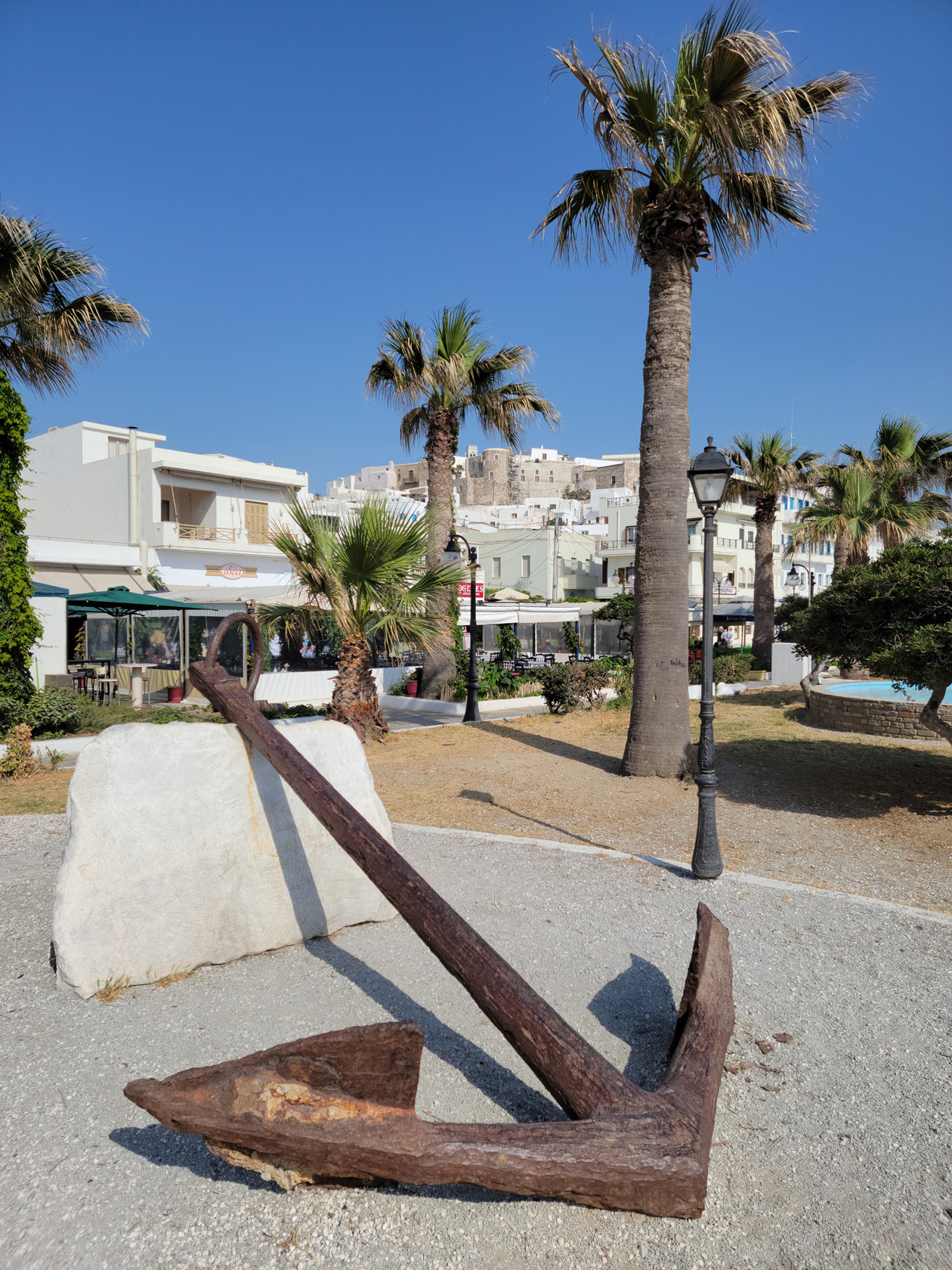
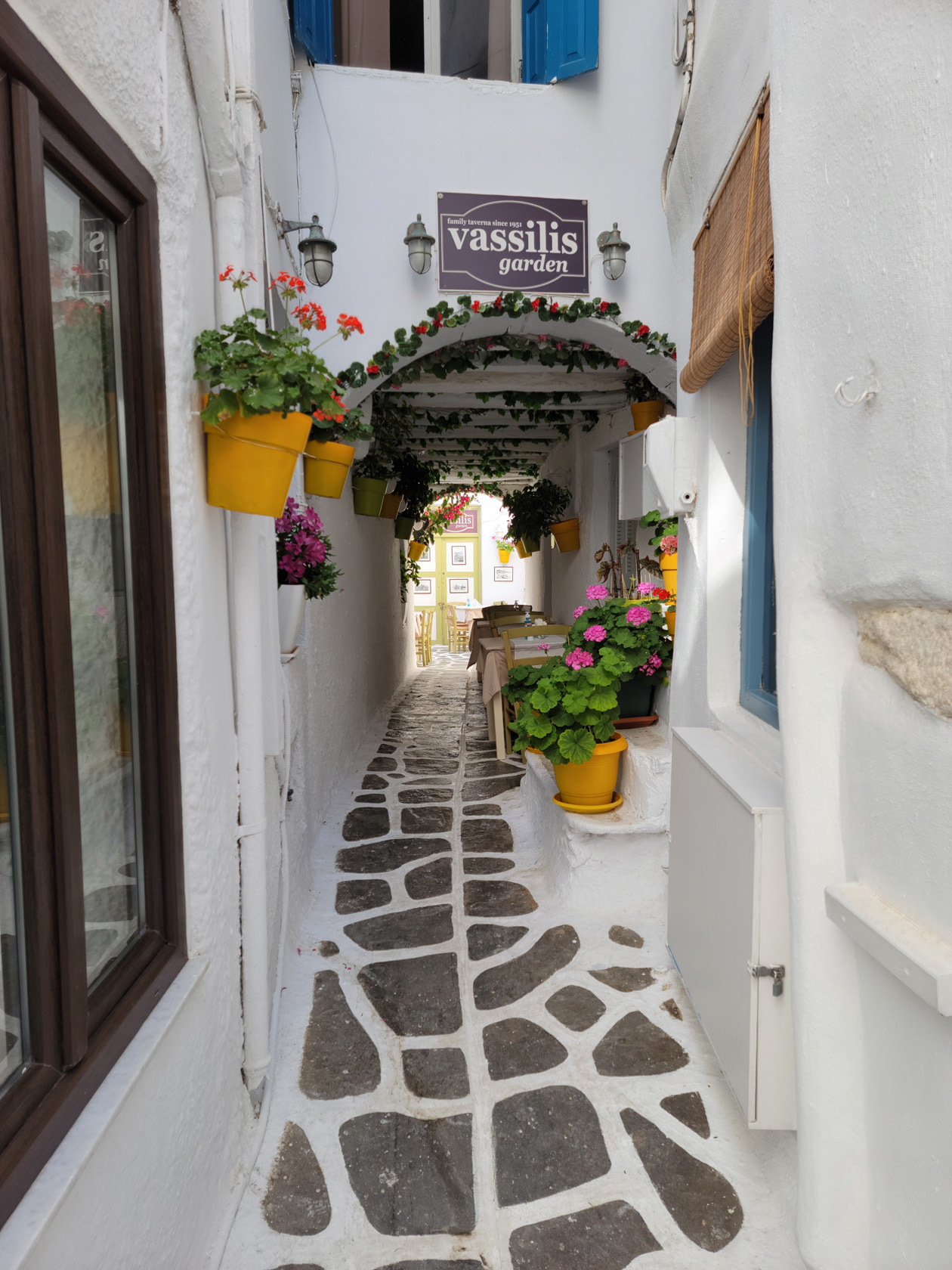
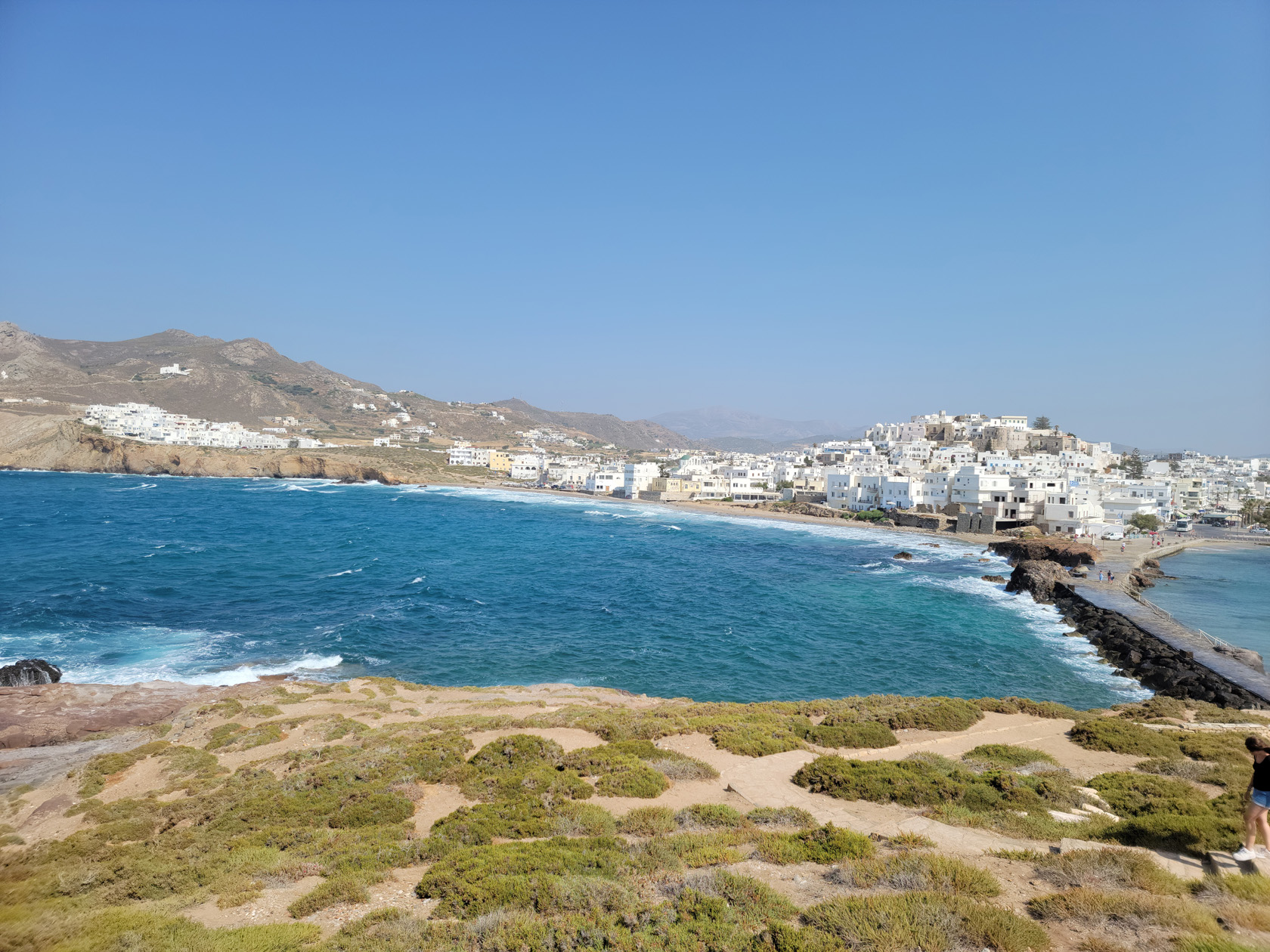
The modern part of Naxos is pretty little port city built into a small hill that of course has a church and castle built on top of it. The hill has very interesting narrow winding streets that one can peruse and occasionally shop at the stores that dot the way.
Naxos, Naxos – The City
The Venetian Castle of Naxos is not much to look at, and from what we could tell, not open to the public, since all the entrances appear locked, signed and boarded up.
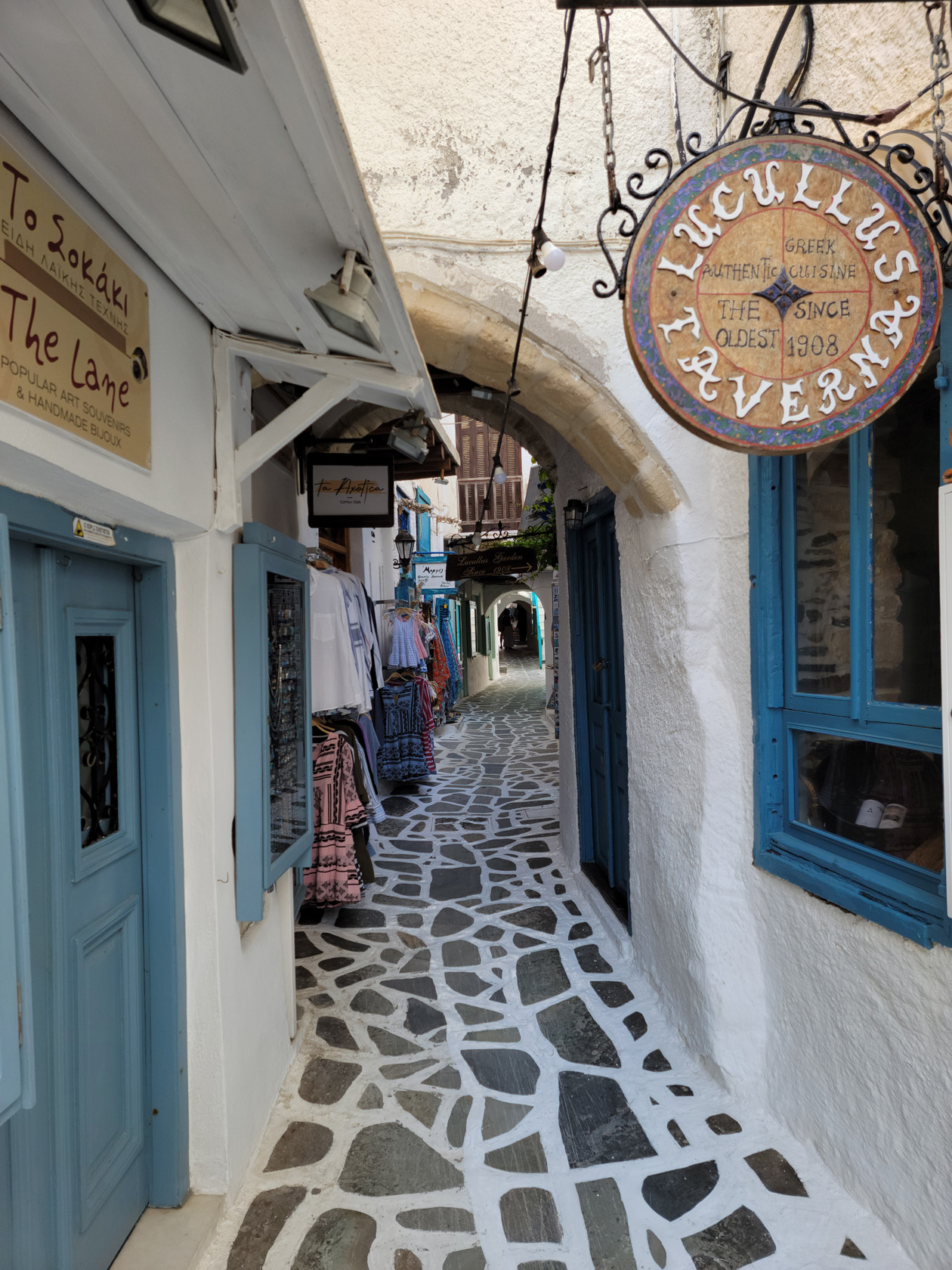
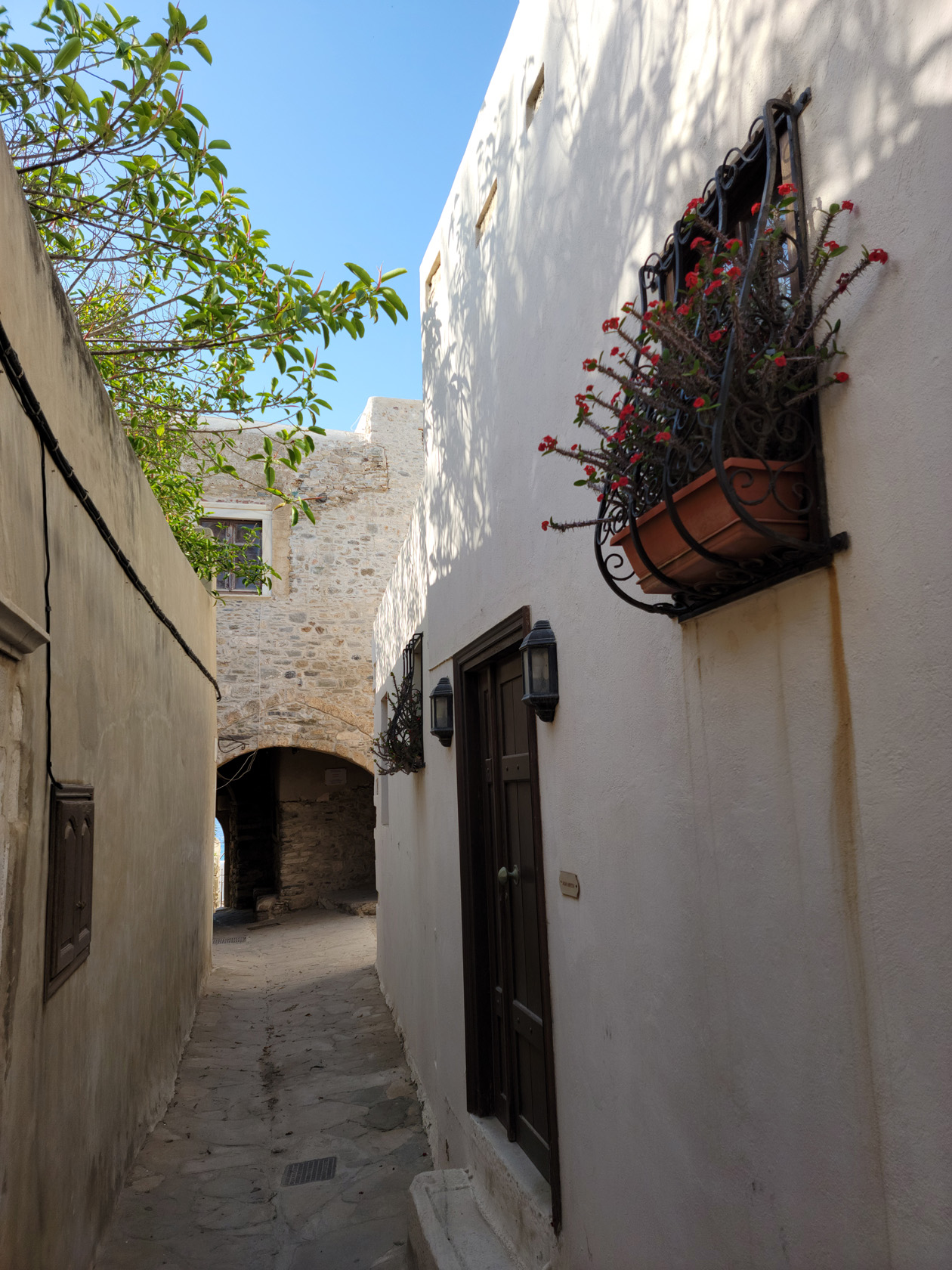
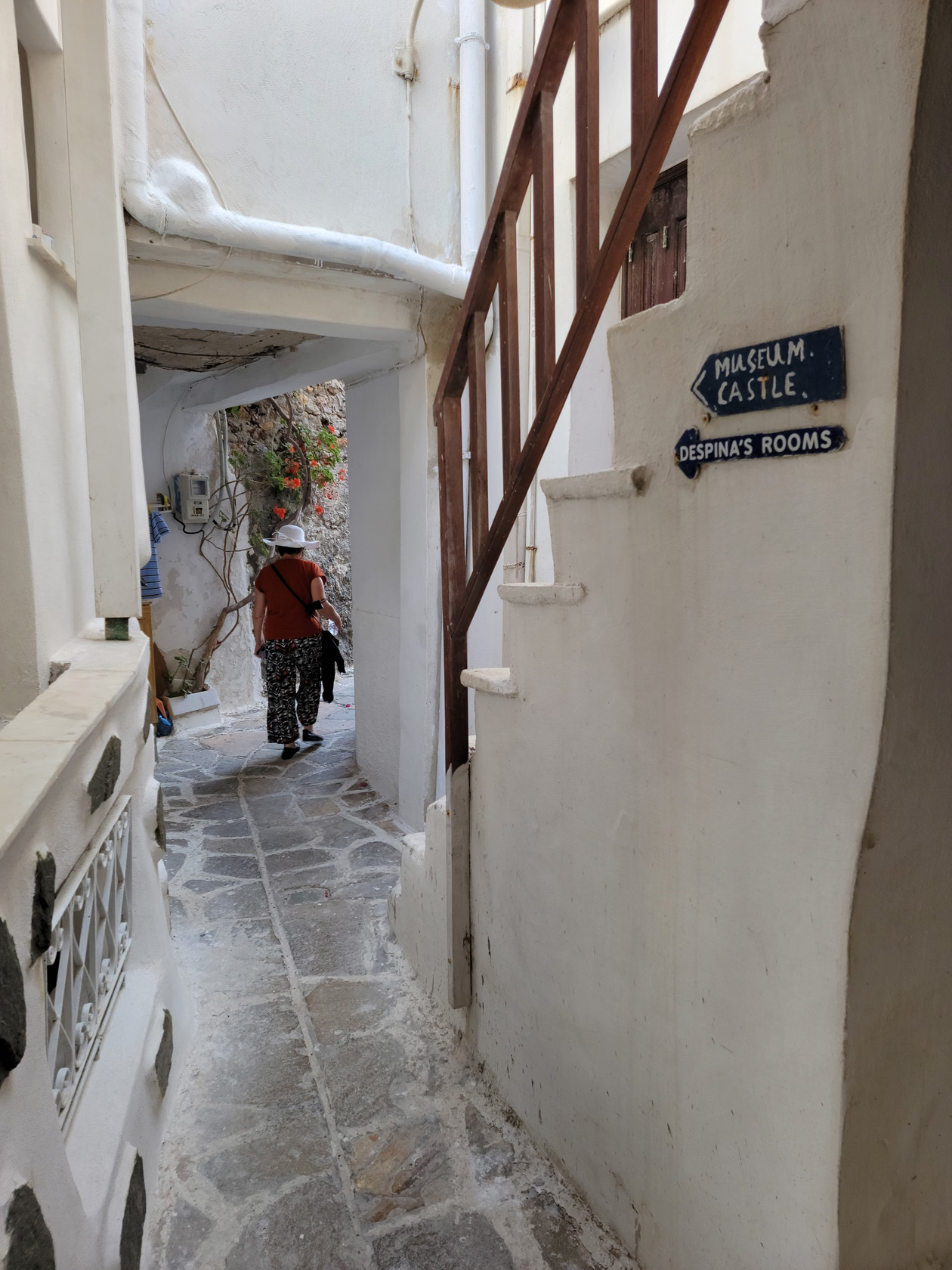
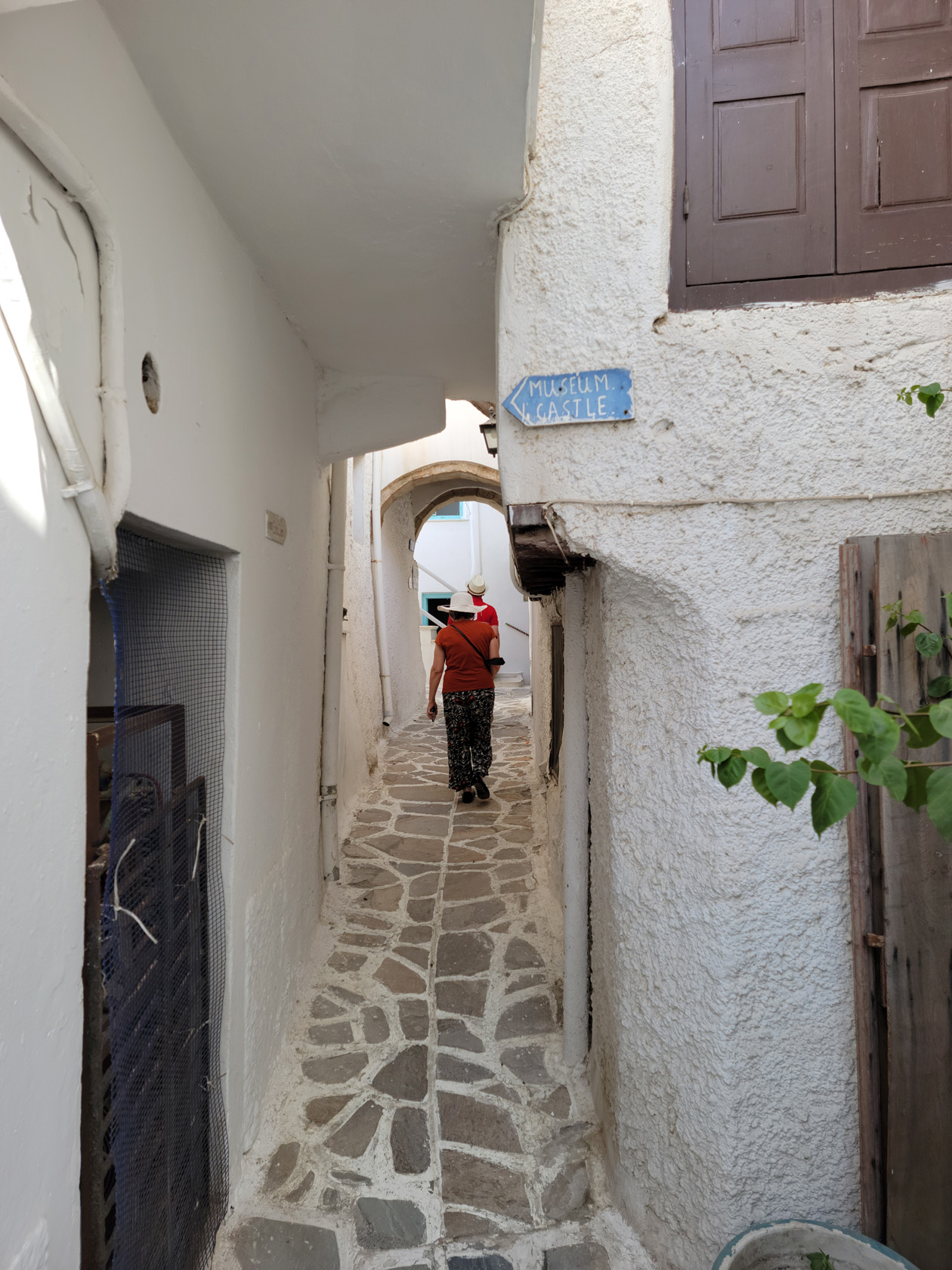
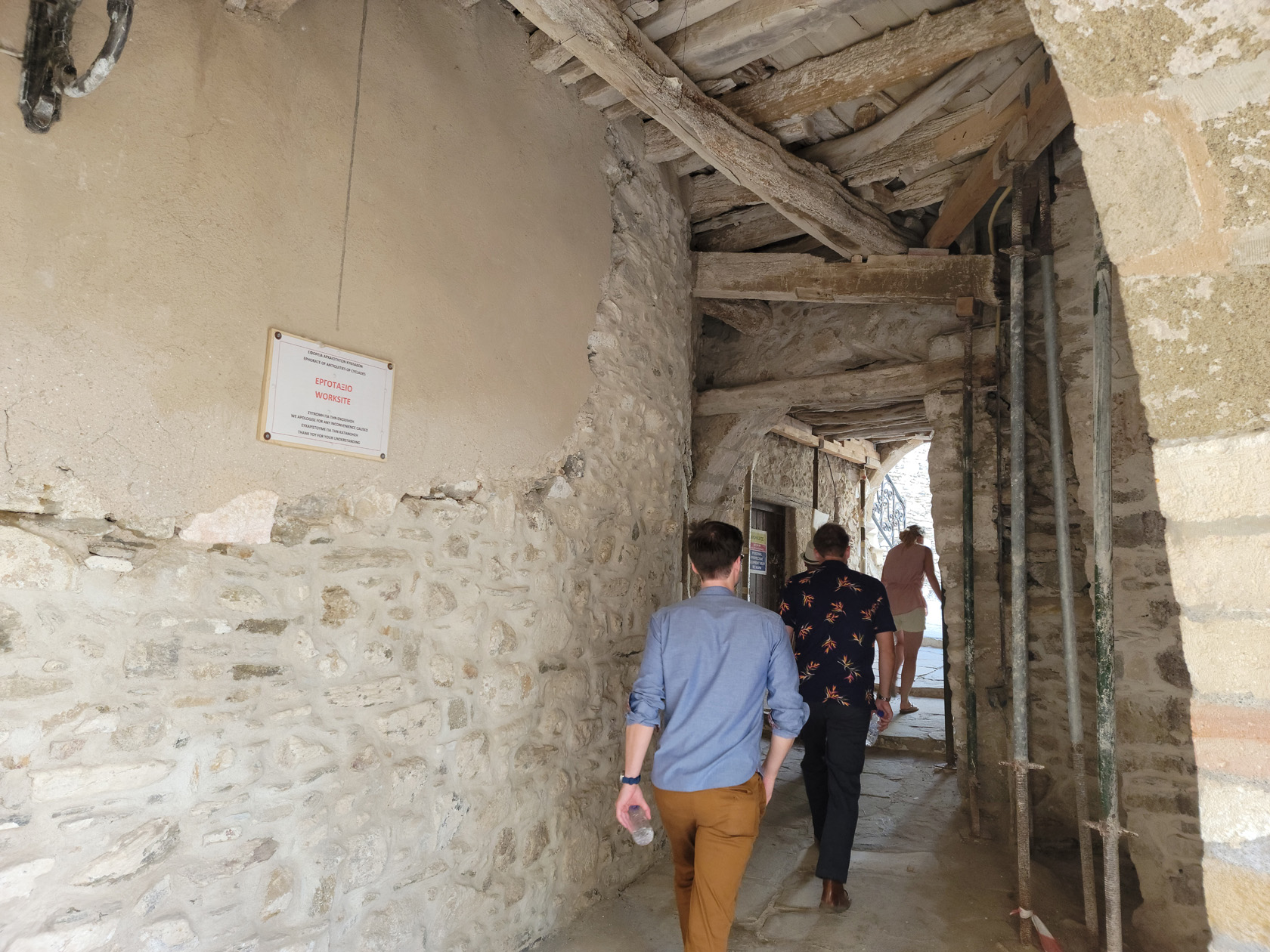
Naxos, Naxos – Alleyway To Castle
Naxos, Naxos – Alleyway To Castle
Naxos, Naxos – Alleyway To Castle
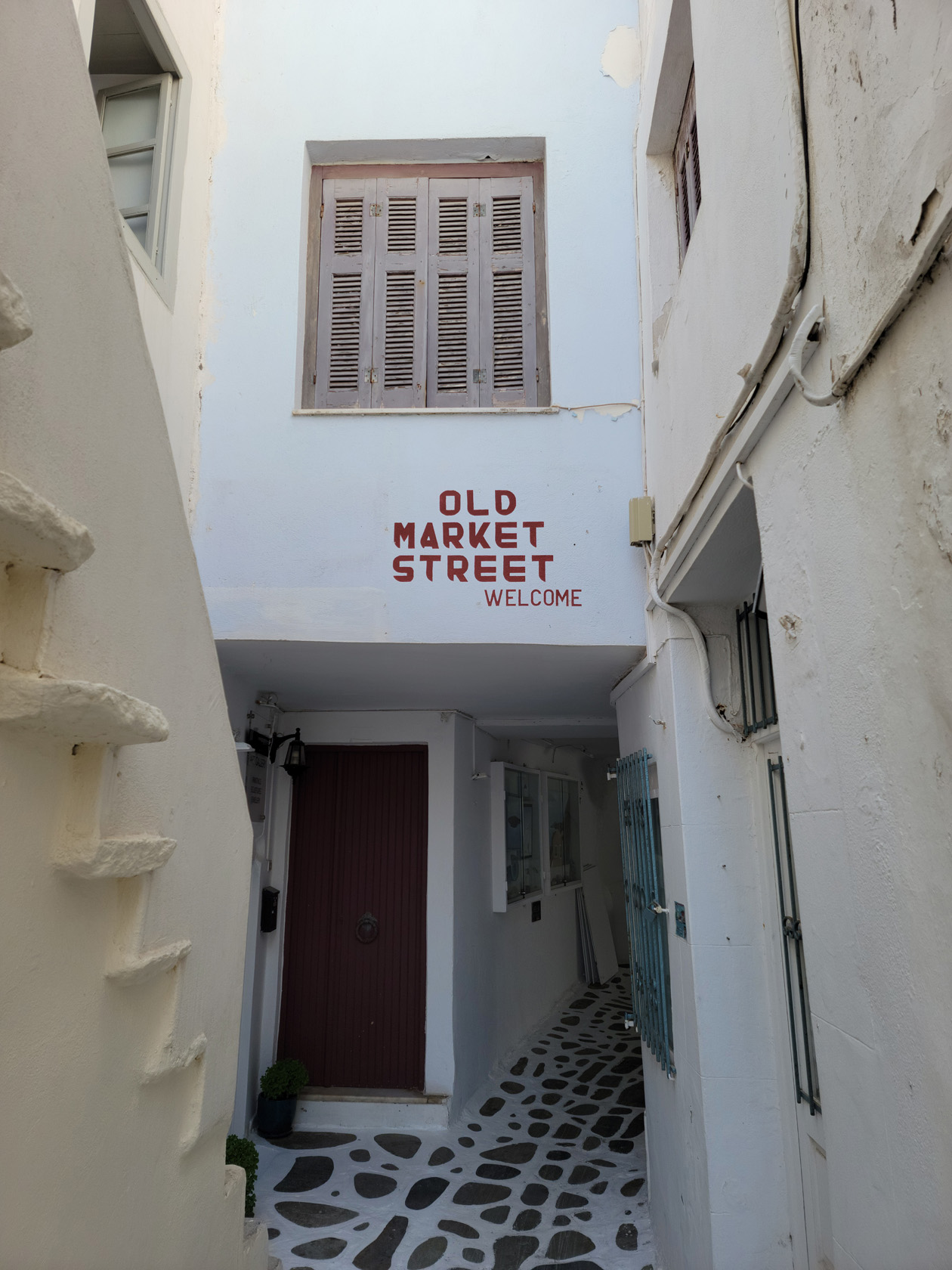
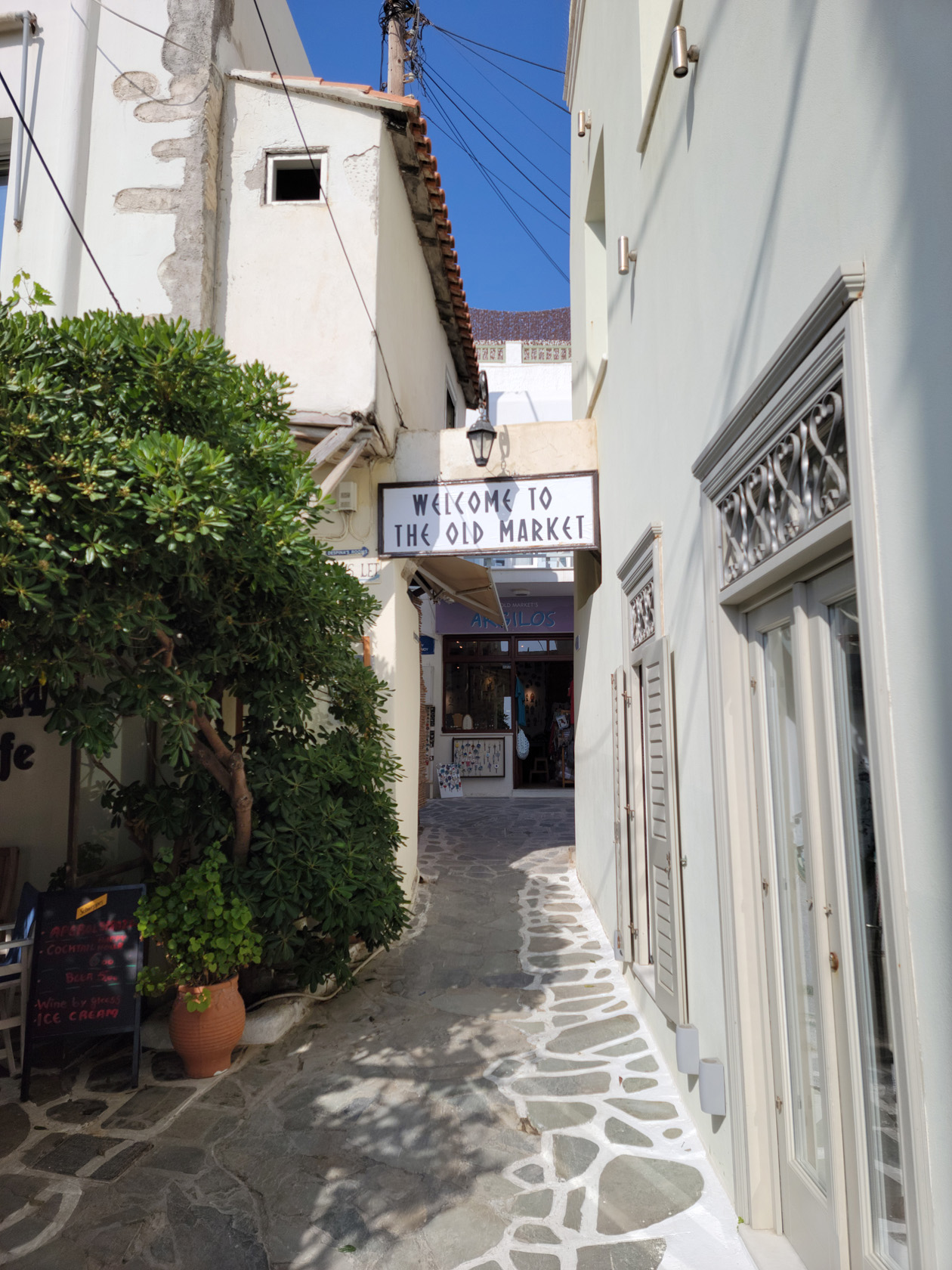
Naxos, Naxos – Alleyway To Castle – Old Market Entrance
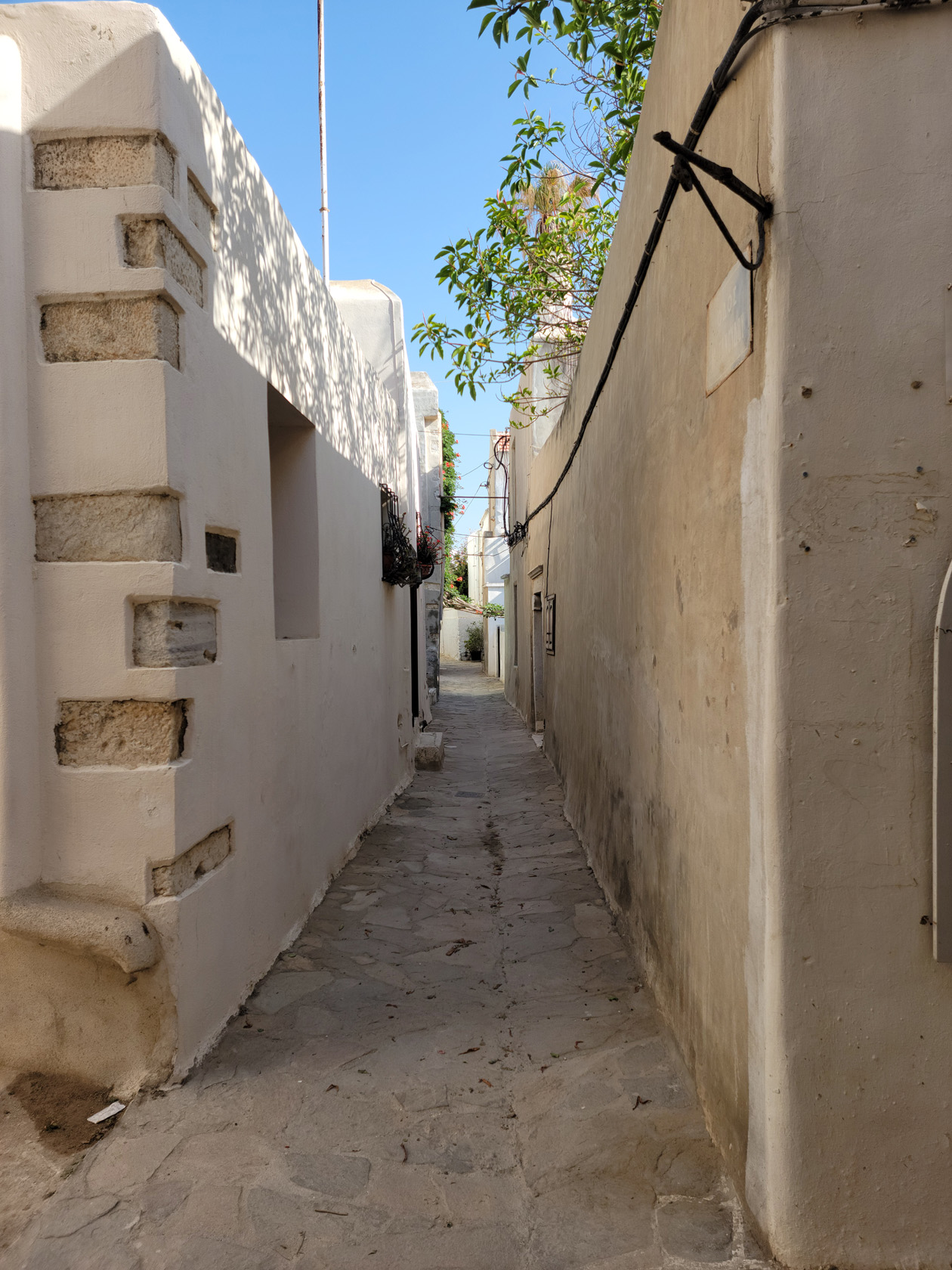
Naxos, Naxos – Alleyway To Castle
Naxos, Naxos – Alleyway To Castle
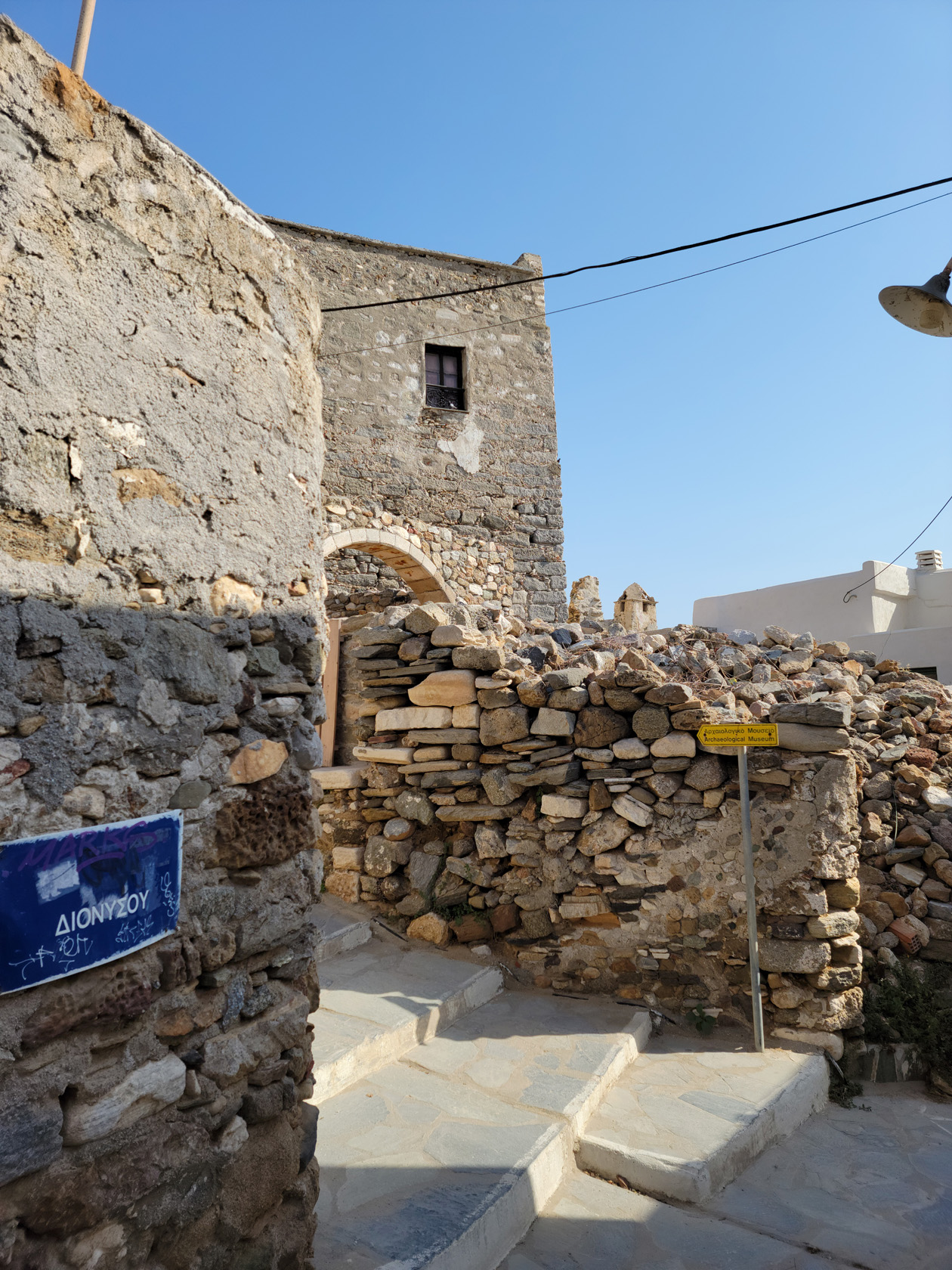
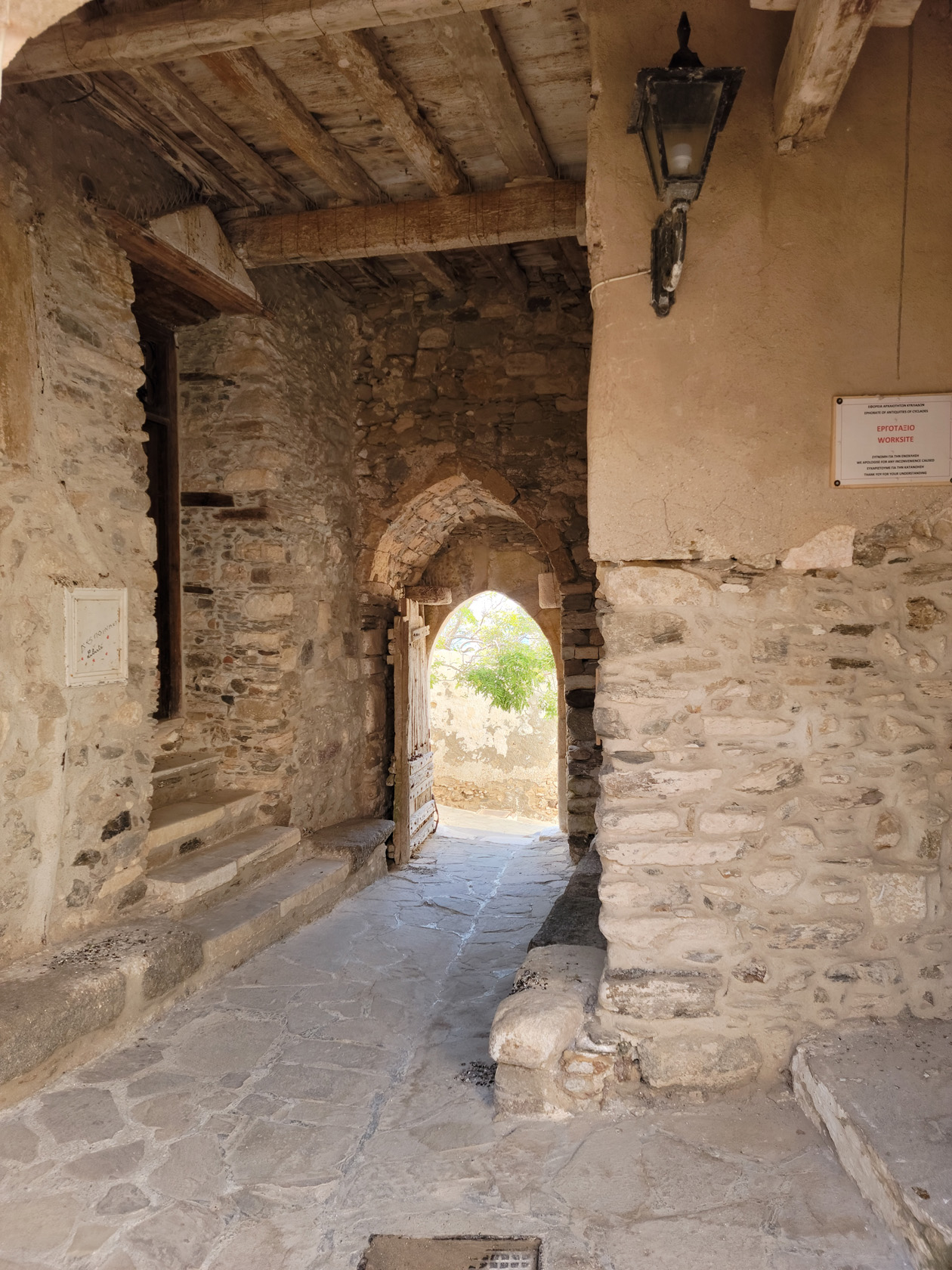
Naxos, Naxos – The Castle
Naxos, Naxos – The Castle
Naxos, Naxos – The Castle
Naxos, Naxos – The Castle
Naxos, Naxos – The Castle – Walking Through Part Of The Castle
The Catholic Cathedral at the top is open to the public, but when we arrived it was during lunch and we were not going to stay until later in the afternoon for them to reopen. It was just a passing thought, since our real intent was to find a place to each lunch ourselves.
The Temple of Apollo
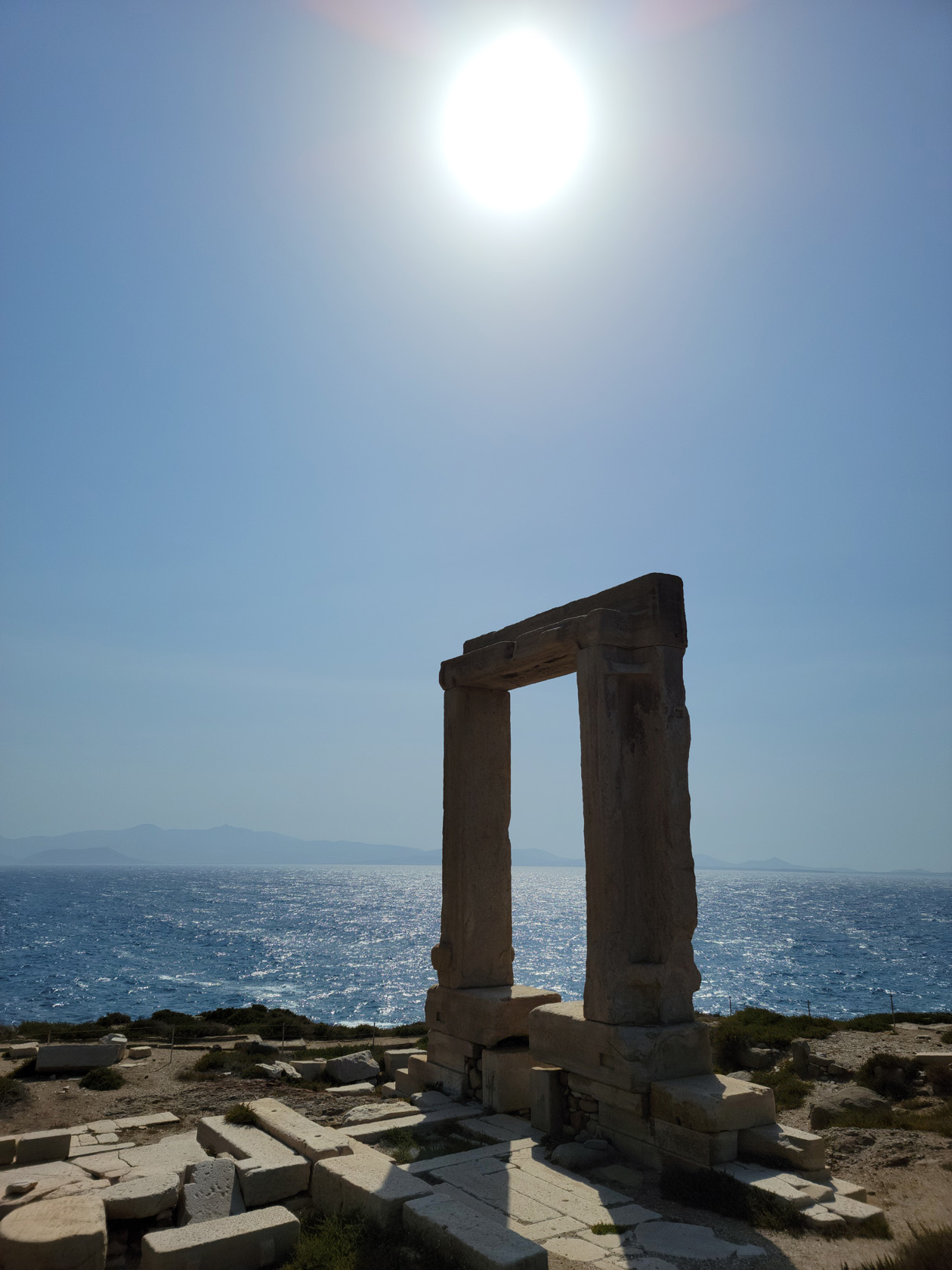
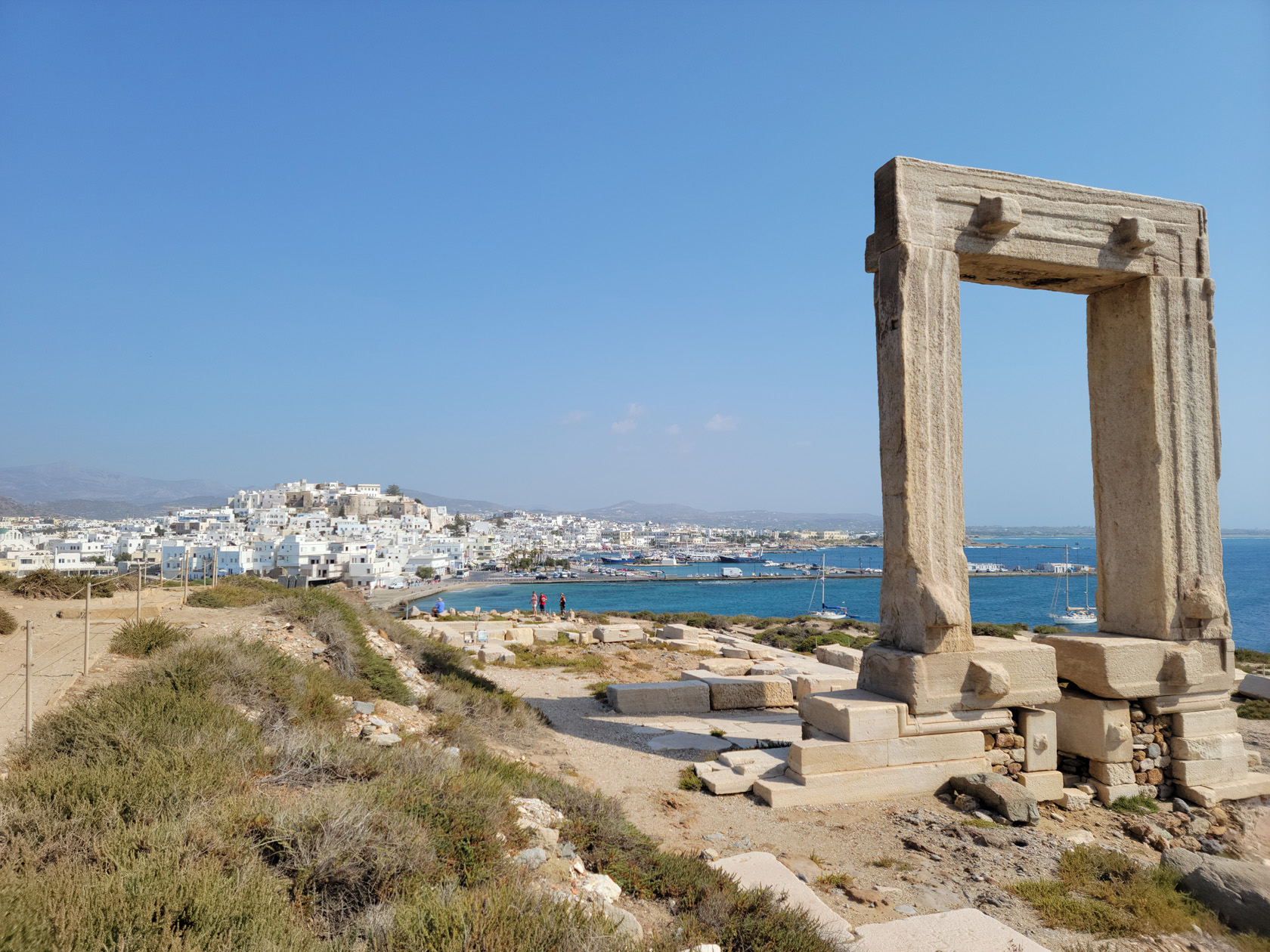
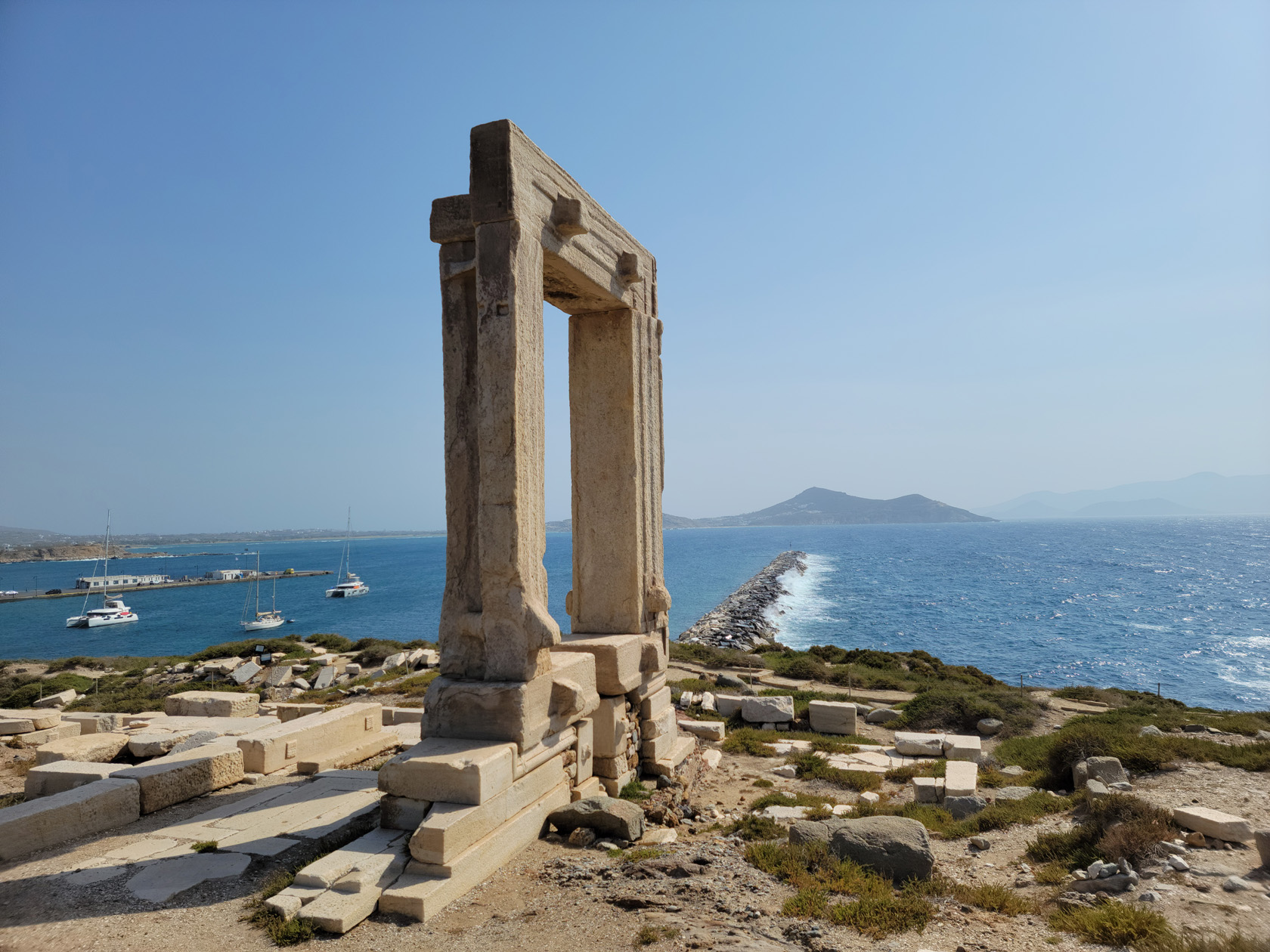
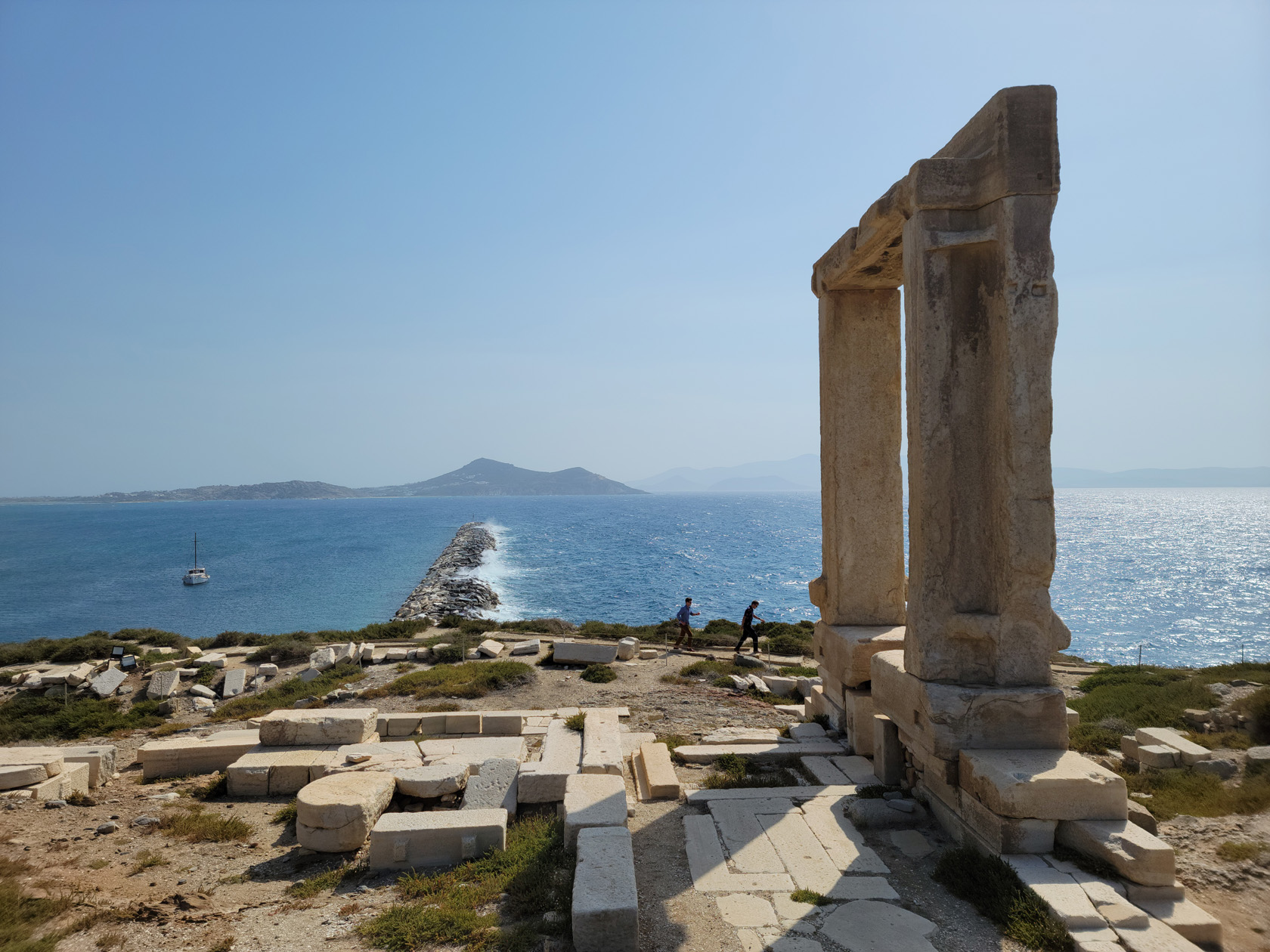
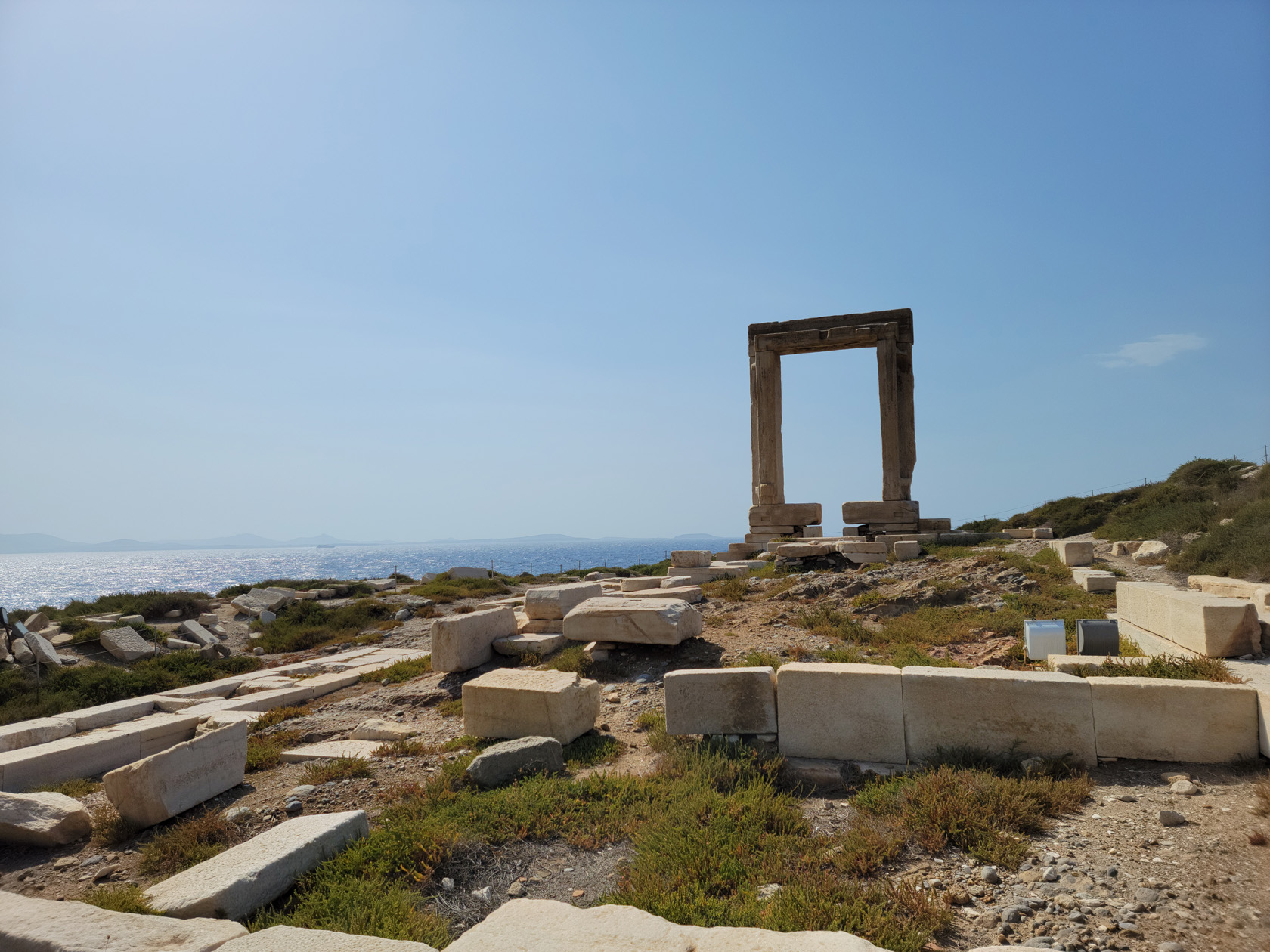
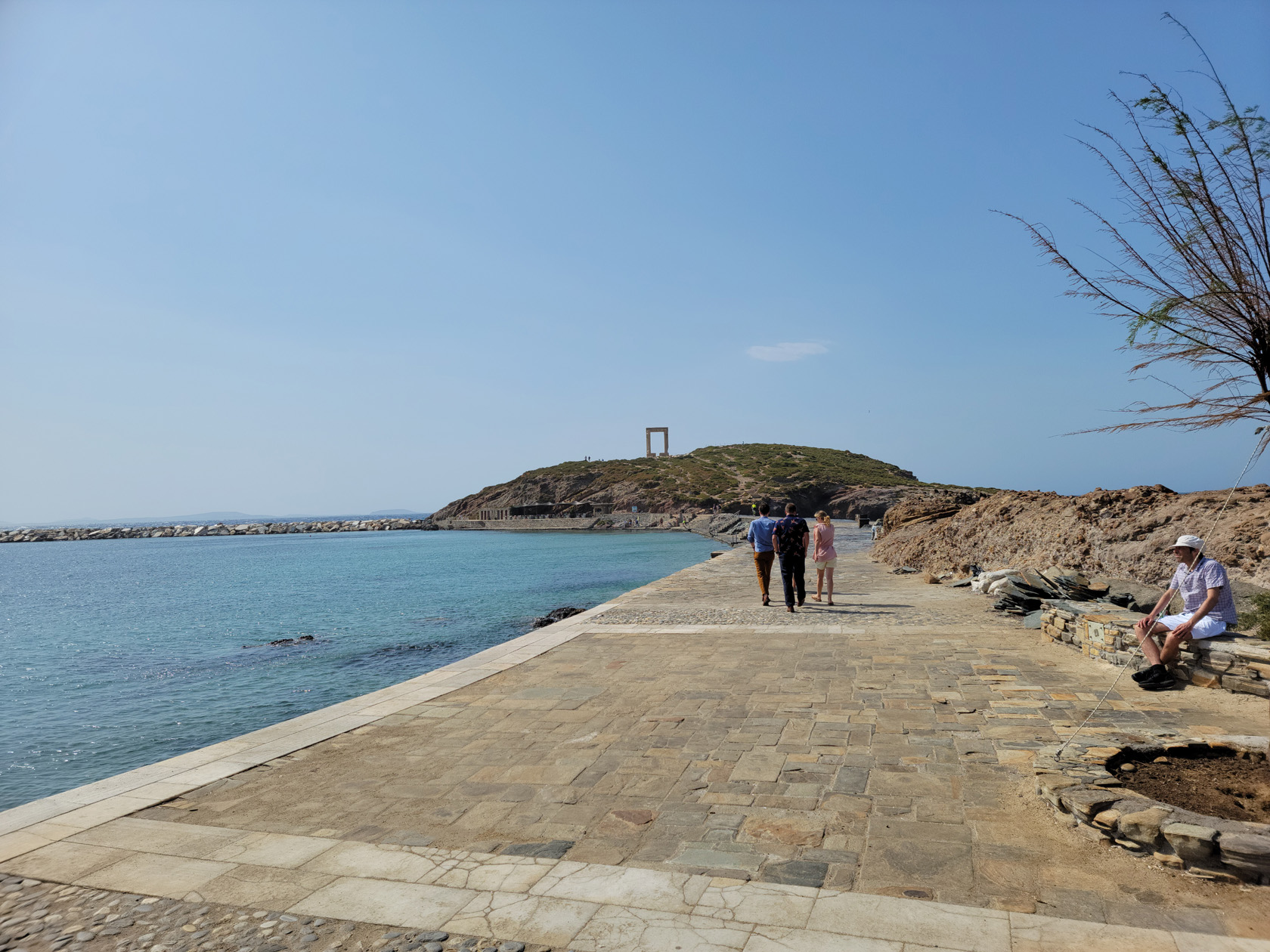
The interesting form that we first came in contact with at our hotel has an actual presence on the island. The Temple of Apollo are the remains of a structure to the god Apollo built by Lygdamis the tyrant in the sixth century BCE on a peninsula just off the harbor of Naxos City. In fact he never actually completed it. Before he could do so, he was conquered by the Spartan army in 524 BCE and never saw power again.
Naxos, Naxos – Temple of Apollo
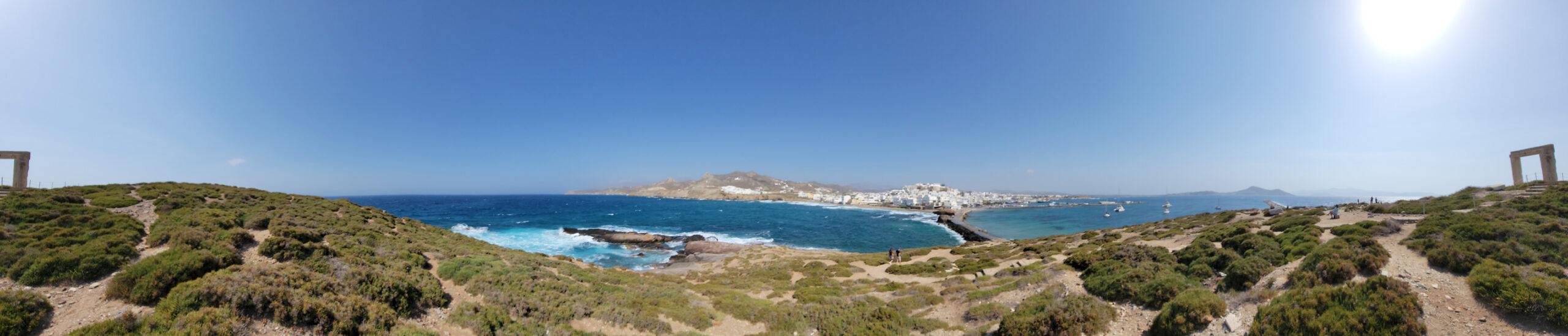
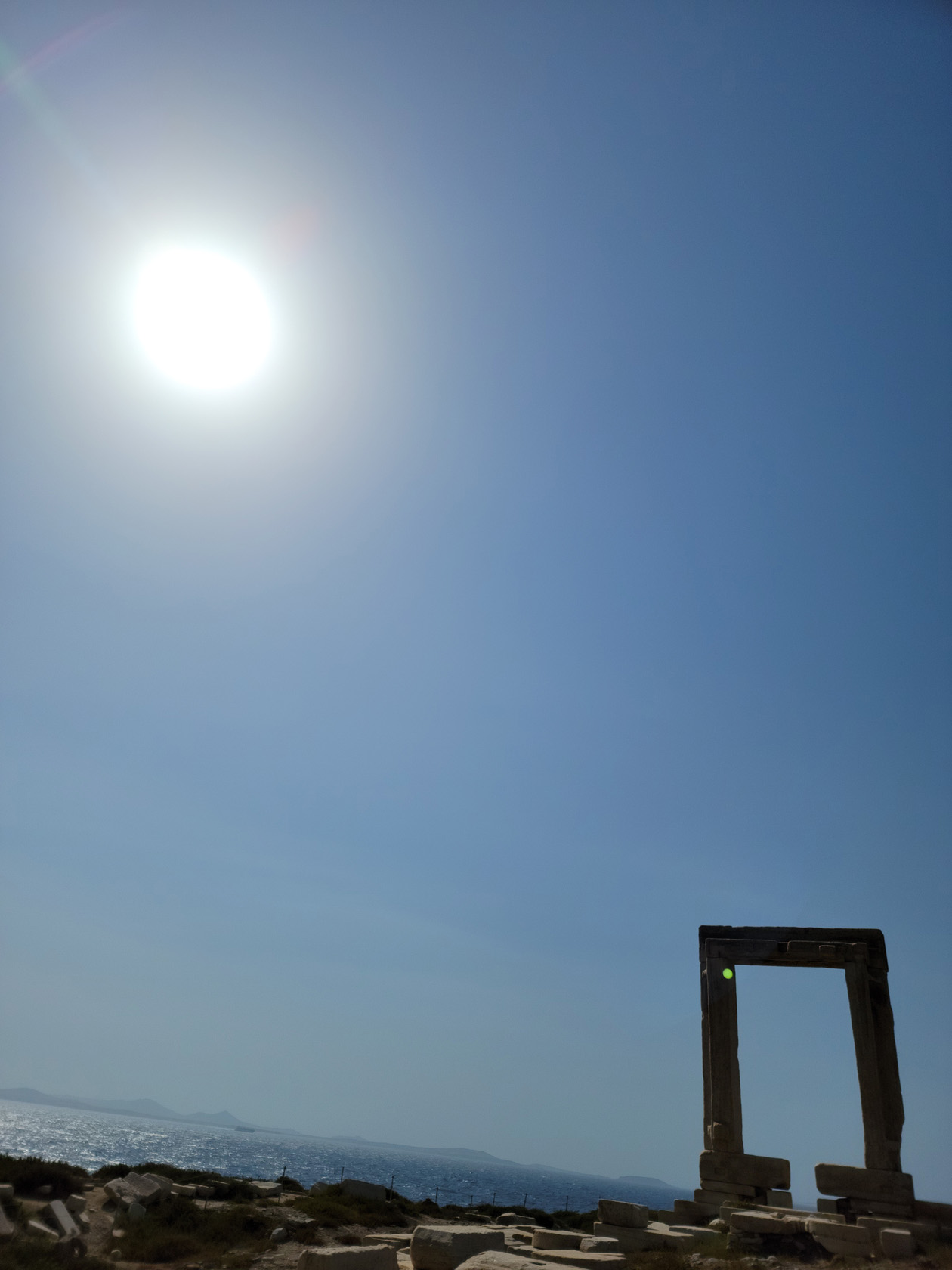
Due to its age and no doubt having been plundered over the millennia, all that stands after repeated excavations and reconstructions, is the gate itself. It stands with its lintel and two sides upright on a small outcropping of rock just to the north of the city against the stark blue Aegean sky.
Naxos, Naxos – Temple of Apollo
Naxos, Naxos – Temple of Apollo
Naxos, Naxos – Temple of Apollo
Naxos, Naxos – Temple of Apollo
Naxos, Naxos – Temple of Apollo
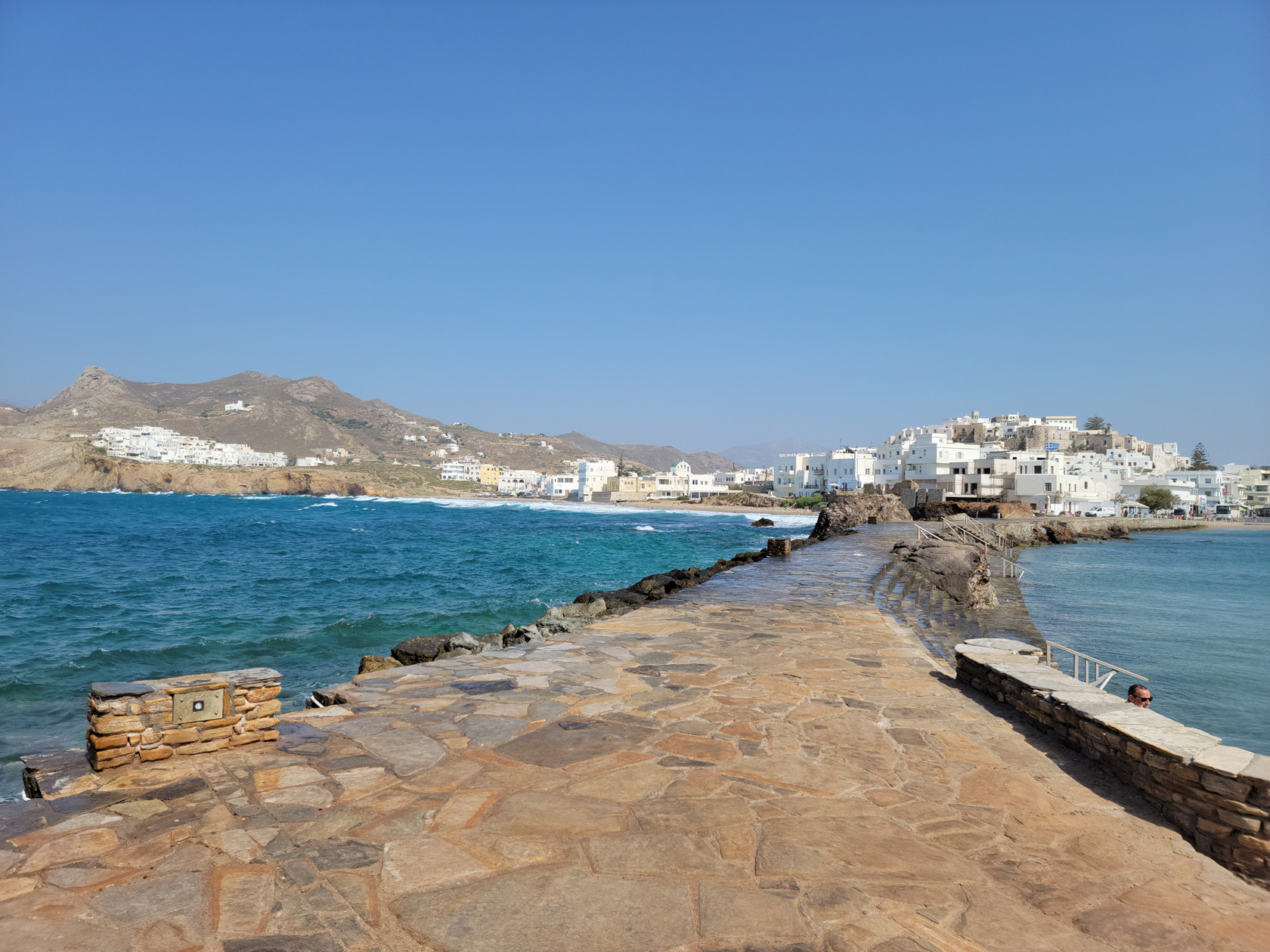
Naxos, Naxos – And Its Jetty From The Temple of Apollo
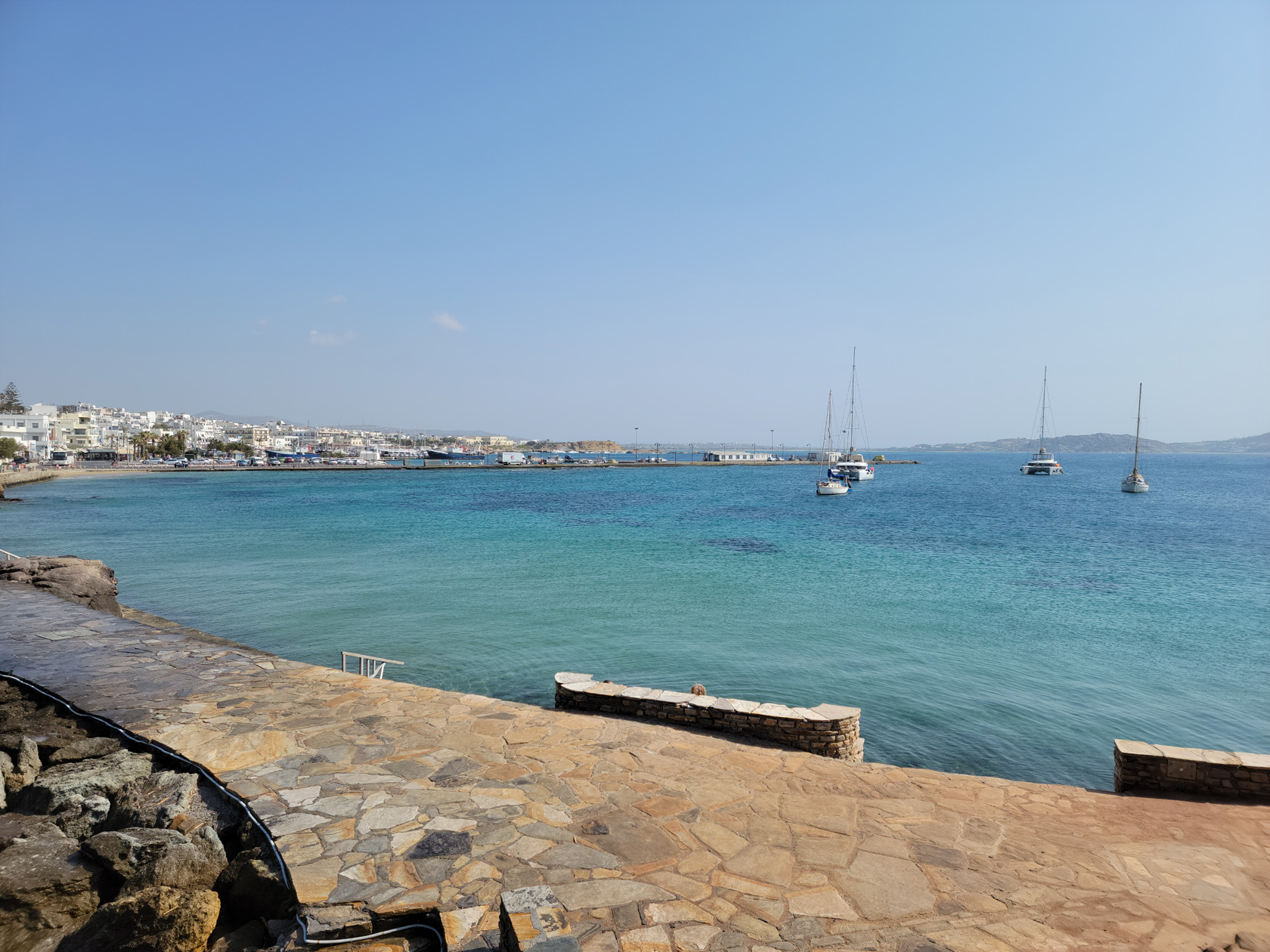
Naxos, Naxos – The Harbor
Naxos, Naxos – From Walkway
Naxos, Naxos – Temple of Apollo
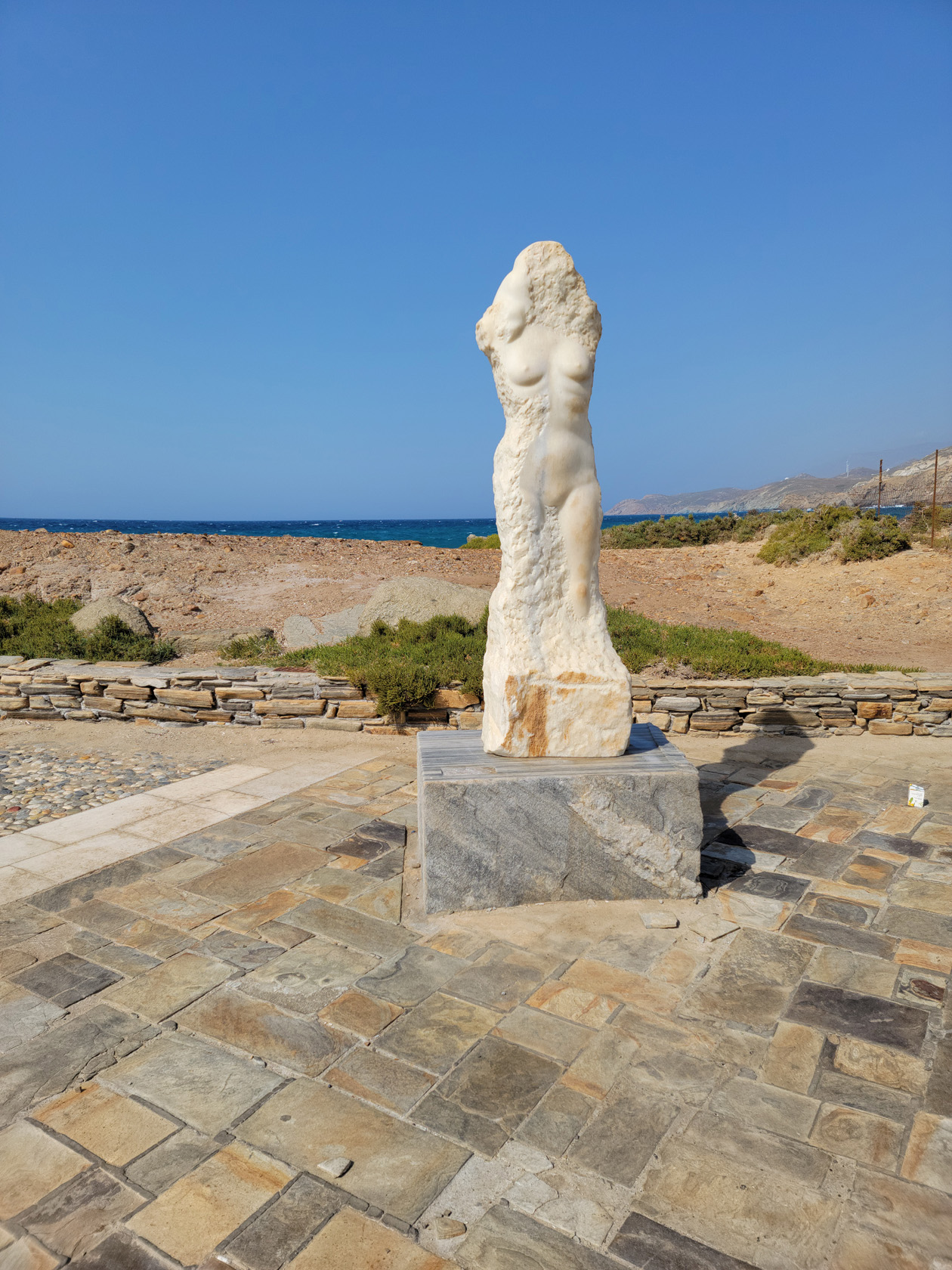
Naxos, Naxos – Temple of Apollo – Statue outside
Our Day Tour
Naxos being such a large island, requires you to at least spend a day exploring areas other than its beaches. We used Naxos Luxury Transport as our Tour Guides to explore a few sites we wanted to see, as well as some others that were suggested by our guide. The entire tour was six hours, most of which was in a van, but included many stops, including Sangry or Sangri (also known as the Temple of Demeter), Manolis Pottery, Chalkio and the Citron distillery, the Flerio Melanes Kouros Statue, the town of Apeiranthos and the Eggares Olive Oil Museum.
It was right around this time that my wife Patti became very sick with bronchitis. To the point at which, she had lost almost her entire voice before we reached the Olive Oil museum in Eggares. What ever dark cloud or spell we were under, it appeared to have followed us into the Naxos hills. I started to wonder, what else could befall us?
The Temple Of Sangri
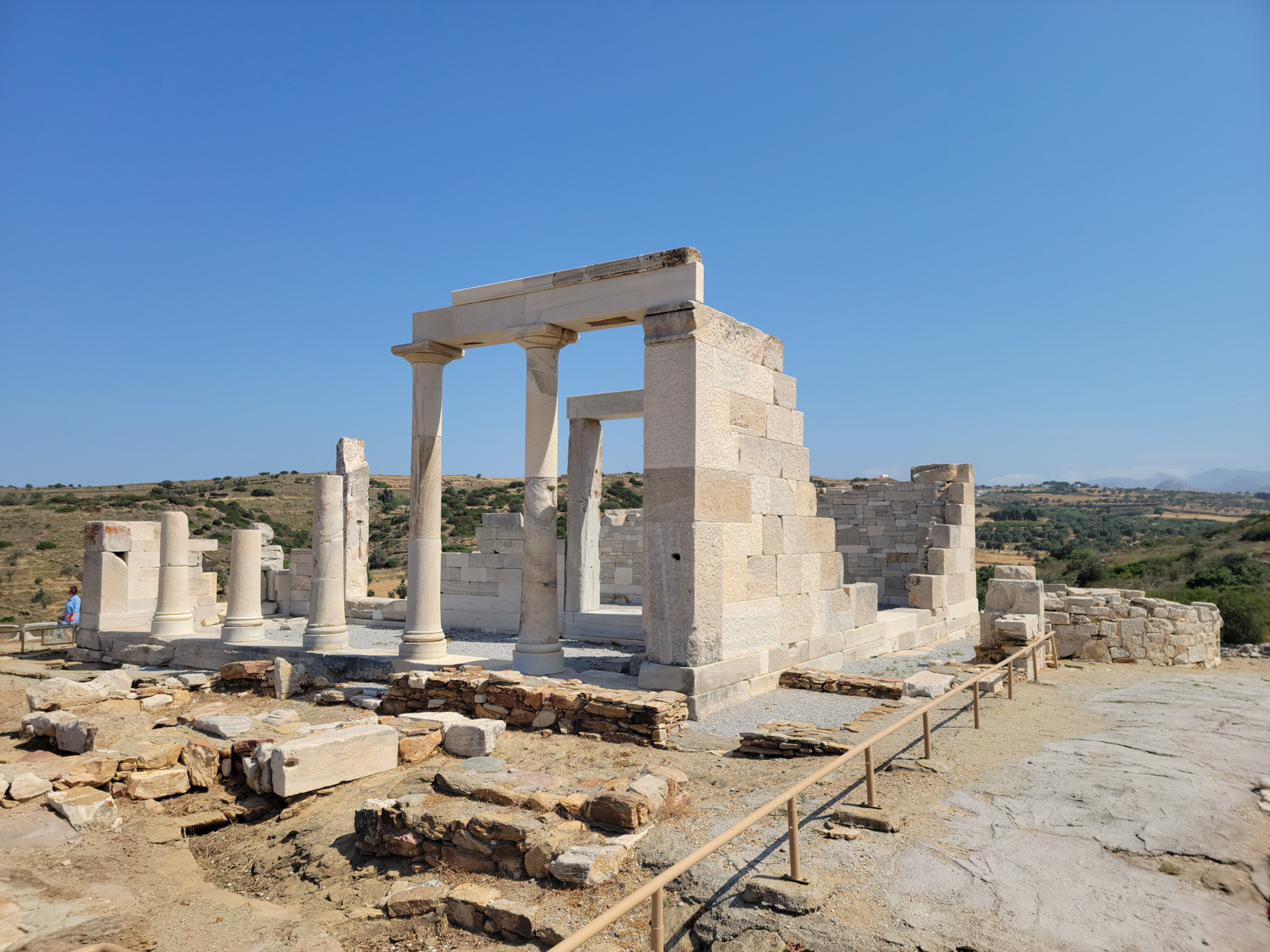
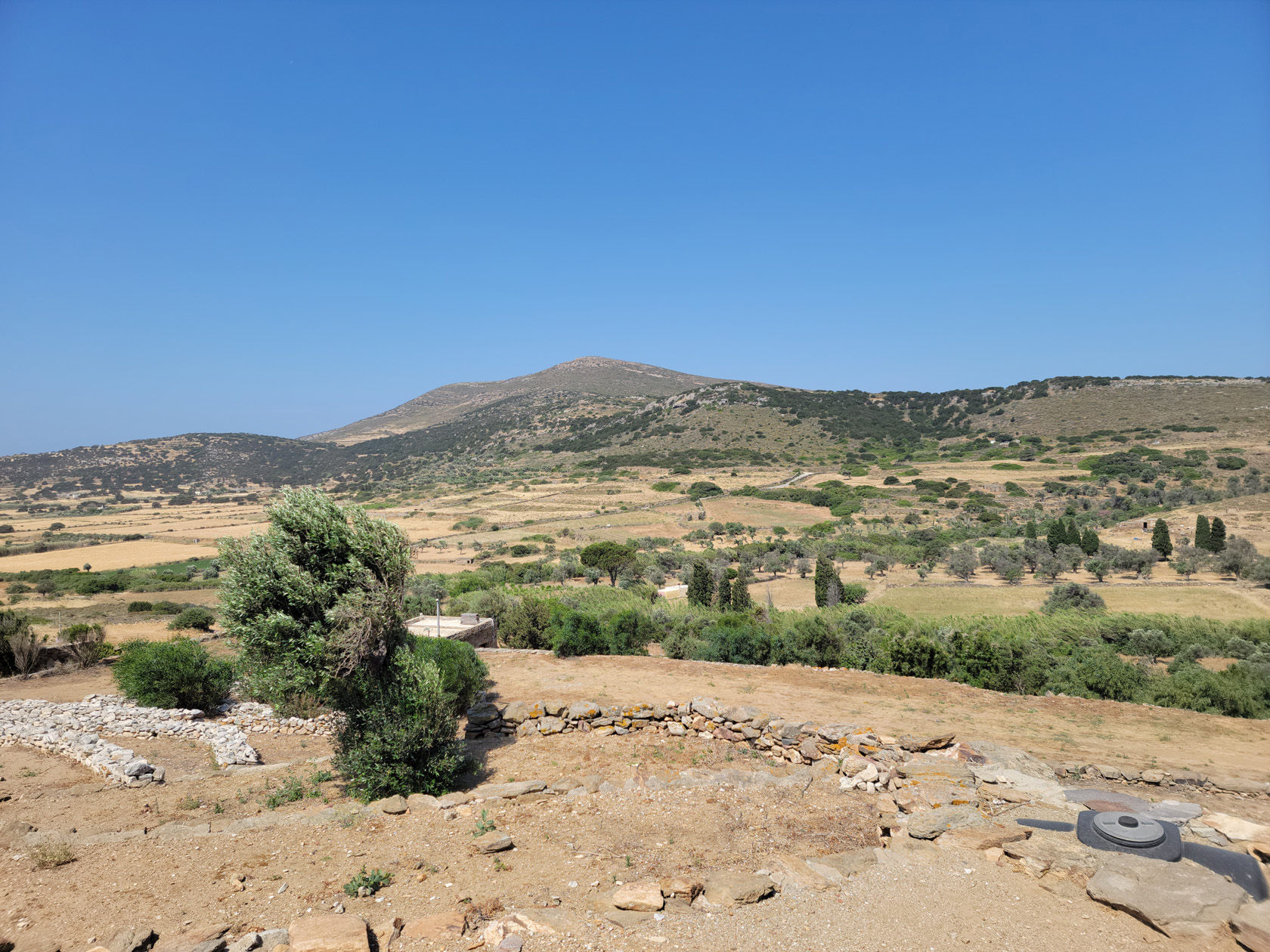
Perhaps a forty-five minute drive from Naxos is the Temple of Sangri. It is also called the Temple of Demeter or the Temple of Kore, there are also signs that the cult of Apollo may have used the site.
Our Day Tour – Sangri Temple
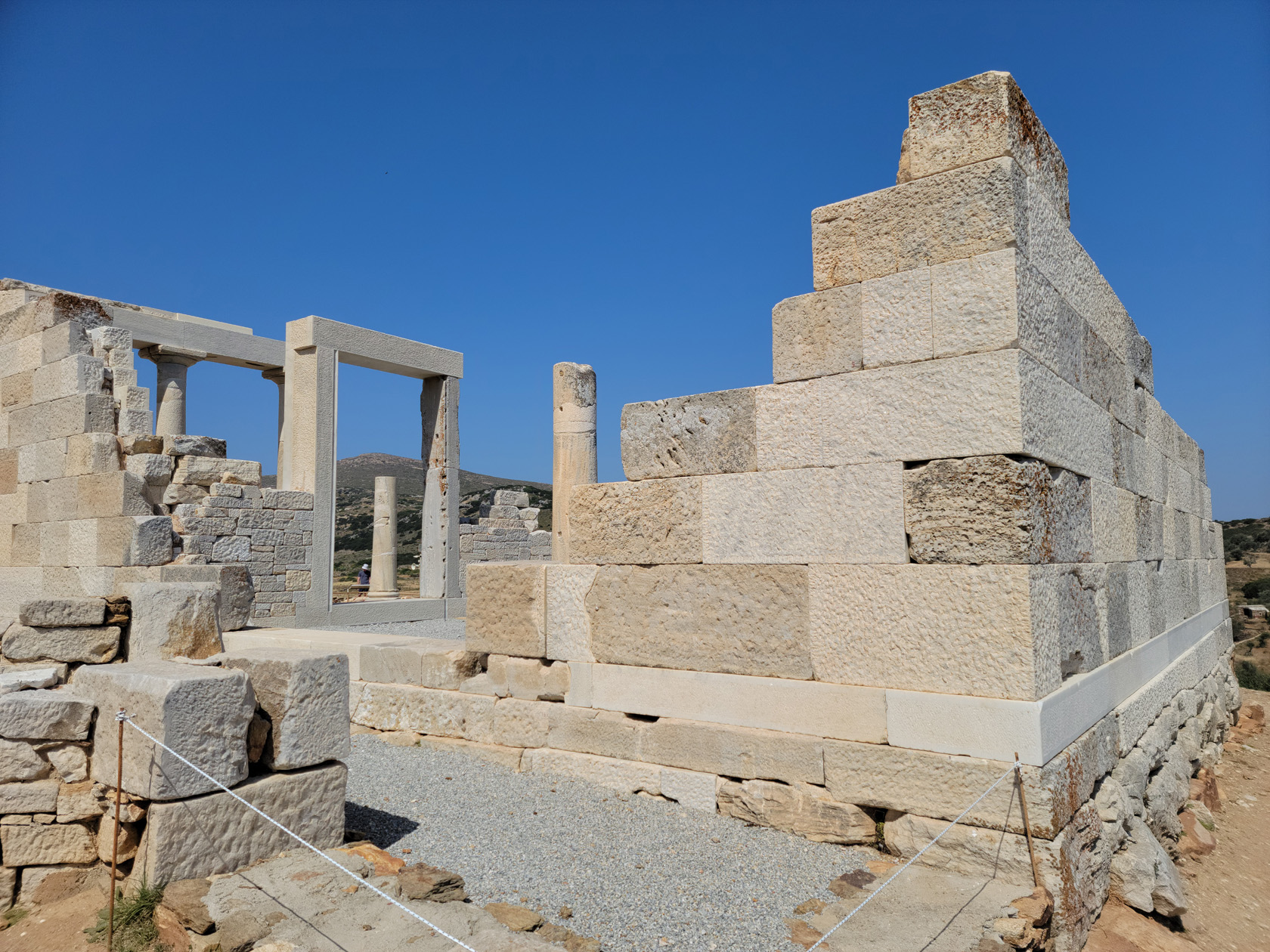
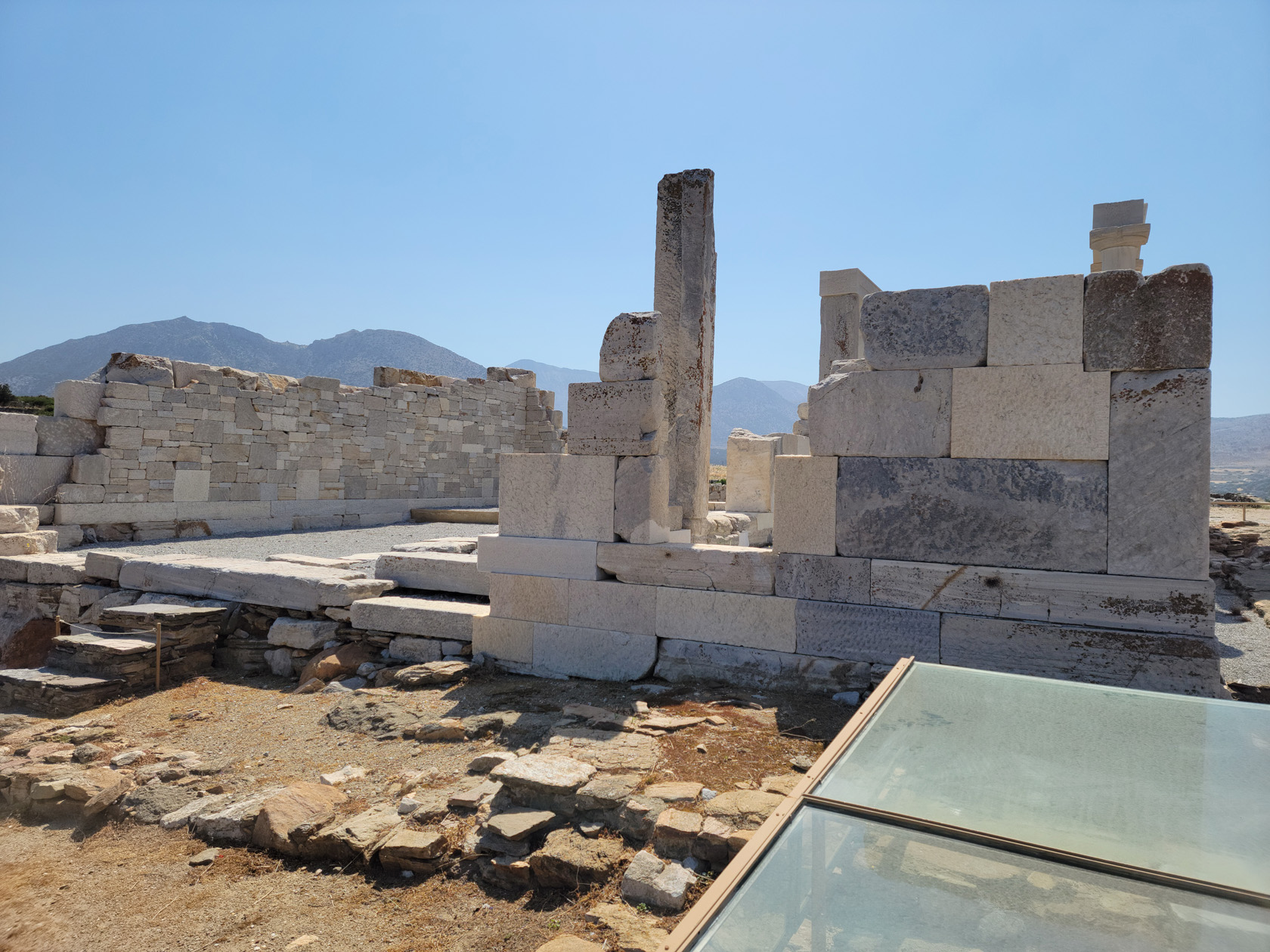
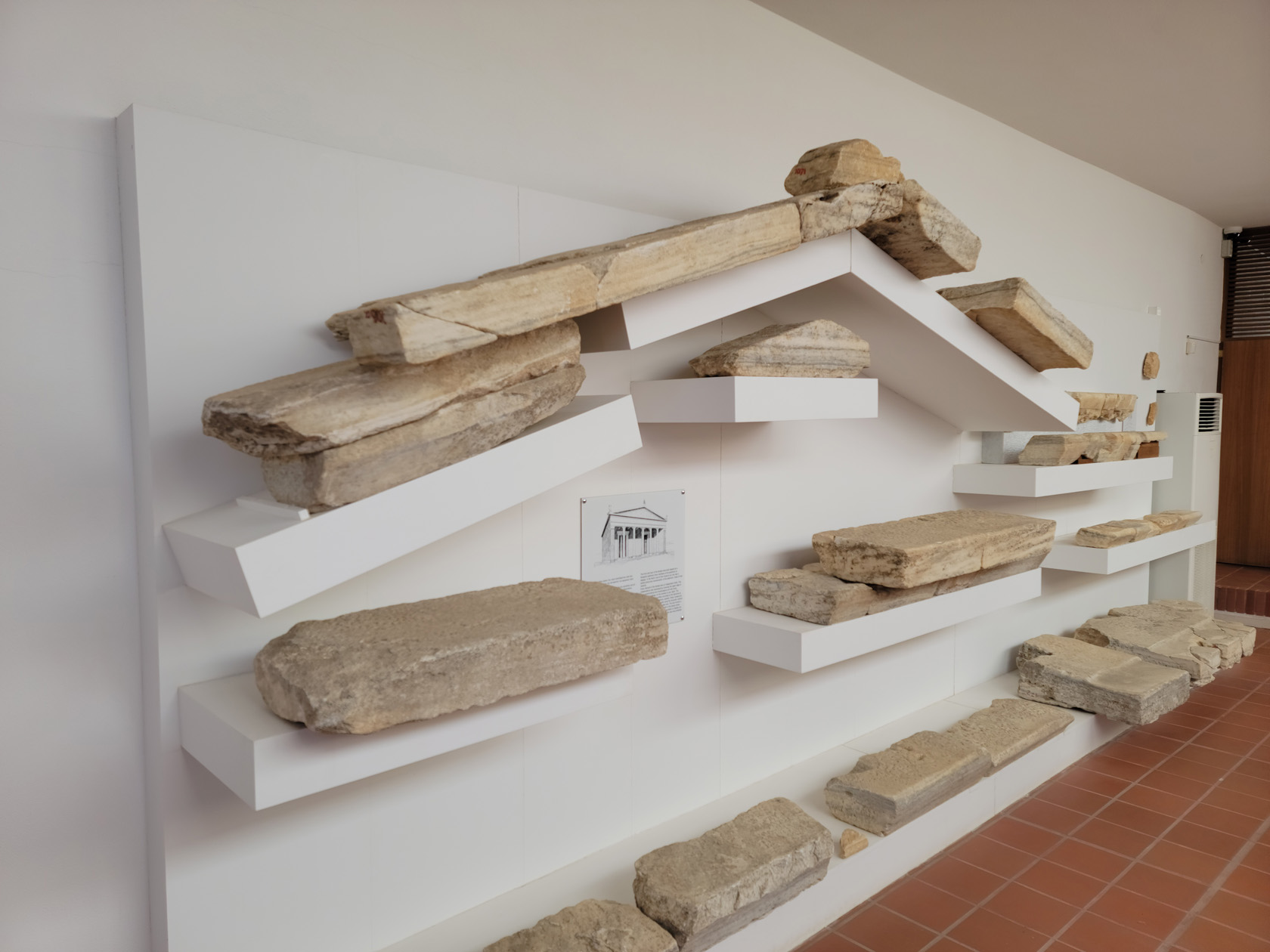
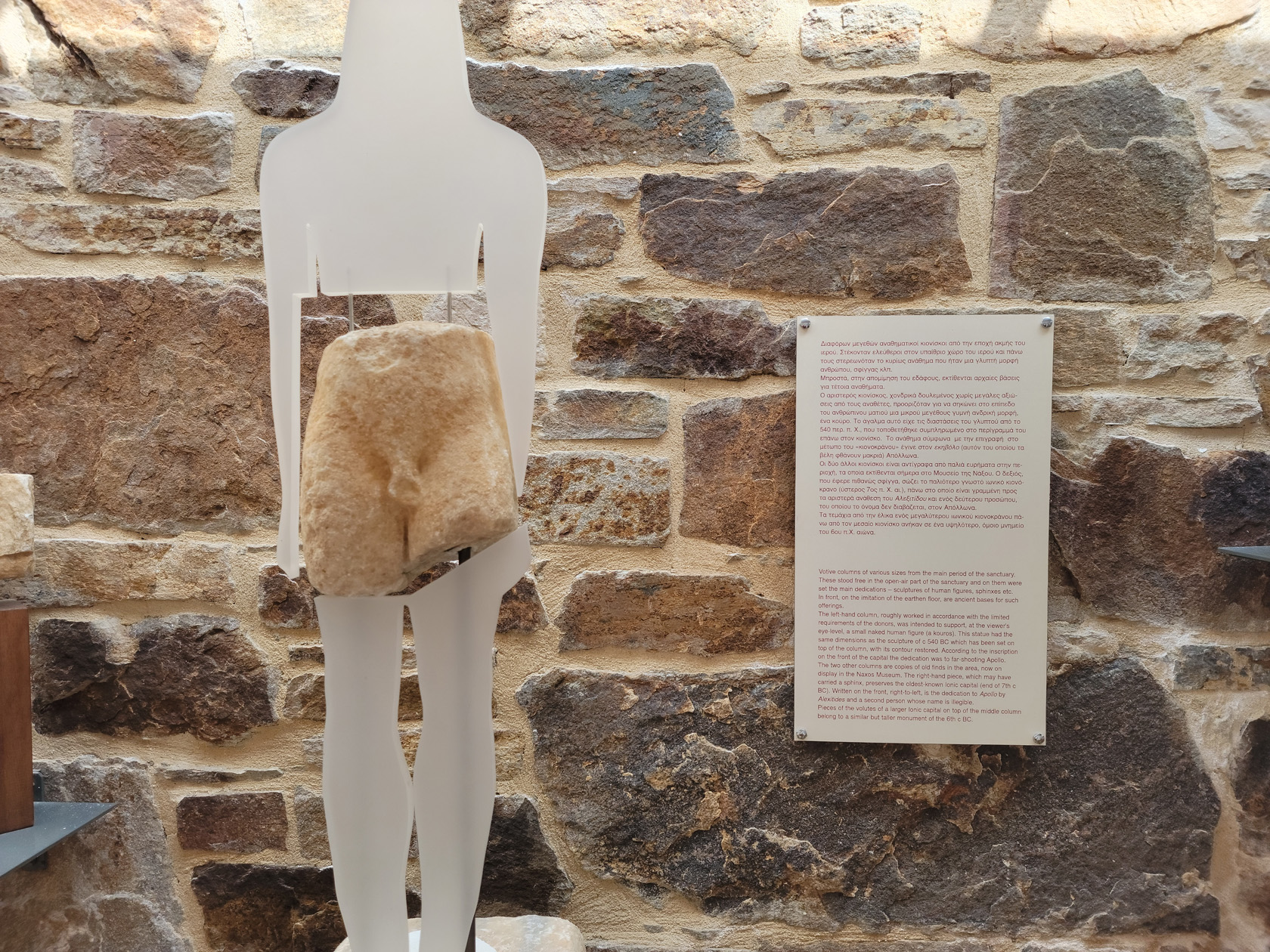
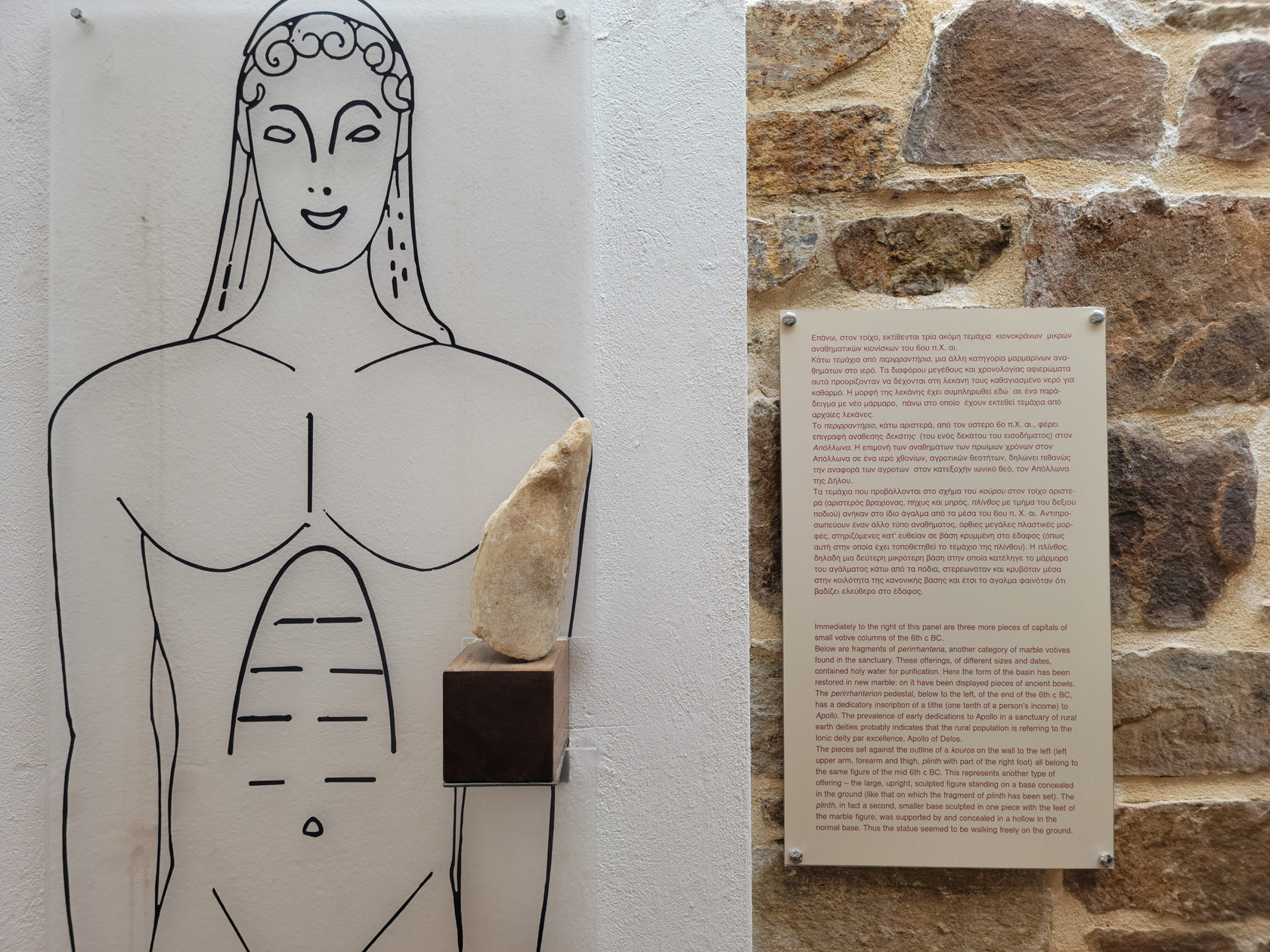
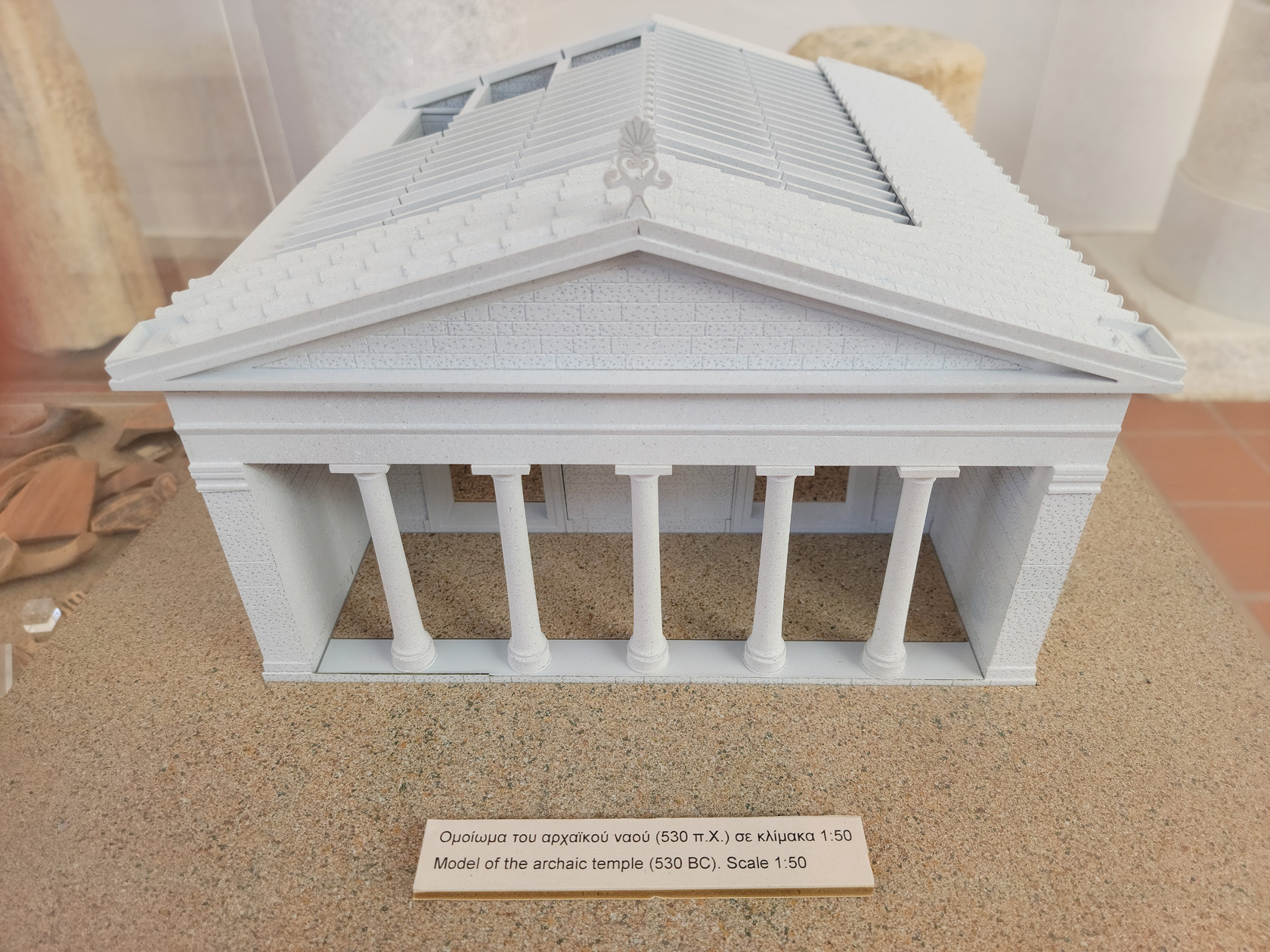
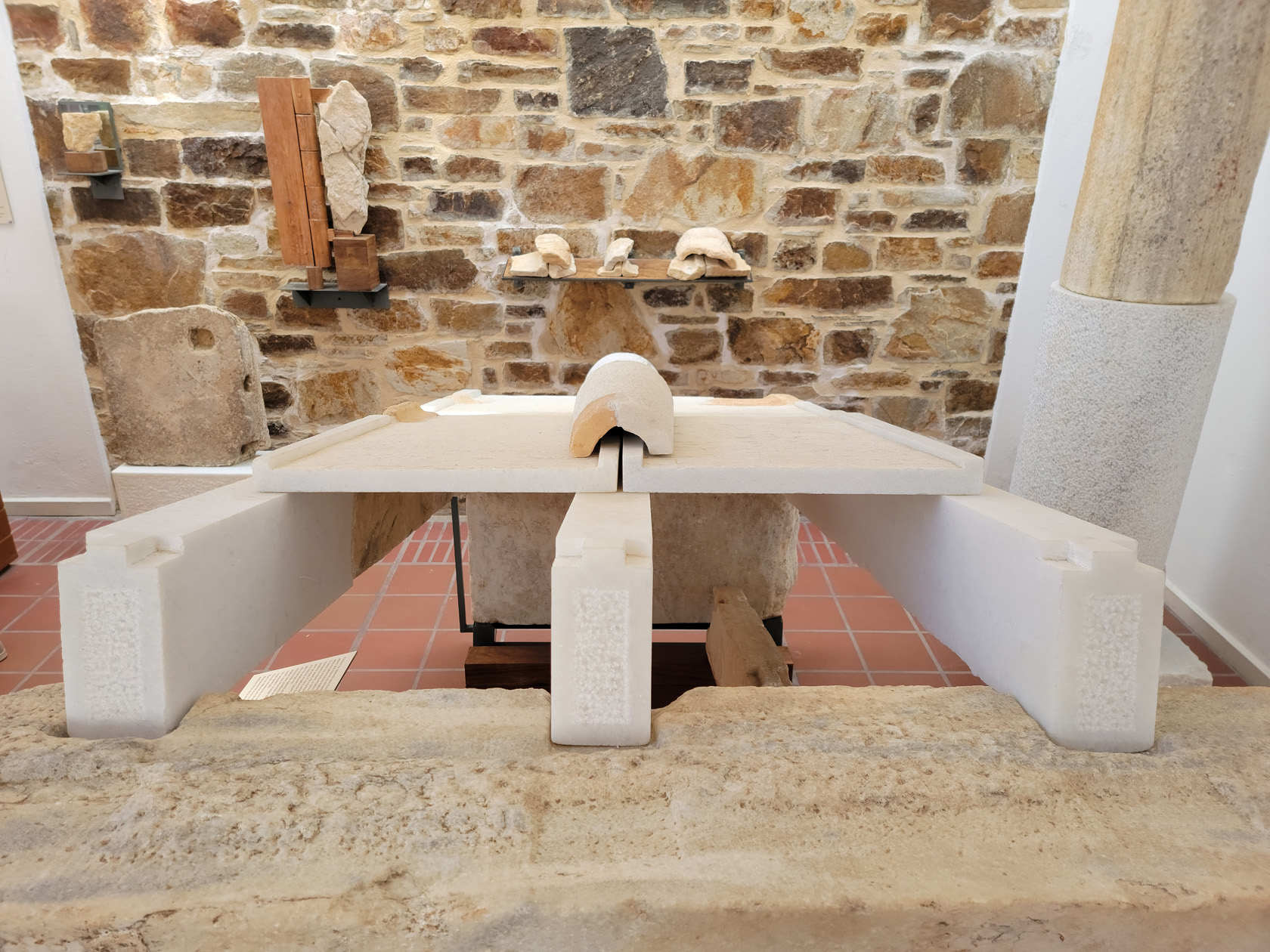
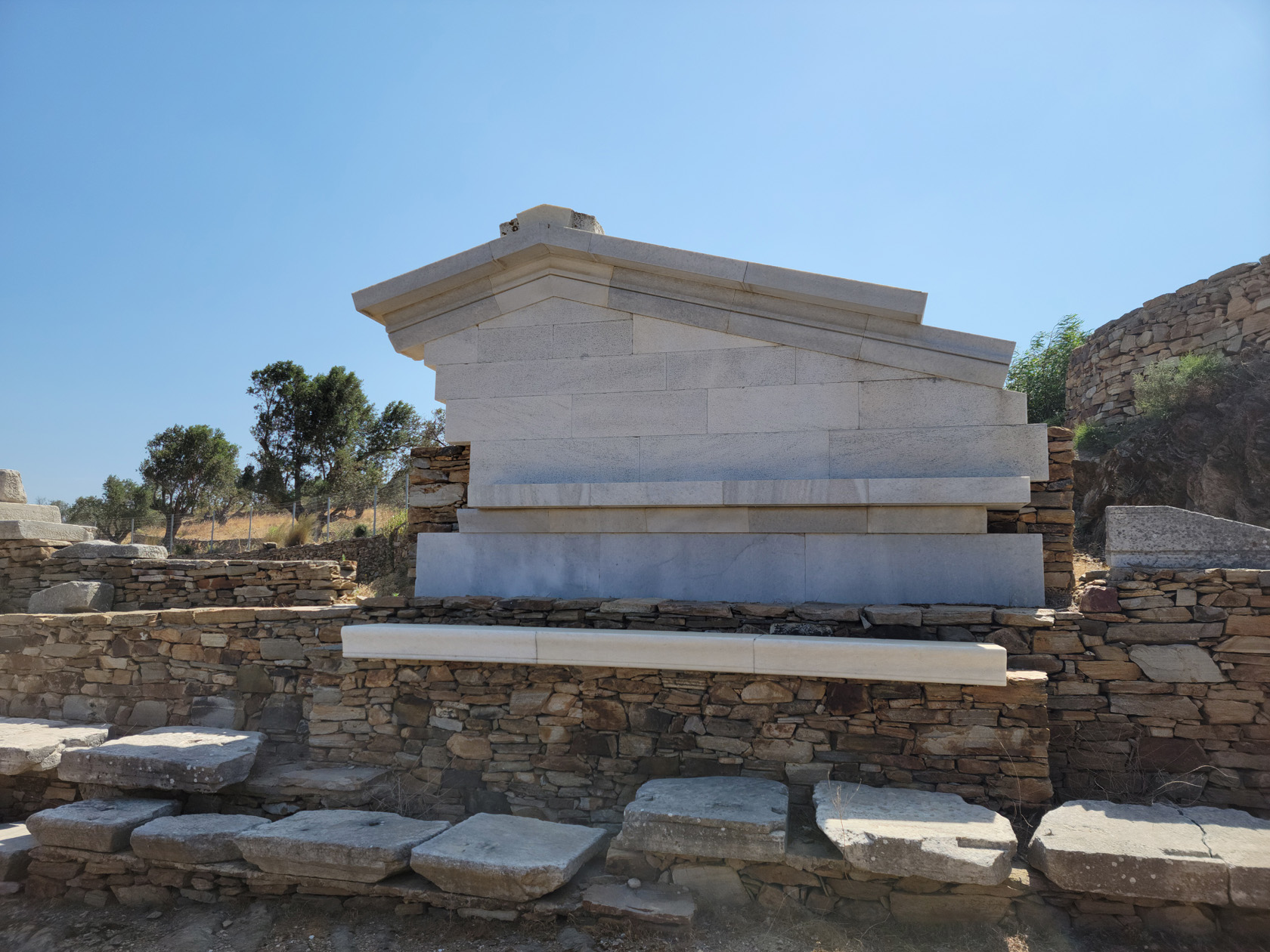
It is an archaic temple that was built on Naxos in the six century BCE. For a Greek temple it is square, rather than the usual rectangular shape. Models that reconstruct its initial design call for a smart, efficient building using internal columns of varying lengths, so that a full marble, translucent roof and ceiling could be accommodated. This provided soft, even internal lighting during the daytime, so that little if any additional lighting was needed.
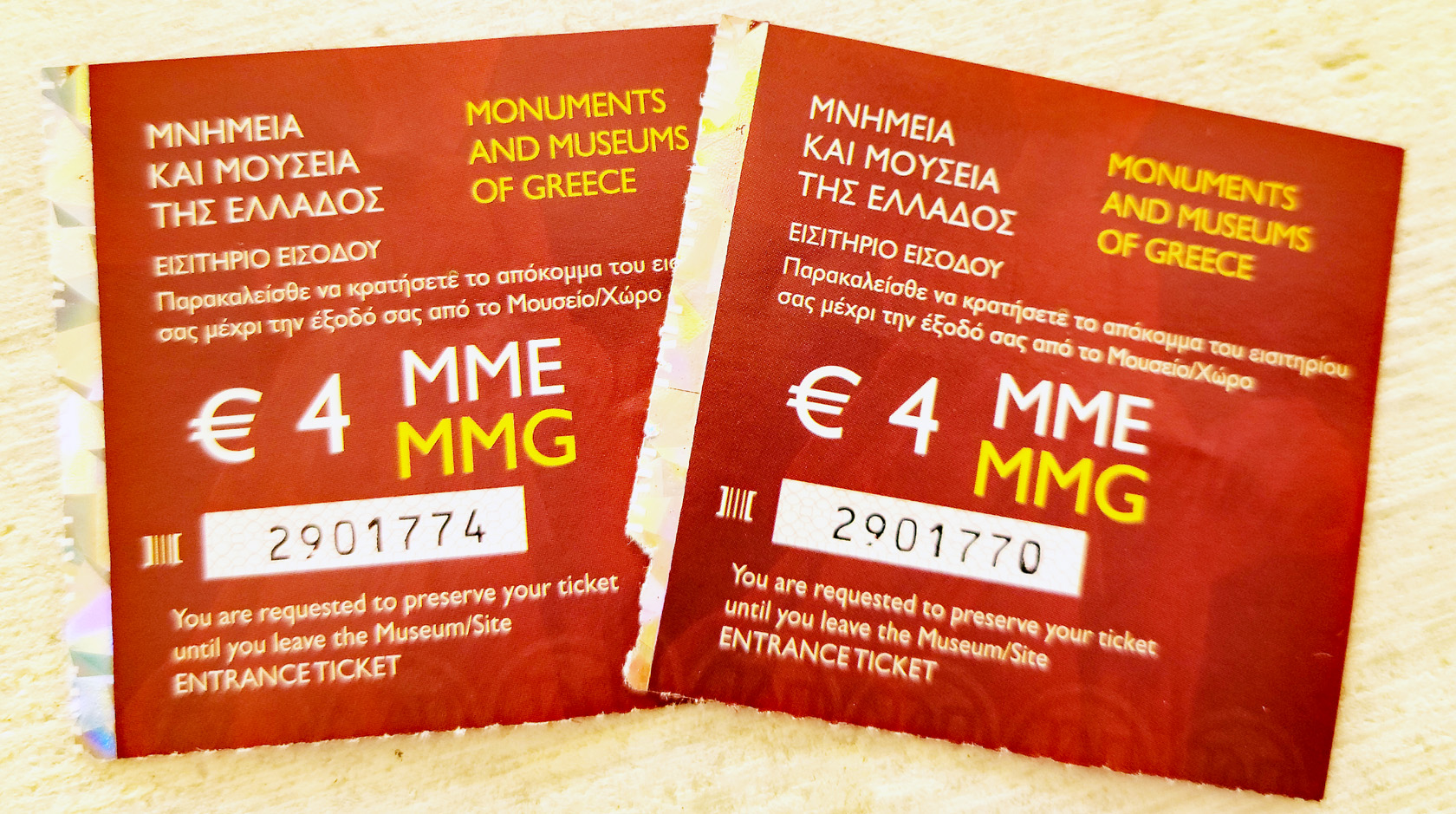
Our Day Tour – Sangri – Tickets For Two
Our Day Tour – Sangri
Our Day Tour – Sangri
Our Day Tour – Sangri
Our Day Tour – Sangri – The Hillside
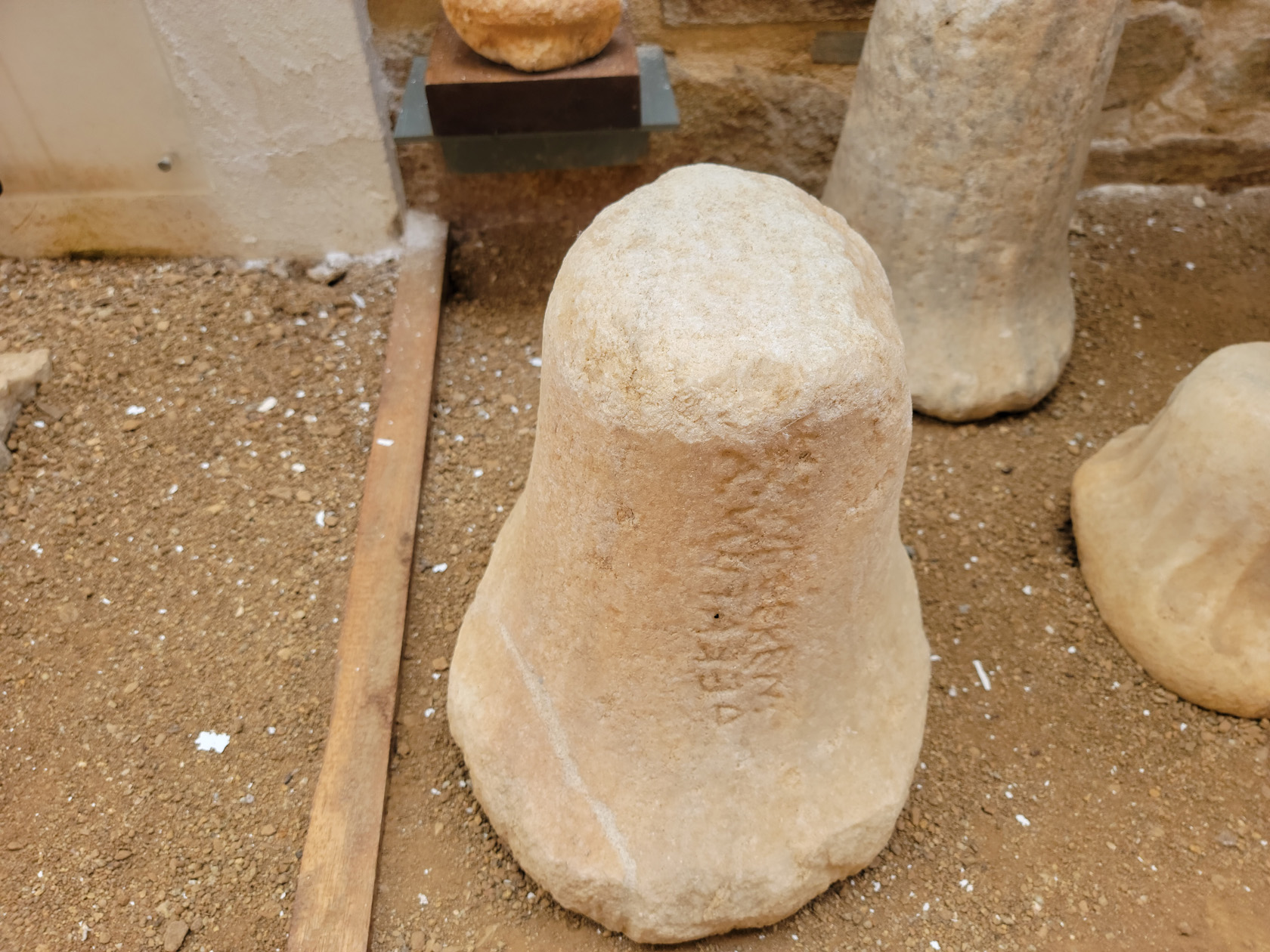
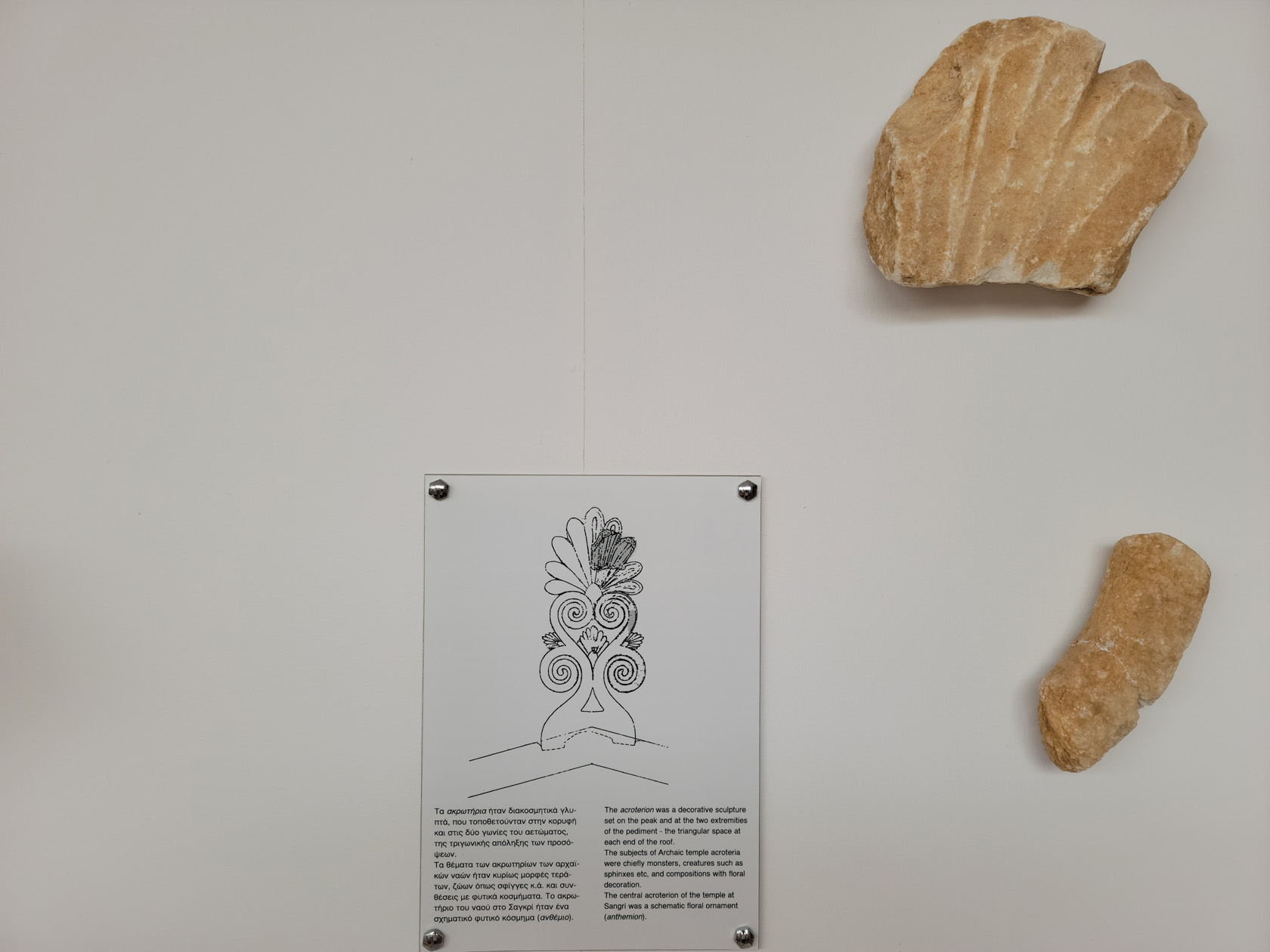
Our Day Tour – Sangri – The Museum
Our Day Tour – Sangri – The Museum
Our Day Tour – Sangri – The Museum
Our Day Tour – Sangri – The Museum
Our Day Tour – Sangri – The Museum
Our Day Tour – Sangri – The Museum
Our Day Tour – Sangri – The Museum
Our Day Tour – Sangri – The Museum
Our Day Tour – Sangri – The Museum
Our Day Tour – Sangri – The Museum
Our Day Tour – Sangri – The Museum
Our Day Tour – Sangri – The Museum
The Pottery Of Limpertas Manolis
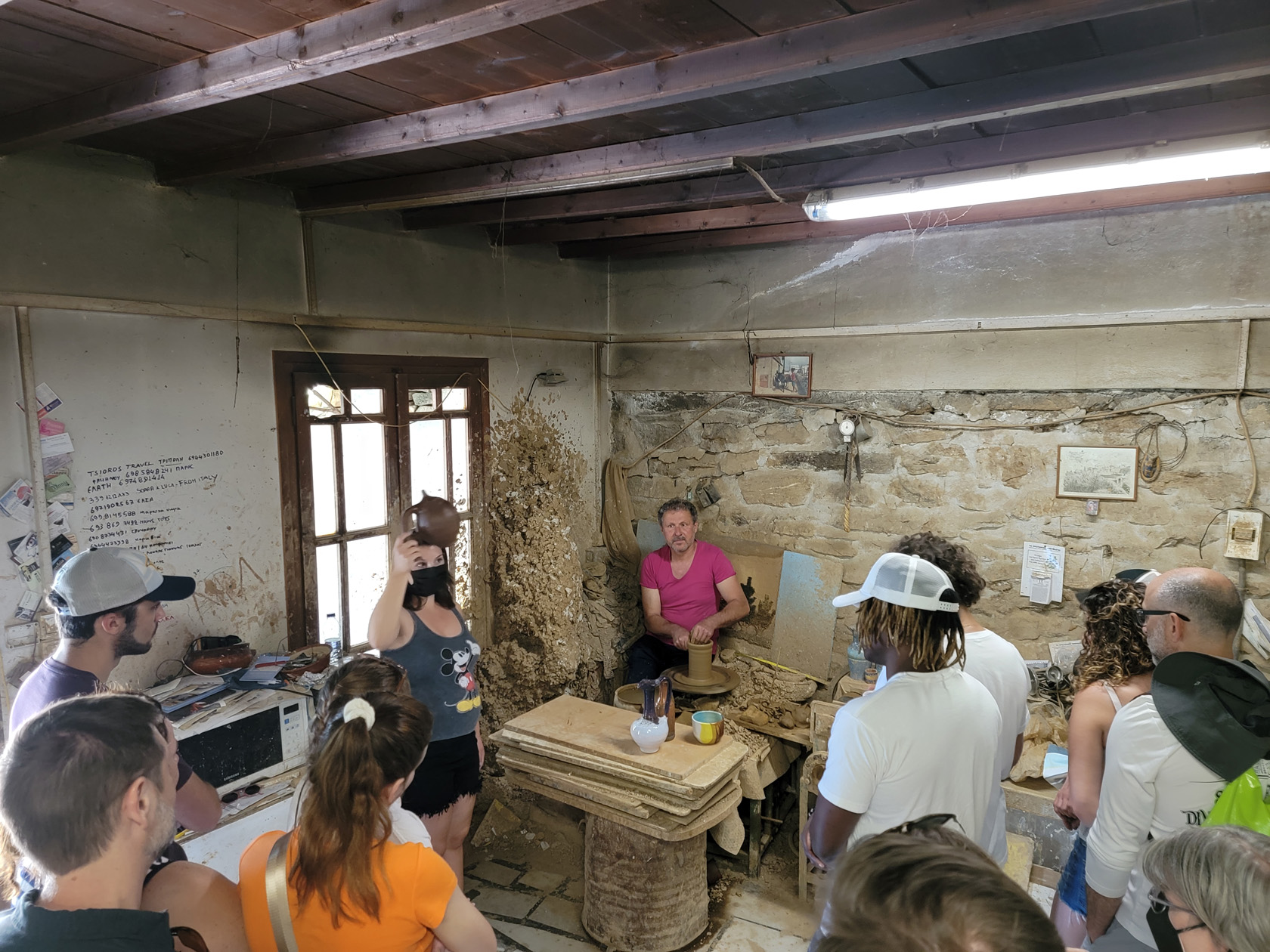
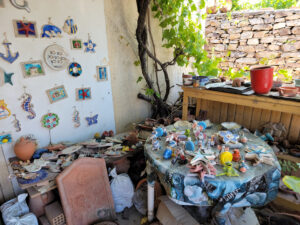
As any typical tour would inject, we visited the local pottery establishment of Limpertas Manolis. His apparent claim to fame was in creating eccentric, yet useful oil decanters and other novel vessels to store things. He also makes the odd spoon holder, vase, cups and saucers.
Our Day Tour – Limpertas Manolis Pottery
Clearly an artist, since his small place was strewn with all kinds of broken and forgotten pieces. Let alone his clear penchant for throwing the odd clay ball at the wall, for which was clearly evident by the definitive and unnatural accumulation growing from the vertical surface from where he sat.
Our Day Tour – Limpertas Manolis Pottery
Our Day Tour – Limpertas Manolis Pottery
Our Day Tour – Limpertas Manolis Pottery
Distillery Vallindras
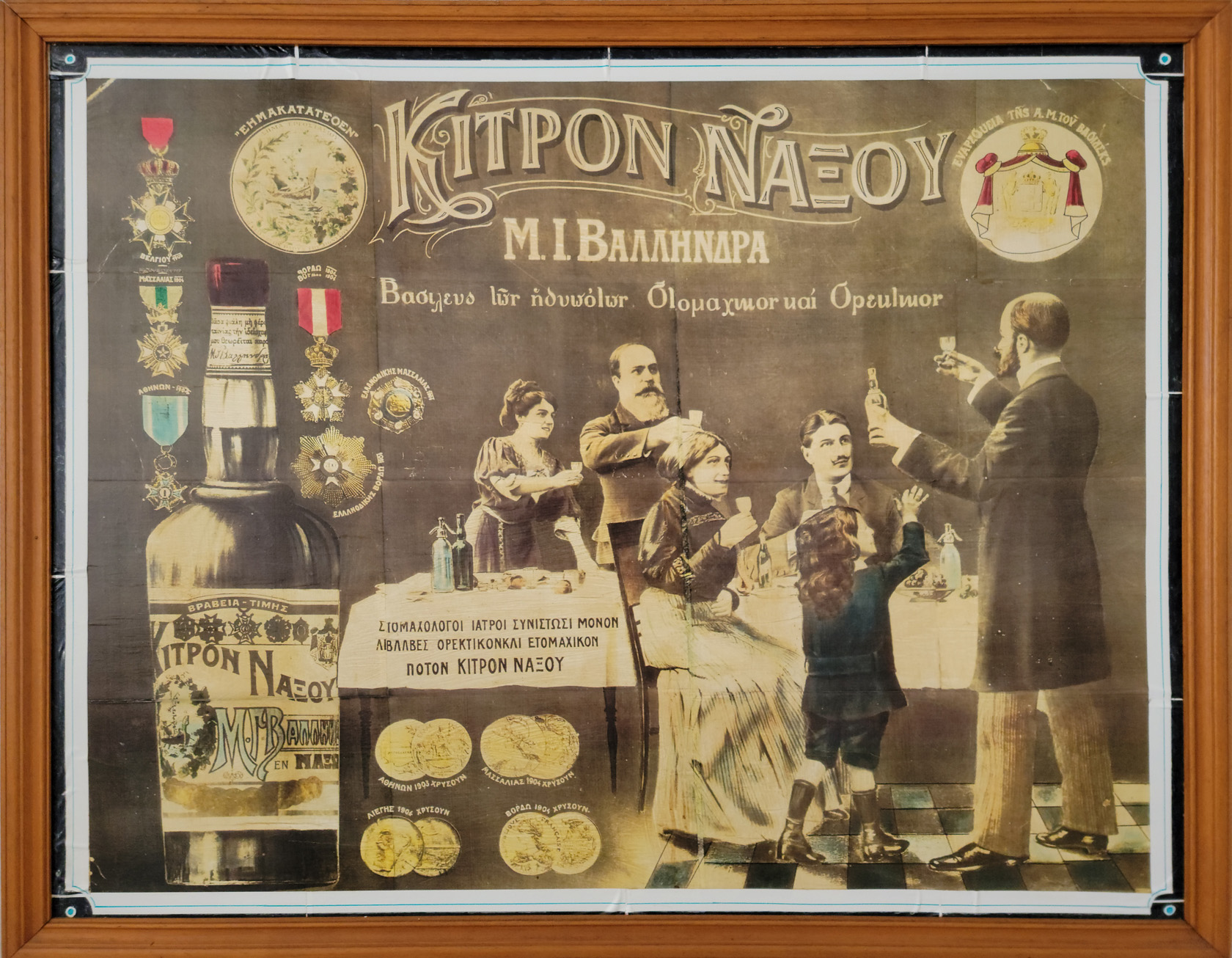
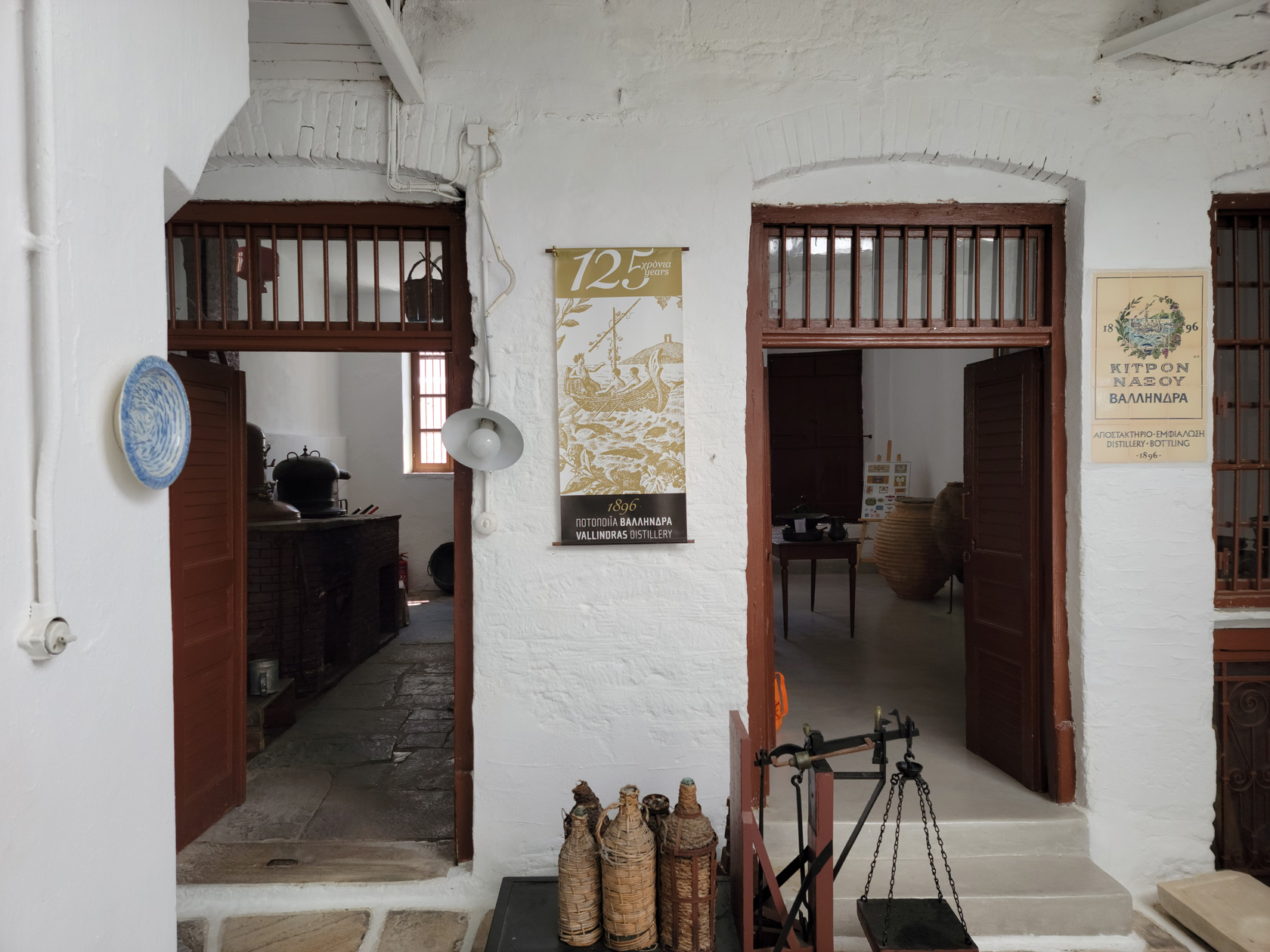
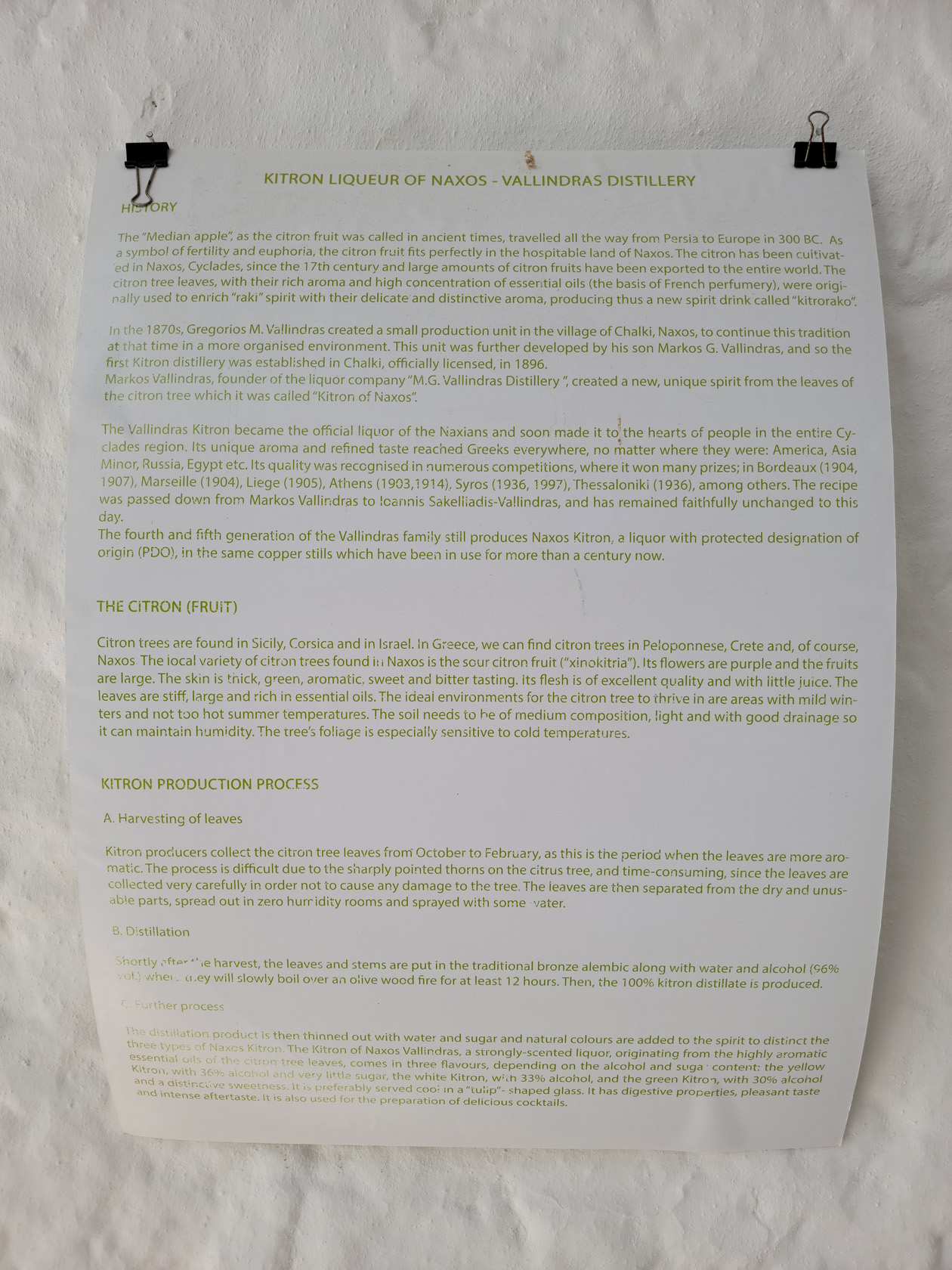
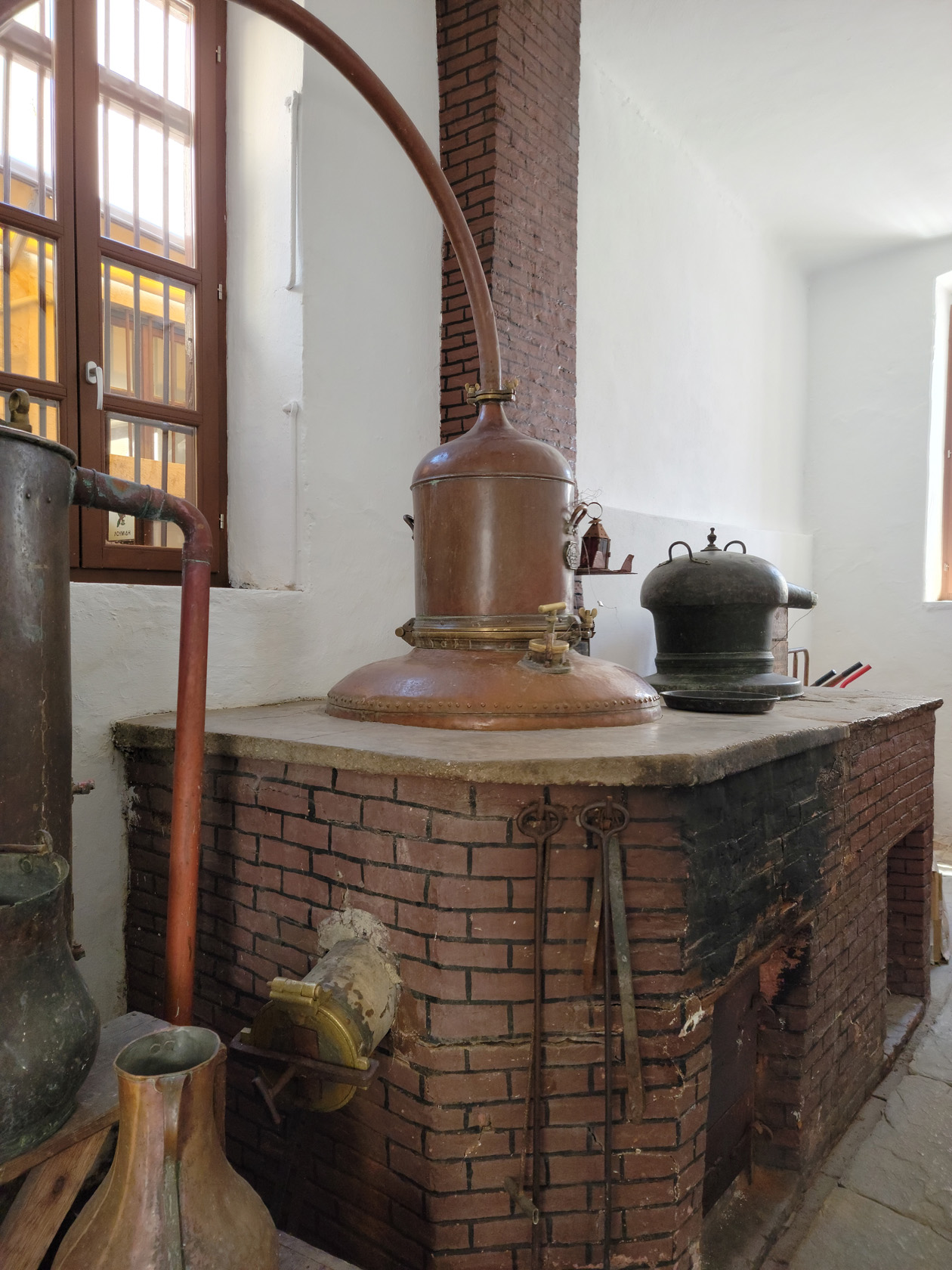
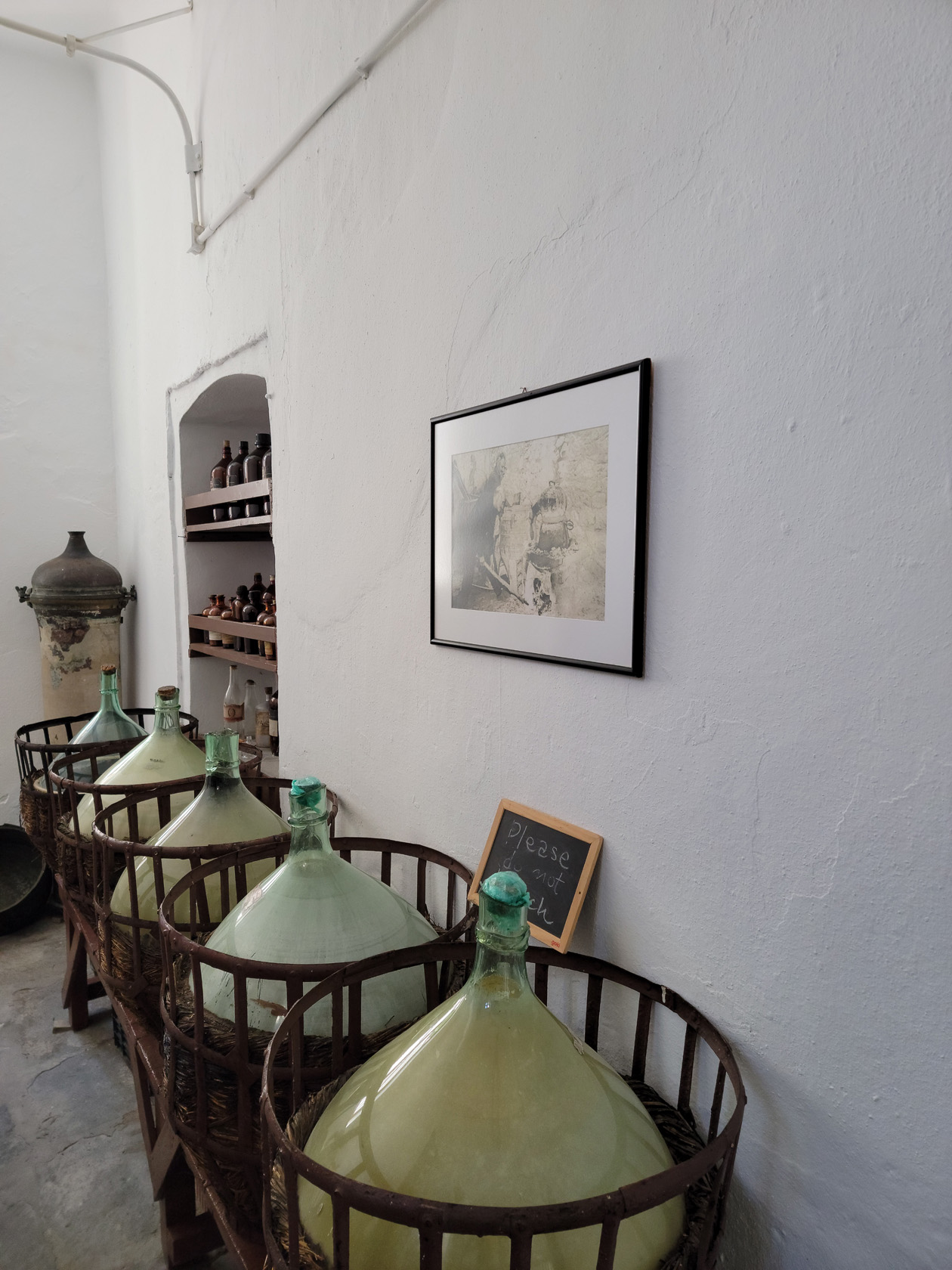
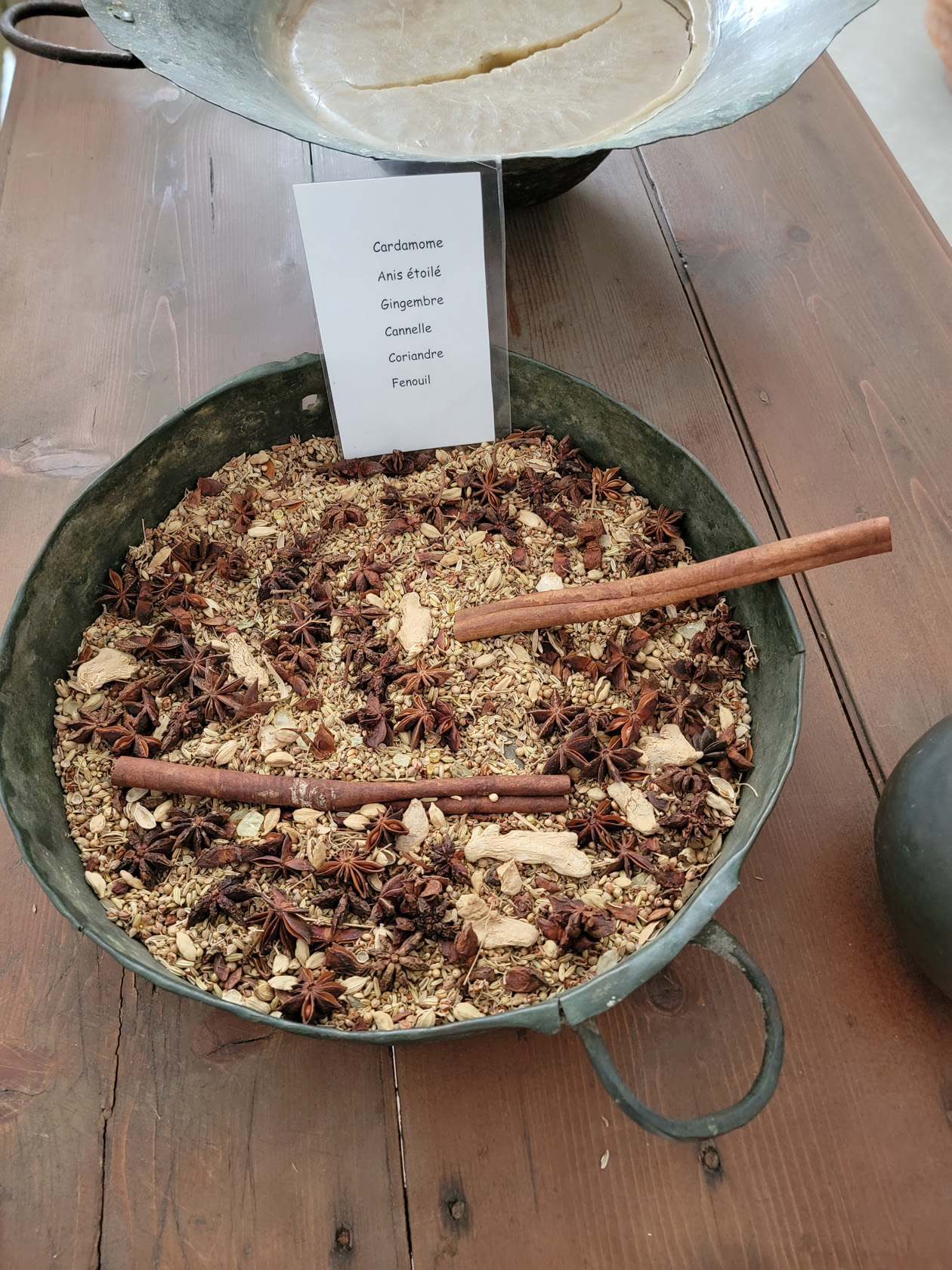
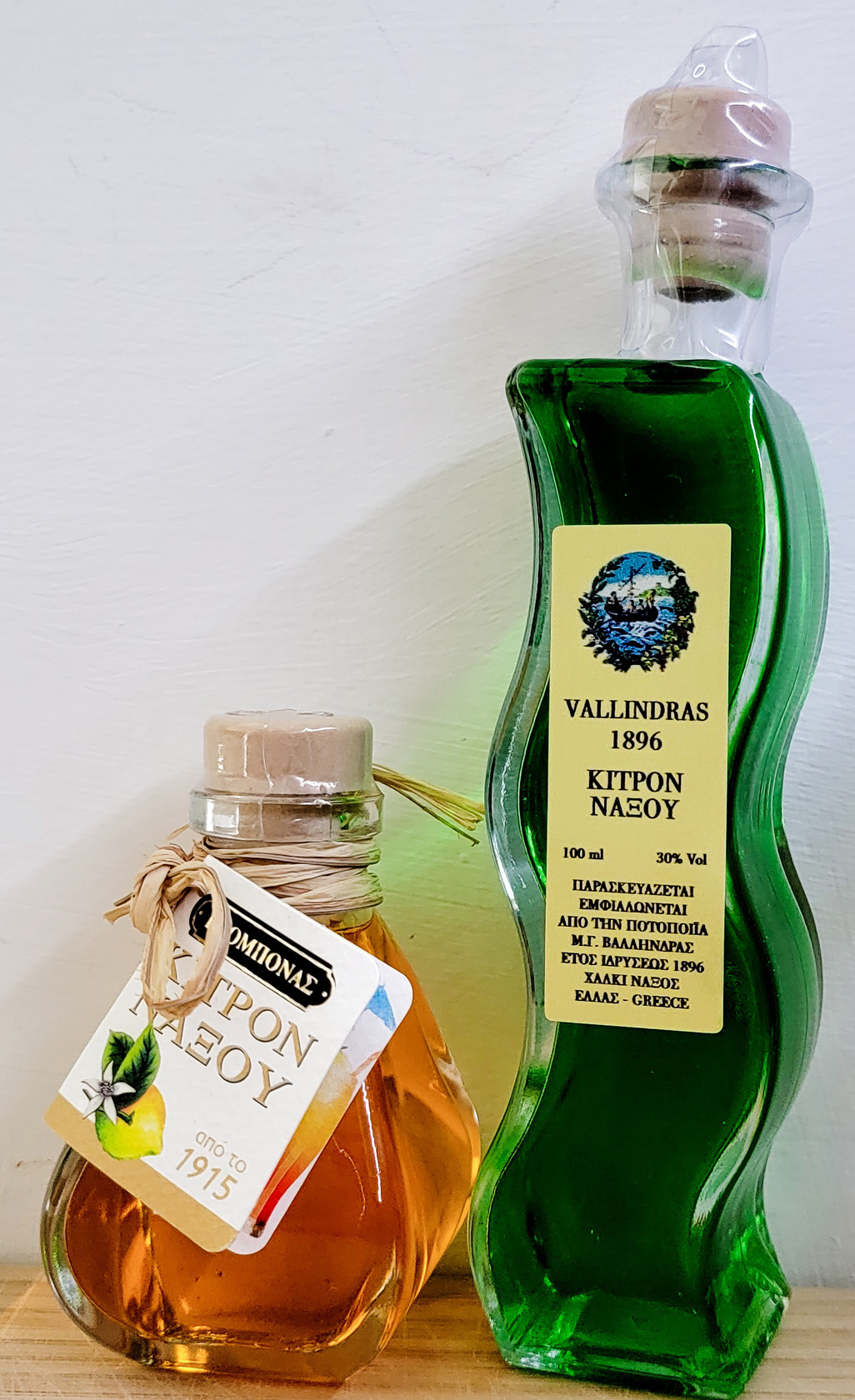
In Chalkio, or Chalki, as some prefer; you can find the distillery M. G. Vallindras. This is an old firm which makes an aperitif widely known throughout Greece, known as Kitron, it comes in three varieties (and colors), depending on the sugar and alcohol content.
Our Day Tour – Chalki – Kipton Distillery
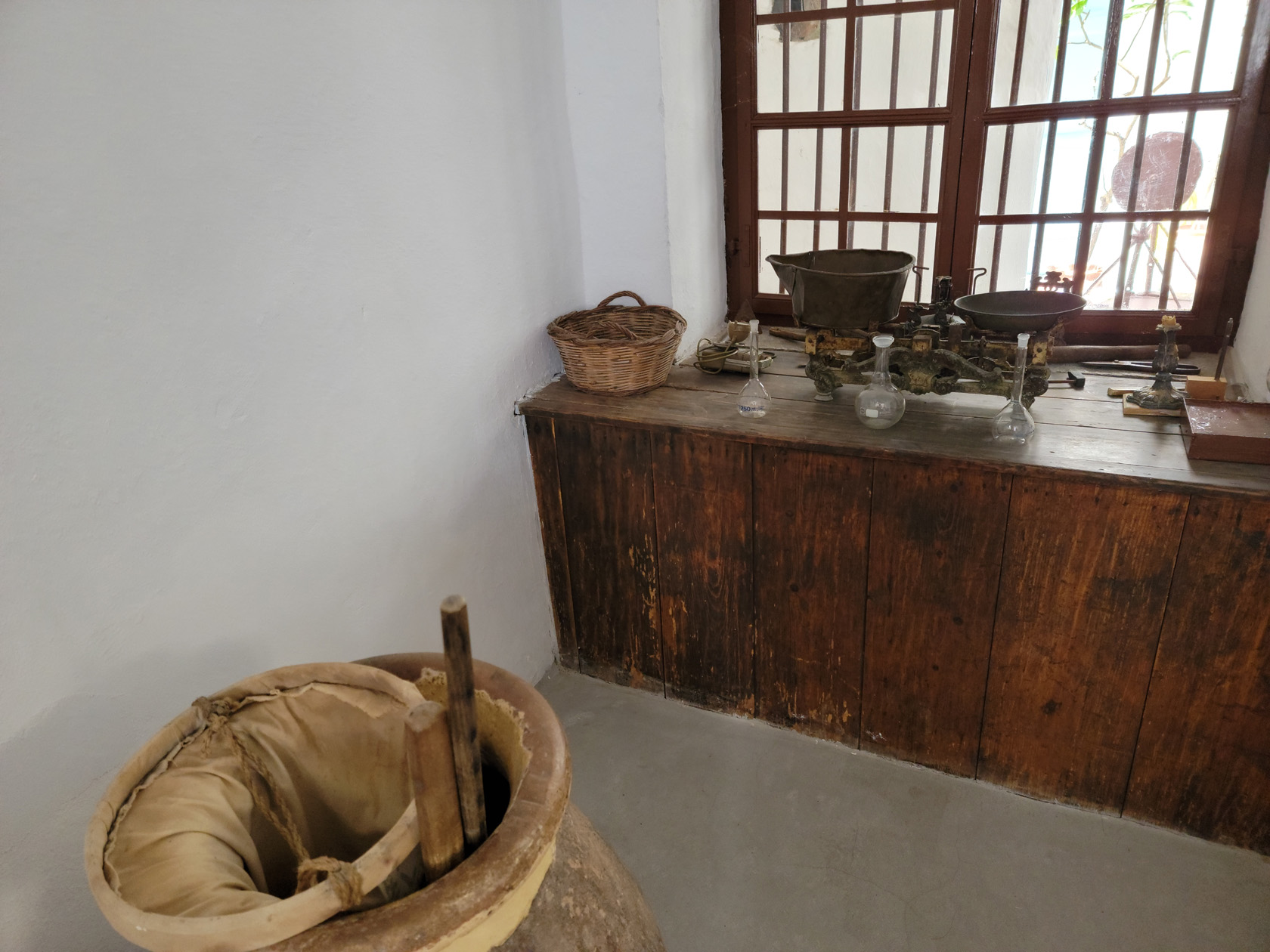
It is a very interesting distillery to visit and learn how this special Greek aperitif is made using Star Anise and other plants. Well worth a stop, if only to pick up a few bottles of their timeless spirits. Most will find the green and yellow varieties more to their liking, they are not as harsh or dry as the clear variety. The taste is more austere than a Molinari Extra or a Ramazzotti, but pleasant after a dinner nonetheless.
Our Day Tour – Chalki – Kipton Distillery
Our Day Tour – Chalki – Kipton Distillery
Our Day Tour – Chalki – Kipton Distillery – Alembic
Our Day Tour – Chalki – Kipton Distillery – Old Bottles
Our Day Tour – Chalki – Kipton Distillery
Our Day Tour – Chalki – Kipton Distillery
Our Day Tour – Chalki – Kipton Distillery – Two of Three Variaties
The Flerio Melanes Kouros
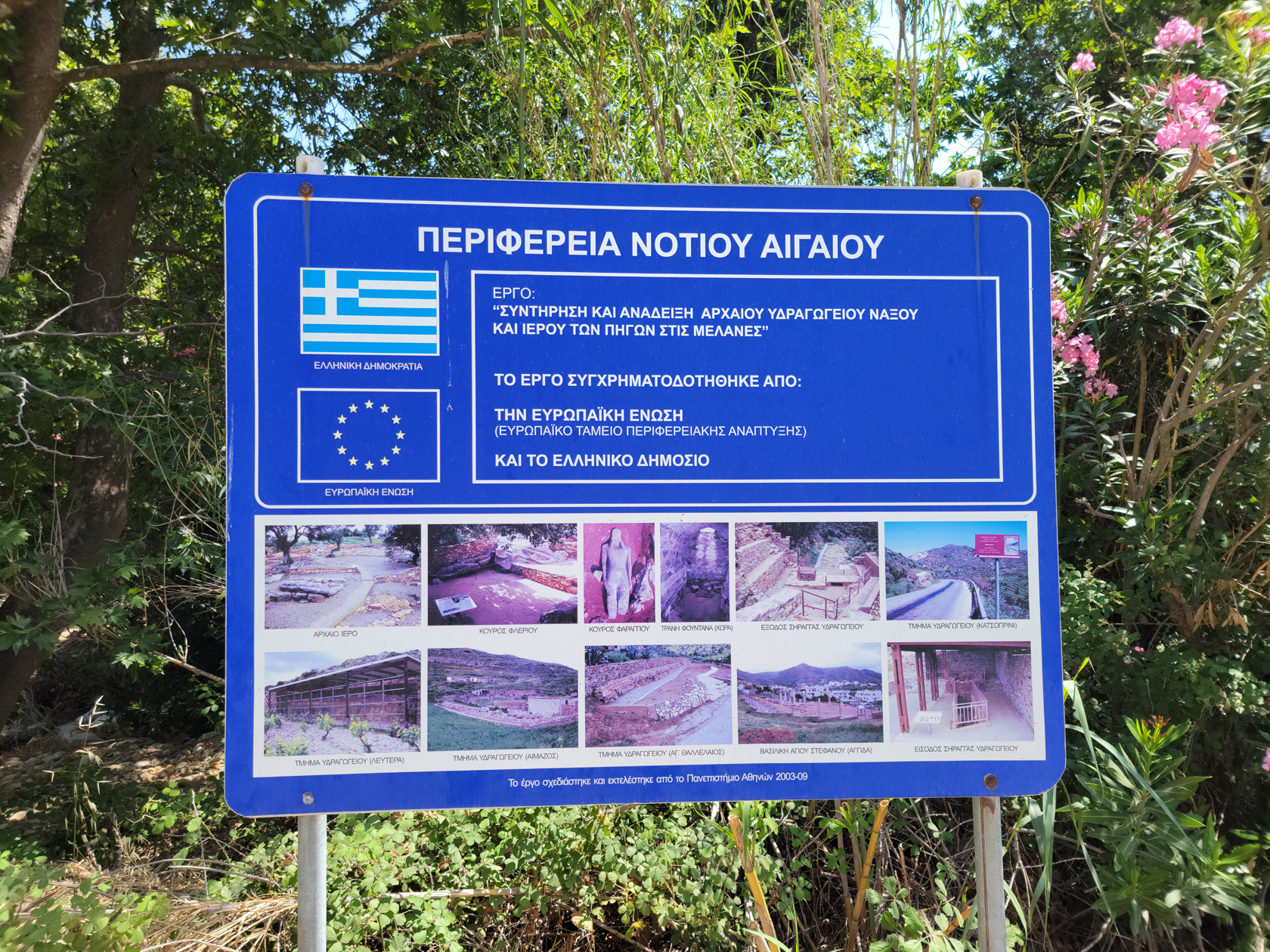
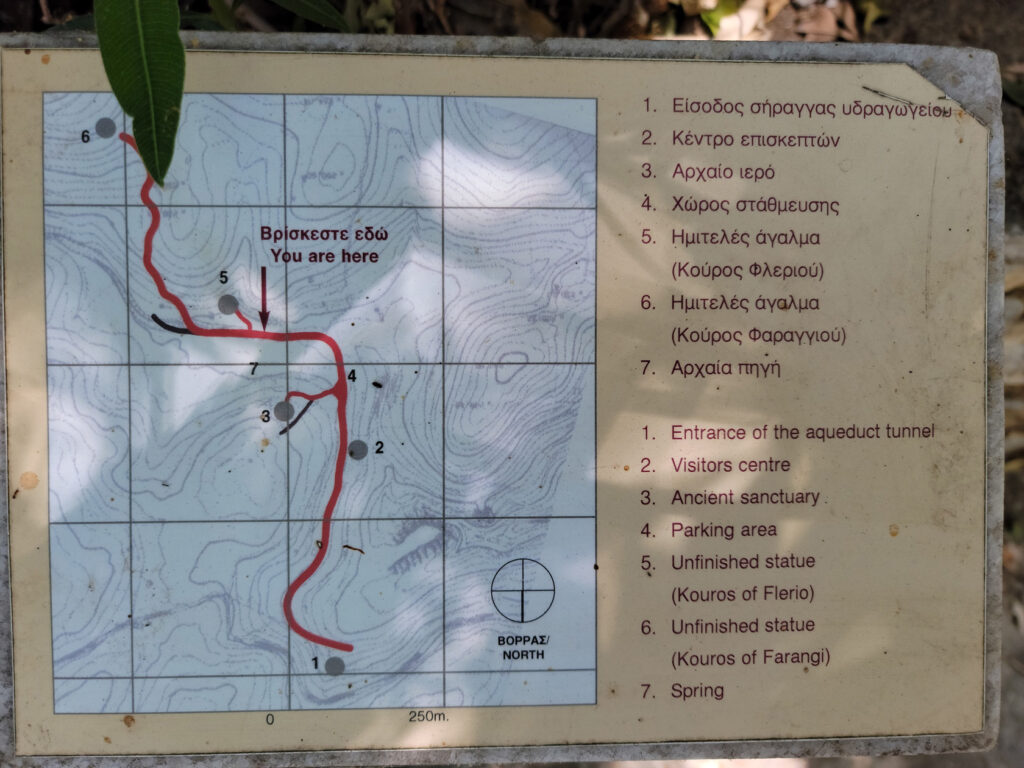
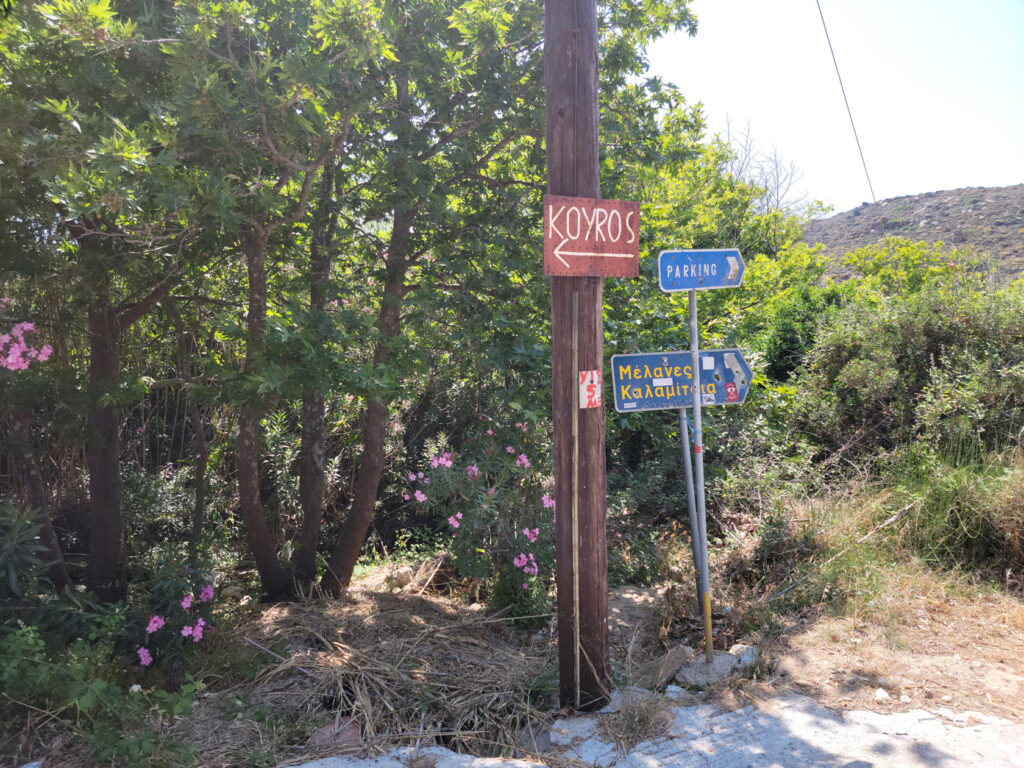
Probable one of the more obscure places to visit archeologically on Naxos is the unfinished Kouros. Located not far from the intersection of the Naxou-Monis and Naxou-Chalkiou roads, you should find a small place to park, it’s rather rural so it should be no problem.
Naxos – The Koyros or Flerio Melanes Kouros Statue
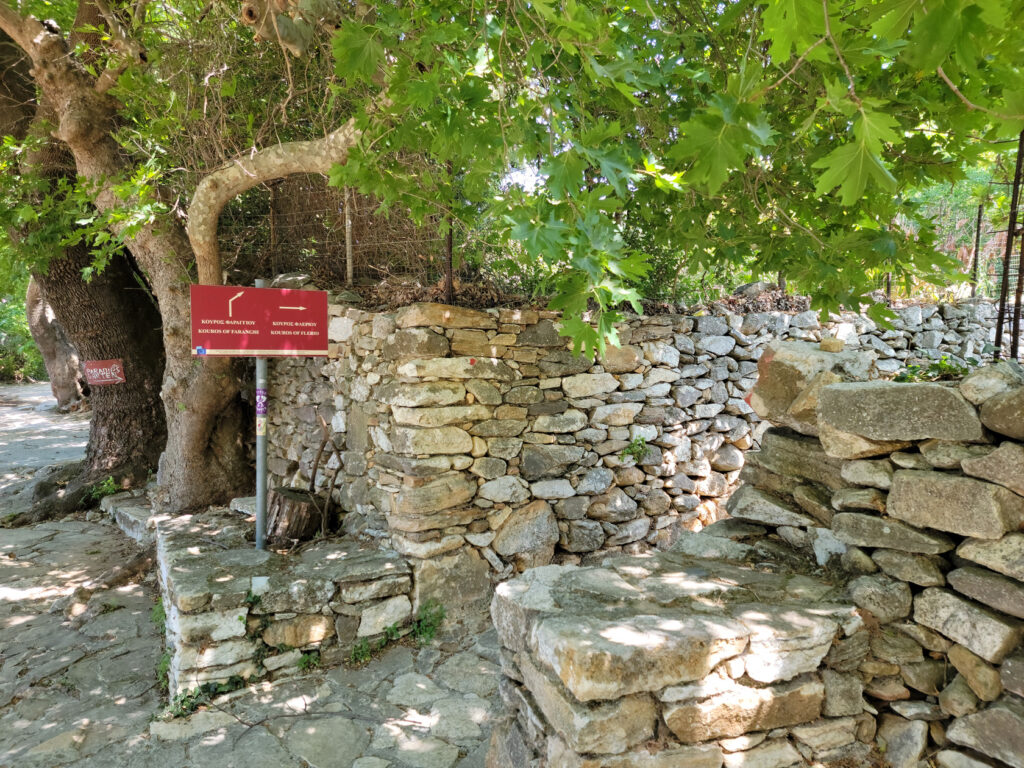
If you are in the right place, there will be some signs indicating the way.
Naxos – The Walkway to Flerio Melanes Kouros Statue
Naxos – The Koyros or Flerio Melanes Kouros Statue
Naxos – The Walkway to Flerio Melanes Kouros Statue
Naxos – The Koyros or Flerio Melanes Kouros Statue
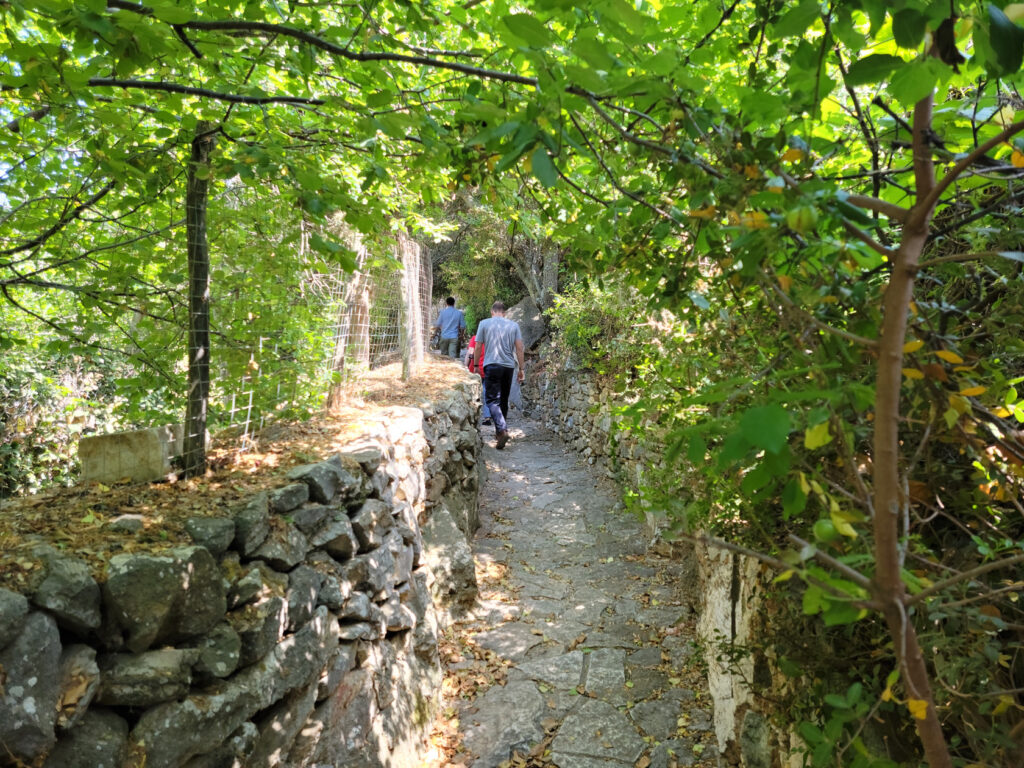
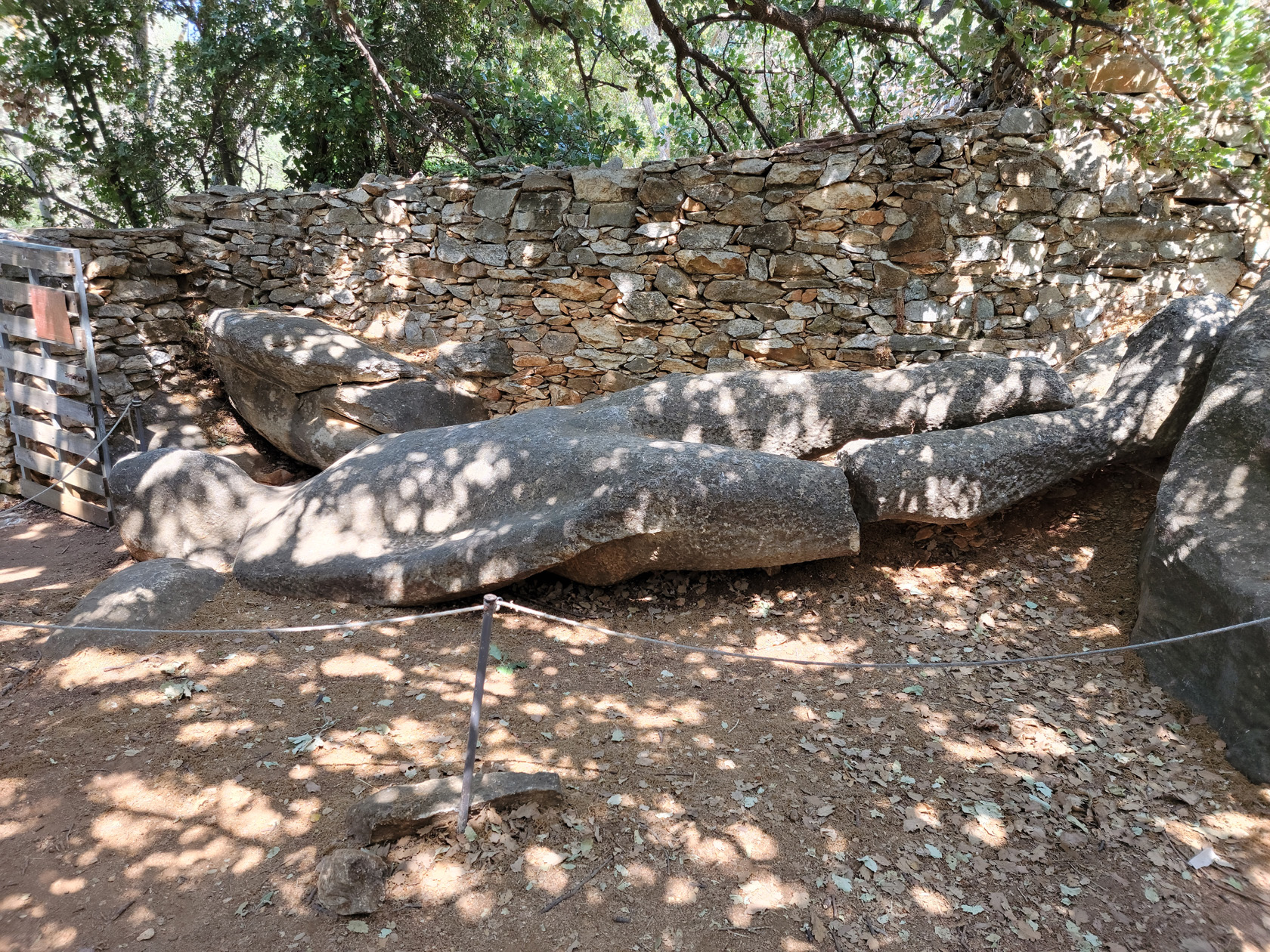
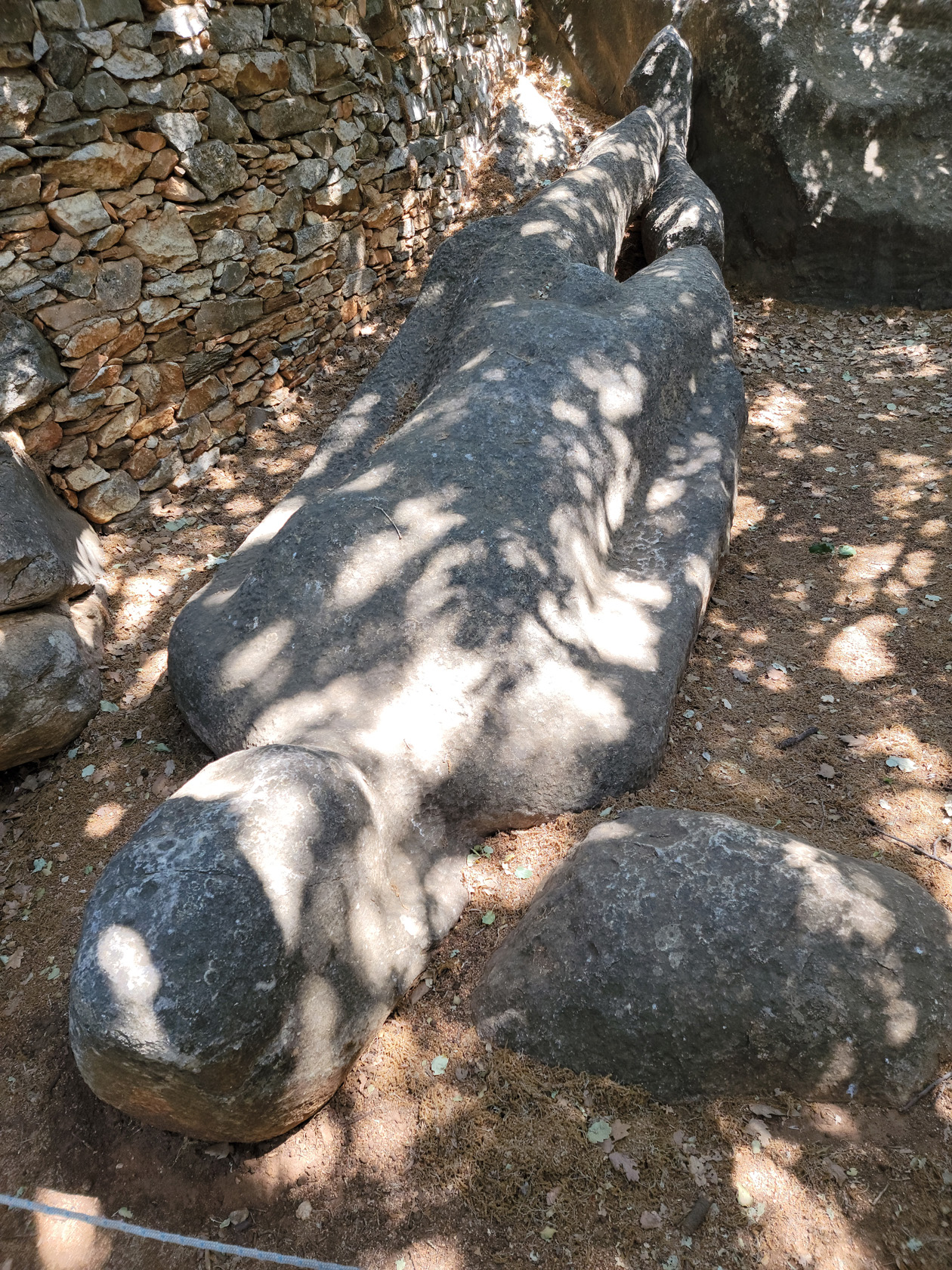
Once found, the Flerio Melanes Kouros is a small walk away up a paved walkway. It appears to reside in a small stone fenced yard, but cannot leave since one of its legs are broken.
Naxos – The Flerio Melanes Kouros Statue
Naxos – The Flerio Melanes Kouros Statue
If you have the time there are a few other things to see in the area. The Faragi Kouros is not far from here and is close to other stones that apparently were chosen for other works, but never started.
Apeiranthos
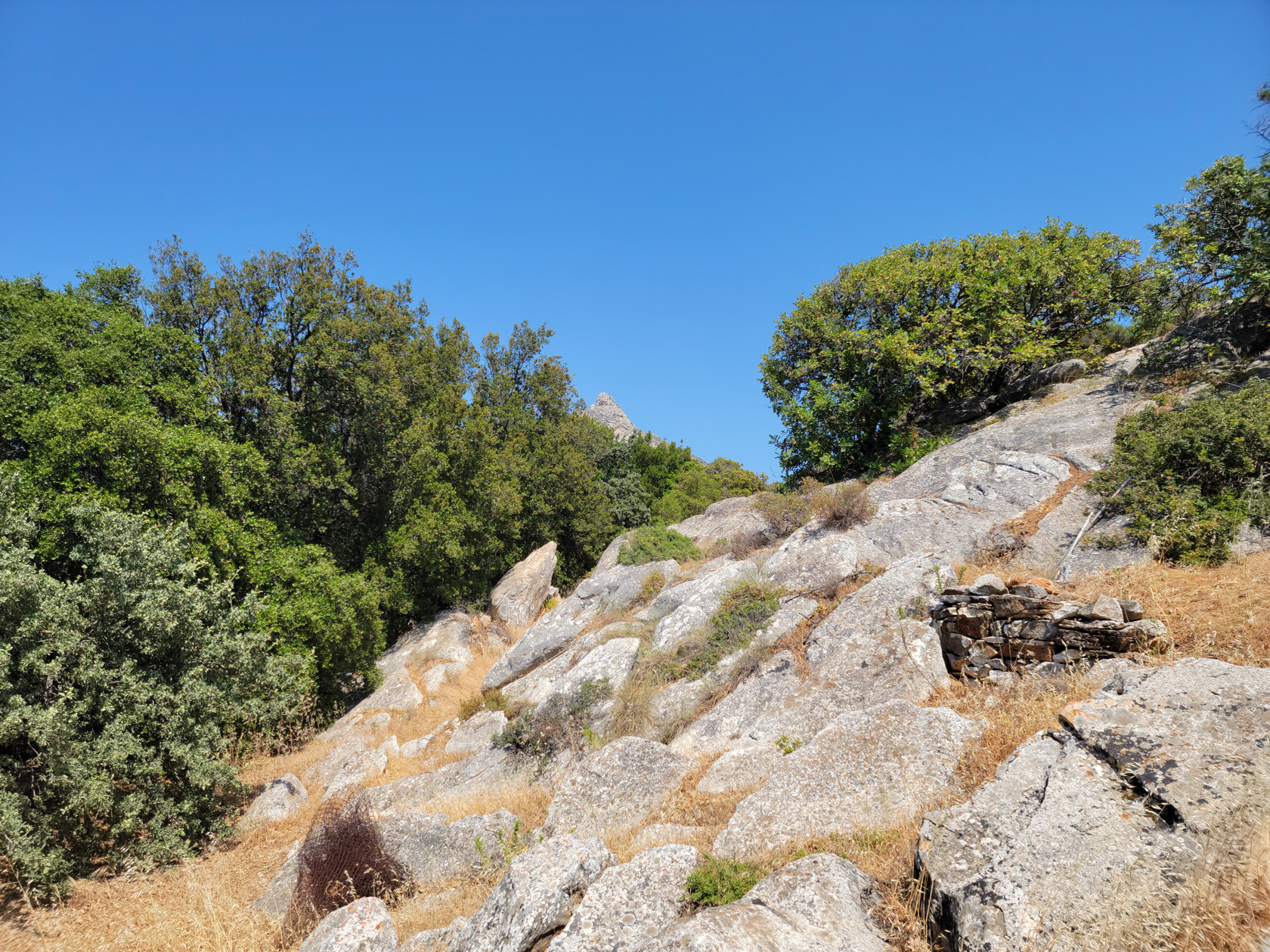
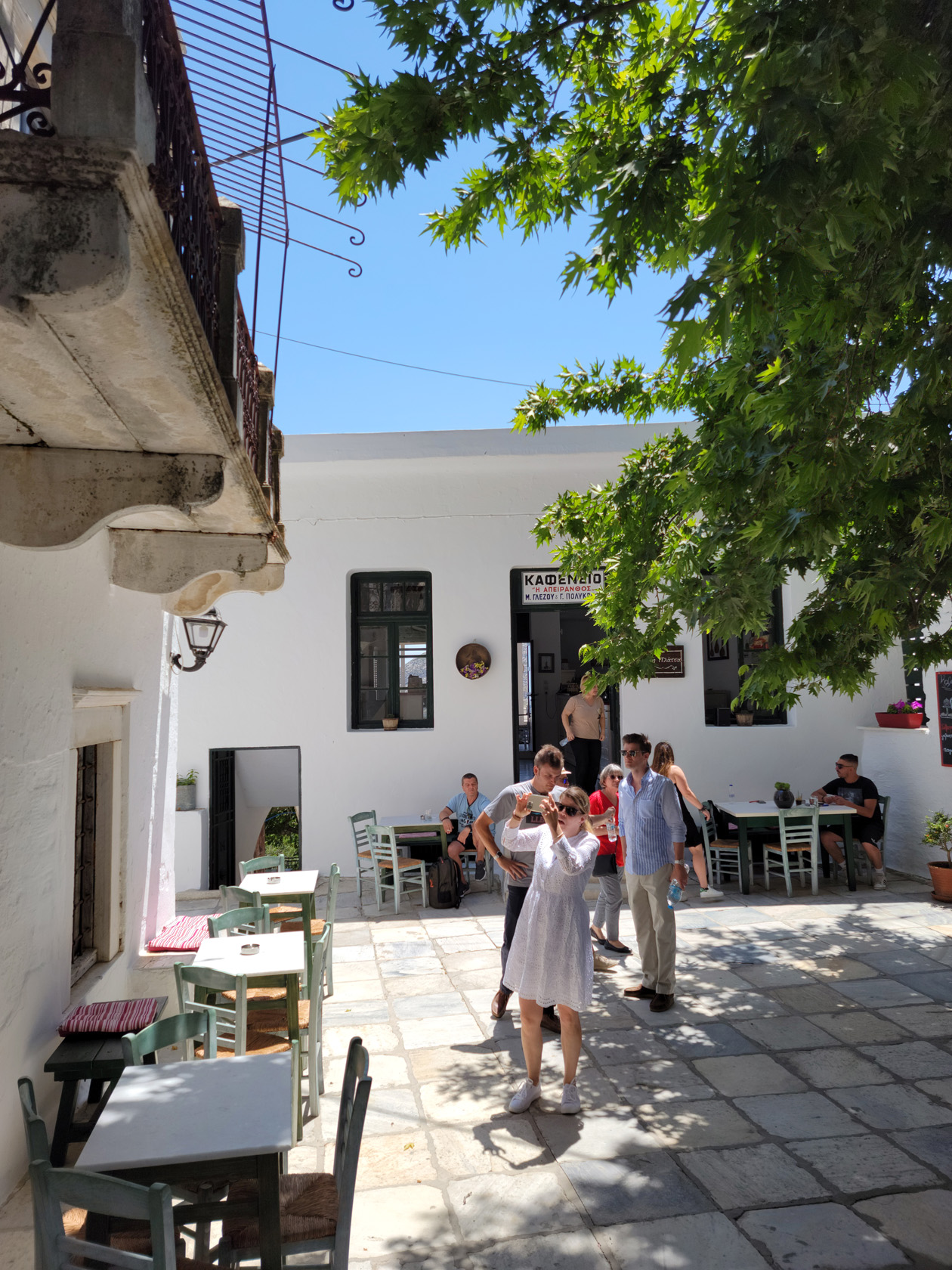
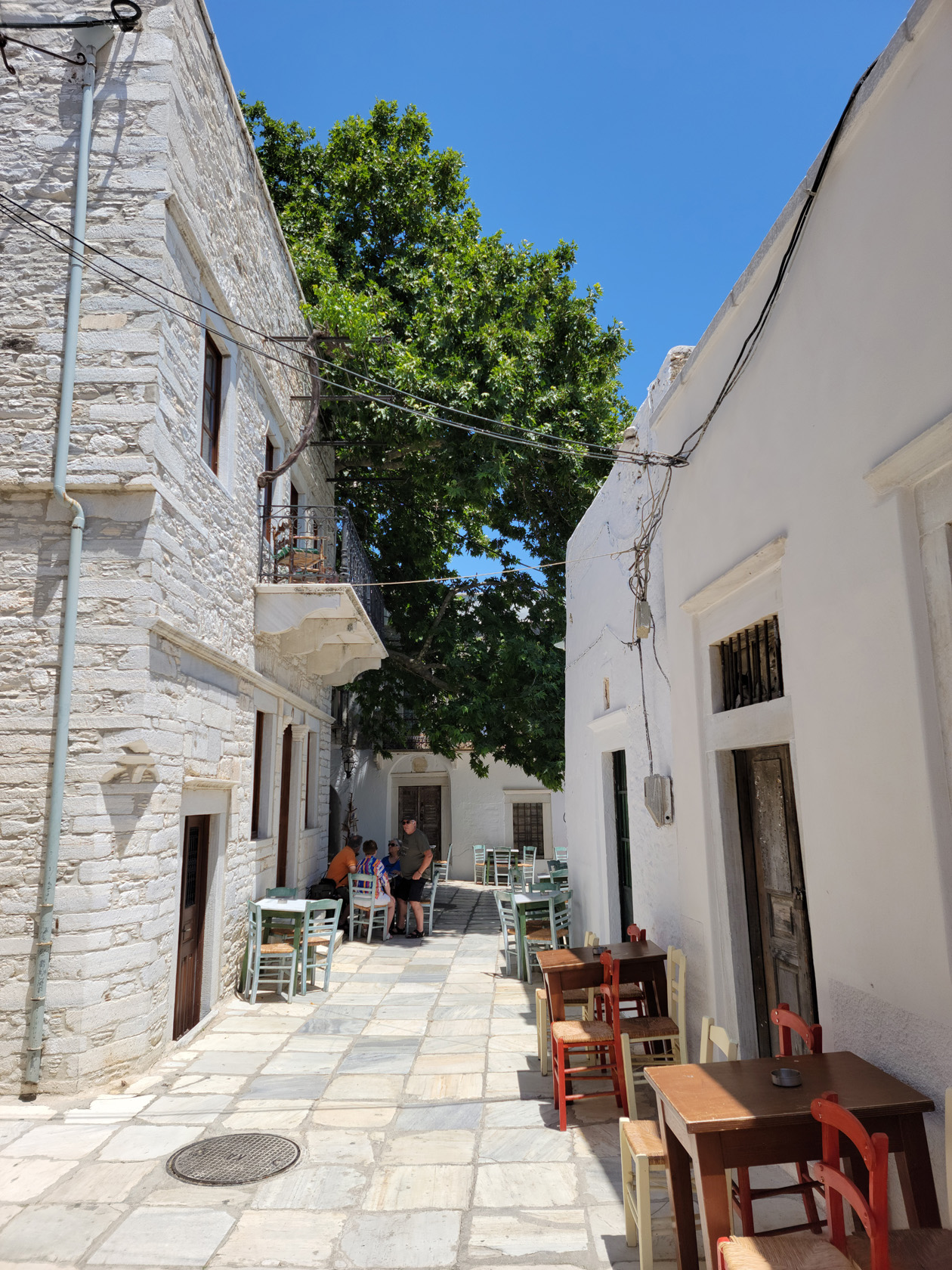
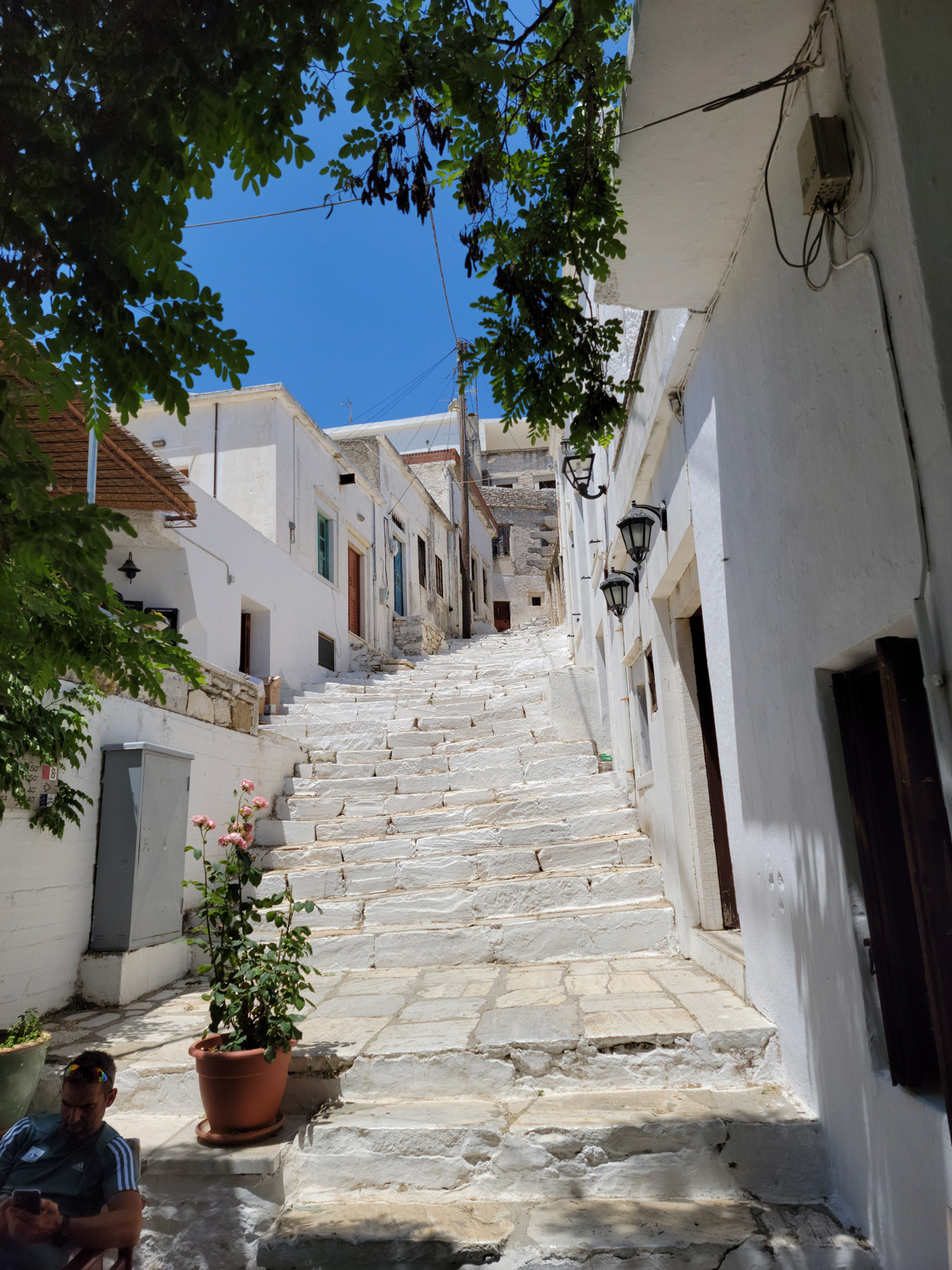
A small town in the hills of Naxos, obtainable only by car, is worth a trip, if only to see its marbled streets and pedestrian ways. If you are on a tour, its a good place to stop for lunch and wander the streets until you are ready to eat. There are many interesting shops to explore and some novel architecture to experience. An hour or two would suffice in order to do both.
Apeiranthos, Naxos – Looking Out At The Hills
Apeiranthos, Naxos – The middle of town
Apeiranthos, Naxos – Main Pedestrian Way
Apeiranthos, Naxos – The marble walkways
Naxos – Another Old Grainery Windmill
Apeiranthos, Naxos
Apeiranthos, Naxos – Old Stone Arch
Apeiranthos, Naxos – Marble, marble everywhere
Eggares Olive Oil Museum
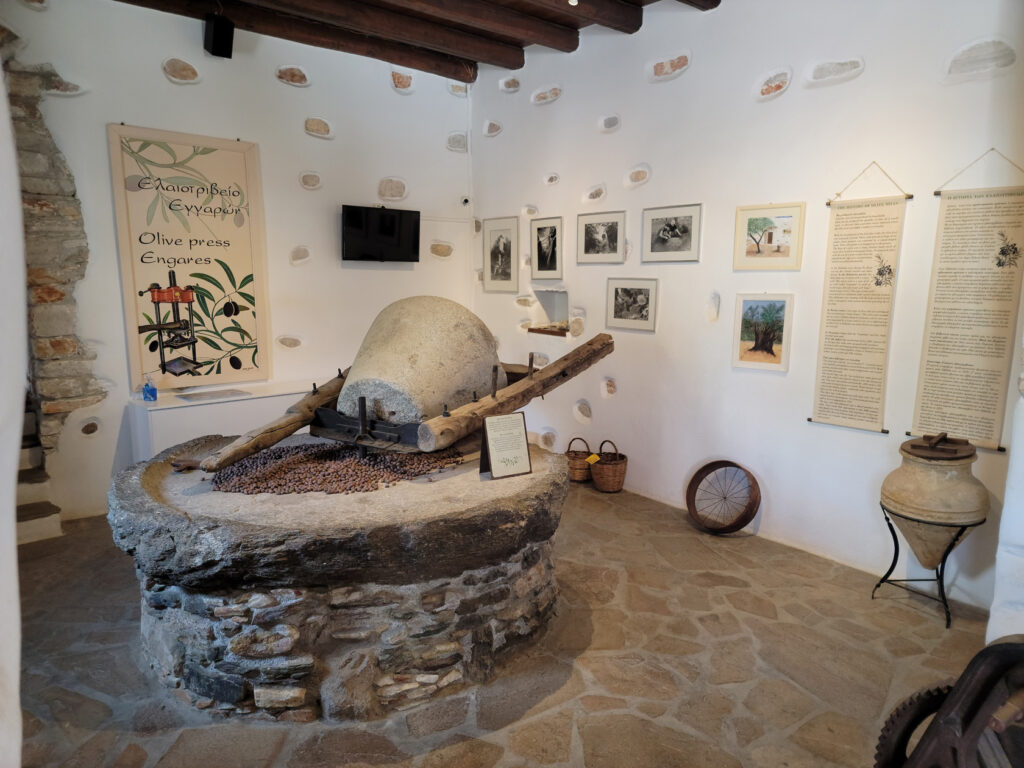
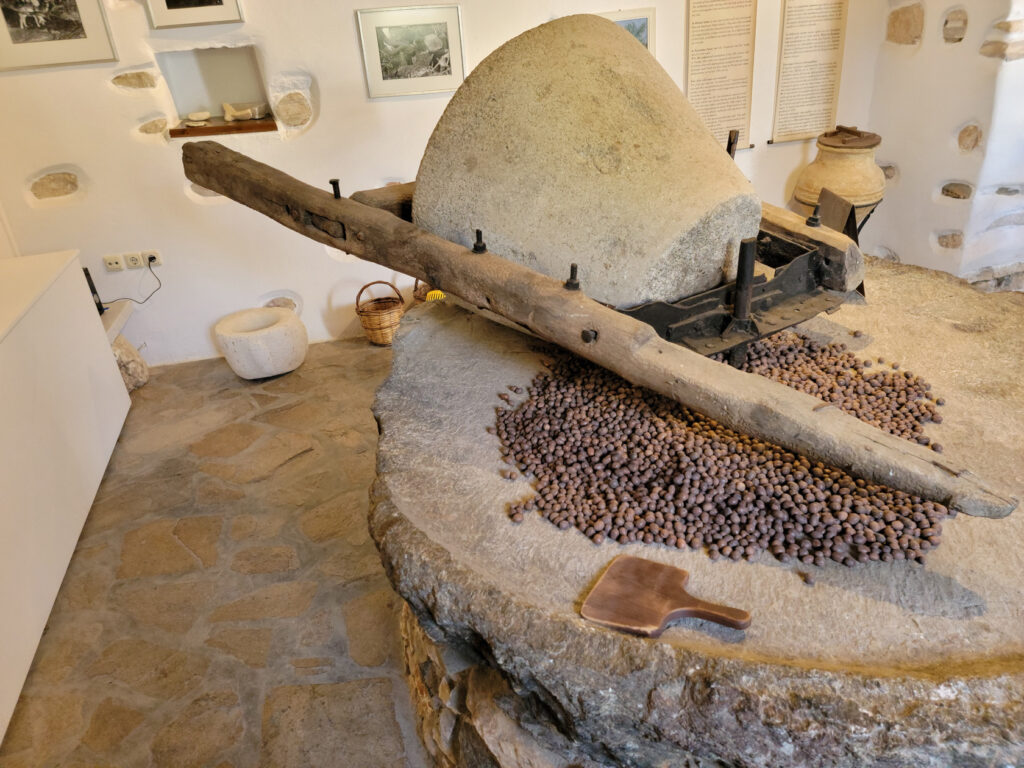
A small private museum showing the discipline of olive oil making can be found not more that a half hour drive from Naxos harbor. The Eggares Olive Oil Museum has a small collection of old oil presses, as well as other tools and the complete history of their firm.
Eggares, Naxos – The Eggares Olive Oil Museum
The museum continues to sell olive oil and olives that it produces in the gift shop. Unfortunately we did not purchase any, since most of the products are not bottled and perhaps not suitable for a return flight. So, instead of taking a chance, we opted out of bringing a sample home.
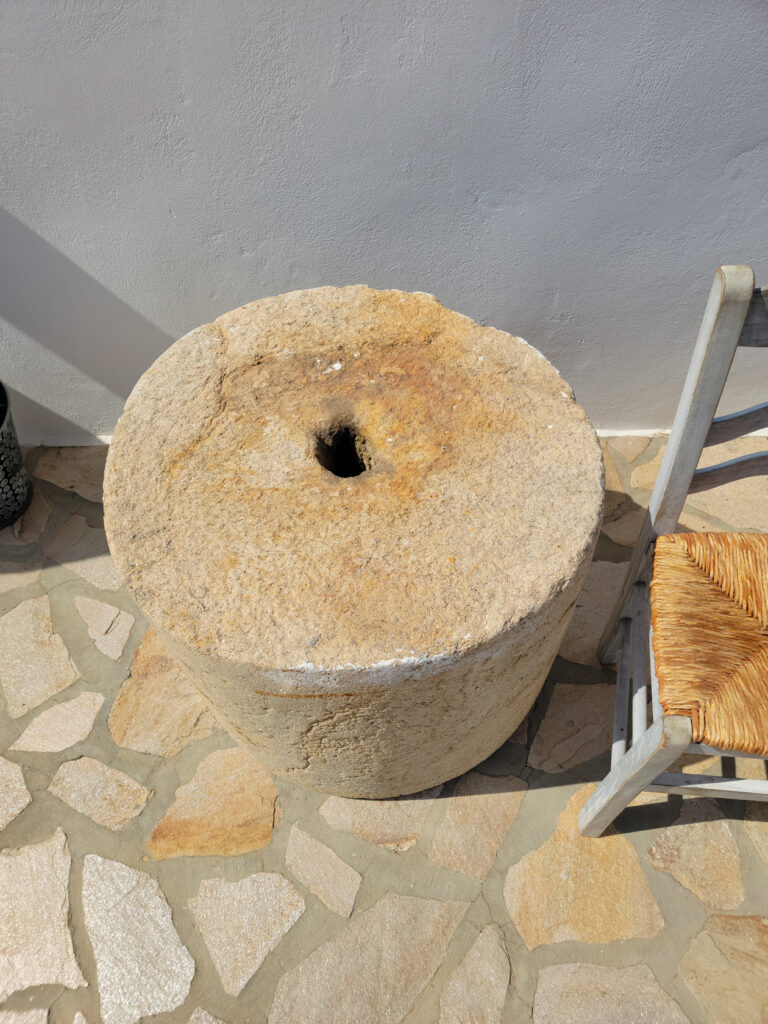
Eggares, Naxos – The Eggares Olive Oil Museum – Old Mill Stone
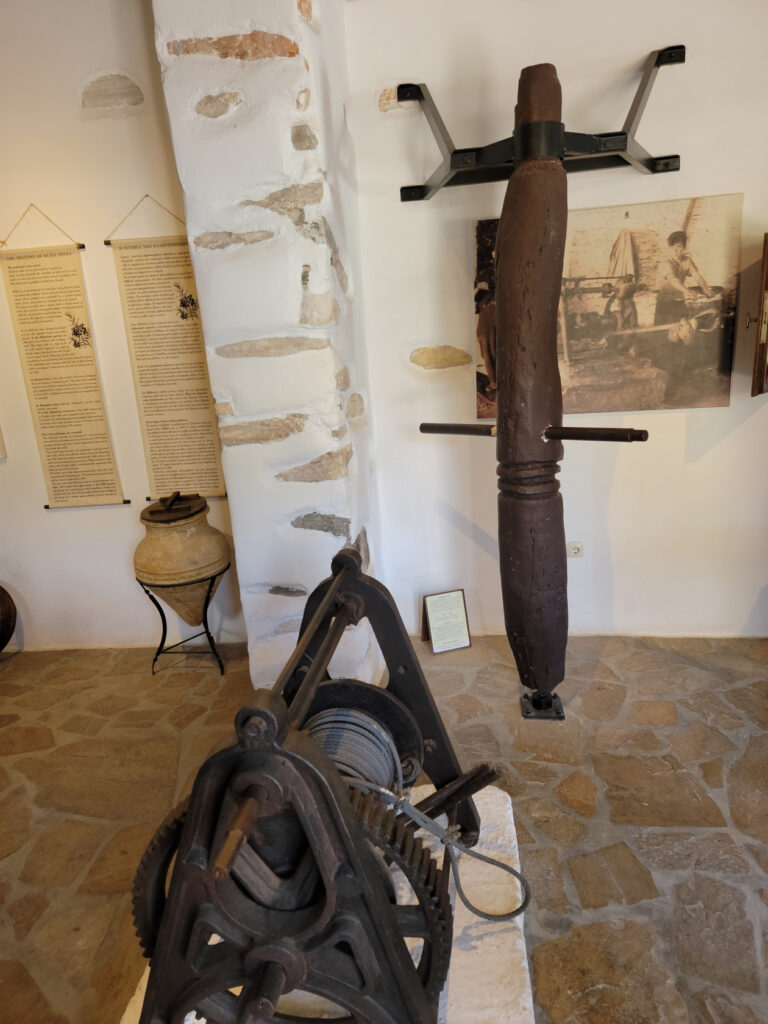
Eggares, Naxos – The Eggares Olive Oil Museum – Winch Used To Turn The Millstone
Eggares, Naxos – The Eggares Olive Oil Museum – Olive Millstone
Eggares, Naxos – The Eggares Olive Oil Museum – Olive Millstone
Restaurants
The beach where our hotel was situated was well endowed with restaurants. What follows is only a sample of what is available, but all have very good menus and delicious food.
Taverna Authentic Greek Cuisine Restaurant
Though we had reservations at another restaurant, we had all decided that we were hungry and had to eat a little early.
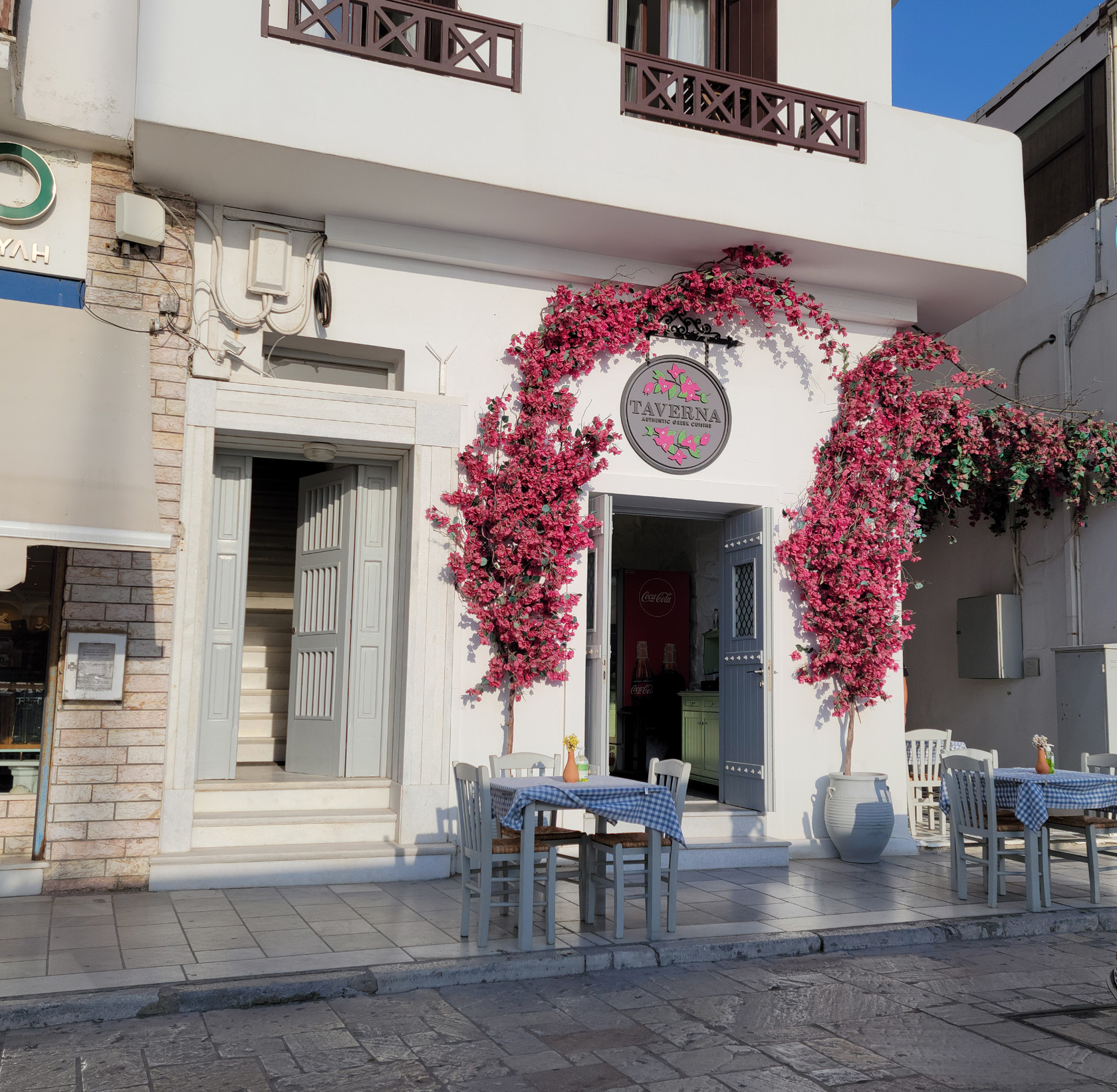
So, we headed back down to the harbor from our sojourn up the hill of Naxos and its castle. There we found the Taverna Authentic Greek Cuisine Restaurant, which as can be imagined, serves numerous authentic Greek dishes.
Naxos, Naxos – Taverna Authentic Greek Cuisine Restaurant – Patti, Ericka, Gabi and Dana
Soon after we arrived, we ate lunch at the Taverna O Giannoulis and enjoyed a very nice meal with water, wine and all the supplements. They have a great Greek menu, the service is very quick and the seating outside is perfect (though we went in June, so heat was never an issue).
Taverna O’ Giannoulis
Taverna O’ Giannoulis – Kitchen
Taverna O’ Giannoulis
Taverna O’ Giannoulis
Amorginos Tavern
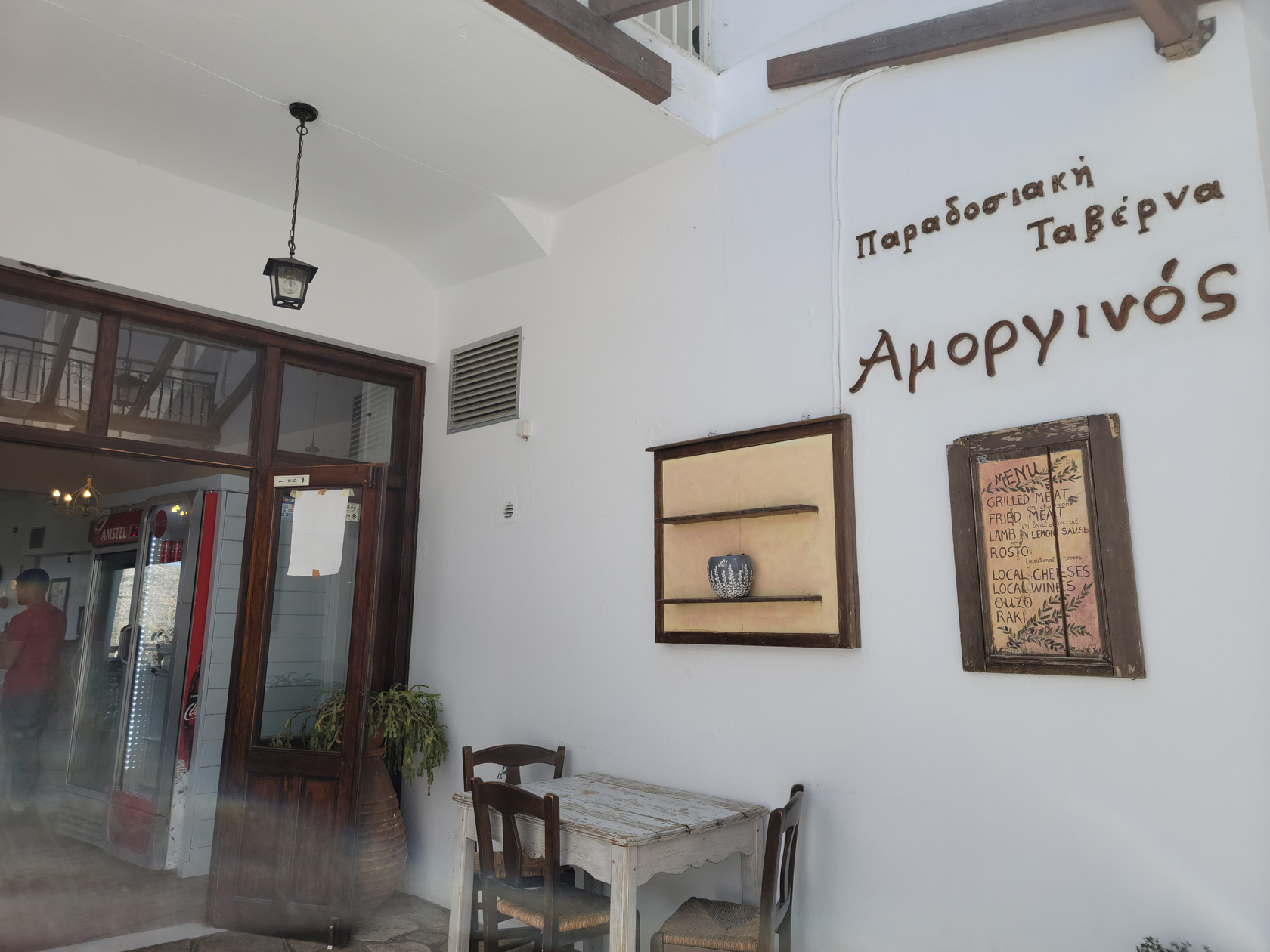
While on our Naxos day tour, we stopped in the town of Apeiranthos, the one where all the streets and pedestrian ways are made of marble. One of two places recommended by our guide, we chose it for its menu and selection of foods.
Apeiranthos, Naxos – The Amorginos Tavern
There is plenty of outside seating, though we sat just indoors, in order to avoid the midday sun. The service was pretty good, though the food was served randomly, apparently whenever it was ready. Which is good if you ordered something hot, but if you expect your food to come out all at once for your group, you may want to go elsewhere. The food was excellent, as was the local wine and the prices were very reasonable.
The Relax Cafe
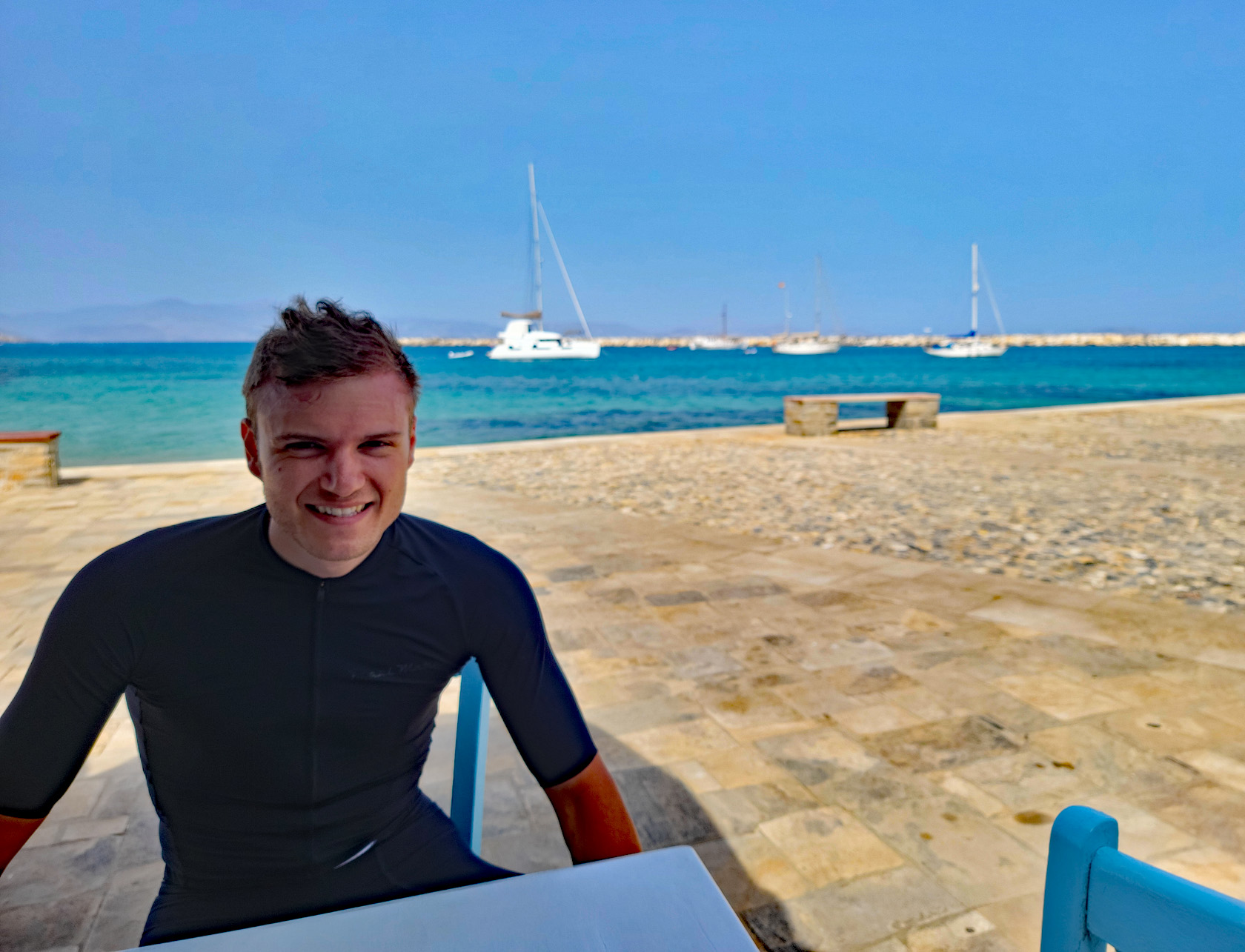
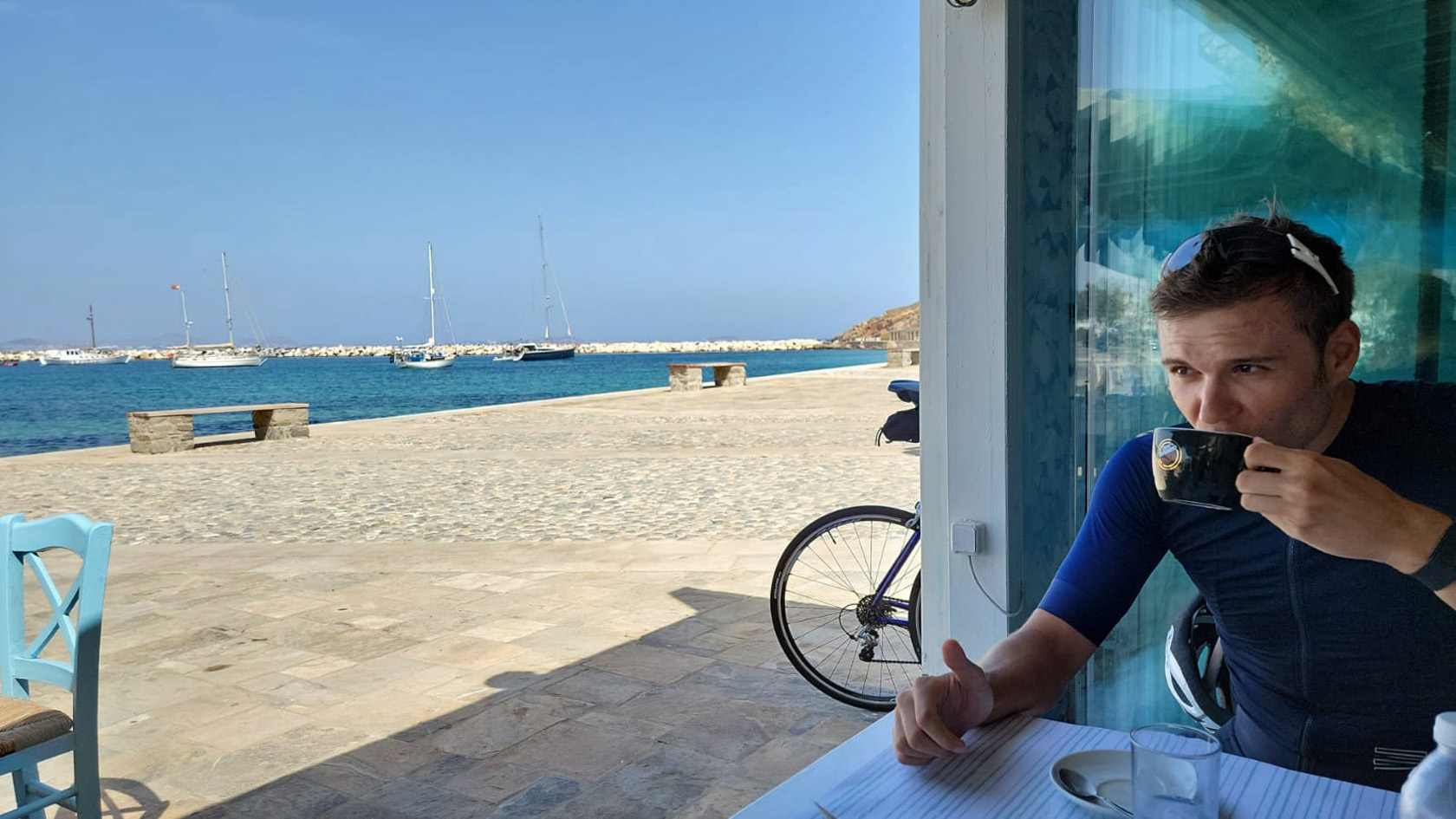
No ride is complete without a coffee stop, and perhaps a bite to eat. After our second morning ride, we decided that we would stop in town, Naxos, and visit the Relax Cafe on the water; not only to enjoy the view, the wind and surf, but also some good coffee and what turned out to be amazing vegetable and cheese omelets (the secret it appears, is not just throwing the freshly cut veggies into the scrambled eggs, but to barbecue or fry them a bit first, infusing them with the burnt taste, yu-ummm).
Highly recommended place for breakfast, unless of course you are timid about calories, as avid cyclist, we aren’t. Enjoy!
Del Mar Cafe
Situated almost in the middle of our strand is the Del Mar Cafe. An Italian restaurant that caters to all needs, especially those nagging Italian taste buds that some of us have. Angela and Marco moved from Italy eight years ago and are excellent hosts, they will ensure your meal is prepared to your expectations. We went here several times for lunch and dinner and used their beach services as well; their wines are also very good, we were never disappointed.
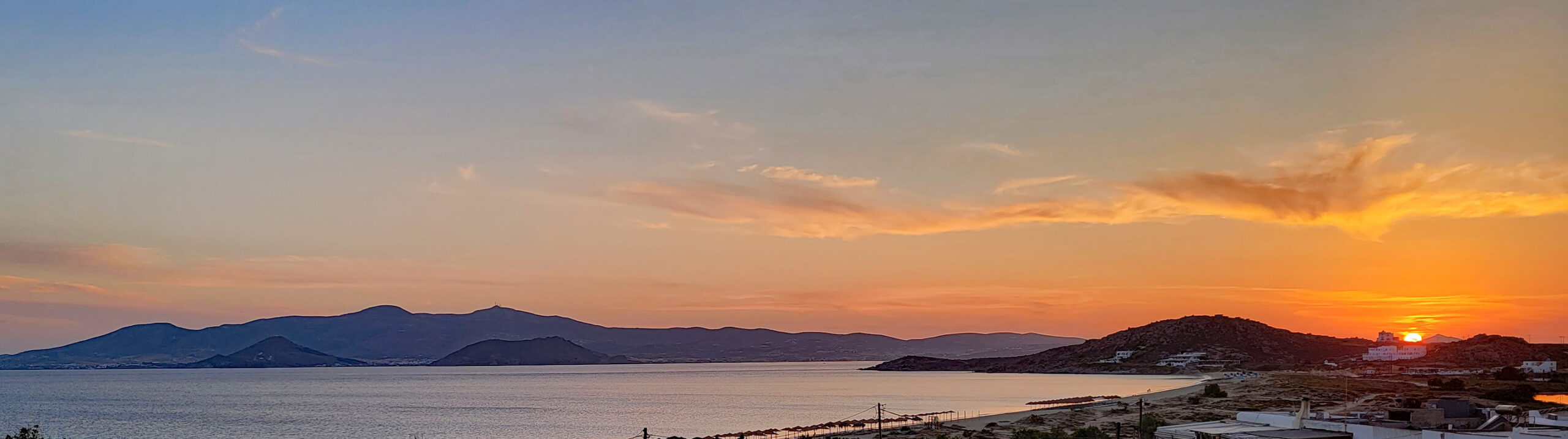
Naxos – A Sunset
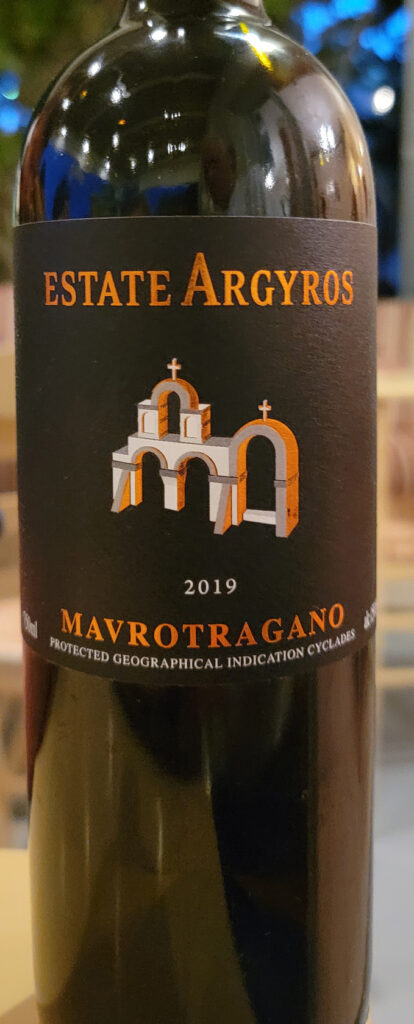
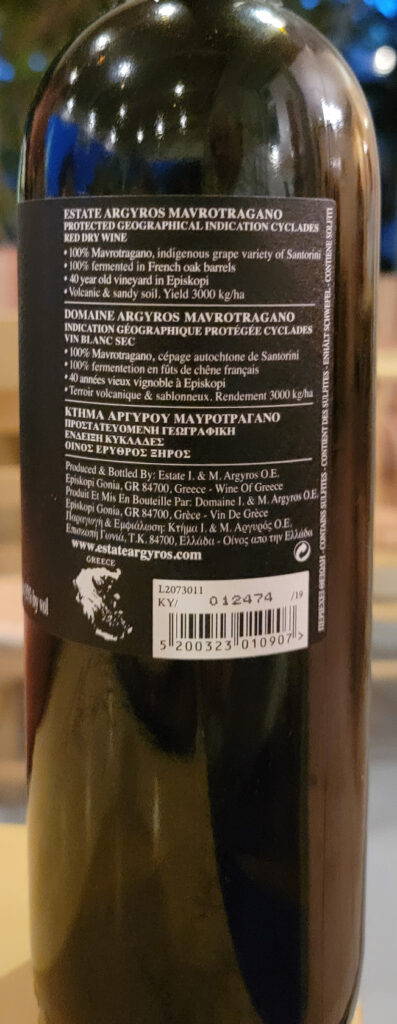
Wines
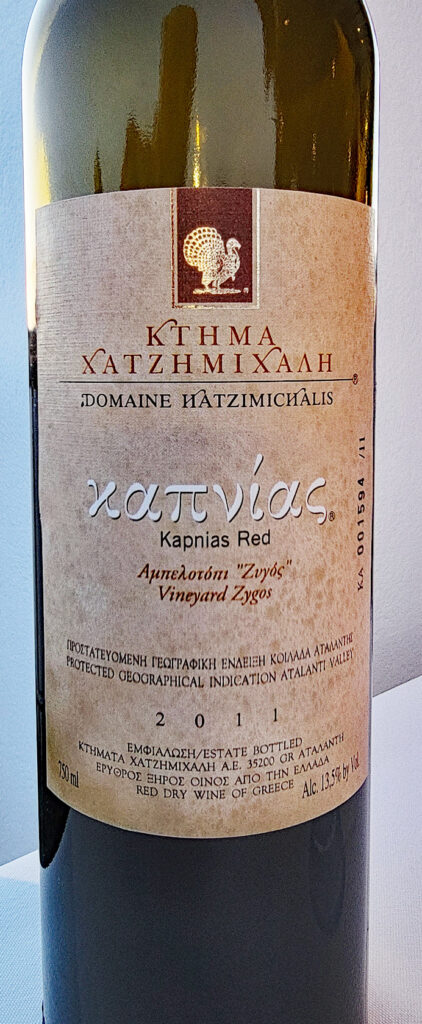
The following wines we enjoyed while dining in Naxos. Most are inexpensive wines, all are from Greece or the neighboring islands and are completely drinkable and satisfying.